Cook escorts Siri on its final journey
Early on June 9th, Beijing time, Apple's 2026 Worldwide Developers Conference (WWDC26) will officially kick off.
This is not only the last WWDC hosted by Tim Cook as Apple's CEO but also a long - overdue "make - up exam" for Apple's AI strategy.
Two years ago, Apple highly promoted the "Apple Intelligence" function, painting a grand picture of "AI everywhere". However, the technology fell short of expectations, product releases were repeatedly delayed, and it even faced a class - action lawsuit.
Facing Apple's stock price approaching a historical high and a market value that has increased by $1.6 trillion in a year, Cook and his team have to tell Apple's new story on the same stage.
The beginning of this story still revolves around Siri.
01
Siri's Complete Transformation
Describing Siri's changes this time as a "revamp" might not be enough.
According to Mark Gurman, a senior Apple insider, the new Siri, codenamed "Campo" internally, aims to transform from a simple voice - command tool into an "AI companion" that can handle various tasks around the clock.
The most obvious change is that Siri finally has its own "home" in the iPhone. It's no longer just a glowing effect around the screen edge. Apple has integrated it into the "Dynamic Island" first introduced in 2022.
Just say "Siri" or long - press the power button, and the Dynamic Island will display a new dark - themed animation. This mode is designed for voice queries and searches.
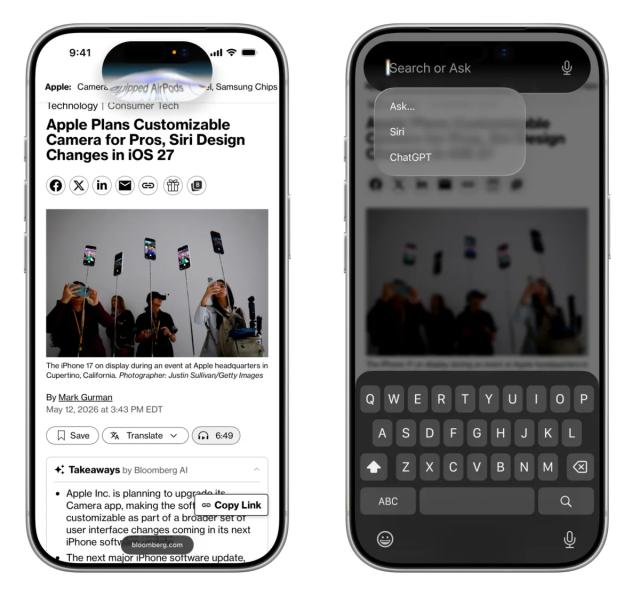
Two forms of the new Siri: the animation in the Dynamic Island (left), and the "Search or Ask" interface that slides down from the top of the screen. Apple is testing allowing users to choose AI services.
When you swipe down from the center of the top of the screen, a brand - new "Search or Ask" interface will slide out.
Note that the notification center can now be accessed by swiping down from the left side of the screen to make room for this AI entry.
This "Search or Ask" panel is designed for users who prefer to type to communicate with AI. Of course, the microphone button is still there.
Here, users can directly launch apps, send text messages, check the weather, add calendar events, search for notes, and even trigger in - app shortcuts. The panel also integrates the current iOS Siri Suggestions function, showing eight commonly used apps, recent web search history, and morning and evening weather information.
More importantly, Apple finally allows users to send multiple commands to Siri at once. This means you can directly say, "Check the weather for tomorrow, create an event from 10 a.m. to 11 a.m., and send a text message to my mom saying I'll go there tomorrow." All requests can be completed in one prompt.
The responses from Siri will be presented as rich text cards through the Dynamic Island, covering topics such as people, places, and news.
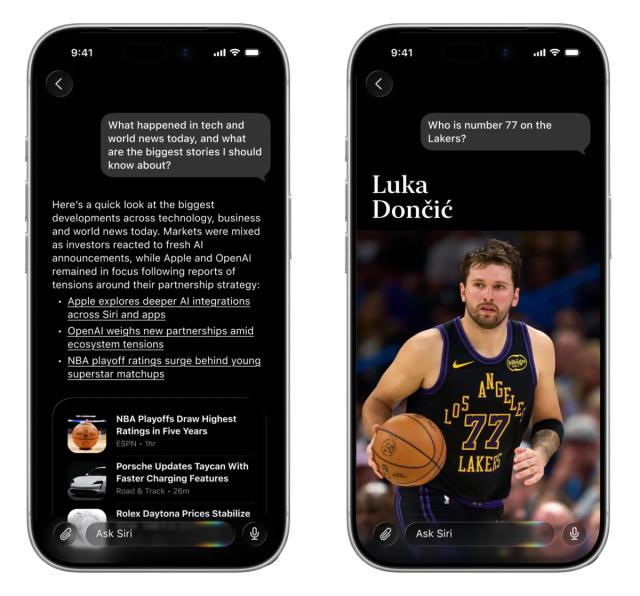
The conversation view can be opened by swiping down from Siri results or within the Siri app. The left side shows information cards such as news and device - side data, and also provides rich images and general knowledge.
Behind Siri's experience is the Gemini model. Apple even hosts most of the new Siri services on Google's cloud servers.
The Dynamic Island entry is suitable for quick one - or two - sentence Q&A, but Apple is clearly not satisfied with this. They have also made Siri an independent app.
There will be a dedicated Siri app on iOS, iPadOS, and macOS. Users can pull down the assistant's results to enter it. The home page shows past chat records and supports light and dark modes.
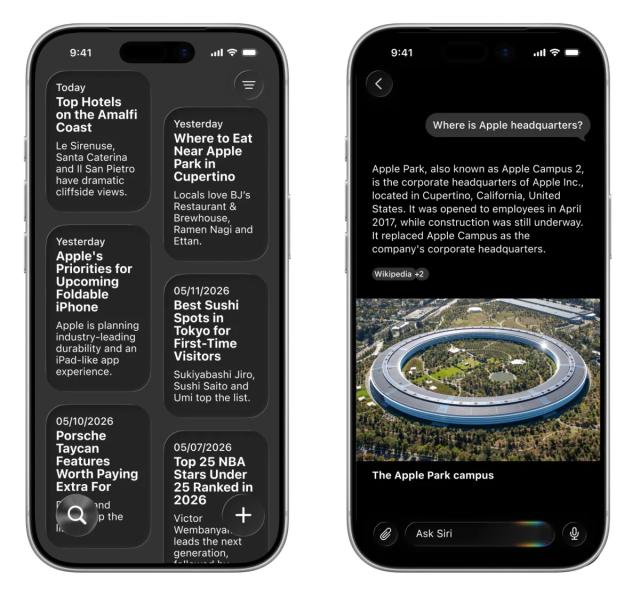
Apple launches an independent app for Siri for the first time. The left side is the conversation list, and the right side is a chatbot interface similar to ChatGPT.
The conversation list has two views: a normal list or a vertical rectangular grid. Each conversation shows a short summary to facilitate continued chatting. This is similar to what OpenAI does. The conversation content is synced between devices via iCloud. When you click into a specific conversation, the interface looks like a text message thread in the "Messages" app. There is an "Ask Siri" prompt box at the bottom for typing, and a microphone button next to it for voice input.
Like other mainstream chatbot apps, the Siri app supports inserting photos or attachments for analysis. It also has an automatic chat record deletion function like the "Messages" app. Users can choose to keep the records for 30 days, one year, or permanently in the settings.
This is clearly aimed at ChatGPT.
Moreover, Apple plans to open the door to more external chatbots. In the "Search or Ask" interface, users will be able to switch between different chatbots. Apple has tested this new integration method with Claude, Gemini, and ChatGPT.
However, these features won't be released all at once. Apple has internally marked the new Siri as "beta" and "preview", meaning it won't be promoted as a fully mature software at launch.
02
Apple Quietly Launches a Search Engine
Another key support for Siri's intelligence is that Apple has launched its own web search product for the first time.
This search ability built into Siri directly competes with Perplexity AI. Siri can answer almost all questions using its self - developed engine without redirecting users to Google or ChatGPT. The responses are presented in forms such as summaries, bullet lists, and significantly enriched images.
There is also a new function called "Ask Siri" to go with it.
It allows users to send text and context information to the assistant from anywhere in iOS for subsequent analysis or to get answers about a certain topic. The usage is simple: highlight the text, and this option will appear next to the copy, paste, and share buttons. This is exactly the same as the "Ask ChatGPT" button in OpenAI software.
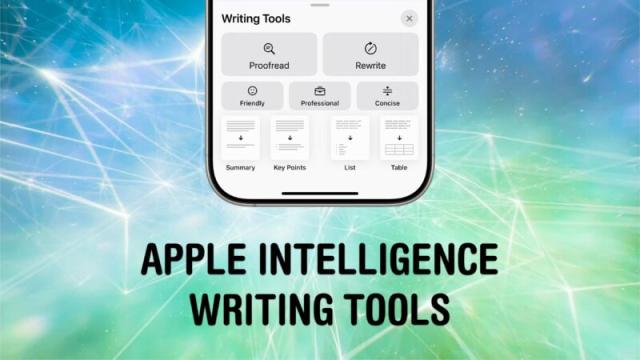
The writing tool is one of the most mature functions in Apple Intelligence's early features.
Apple also plans to launch a "Write with Siri" function to assist in text writing across the entire operating system.
This function can be accessed through a new button on the iOS and iPadOS keyboards. Users can tell Siri what they want to write and get help from the assistant.
03
AI for Both Photography and Photo Editing
Siri is the star of this update, but Apple Intelligence's ambitions go far beyond that. iOS 27 will undergo a profound AI transformation of the camera and photo functions.
Let's first look at "Visual Intelligence". This function was mainly linked to the iPhone's camera control buttons before, and many people may never have used it. Now, Apple has decided to integrate it directly into the camera app as a prominent new Siri option, aiming to make more people use it more frequently.
The "Visual Intelligence" function has also been expanded, adding the ability to recognize nutrition labels and related information.
Currently, it can also recognize objects such as plants, extract information like calendar details, and send images to ChatGPT or Google Search for more information.
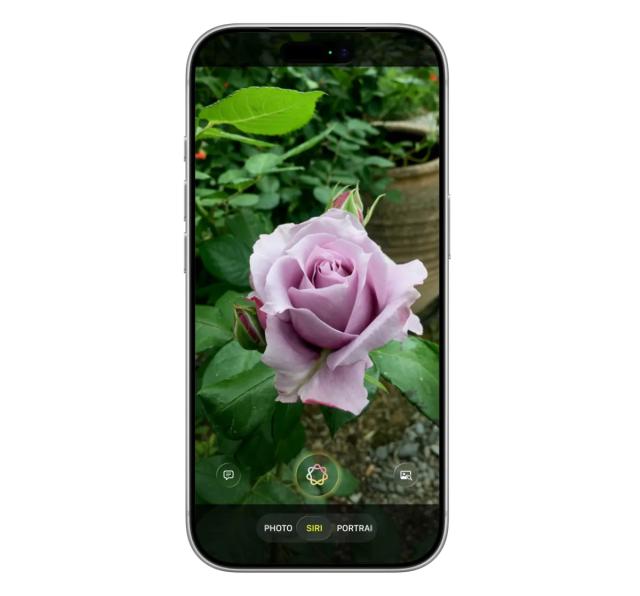
Siri is integrated into the camera app for the first time, integrating visual intelligence functions and can recognize objects through external AI services such as Google or ChatGPT.
In terms of photo editing, Apple has prepared a new set of tools. Among them, the "Expand" function is quite interesting: users can generate additional image content beyond the original picture. For example, if you take a close - up of a landmark and hold your finger on the edge of the photo and drag it out, the AI can fill in the surrounding streets, sky, and buildings. You can control how much content to add and in which direction.
Another tool called "Re - compose" is mainly for spatial photos, which are the 3D image format prepared by Apple for the Vision Pro headset. It allows users to adjust the perspective of the picture after taking it, such as changing a frontal photo of a car to emphasize the side.
The "Clean up" function, which was criticized by many users, was launched as one of the first AI functions in 2024. Many people complained that it didn't live up to the hype, and it often failed when removing objects from the picture. Apple has significantly improved it during the iOS 27 cycle, making up for the previous complaints.
Gurman mentioned that Apple is actively testing a photo - editing function based on natural - language prompts, allowing users to request specific edits such as cropping or changing colors through voice or text. However, this function may not make it into the first version of iOS 27.
For users who like personalized expression, Genmoji custom emojis are becoming more proactive this time. The system will add a "Suggested Genmoji" option, which automatically generates a batch of personalized Genmoji images based on the user's photo library and commonly used input phrases.
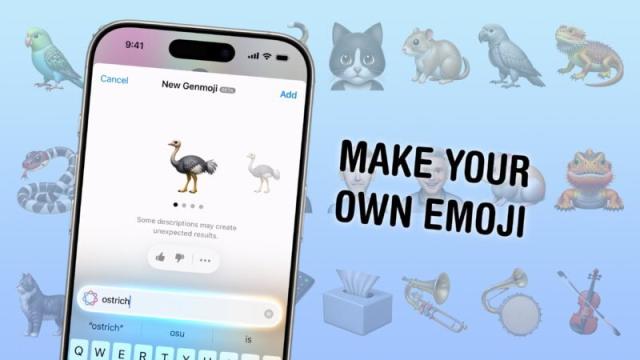
Genmoji can handle various occasions.
The underlying image - generation model that powers Genmoji and Image Playground has also been replaced, aiming to make the generated images clearer and more realistic. The Image Playground app itself has been completely redesigned. On iOS 27, iPadOS 27, and macOS 27, the previously created images in the home - page grid now have rounder edges.
In terms of efficiency tools, the Safari browser has added an AI function called "Organize Tabs". It will automatically categorize the dozens of tabs opened by users by different themes and will be supported on all devices.
iOS 27 and macOS 27 will make Safari tab management easier.
In addition, the Apple Health app will also get a series of new AI functions, including improved blood - sugar tracking and the ability to monitor users' workouts using the device's camera. However, these health functions originally belonged to a comprehensive health - coaching project codenamed "Mulberry", which was later scaled down and is not expected to appear in the initial version of iOS 27. Apple may announce them at another time after WWDC.
04
Opening the Door to Third - Parties
For developers, Apple has prepared a new system called CoreAI, which allows developers to more easily integrate AI into their own apps. Manufacturers of AI agents will be able to access Siri and Apple's internal AI apps and services.
More importantly, Apple plans to open some of its core AI capabilities to third - party providers.
Previously, when generating images in Image Playground or texts in the "Writing Tool", if an external model was to be used, only ChatGPT could be connected. After this change, third - party alternatives can be provided through apps installed from the App Store. Apple has tested Claude and Gemini for this. Users will see more options besides ChatGPT in the relevant interfaces.
Wamsi Mohan, an analyst at Bank of America, pointed out in an investor report that Apple may become a "market" for app operations. In the past, apps competed for downloads and screen time. In the future, they may compete to be the services called by smartphone agents.
For example, if Uber wants Siri to send ride requests to it, it may have to pay Apple a high fee. For Apple, which has had a tense relationship with developers over App Store commissions for years, this may be both a new source of revenue and a potential source of new friction.
05
Test of Cook's Legacy
Apple's continuously soaring stock price has already reflected investors' expectations in advance. The question is, can a better Siri justify the sky - high valuation that assumes its success?
Craig Moffett, an analyst at MoffettNathanson, explained that for the valuation to be maintained, Siri needs to transform from a passive command entry to an agent capable of performing multi - step tasks across apps.
But this brings back an old problem: whether developers are willing to access the App Intents (Apple's developer framework) system, which also involves the controversy over commissions. This creates a "chicken - and - egg" situation: Siri will only become truly useful with enough developer support, but developers may wait to see if consumers actually use it before investing development resources.
For Cook personally, this is more like a curtain call for his legacy.
Dan Newman, the CEO of The Futurum Group, believes that Apple Intelligence is a "major stain" during Cook's tenure and also his "last chance to trigger an AI inflection point before John Ternus takes over as CEO."
The Wall Street Journal also reminded that Apple actually has a good hand. The iPhone knows users better than anyone else. Companies that have spent hundreds of billions of dollars building AI models may ultimately have to reach consumers through Apple. Cook has already turned Apple into a toll - booth: charging developers to access users and getting money from Google in exchange for being the default search engine.
A truly intelligent Siri could potentially set up new toll - gates in the AI era.
But the premise is that Siri