The demand for MLCC has skyrocketed, and it may become "the next memory semiconductor".
MLCC (Multi-Layer Ceramic Capacitor) is one of the most widely used and fastest-growing chip components globally. It undertakes the core function of charge storage in electronic circuits and is also known as the "rice of the electronics industry". In electronic circuits, it mainly serves as a basic component for filtering, voltage regulation, energy storage, and decoupling. However, in the past, MLCC has always been regarded as a highly standardized general passive component and rarely attracted external attention.
Recently, however, a research report from Morgan Stanley on disassembling NVIDIA's next-generation Rubin architecture has brought this niche component into the spotlight. In the VR200 NVL72 single cabinet, the usage of MLCC (Multi-Layer Ceramic Capacitor) will surge by 182% compared to the GB300. Soon after, Goldman Sachs put forward a more eye-catching judgment in its research report: MLCC is becoming the "next storage". Memory chips have been the core narrative of the semiconductor cycle in the past decade, and now Goldman Sachs has placed MLCC at the same level. This means that in the AI era, MLCC is transforming from a "background prop" to one of the "main characters".
What is MLCC?
Passive components include RCL devices, passive RF devices, etc. RCL devices, in turn, include capacitors, inductors, and resistors. Capacitors in RCL devices have functions such as bypassing, decoupling, filtering, and energy storage, and are the main component of passive components. They can be divided into ceramic capacitors, aluminum electrolytic capacitors, tantalum electrolytic capacitors, film capacitors, etc. Compared with other capacitors, ceramic capacitors have the characteristics of small size, wide voltage range, and low price, and occupy the main share of the capacitor market.
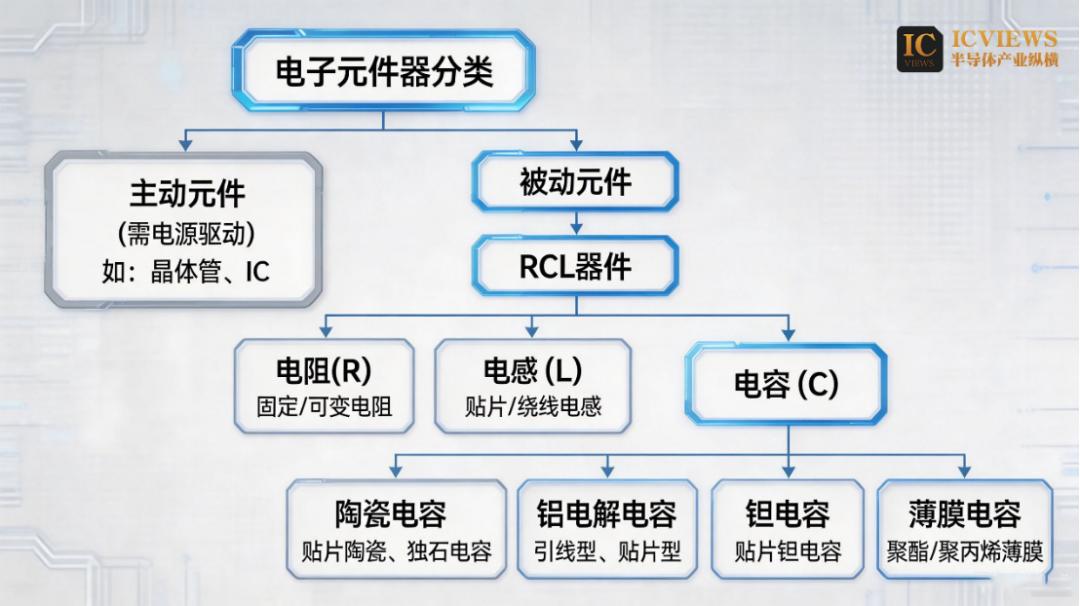
Ceramic capacitors can be further divided into single-layer ceramic capacitors, chip multi-layer ceramic capacitors (MLCC), and leaded multi-layer ceramic capacitors. MLCC, also known as chip capacitors, consists of three parts: internal electrodes, ceramic layers, and end electrodes. Ceramic dielectric films printed with electrodes (internal electrodes) are stacked in a staggered manner, and after high-temperature sintering, a ceramic chip is formed. Then, metal layers (external electrodes) are sealed at both ends of the chip to form a monolithic-like structure, so it is also called a monolithic capacitor. Compared with single-layer ceramic capacitors and leaded multi-layer ceramic capacitors, MLCC has the characteristics of a wide temperature range, a wide capacitance range, low dielectric loss, small size, and low price. Therefore, it is also widely used and occupies more than 90% of the ceramic capacitor market share. In terms of downstream applications, MLCC is widely used in many important fields such as mobile terminals, high-end equipment, automobiles, computers, communications, and household appliances.
AI demand drives a sharp increase in MLCC demand
MLCC was often regarded as a "sunset industry in the mature stage" in the past. However, the rise of AI servers has opened up a brand-new incremental market for MLCC. So, why do AI servers suddenly need so many MLCCs?
During the operation of AI servers, there will be microsecond-level fluctuations in power demand, and the current demand will fluctuate sharply in a very short time. Traditional power supply systems have difficulty in responding in time. MLCCs are usually deployed near AI chips. When the chips have instantaneous power demand, they can quickly release electrical energy, thereby avoiding server operation failures. Therefore, dozens to hundreds of high-capacitance MLCCs surround each high-performance AI chip. It is estimated that the value of MLCCs in a single cabinet has increased from about $3,000 in the H100 platform to about $12,000 in the GB200 platform, and is expected to further rise to about $22,000 in the Rubin VR200 platform. After the mass production of Rubin Ultra in 2027, it may even reach $40,000; the corresponding usage of MLCCs has increased from about 15,000 to more than 90,000. The NVIDIA GB200 NVL72 server will use about 600,000 MLCCs, a further increase compared to the previous platform. Currently, the overall market size of MLCC is about $15 billion, of which the market size in the AI server field is $1.3 billion, and it is experiencing a strong explosion with a compound annual growth rate of 80%, while the growth in other key industries such as automobiles and mobile phones has slowed down.
The explosion on the demand side has gradually spread to the price side. Since the end of November 2025, the price of MLCC has entered an upward channel. Leading manufacturers led by Murata have significantly adjusted the prices of AI server and high-end automotive-grade products since the first quarter of 2026, driving Japanese manufacturers such as TDK and Taiyo Yuden, as well as Taiwanese and domestic manufacturers to follow suit, and the industry has reached a consensus on price increases. Just recently, Walsin Technology, a major passive component manufacturer, also issued a price increase notice to its agents, starting to raise the prices of chip resistors and some MLCC products from June 1st, mainly due to the continuous rise in the prices of multiple raw materials.
The "two superpowers and many strong players" pattern dominated by Japan and South Korea
The global MLCC market is dominated by Japanese and South Korean companies, presenting a "two superpowers and many strong players" pattern. Murata of Japan ranks first, followed closely by Samsung Electro-Mechanics of South Korea. The top five manufacturers together account for more than 70% of the market share, and the monopoly in the high-end field is even more obvious. The high-end MLCCs for AI servers are mainly controlled by Murata and Samsung Electro-Mechanics, and Samsung Electro-Mechanics alone occupies about 40% of the market share; the automotive-grade MLCCs are monopolized by Japanese companies.
It is understood that Murata invested 560 million yuan to expand high-end production capacity in Japan in 2025, and the production will start in Q4 2026; an additional 800 million yuan will be invested in capacity expansion in 2026. It also plans to increase the overall production capacity by 10% in FY27 and invest an additional 80 billion yen in MLCCs for AI servers, with a 20% - 25% increase in high-end production capacity in FY28. The new high-end factory of Samsung Electro-Mechanics in the Philippines will not start production until 2027. The Tianjin factory is being renovated to produce high-end MLCCs for servers, and the production capacity will be gradually released starting from October 2026.
A complete MLCC industrial chain has also been formed in China: Fenghua Hi-Tech and Sanhuan Group respectively rank first and second in the A-share market share and sixth and ninth globally; Torch Electronics and Hongyuan Electronics have been deeply involved in the field of special MLCCs for many years, and the proportion of downstream aerospace customers exceeds 50%.
However, the structural deficit is still obvious. In 2025, China imported about 2.56 trillion MLCCs, with an amount of nearly $6.2 billion. The average unit price is about $2.41 per thousand pieces, while the export unit price is only $2.11 per thousand pieces. The imports are high-end products, while the exports are mid - and low - end products, and the structural deficit is obvious. Currently, the mid - and low - end production capacity of China's MLCC industry is already complete, and the breakthrough in the high - end field is in progress. With the acceleration of the localization of AI computing power and automotive electronics, the logic of MLCC localization is quite similar to that of memory chips in the past.
The supply chain depth of MLCC: from ceramic powder to release film
The production process of MLCC is complex, involving dozens of steps such as slurry preparation, ceramic film forming, printing, stacking, pressure equalization, cutting, debinding, and sintering. The core includes technologies such as material technology, lamination printing technology, and co - firing technology. These related technologies directly affect the final performance of the product.
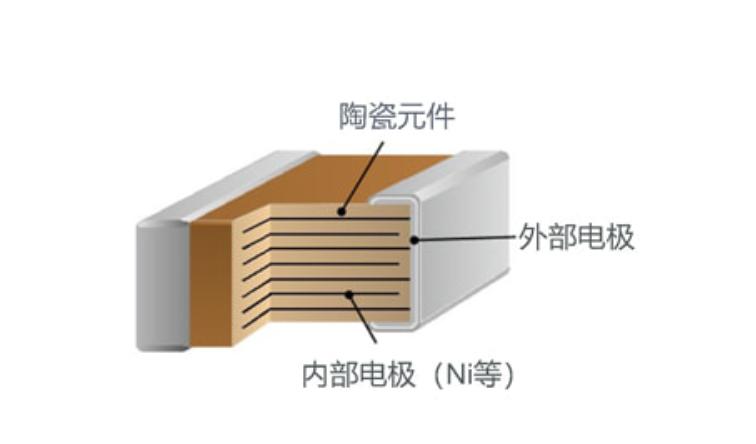
From the perspective of cost structure, ceramic materials account for the largest proportion. Due to the complex preparation process, long R & D cycle, and verification barriers from downstream customers, the global competition pattern of ceramic materials is relatively concentrated and is mainly monopolized by Japanese and American companies, such as Sakai Chemical of Japan and Ferro Corporation of the United States. With the continuous improvement of technology and the acceleration of the domestic production process, the number of domestic enterprises producing ceramic materials is gradually increasing, and the output is constantly rising, including enterprises such as Guoci, Fenghua, and Sanhuan. Among them, Guoci Materials, with years of technological accumulation, has achieved full coverage of all types of basic powders and formula powders, and its downstream customers include Samsung Electro - Mechanics, Yageo, and Fenghua. In the high - end field, the technology of high - end ceramic powders in China still needs further breakthrough.
Electrode materials are another key material. Electrode materials are divided into internal electrode nano - nickel powder and external electrode copper paste and silver paste, which are the core materials for the conductive lamination of MLCC. Currently, nickel powder is mainly used for internal electrodes (silver - palladium alloy is used for high - end products, and electrode copper is used for low - end products). High - end MLCCs for automotive and AI applications have extremely high requirements for the precision of ultra - fine nano - nickel powder. The purity of nickel powder is required to be above 5N (99.999%), the particle size is required to be between 100 - 500nm, and the sphericity should be good. Silver - palladium alloy paste is usually used for external electrodes, which is attached to both ends of MLCC by printing or spraying. The silver - palladium ratio determines the conductivity and bonding strength, and the dispersion and stability of the paste affect the uniformity of the electrodes.
The release film in the casting auxiliary materials is a key consumable that is easily overlooked. Casting auxiliary materials include release films, carrier tapes, etc., which are essential consumables for the MLCC casting process. As a key consumable for MLCC production, the MLCC release film is a film with surface separability, and its demand is directly attached to the growth of the MLCC industry. In the casting and forming step, the ceramic slurry is coated on the rotating PET release film through the casting port of the casting machine to form a uniform thin layer of slurry. Then, it is dried and shaped at high temperature in the hot - air zone and then peeled off to form a ceramic film. The release film has high requirements for smoothness, and the upstream materials include PET base film and release agent. The PET base film requires very high smoothness, and Toray and Teijin DuPont of Japan are the world's major producers; silicone release agents are mainly provided by manufacturers such as Dow Corning, Wacker, and Shin - Etsu.
The release film is divided according to the thickness of MLCC casting. Below 3μm is high - end, 3 - 5μm is mid - end, 5 - 8μm is mid - low - end, and above 8μm is low - end. The Ra value of the base film of mid - and high - end release films is required to be controlled at 20 nanometers or even lower. The release film accounts for about 10% - 20% of the cost in MLCC production. For a long time, the mid - and high - end markets have been mainly occupied by Japanese and South Korean companies such as Lintec, Toray, and COSMO. With the development of MLCC towards high capacity and miniaturization, the requirements for release films have increased. High - end release films need to meet the process requirements of MLCC development towards ultra - thin layers (such as 1000 layers), with a thickness tolerance of ≤±1μm, dust - free cleanliness, and winding consistency.
Currently, the price fluctuations of MLCC raw materials and supply chain pressure are intensifying. Fenghua Hi - Tech recently stated that the core materials of its main products include metal materials such as silver, copper, nickel, and tin, as well as ceramic powders. Among them, the price fluctuations of precious metals have a greater impact on profitability. Affected by factors such as the volatile international political situation, high commodity prices, and the reconstruction of the global supply chain, if the raw material prices continue to rise or the supply pattern becomes tighter in the future, the company will face the pressure of rising supply chain costs.
The explosion of server demand and the oligopoly on the supply side have driven the price of DRAM to double, creating the performance myths of Samsung, SK Hynix, and Micron. Today's MLCC is also at a similar inflection point of "exploding demand + concentrated high - end supply". However, the technology iteration speed of MLCC is not as fast as that of memory chips. The industry moat is more reflected in material formulas, lamination processes, and reliability certifications, rather than process miniaturization. This means that once domestic enterprises break through the certification barriers in the high - end field, the catch - up cycle may be shorter than that of memory chips.
From the perspective of the industrial chain structure, MLCC and memory also have the characteristics of "high barriers in upstream materials, rapid explosion of downstream demand, and large space for domestic production". MLCC is becoming an irreplaceable strategic resource in AI computing power infrastructure.
This article is from the WeChat official account "Semiconductor Industry Insights" (ID: ICViews), author: Peng Cheng. It is published by 36Kr with authorization.