From AI Hype to Value Return: How Enterprises Can Truly Monetize AI

The estimated reading time for the full text is about 14 minutes.
In today's business environment, the AI boom is surging. However, if enterprises want to convert AI investment into tangible benefits, they must accurately target the implementation value, establish reliable data statistics rules, and strictly control the project progress based on actual business results.
Key points at a glance
- Although many AI projects pass the technical acceptance, it is difficult for them to gain commercial benefits. Enterprises often confuse technical implementation with business implementation, ignoring cost losses, negative brand impacts, and compliance risks.
- AI revenue generation mainly covers four implementation directions: expanding new business to increase revenue, optimizing internal operations to reduce costs, improving customer interaction, and optimizing employees' daily work. Selecting a single main line for implementation makes it easier to calculate the real return.
- Enterprises that manage AI as a regular project investment, determining priorities, assessment criteria, and exit conditions in advance, generally achieve better overall implementation results than their peers who blindly try and make mistakes on a large scale.
In 2021, McDonald's launched an AI voice ordering system at its drive - thru restaurants. The original intention was to reduce labor costs through automation, speed up food delivery, and handle peak dining hours smoothly.
After three years of pilot implementation in more than a hundred stores, the order recognition accuracy of the system reached 85%, seemingly meeting the technical standards. However, the remaining 15% of recognition errors caused a series of problems in actual operations. Social media platforms frequently reported that the AI added a large number of single - item orders to individual orders, confused voices from adjacent lanes, and even made unreasonable recommendations such as ice cream with bacon.
These frequent malfunctions not only increased the customer complaint rate and disrupted the store's operation rhythm, offsetting the cost savings from intelligentization with additional losses, but also led McDonald's to face a class - action lawsuit, being questioned for collecting users' voice information without permission. Finally, the project was officially terminated in July 2024.
This case deeply reflects the common situation in the industry: many AI products meet the design standards but fail to realize their commercial value. Since the popularization of generative AI at the end of 2022, many enterprises have launched intelligent layouts across all business lines, but the implementation data is not satisfactory. According to the 2025 State of AI report released by McKinsey in 2025, only 6% of enterprises achieved a more than 5% increase in earnings before interest and taxes with the help of AI; the global CEO survey data of PwC in 2026 shows that only 12% of enterprises achieved both cost reduction and revenue growth simultaneously.
The effectiveness of project implementation is not necessarily related to the algorithm's precision and data volume. The key lies in whether enterprises can clearly sort out the sources of benefits, implementation methods, and accounting methods in advance.
From a practical perspective, the root cause of most project failures is the lack of implementation value control by enterprises.
Many enterprises have much looser investment review standards for AI projects than for fixed - asset investments. AI is usually included in the scope of innovation and trial - and - error. The revenue calculation is led by the technical department, and project evaluation only refers to technical parameters. Management rarely takes the initiative to stop innovation projects. As a result, many projects are launched in a hurry, lacking a clear profit logic, input - selection plans, and offline standards.
By in - depth review of more than 30 traceable AI projects in more than a dozen countries in Asia, Europe, and the Americas, and relying on real implementation data, this article extracts the AI Return on Investment Implementation Framework.
AI Return on Investment Implementation Framework
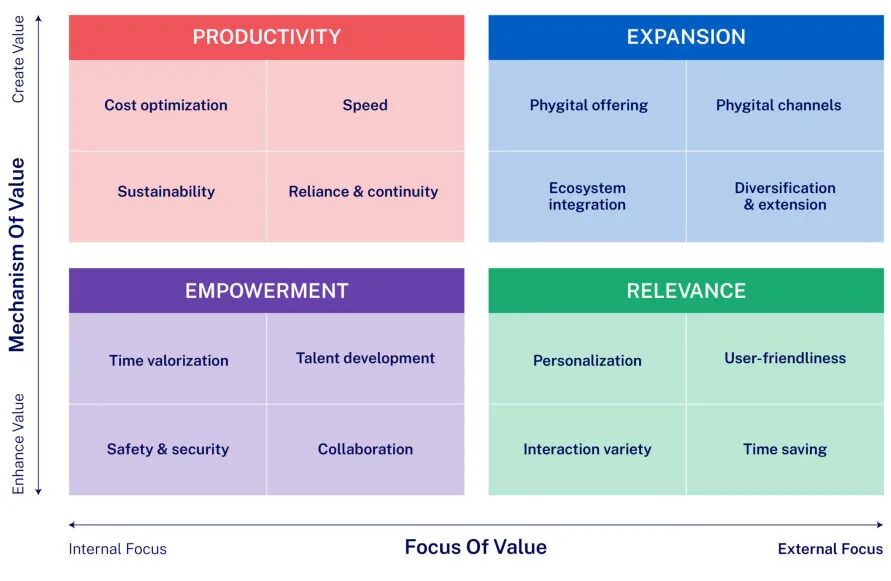
For a reliable AI project implementation, the primary task is to clarify the value positioning. The research divides the AI implementation directions into two dimensions: service objects (internal operations / external customers) and business transformation forms (optimizing existing business / developing new business), and builds a 2×2 quadrant model to clarify the core question: what kind of business problems does AI implementation aim to solve?
After determining the implementation direction, corresponding implementation actions and quantitative assessment indicators are required. If this step is skipped, enterprises are likely to fall into a dilemma of mixed goals, expecting a single system to achieve multiple tasks such as cost reduction, revenue increase, and experience improvement simultaneously, which ultimately leads to conflicting implementation measures and chaotic assessment standards.
Four Directions for AI Implementation and Monetization
The four quadrants correspond to four commercialization paths of AI. The investment costs and implementation difficulties of each path will vary depending on the industry and enterprise resources. Enterprises should focus on the most suitable path according to their own business characteristics and not one - sidedly believe that a certain model is superior.
1. New Business Expansion: Develop New Revenue with AI
This model requires relatively high investment and has more uncertainties. The core is to incubate new products and business models with the help of AI.
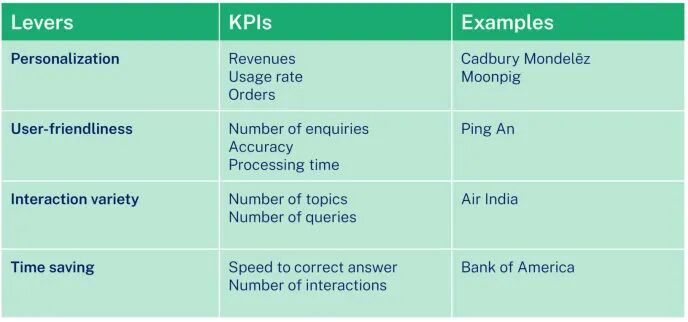
Take DBS Bank in Singapore as a typical example: Since 2019, DBS Bank has implemented more than 2,000 AI models covering hundreds of scenarios. Its incremental revenue mainly comes from the integrated online - offline wealth management service. Offline, when customer managers have face - to - face conversations with customers, AI can simultaneously output wealth management reference suggestions for customers; online, users will receive personalized savings and wealth management push messages. In 18 months, the platform pushed 1.2 billion wealth management reminders to 13 million users. The savings of customers using the intelligent service doubled, and their wealth management investment was five times that of ordinary users. As of 2025, the AI project created an incremental value of more than S$1 billion (about US$780 million) for the bank.
There are mainly the following four implementation forms for generating new revenue:
- Intelligentization of existing products: Yamaha launched the AI music - arranging software VOCALOID6, which is sold on the market at a price of US$225, endowing the product with new value and competitiveness.
- Intelligentization of consumption channels: Walmart launched a price - comparison mini - program. The average customer unit price of in - store customers using this tool increased by 25%. By optimizing the consumption channels, new revenue growth points were successfully explored.
- Optimization of industrial chain collaboration: AB InBev's BEES platform uses algorithms to optimize inventory and supporting services for millions of small and medium - sized merchants in 29 countries, activating the collaborative effect of the industrial chain and achieving a win - win situation for all parties.
- Commercialization of self - developed technology: Amazon Web Services Bedrock and Adobe Firefly package their internally developed AI capabilities into standardized products for external sales, successfully opening up new revenue channels.
2. Internal Efficiency Optimization: Focus on Existing Processes to Reduce Costs
The implementation cycle of focusing on internal efficiency improvement is shorter, and the revenue certainty is higher, especially in the heavy - asset manufacturing industry.
Jubilant Ingrevia, an Indian chemical enterprise, is an excellent example. In the highly competitive chemical industry, Jubilant Ingrevia faces the dual challenges of cost pressure and environmental protection requirements. At this time, AI has become the key technology for them to seek breakthroughs. The enterprise uses digital twin and predictive AI to transform the production line, reducing production fluctuations by 63% and cutting the unplanned downtime of equipment by more than half. While improving product quality, it effectively controls production costs. After implementing AI energy - consumption control, the enterprise's Scope 1 carbon emissions decreased by 20%, successfully achieving the goals of cost reduction and low - carbon simultaneously.
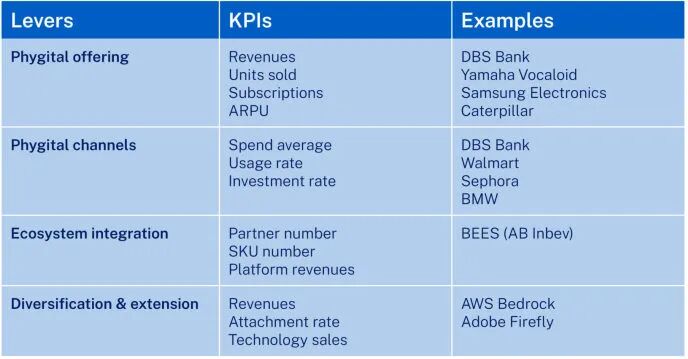
AI cannot automatically achieve cost reduction. It needs to be bound to specific production actions and compared with the pre - transformation data to accurately quantify the efficiency improvement. Its four implementation forms are as follows:
- Fine - grained resource management: UPS uses AI to plan delivery routes, significantly reducing fuel and vehicle maintenance expenses and effectively reducing operating costs.
- Compression of production cycle: Unilever's Dove factory relies on AI to shorten the production time of a single batch by 15%, significantly improving production efficiency.
- Fine - grained energy - consumption management: Dollar General in the United States implemented an AI building control system, reducing the overall energy consumption by 12% and achieving efficient use of energy.
- Fine - grained inventory prediction: The shoe company Flo conducts AI sales forecasting by store, product, and date. The out - of - stock rate decreased from 15% to 3%, and the revenue loss caused by out - of - stock decreased by 12%, effectively optimizing inventory management.
3. Existing Customer Operation: Optimize Services to Improve User Conversion
This path does not require the development of new products. Instead, it relies on AI to optimize the original service chain, deeply exploring the revenue potential of existing customers by improving customer interaction.
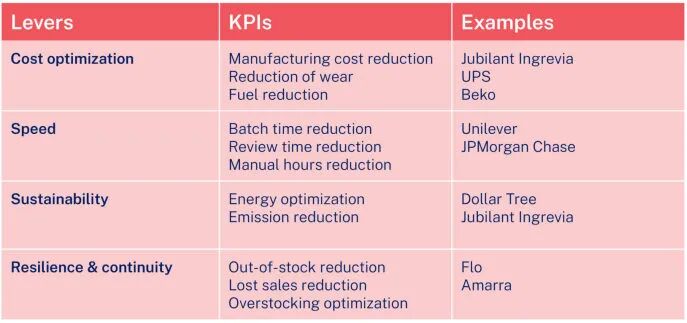
Mondelēz India's measures during the Diwali marketing season are a model. At that time, Mondelēz used generative AI to create digital avatars of celebrities. Small - store owners only need to enter the store name to generate customized short - video advertisements, and virtual artists can target and invite surrounding consumers. The project produced a total of 130,000 customized advertisements, and the average revenue of partner merchants increased by 35%. In this scenario, AI did not create new products but successfully revitalized existing customer sources through large - scale personalization. Its four implementation forms are:
- Product personalization adaptation: Nearly half of the transaction orders of the greeting - card brand Moonpig are completed with the help of AI personalization features, accurately meeting customers' personalized needs.
- Simplification of work processes: Ping An Insurance's car - insurance policyholders can complete AI damage assessment and claim reporting by uploading on - site photos, greatly simplifying the claim - settlement process and improving the customer experience. For Chinese insurance enterprises, this provides a useful reference for quickly responding to customers' needs and improving customer satisfaction in the large and complex domestic market, highlighting the importance of combining AI technology with local market characteristics.
- Diversified customer - service reception: Air India's AI customer service handles 1,300 types of a total of 30,000 user consultations every day, comprehensively covering various customer problems and showing strong service capabilities.
- Compression of service time: Bank of America's intelligent assistant has had more than 2 billion interactions in total, and 98% of consultations are completed within an average of 44 seconds, significantly improving service efficiency and winning high recognition from customers.
4. Employee Efficiency Optimization: Automate to Replace Repetitive Work
We should break away from the inherent thinking of "AI replacing human labor" and use machines to undertake repetitive work, optimize employees' workload, and release human value.
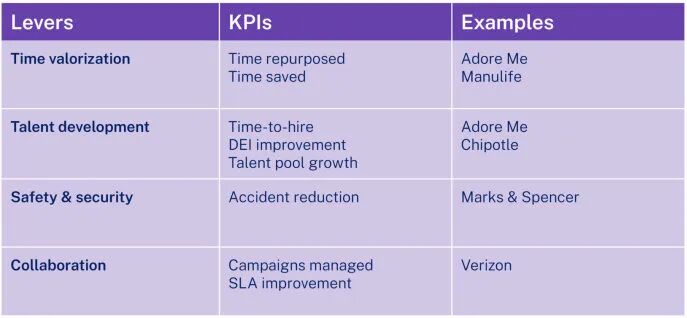
The lingerie brand Adore Me (later acquired by Victoria's Secret) was once troubled by the insufficient production capacity of product copywriting. The massive SEO detail - writing work seriously occupied the creative manpower. From the perspective of the job characteristics model theory in organizational behavior, Adore Me's approach, by assigning low - repetition work to AI, makes employees' work more autonomous and diverse in skills, which is in line with the view of enhancing employees' intrinsic motivation and work performance in this theory. The enterprise implemented generative AI to draft the first version, and editors retained the final modification right, leaving the repetitive writing work to machines. After implementation, each copywriter saved 35 hours of work per month, and the product click - through rate increased by 23%, effectively improving employee efficiency. Its four implementation forms are as follows:
- Streamlining administrative work: Manulife uses AI to compress the time for summarizing lease documents from several hours to a few minutes, greatly improving work efficiency.
- Optimizing talent recruitment efficiency: Chipotle's AI recruitment tool shortens the recruitment cycle by 75% and improves the personnel matching degree, providing strong support for the enterprise to quickly recruit suitable talents.
- Factory safety management: Marks & Spencer combines monitoring and AI, reducing factory work - related accidents by 22%, effectively ensuring employees' safety and improving the safety of the working environment.
- Cross - departmental collaboration efficiency improvement: Verizon relies on AI to coordinate large - scale marketing projects, achieving real - time collaboration among multiple parties, breaking down departmental barriers, and improving overall operational efficiency.
Common Reasons for AI Project Implementation Failures
This implementation framework clearly defines the revenue path, while a large number of failed projects highlight the serious problems caused by the lack of value control. Most project failures are not limited by technical or data shortcomings but by the serious disconnection among strategic goals, implementation actions, and assessment criteria.
Take the Nordic consumer - finance platform Klarna as an example. The platform once replaced hundreds of human customer - service representatives with AI but then re - hired people. Although the robot reduced the call - handling cost, the user satisfaction continued to decline. This is because the enterprise over - emphasized internal cost - reduction indicators and ignored the terminal service quality, resulting in the failure to realize the business value despite the technical compliance.
IBM's Watson Oncology project is a typical case of mismatch. The enterprise invested heavily in commercialization, but the assessment only referred to technical indicators such as algorithm operation speed and recognition accuracy. Subsequent third - party evaluations showed that the matching degree between the AI's diagnosis and treatment suggestions and the plans of senior doctors was only 12%, and many hospitals reported potential safety hazards in the plans. The problem of the project was not the technology itself but the lack of using the patients' diagnosis and treatment effects as the core assessment standard.
Taco Bell's drive - thru AI ordering system and Air Canada's intelligent customer service also passed the technical acceptance but ultimately damaged the brand reputation and triggered compliance risks. The common problem is that enterprises try to pursue multiple goals such as cost reduction, speed improvement, and experience optimization simultaneously without locking in a single implementation direction. The fuzzy goals lead to chaotic implementation and ineffective control.
Sorting out the commonalities of these failed cases mainly includes fuzzy implementation priorities, mismatches between implementation measures and goals, and assessment only focusing on technical indicators, thus hiding hidden costs such as revenue losses, brand damage, and compliance penalties. Enterprises