Some changes that Yao Shunyu has brought to Tencent
Today, the headlines of major media outlets are undoubtedly all about Yao Shunyu.
Why did he join Tencent? What are the opportunities in Tencent's second half of the AI game? Is Tencent's AI development lagging behind... It seems to be a concentrated collision between Tencent's hot - button issues and its key figures.
On December 17th last year, Yao Shunyu joined Tencent as the Chief AI Scientist and the person in charge of Tencent's Hunyuan large - language model and AI Infra. It can be understood that he is the top person in Tencent's large - model business.
In April this year, Yao Shunyu submitted his first report card after joining Tencent, the Hy3 preview.
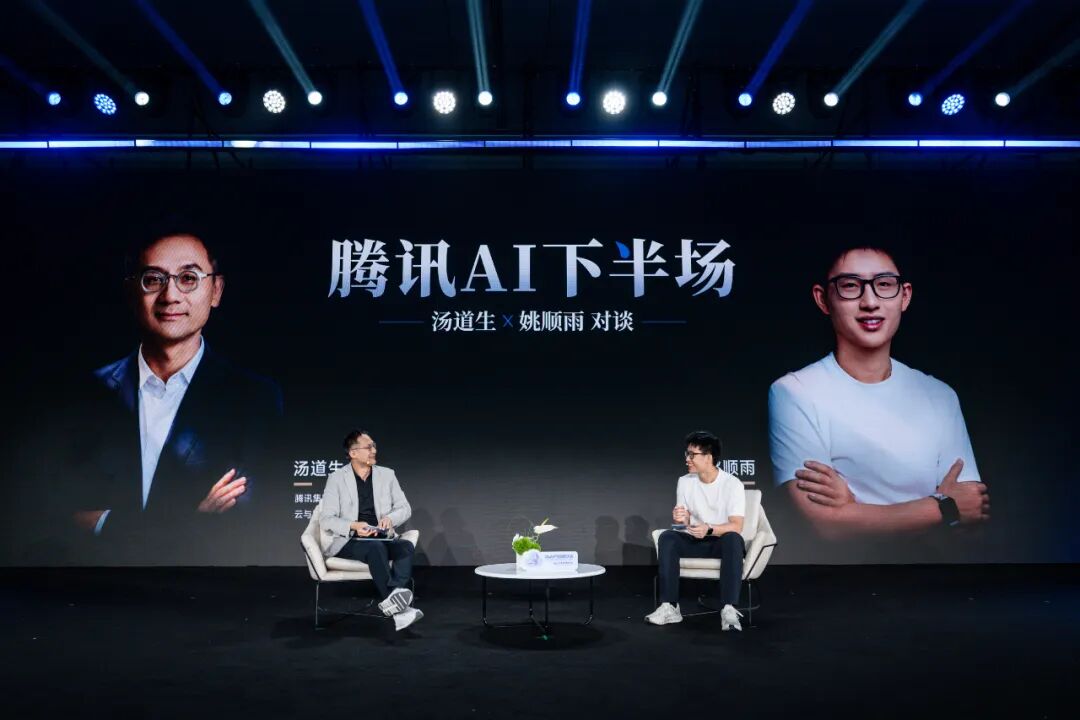
Today is the first time he has appeared in public under his Tencent title, speaking at the Tencent AI Industry Conference.
This is the background information for the full - screen reports about "The Transcript of the Conversation between Yao Shunyu and Tang Daosheng". But what we really want to know is, what changes has Yao Shunyu brought to Tencent in the half - year since he joined?
01
Firstly, it may involve the part of Tencent's evolution towards an AI - oriented organizational form.
When talking about the most important thing in the second half of the AI game, Yao Shunyu mentioned that a long - term AGI - based organization should be established, which involves the basic parts of pre - training and post - training; products and new research paradigms. An equalized, triangle - like organization should be built around these three parts.
In the context of the AI narrative, organizational evolution is a grand proposition. Yao Shunyu's role is just a key position in the top - level design. The evolution of the organizational forms of different businesses and products, and even the changes in individual functions, are more crucial.
In response, Tang Daosheng gave some current transformations that Tencent is undergoing: Taking the WorkBuddy product as an example, small teams of three or five people focus on a certain area and iterate rapidly.
Specifically for individuals, everyone's roles and functions are changing: In the past, engineers had to spend a lot of time writing code. Today, everyone is more like an idea - driven leader. Everyone is a product manager, who needs to thoroughly understand user needs, drive multiple Coding Agents for R & D, and also participate in evaluations... The entire process of creating AI - native products is being redesigned.
Tang Daosheng also pointed out a problem. Most of Tencent's code this year is generated by AI. "Our engineers may spend more time on architecture design, and the code - writing work is handed over to AI."
02
The second obvious change that Yao Shunyu has brought to Tencent is Co - Design, that is, a closer combination of the model and the product. An important decision he made after coming to Tencent is that the Hunyuan large - language model will no longer participate in leaderboards, but instead focus more on scenarios and practicality.
Less than a month after joining Tencent, Yao Shunyu participated in AGI - NEXT, a cutting - edge summit initiated by the Beijing Key Laboratory of Fundamental Models at Tsinghua University, via an online connection. At that summit, the most prominent memory of Yao Shunyu for the outside world was the "giant face" of his on the screen; and his view on the differentiation between AItoB and toC.
Moreover, at the meeting, Yao Shunyu implicitly mentioned, "In China, more emphasis is placed on leaderboards or numbers... I think we need to break free from the constraints of these leaderboards and adhere to what we think is the right process."
In today's morning conversation, Yao Shunyu finally clearly explained to the outside world that the practical value of the model is greater than the value of participating in leaderboards. "We have done a lot of work on this, conducting in - depth Co - Design with various products. A very key point is to build mutual trust, how to make good use of product data, how to handle data feedback, and how to do a good job in evaluation..."
As we know, the iteration of the Hunyuan large - language model is most closely combined with the Yuanbao product. Whenever there is a new version of the model, it is first used by Yuanbao, and if there are any problems, they are promptly reported.
Yao Shunyu talked about a detailed Co - Design detail with Yuanbao at the meeting:
At that time, we sent our strongest post - training backbone to help Yuanbao do a good job in post - training. At that time, our pre - training was not ready yet, but we knew that maintaining a product like Yuanbao and its DAU would be very, very important for our subsequent model development, and it was also very important for innovative cooperation.
Actually, many algorithm engineers didn't understand at that time, and I had to explain very hard. But now it seems that these efforts were all trade - offs. I think this action made the product team realize that the model team really has the product in mind, which played a very important role in our subsequent cooperation, including the successful launch of Hy3 preview in Yuanbao. Of course, there are many technical aspects to discuss, but the most difficult part is actually how to build trust and how to think from the other side's perspective.
In essence, the significance of participating in leaderboards lies in scoring the model's capabilities, which is an external evaluation. But ultimately, it has to return to the real world and see if it can solve real problems and meet real needs through products.
Abandoning leaderboard participation is equivalent to directly connecting the development of the large - language model to the real world: "One of the main purposes of releasing a preview model first is to obtain real - world feedback and fix problems that were not found in various leaderboards, which will bring great improvements in the official version."
He also proposed that the mutual achievement of products and models is an increasingly important AI topic.
For example, the Co - Design with Yuanbao has enabled the Hunyuan large - language model to have strong chatting and searching capabilities. This ability has been transferred to other products such as ima and Workbuddy, and the different data generated by these products can be generalized to each other, forming a network - like system. This value will be recognized and discovered more deeply.
03
In addition to the two major changes that Yao Shunyu has brought to Tencent, we also want to talk about the opportunities in Tencent's second half of the AI game.
This was the theme of the conversation between Tang Daosheng and Yao Shunyu this morning.
It is certain that Tencent's core strategy for AI in the future will be based on and rooted in scenarios, enabling AI to provide more value for users and solve more real problems.
Tang Daosheng said on - site that Tencent has always adhered to the goals of practicality, usability, and scalability in AI development. The most core experience is to be rooted in scenarios. Real scenarios contain both user needs and the data most needed for model iteration. Tencent's rich product scenarios, interaction data, and ecological connections can not only provide high - quality context for the model but also enable the model to call tools and connect systems to truly complete the task loop.
Especially under the premise that the Agent trend has become an industry consensus, Tencent's vast application scenarios have become an inherent advantage. At the beginning of the year, during the "lobster wave", Tencent actively deployed and even launched a full - scale offensive, which is a strong proof. WorkBuddy is already a desktop application product with a high penetration rate.
04
And finally, the question of whether Tencent's AI development is lagging behind.
In this morning's conversation, Tang Daosheng brought up this topic to Yao Shunyu. Yao Shunyu's first reaction was, "It seems that this should be a question I ask you." There was a burst of laughter at the scene.
After some preliminary statements, such as AI being a long - term game and the second half just starting, Yao finally gave his own view:
"In the past, a lot of exploration has been done on models and products, and many detours have been taken. I think this is normal. If you have never done something before, there will definitely be twists and turns in the first attempt. The more important thing is whether you can face yourself honestly, whether you can be real, whether you can see the feedback and make changes, and whether you can be patient. These are the most important things in the second half of the game."
Tencent's AI strategy has always been the focus of external discussions. When the 2025 annual financial report was released, Tencent's stock price dropped sharply. Some people thought that Tencent's investment in AI was too aggressive, while others thought it was too conservative. A contradictory sentiment has influenced people's judgment of this Chinese Internet company with the highest market value.
On the eve of the Spring Festival in the Year of the Horse in 2026, domestic Internet companies were still spending large amounts of money on Chatbots and launching an AI red - envelope war. After the Spring Festival holiday, this wave turned into the "lobster - raising" trend. If the form and trend of AI products change at such a speed, is the real question about the speed or the correct direction?
As Yao Shunyu said at the beginning: After pre - training and post - training, we are like having a universal hammer that can hit any nail. This is a general methodology that can solve various problems. At this time, the more difficult thing becomes how to find good problems to solve.
The key is whether Tencent has found that "good problem".
This article is from the WeChat official account "New Berry Daybreak" (ID: new - daybreak), author: Zhai Wenting, published by 36Kr with authorization.