The utopia of Xiaohongshu cannot contain commercialization
In the Chinese Internet, Xiaohongshu's product development approach may be the most similar to that of Zhang Xiaolong (the mastermind behind WeChat).
In an Internet environment increasingly eager for monetization, Xiaohongshu is one of the few platforms that has not been completely "Douyin-ized." It continuously adds new content forms but rarely shows a strong desire for radical transformation.
The outside world has never doubted Xiaohongshu's ability to create content. However, the certainty of its content creation ability has not been translated into certainty in commercialization.
Over the past few years, Xiaohongshu has tried numerous times to turn its traffic into business. For a platform with such an innate "grass-seeding" gene, it has failed in various fields such as local life services, food and beverage group - buying, tourism, and e - commerce. It's easy to plant the "grass" (generate interest), but hard to "pull the grass" (convert interest into actual consumption). This saying has been around for years, and the answer has yet to emerge.
In this era, the word "anxiety" seems to be overused, but Xiaohongshu is truly anxious.
The external clock keeps ticking. With a valuation reaching $50 billion, investors are waiting for a super IPO to cash in. The commercialization story needs to be more detailed. Since the second half of 2025, Xiaohongshu has shown an unprecedented sense of urgency: the establishment of a large commercial division, structural integration, Ke Nan being promoted to President, and the independent upgrade of the AI department. The most intensive wave of adjustments in 13 years has all been concentrated in this year.
Just last week, Xiaohongshu officially announced its cooperation with the World Cup.
01 How did Xiaohongshu get involved with the World Cup?
According to LatePost, Xiaohongshu has been confirmed as the rights - holding broadcaster of this year's FIFA World Cup in the United States, Canada, and Mexico. It is also the only rights - holder of live, on - demand, and short - video copyrights besides China Media Group and Migu. Currently, the Xiaohongshu App icon has been marked with "World Cup Live."
For Xiaohongshu, which is accustomed to low - key trials, this marketing move is quite obvious.
This event is not entirely unexpected. Last year, Xiaohongshu obtained the live - broadcast rights of the Bundesliga. Not to mention, the F1 Shanghai Grand Prix at the beginning of this year set an example with the hot discussions it generated on Xiaohongshu. However, the scale and duration of the World Cup are much greater than these trials.
Some media quoted insiders from Xiaohongshu as saying that the platform hopes to push its DAU (Daily Active Users) over 200 million and increase its MAU (Monthly Active Users) by 50 million on the existing basis. This statement fits Xiaohongshu's current situation: the platform needs new user growth and new content scenarios.
Most of the outside world views Xiaohongshu's World Cup broadcasting as a move to expand its male user base. This judgment is generally correct. Xiaohongshu's user structure has long been skewed towards women, and male users are a clear direction for growth. As a once - every - four - year phenomenon - level and national - level event, the World Cup is almost the most accessible entry point in sports content to penetrate different circles.
However, spending nearly one billion yuan just for male users obviously does not meet the expected return on investment.
In the view of Tingchao TI, this large investment is aimed at general content.
For a long time, Xiaohongshu's most stable external perception has been "grass - seeding." This perception is strong but also forms a boundary. If a platform is long - term regarded as a consumption decision - making entry, users will open it with a task in mind: open it when they have a problem and leave after finding the answer.
The World Cup provides Xiaohongshu with another narrative space.
Sports events have strong timeliness and emotional appeal, which is not entirely the same as the content logic that Xiaohongshu is most good at. Xiaohongshu's most familiar content production method is the natural precipitation of user experiences. A product review, a travel guide... can be repeatedly searched, collected, and updated, and finally become the platform's long - term content assets.
However, the logic of the World Cup is different. The value of the content moves with the schedule, and the discussion window before and after the game is very short. The platform must organize content supply and community discussions around the game process in advance.
To put it simply, as the user scale enters a stable stage, the platform can no longer rely solely on the search perception of "When in doubt, turn to Xiaohongshu" for growth. This is actually in line with the idea when Xiaohongshu announced to change its slogan from "Life Guide" to "Life Interest Community" last year - Xiaohongshu needs to make users willing to stay even when they don't have a clear consumption problem.
The World Cup is not an isolated layout. Looking at Xiaohongshu's overall actions in recent months, it seems to be a manifestation of this direction.
It is worth noting that Xiaohongshu App has quietly established a channel system. Below the top navigation bar on the home page, Xiaohongshu divides the content into channels such as RED (videos), live - broadcasts, fashion, and food. It has even created a separate entry for "short dramas." In the content stream, besides short dramas from leading platforms like Hippo Theater and Tinghua Island, there are also many exclusive short dramas on Xiaohongshu.
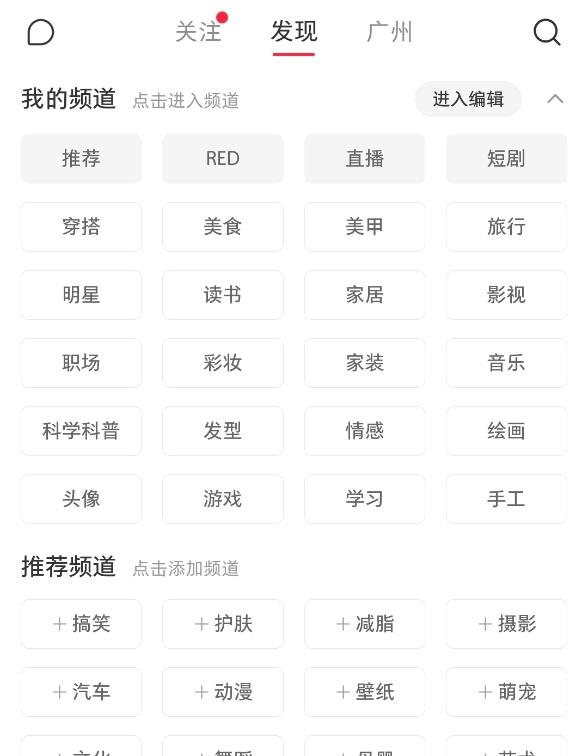
Photo/Xiaohongshu App
By including more content verticals in fixed distribution positions, it is obvious that Xiaohongshu intends to undertake content scenarios with longer content consumption, stronger operation, and higher costs.
At the just - concluded New Generation Creation Festival, Xiaohongshu dedicated a large part to mid - and long - form videos. Data shows that in April this year, the user consumption time of mid - and long - form videos increased by 43% year - on - year, and nearly 100 million users watched mid - and long - form videos every day.
Graphic notes have helped Xiaohongshu establish a strong search perception, but they are more suitable for carrying answer - based information. Short videos can bring faster content consumption, but they are likely to enter the competition standards defined by Douyin. To undertake more complex topics, more complete expressions from creators, and higher - cost content production, Xiaohongshu needs mid - and long - form videos.
In fact, in the past two years, Xiaohongshu has secretly carried out several rounds of content iterations. From the emergence of short videos to mid - and long - form videos, under the wave of AI, many creators and individual developers have emerged in the technology vertical. Since this year, some celebrities have even started to produce micro - variety shows on Xiaohongshu.
As early as last month, Xiaohongshu also started the internal testing of the audio podcast function.
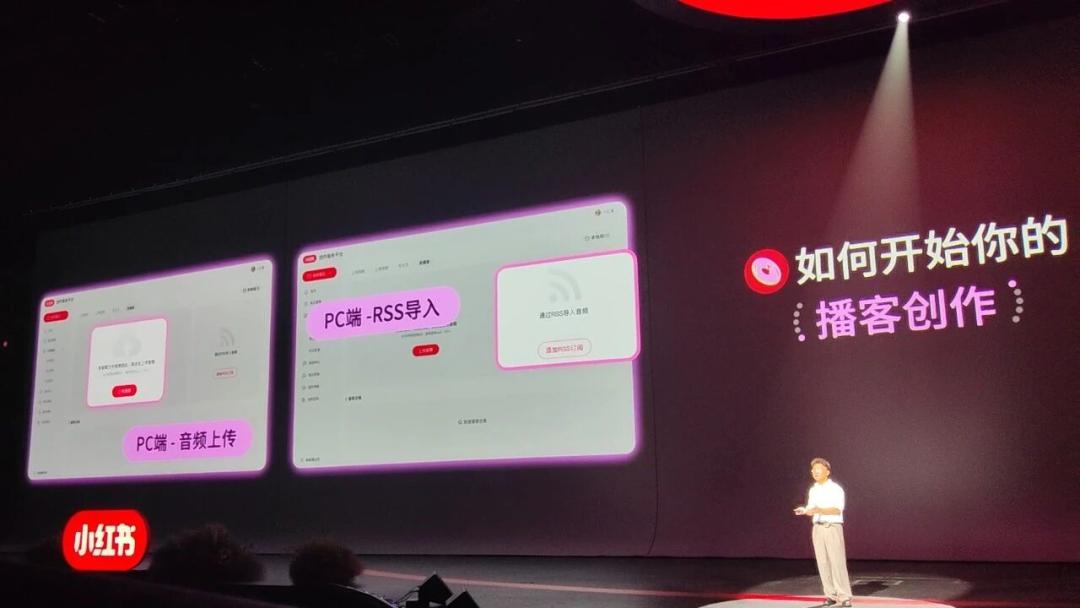
Photo/Spicy
It is worth noting that the podcast function supports direct audio upload on both PC and mobile devices and also supports RSS synchronization import. This shows that the platform wants to capture not only new content from in - station creators but also existing content in the external podcast ecosystem.
However, friction comes faster than the communication effect.
Zhuang Minghao, the host of the podcast channel "Skill of Slaying the Dragon," mentioned that after Xiaohongshu opened the podcast function and supported RSS synchronization import, some accounts participating in the internal testing were judged to be in violation by the system due to a large number of content uploads in a short period.
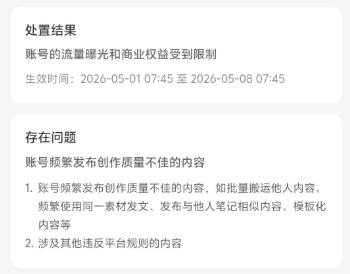
Source: Jike@rosicky311_Minghao
When talking about content earlier, Xiaohongshu liked to use the term "natural growth." Ke Nan also said that Xiaohongshu should adapt to user needs and the content chain, follow the rhythm and rules of ecological growth, and build a native business system on Xiaohongshu to help business players create value.
This is an idealized expression and is in line with the platform's tone that Xiaohongshu has always wanted to maintain.
However, when this idealized expression is implemented in the system, it first becomes a rule issue. Xiaohongshu's risk - control system is calibrated according to the content rhythm of the UGC community, with higher requirements for originality and posting frequency. However, the RSS synchronization logic of podcasts is completely the opposite, corresponding to batch import, high - frequency uploads, and content migration. These two logics are inherently contradictory.
This kind of friction will not only occur in podcasts.
Although the F1 event on Xiaohongshu has generated a lot of heat, most of the content that has emerged is not about vehicle performance, driver skills, and race strategies, but about Shanghai Grand Prix check - ins, driver looks, and star effects. To some extent, this shows that Xiaohongshu has the ability to make sports IPs more relevant to daily life, but this translation mechanism also changes the original user structure of sports content. It can bring more extensive discussions but may not be able to retain enough hardcore sports users.
The World Cup will also face similar problems. Traffic will definitely come, but what really matters is what kind of content relationship these traffic will leave behind.
Xiaohongshu is no longer short of content creation ability, but it needs a wider content radius and more user time. The World Cup, mid - and long - form videos, and podcasts first address the issues of content supply and user retention. The next step will be more practical: how to convert this traffic into advertising, e - commerce, and transactions.
02 It's time to calculate the accounts
After successively opening external link cooperation with Taotian, Pinduoduo, and JD.com, at the beginning of this year, Xiaohongshu notes can also be directly linked to WeChat mini - programs.
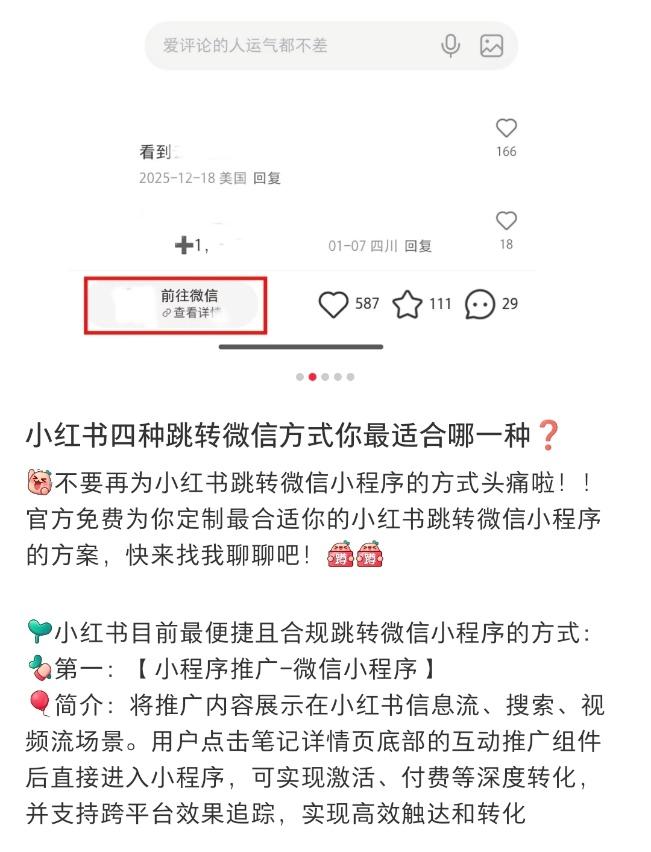
Photo/Xiaohongshu
However, this entry does not appear in all scenarios. Tingchao TI found through testing that for brand content with a mini - program external link, the jump component only appears when entering from the home - page information stream of Xiaohongshu. Even for the same piece of content, if entered from the brand's homepage, the jump component will disappear.
Interestingly, for posts with a jump component, an advertising label will also be marked in the lower - right corner of such notes in the information stream.
- Merchants can pursue results, but users also need to know that what they are seeing is an advertisement.
Xiaohongshu wants to shorten the distance between "grass - seeding" and transaction, but is reluctant to let the transaction entry be completely mixed into the ordinary content path. So, on the one hand, it leaves a conversion entry for brands, and on the other hand, it draws a "demarcation line" in the community content, as if declaring that transactions can be closer to users but should be placed in a clear commercial distribution scenario.
This is almost the most real state of Xiaohongshu's commercialization over the years.
At this year's GROW Merchant Conference, Xiaohongshu proposed "Come to Xiaohongshu to sell good products." Data shows that 39 million users have clear product purchase requests every day, generating 140 million active purchase requests. Zhi Heng also mentioned that "LTV × number of users" is the core logic of Xiaohongshu's e - commerce.
These expressions are very "Xiaohongshu." Good products, LTV, and user relationships sound more decent than GMV, low prices, and return on investment.
However, e - commerce ultimately has to face harsher realities. User relationships can explain long - term value, but in merchants' accounts, what matters are still transactions, repurchases, advertising costs, and profits. The platform can emphasize "good products," but users will also compare prices and after - sales services before making a payment.
In a certain sense, "good products" in the context of Xiaohongshu have a layer of screening.
Xiaohongshu does not naturally have a low - price perception. Currently, the products that are more likely to succeed on the platform are often niche or non - standard products with content expression space, aesthetic premium, and a story behind the brand owner. They may be suitable for being packaged and explained in Xiaohongshu's note content and are not easy to be simply compared in price.
However, these types of products are not the ones that are most likely to be scaled up in mass e - commerce. More mature commercial budgets usually come from standardized consumer goods.
A typical example is beauty and personal care products, which have always been a strong content area on Xiaohongshu and are also the most concentrated area for brand advertising. However, beauty and personal care products are typical standardized products when it comes to the purchase stage.
Users can view product ingredients and usage experiences on Xiaohongshu, but when it comes to placing an order, price subsidies and platform habits will lead them to more mature e - commerce platforms. The closer Xiaohongshu gets to transactions, the more it has to face the aspects it is not good at: product inventory, fulfillment, supply chain, price system, and after - sales service.
This may also be the underlying reason for Xiaohongshu's decision to open external links. Although Xiaohongshu has great "grass - seeding" value and high user activity, its conversion rate is much lower than that of traditional e - commerce platforms. Spending a lot of effort to obtain a sales channel with a low GMV has a low ROI for key accounts.
If it cannot prove its contribution to off - site transactions, its advertising bargaining power will be weakened. Opening external links and data transmission of transactions is actually helping Xiaohongshu re - explain its "grass - seeding" value.
However, this also puts Xiaohongshu in a more awkward position.
For in - station e - commerce to grow, the platform needs to cultivate users' transaction perception; for off - site links to be opened, the platform has to admit that some transactions cannot be retained. Xiaohongshu wants to keep the purchases after "grass - seeding" within its own system as much as possible, but also has to accept the existing transaction habits of brands and users. The co - existence of these two paths can relieve the commercialization pressure in the short term, but in the long term, it will only make Xiaohongshu's e - commerce positioning more difficult to define.
Tingchao TI once asked Xiaohongshu whether it had figured out what kind of e - commerce it wanted to be, considering the contradiction between "good products" and standardized products.
Xiaohongshu's response was: It's hard to answer.
The change of channels has changed the flow of Internet traffic. From a marketing perspective, in this content - centered era, Xiaohongshu has long been the "Jerusalem" that major brands cannot afford to abandon.
Even when Yu Hao bombarded Xiaohongshu on Weibo some time ago, he still posted 20 posts on Xiaohongshu