Doubao charges, giving a major reminder to the automotive industry
On June 1st, 36Kr reported that Doubao was about to start charging, with the launch expected in late June. It also stated that the pricing would be divided into three tiers. This report immediately caused an uproar in public opinion.
After two days of fermentation, the above information finally led to an official response.
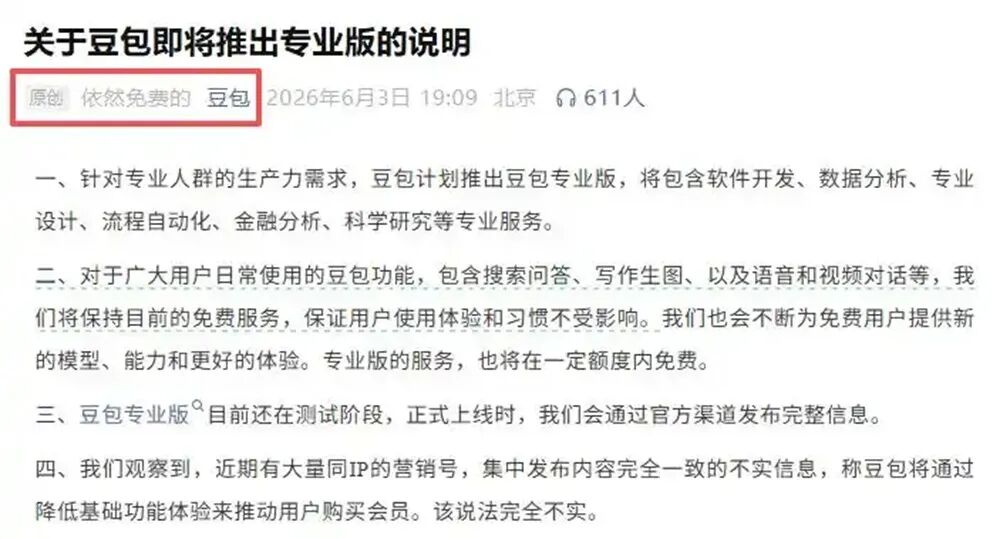
On June 3rd, Doubao's official released a statement titled "Explanation on the Upcoming Launch of Doubao's Professional Version", officially responding that the daily functions would remain free, and the charging would only apply to professional productivity scenarios. At the same time, it accused a large number of marketing accounts of spreading false information in the past two days.
This so - called "rumor refutation" was more like an admission. The core meaning of the entire statement actually acknowledged the main information reported by 36Kr, that is, the fact that Doubao was about to start charging. It only expressed dissatisfaction with the common hype behavior of "a large number of marketing accounts spreading false information" in the cyber world.
Of course, many netizens later traced back Doubao's previous information and found that as early as a month ago, a service statement for the paid version had appeared on Doubao's App Store page, and three tiers of payment standards of 68 yuan, 200 yuan, and 500 yuan were marked. Although there was no actual payment entry in the product at that time.
Sort out the truth and falsehood in the "Doubao charging" storm
At first glance, this entire cycle from the "charging rumor" to the official "rumor refutation" is similar to the common corporate PR crises in the cyber space over the years: the matter is real, but the official is hesitant to face it directly. Finally, it issued a so - called rumor - refuting statement that actually admits the fact, shifting the blame to the self - media accounts that followed the hype after the public opinion fermented.
So let's sort out the sequence and causality of this event in detail. First of all, it must be affirmed that the "charging" rumor is true.
Doubao's official statement "Explanation on the Upcoming Launch of Doubao's Professional Version" on June 3rd was not denying 36Kr's report about the "upcoming launch of the paid version", but rather admitting that a paid professional version would be launched for professional productivity scenarios such as software development, data analysis, professional design, process automation, financial analysis, and scientific research.
But at the same time, the official also emphasized that daily functions including search and Q&A, writing and image generation, voice/video conversations would remain free. It also explained again that the professional version was still in testing, and after its launch (charging), it would go through public and compliant channels.
So from the most objective perspective, Doubao's official was not refuting the rumor of "charging", but rather emphasizing that it would never cancel the free version and force all users to buy memberships - this is also the core issue of its accusation of "a large number of marketing accounts spreading false information".
By now, I believe everyone has understood: the charging areas and the functions that remain free seem reasonable. So why did a large number of "false messages" immediately appear online?
Let's look at the fourth point of the official statement. Its accusation is quite sharp - We have observed that recently, a large number of marketing accounts with the same IP have intensively published completely identical false information, claiming that Doubao would reduce the experience of basic functions to encourage users to buy memberships. This statement is completely false.
I can't verify whether this accusation is true, but it is very logical. After all, Doubao currently has a monthly active user base of up to 345 million, ranking first among domestic large - language - model applications. It is naturally a target for competitors' traffic wars and the platform traffic account industry chain. Moreover, the three - tier pricing description on its App Store page in early May not only challenged the domestic Internet users' perception that "AI should be free", but also provided "concrete evidence" for subsequent rumors.
However, the tug - of - war behind this actually reflects that Doubao's decision to charge for professional services is a foregone conclusion. Behind this risky business choice is the fact that even a giant like ByteDance is gradually struggling to "burn tokens".
Why does Doubao take such a big risk?
Many friends outside the industry don't know what "Token" is. Here is a simple explanation.
In the field of AI, the accurate translation of "Token" is neither "token" nor "voucher", but "token" (word unit), which is the smallest computational unit for large - language models to process text. Taking Chinese characters as an example, each common character usually counts as 1 - 2 Tokens.
Why not calculate directly using characters or words? The cruel truth behind it is -
Although large - language models can sometimes give some excellent feedback information and organize text quite beautifully, they don't really "understand" the semantics of each character and sentence in the input and feedback results, whether it's Chinese characters, English letters, or Japanese kana, let alone words composed of characters or letters. The program only recognizes a digital ID table (vocabulary list, with tens of thousands to hundreds of thousands of items). After inputting information, the process of the system splitting the sentence you said into a series of IDs is called "Tokenization", and each part split out is a Token. After inputting the IDs, the system will calculate a targeted optimal solution (i.e., the Token sequence with the highest probability) based on the existing algorithm, and then convert it into human language that ordinary users can understand.
So, for large - language - model providers, the essence of the service they provide is: users input a series of Tokens, and then the system gives a series of Token sequences that are most likely and approximately optimal in terms of probability.
Since it's all about Tokens, how many Tokens does Doubao input and output in a day?
Doubao's official publicly disclosed around March that the daily average reached 120 trillion. In contrast, in May 2024, this number was only 120 billion. It increased by 1000 times within 22 months!
Let me calculate the cost of these burned Tokens in a way that everyone can understand. First of all, the cost of Tokens essentially consists of three parts: GPU hardware depreciation (50% - 60%), power cost including heat dissipation (25% - 30%), and other costs such as labor cost, computer room rent, and network rent (10% - 15%). Although the costs of different large - language - model providers vary, here, according to Doubao Pro's standard: the input cost per million Tokens is about 0.8 yuan, and the output cost is about 2.0 yuan.
It can be seen that if you just use Doubao as a Q&A robot for a casual chat, the cost is negligible. But if someone asks Doubao to summarize a several - thousand - word article - like the common request in the comment section, "Use a large - language model to summarize the whole article in a few sentences" - it may cost a few cents at a time. And if someone wants to generate a PPT or even a few - minute video, the cost of a single task may reach a few yuan.
Since two decades ago, the logic of the domestic Internet traffic economy has been: attract more users to spread the fixed costs from hardware to network services, and then monetize user traffic through advertising or other value - added methods. This cycle continues, gradually reducing the marginal cost to zero and realizing profit growth.
But in the era of large - language models, the rules have changed: attracting more users means a linear or even super - linear increase in Token consumption, and each interaction has a hard cost. The problem is that you can't insert ads during this process, otherwise, it will completely ruin the user experience. As a result, the marginal cost will never be zero, and the more active the users are, the more losses the company will incur. Even ByteDance, known as the "Internet money - printing machine", is helpless in this situation - after all, you can't force users to watch a 30 - second ad before getting an answer to each question.
So, it's not an excuse for Doubao: the essence of this charging is that the operator hopes to use the payments from professional users to subsidize non - professional access and reduce its losses.
Shift the focus to cars
After discussing the above, I believe you have a clear understanding of the recent events related to Doubao's charging. Since C Dimension is a technology - related matrix account built by an automotive media, let's talk about the wave of "integrating large - language models" that started the year before last. Looking back now, what is it?
Actually, this trend can be traced back to the second half of 2023. At that time, after many vehicle brands had initially installed intelligent cockpits, they gradually found that the traditional voice assistants were a bit stupid. Coincidentally, large - language models began to show their edge. So, starting from the end of the year, Geely, Dongfeng, SAIC, Changan, etc. began to announce their respective cooperation plans.
The direct result was that at the Beijing Auto Show in 2024, more than 20 large - language - model installation projects were unveiled. Each brand seemed eager to stick an AI logo next to the rear - end logo of their cars. The side effect was that a group of Internet traffic giants flocked to the auto show to gain attention. Of course, there was also a major event in 2024. DeepSeek emerged, and within less than two weeks, more than a dozen automotive brands announced that they would "integrate DeepSeek".
So, what achievements has this wave of "AI in cars" brought? Here, I'll be lazy and directly quote what Yang Tao from J.D. Power said when he was interviewed by "Shanghai Automotive News" during the 2025 Shanghai Auto Show.
"In the past two years, large - language models have completely changed the in - car interaction logic," said Yang Tao, the general manager of the automotive product division of J.D. Power China. "Traditional voice assistants can only recognize fixed commands, while large - language models can understand fuzzy semantics and even user emotions through natural language processing (NLP)."
However, the current functions are still mainly focused on entertainment and information retrieval, and there is still a gap from the expected "full - scenario intelligent butler": "What is most needed while driving is often active safety reminders or fatigue monitoring, but now the system is more keen on recommending short - videos."
To put it more simply, vehicle manufacturers have spent a lot of money and time building or purchasing large - language - model capabilities. The only improvement that users can perceive is that after integrating large - language models, the in - car system finally won't misinterpret "Play 'Sunny Day'" as "Play 'Downpour'". This is indeed a real improvement, but it is far from supporting the narrative of an "intelligent revolution".
To put it bluntly, all the "large - language models integrated into the cockpit" so far are essentially using in - car APIs to call large - language models, which are essentially smarter voice assistants (remote controls). The real automotive AI is to make the car "come alive", becoming an entity that can truly communicate and interact, execute the instructions of drivers and passengers, and even take the initiative to provide services for people in the car.
In this regard, the reality is still far from the expectation.
Accompanied by the rapid rhythm of an electronic synthesizer, a pure - black Pontiac Firebird is speeding on the endless ground in the twilight, with a red indicator light on the front of the car moving back and forth.
"Please don't call me ‘car’ or ‘four wheels’, I'm KITT, Knight Industries Two Thousand."
Yes, the above scene is from the classic American TV series "Knight Rider", a childhood science - fiction car dream engraved in the memories of countless Chinese people born in the 1970s, 1980s, and even some in the 1990s. The super - intelligent, self - aware in - car AI "KITT" on that all - powerful magic car is actually the standard image of the "real intelligent car" that we have been looking forward to for decades.
The first season of "Knight Rider" premiered in 1982, which is 44 years ago. Unfortunately, in the past 44 years, although cars have made unprecedented progress and breakthroughs in in - car electronic systems and cockpit interaction interfaces, they have still made little progress in the key aspect of "intelligence".
Looking back at what happened last year and the year before: in the end, the frenzy of car manufacturers queuing up to integrate large - language models and Doubao's current situation of being on the "free or charge" front line are two acts of the same play -
The first act is the over - hyped "AI magic seems great and cheap"; the second act has become the ironic drama of "Oh, it turns out that every token costs electricity". But this is not a bad thing: for the industry and users, only by getting out of the illusion and breaking the myth can real construction begin.
This article is from the WeChat official account "C Dimension", written by Lindon Wan, and published by 36Kr with authorization.