The paid service of Doubao is not that complicated.
On the evening of June 3rd, Doubao's official account issued an announcement. The title was quite interesting: "Explanation on the Upcoming Launch of Doubao's Professional Version", and the signature was "Still Free".
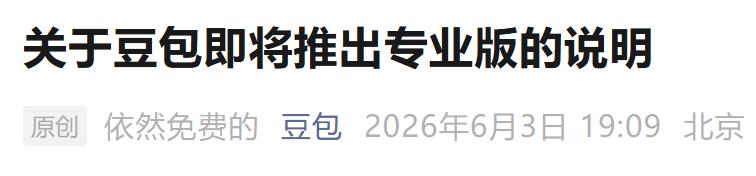
There were four pieces of information: the basic functions will be free permanently; the professional version is designed for scenarios such as software development and data analysis; it is still in testing; and, a rumor was refuted. The official said that recently, a large number of marketing accounts with the same IP had been posting the same content, claiming that Doubao was "dumbing down to force users to pay". In the accompanying picture, several accounts posted exactly the same copy at the same minute (22:29 on June 2nd), and all the sources were marked as "Jingqingyun".
One announcement, two voices. Public opinion quickly split into two camps: one camp said that Doubao had finally shown its true colors and started to "harvest the leeks"; the other camp said that tiered pricing was perfectly reasonable, and the negative articles were too obvious.
Both sides were arguing heatedly, but they might have overcomplicated the issue. The core logic behind Doubao's tiered pricing this time is actually quite clear: to identify a small group of professional users from over 300 million users and let them pay for the additional computing power.
What really deserves pondering is why the word "charging" can trigger such a wide - scale trust crisis.
The Free Version Remains Unchanged, and the Professional Version is Launched Separately
Let's first break down the announcement. The official has clearly defined the boundaries: the free version is for daily use, including search and Q&A, writing and image generation, voice and video conversations. These functions will remain free and will continue to be updated; the professional version is for high - consumption scenarios, such as software development, data analysis, professional design, process automation, financial analysis, and scientific research.
The key here is to divert users according to scenarios, rather than imposing a one - size - fits - all restriction on ordinary users' permissions. Free users will not suddenly lose any functions, and professional users will pay for the additional computing power consumption. The rights and interests of the free version will not be reduced. The official has separately launched a professional product line to specifically serve users with high - intensity computing power requirements.
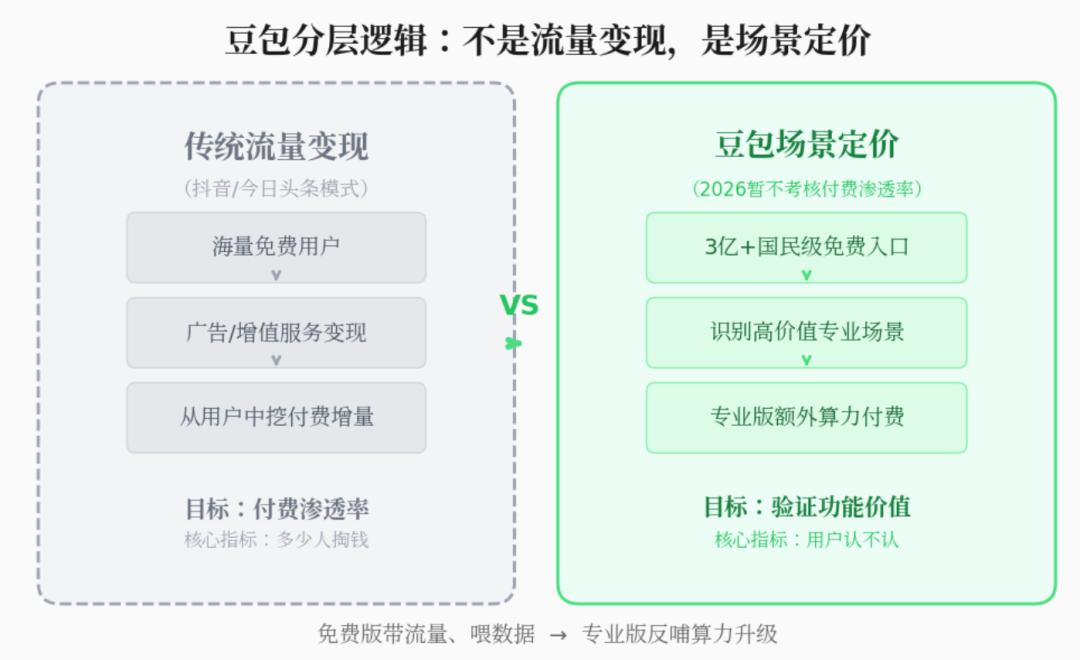
With three pricing tiers of 68, 200, and 500 yuan per month, it is clear that Doubao really wants to make money from professional scenarios. However, there is a detail in the industry: in 2026, ByteDance will not use the paid penetration rate as the core assessment indicator for the time being. The short - term operation is not aimed at large - scale customer acquisition. The primary task is to verify whether the functional value of the professional version can be recognized by the market.
This is different from the traditional "traffic monetization" approach. The latter usually tries to dig out paid users from a large number of users. This time, Doubao seems to be identifying high - value scenarios from a large number of users and then pricing the scenarios. The free version will continue to serve as a national - level entry point, bringing traffic and feeding data to ByteDance's ecosystem; the professional version will meet the high - computing - power and high - cost requirements, and use the paid income to support the upgrade of computing power.
However, users' concerns objectively exist. Whether the monthly pricing of 500 yuan matches the product value can only be tested after the official launch. Many users are worried that once there is a significant gap in the experience of the professional version, the service quality of the free version will be passively reduced. The official has promised to "ensure that users' experience and habits are not affected", but a promise is one thing, and fulfilling it is another.
There is nothing wrong with the tiered model itself. The key lies in the implementation stage, where both product lines should maintain the established service standards.
How Did the Rumor of "Dumbing Down" Spread?
The logic of the announcement is not very complicated, but the rumor of "dumbing down to force users to pay" spread very quickly. At least three things contributed to this.
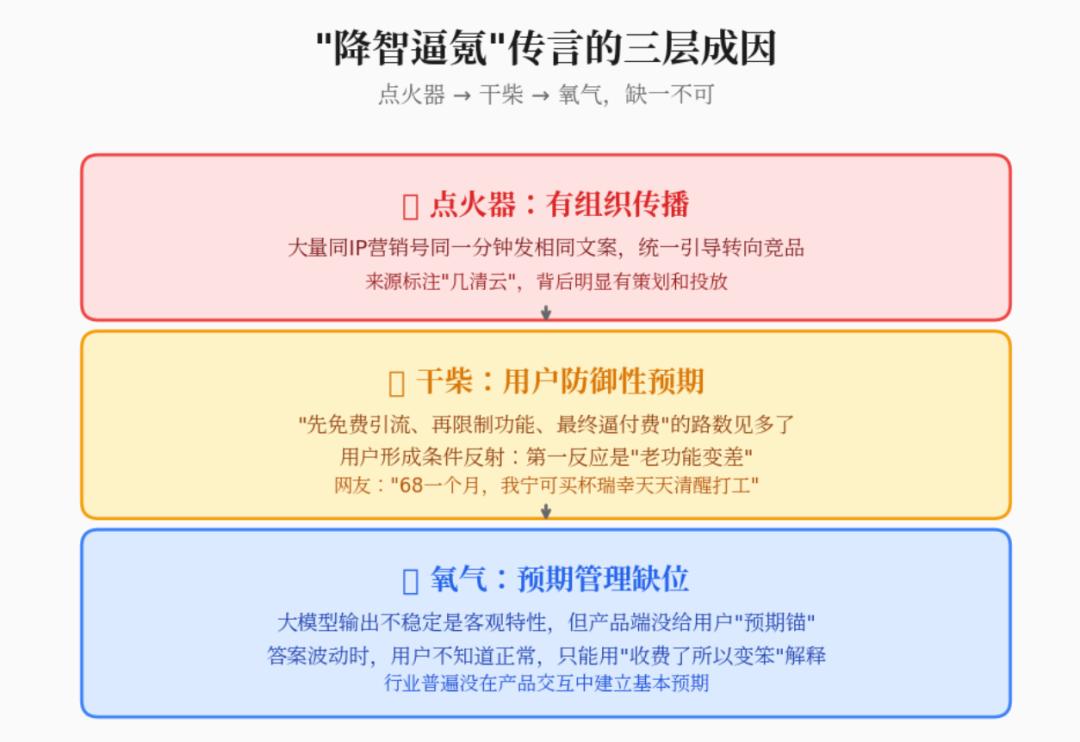
First, there was organized promotion. The official announcement clearly stated that a large number of marketing accounts with the same IP had been posting exactly the same content. The accompanying picture showed that multiple accounts posted the same copy at the same minute, word for word, and uniformly guided users to competing products. This kind of batch operation clearly had planning and placement behind it.
However, for the negative articles to work, there had to be fertile ground. This leads to the second thing: users' defensive expectations. People are familiar with the pattern of Chinese Internet products, which is to "attract users for free first, then restrict functions, and finally force users to pay". Users have developed a conditioned - reflex - like vigilance. As soon as Doubao mentioned charging, some people's first reaction was that the old functions would get worse, and the new functions were ignored.
In the Weibo hot search "Doubao is stupid and still charges", someone complained that "asking the same question three times got three different answers". This kind of anxiety has little to do with Doubao's actual strategy. It is the inertial expectation shaped by past experience. The netizen's comment "I'd rather spend 68 yuan a month on a cup of Luckin coffee to stay awake at work every day" is a popular expression of this mindset.
The third thing is the lack of management of users' expectations, which further amplified this anxiety. The unstable output of large models is an objective technical characteristic, but the product side has not given users a stable "expectation anchor". When the answers fluctuate, users don't know that this is a normal phenomenon and can only use the most familiar explanation framework ("it has become stupid because of charging") to fill the cognitive gap.
Manufacturers don't need to dig deep into complex technical parameters. They only need to establish basic expectations in product interaction, such as clearly indicating that "the model is continuously being updated, and the same question may get answers from different perspectives". Currently, the industry generally fails to do this, and Doubao is no exception.
These three things form a progressive relationship: organized dissemination is the ignition source, the long - term accumulated defensive psychology of users is the dry firewood, and the lack of expectation guidance in the industry is the oxygen. Doubao can directly deal with malicious rumors, but users' concerns and the lack of industry popularization are long - term structural problems that cannot be completely solved by a single announcement. Even if all the negative articles in this round are cleared, similar trust conflicts may still occur when other AI products start charging in the future. This is a common pain point for the entire industry as it moves from the free era to the tiered commercialization stage.
An Observation, Not a Conclusion
Looking at the above as a whole, Doubao's attempt this time can be regarded as an experiment by a leading AI product to explore a tiered business model. The core of the experiment lies in two aspects: whether the functions of the professional version can meet the needs of practitioners and whether the free version can stably maintain the original service standards.
The market cannot hastily define several industry trends. ByteDance's adjustment of a single product does not mean completely abandoning the traffic logic. Douyin and Toutiao still use the mature traffic monetization model; most domestic AI companies are still in a state of continuous loss, and the industry as a whole is still far from being mature. Morgan Stanley marked this adjustment as a key node for the start of commercialization, but a node does not mean the maturity of the industry; DeepSeek is deeply involved in reducing the price of B - end APIs, while Doubao focuses on C - end tiered subscriptions. The two products are on different tracks and do not face direct competition. The business choices of these two products are not sufficient to infer a split in the industry route.
Putting aside grand statements such as industry routes and inflection points, the focus of observation should be on three implementation performances: the long - term service stability of the free version, the matching degree between the pricing and value of the professional version, and the implementation of information popularization for users.
Summary
The problem in this round of public opinion fermentation is not that the monthly fee of 68 yuan is too high. The word "charging" has touched the psychological scars of Internet users who have been repeatedly deceived over the years.
A six - month period can intuitively verify the product's performance: whether the experience of the free version is secretly reduced; whether the professional version can effectively solve the pain points of practitioners' work; and whether the product side can give a reasonable and popular explanation for users' confusion about the fluctuating answers.
The free - using complex of users and the trust gap left by the past non - standard operations in the industry cannot be completely eliminated by the self - discipline of a single enterprise. Doubao can strictly adhere to its own product standards, but the trust reconstruction of the entire industry cannot be completed in the short term. It will take several years to make up for the deficiencies.
All judgments are not in the written articles but are hidden in the long - term product experience and the development of the industry over time.