From Digitalization to Autonomous Agents: The Next Transformation of the Finance Organization
Since 2025, desktop intelligent agents based on large models have entered a period of rapid development. Different from the early chatbots that could only conduct Q&A interactions, the new generation of desktop intelligent agents have the capabilities of cross - system operation, and autonomous task planning and execution. AI is no longer just an "advisor" providing suggestions, but has begun to become an "intelligent assistant" capable of completing actual work.
For a long time, the finance departments of large groups have been deeply troubled by the problem of fragmented multi - systems. Financial staff need to switch repeatedly between ERP, fund, tax, online banking, and business systems in their daily work. Tasks such as month - end closing, three - document matching, and cross - entity reconciliation consume a large amount of human resources. Traditional RPA can only solidify single - point processes and is difficult to handle the variable document formats and multi - step cross - system tandem work. Under these industrial pain points, desktop financial intelligent agents relying on large models have been rapidly implemented. As a form of financial - specific intelligent agents, FinClaw is reconstructing the enterprise financial management model.
For the finance departments of large enterprises, this change is of special significance. For a long time, financial work has required frequent switching between ERP, fund systems, tax systems, bank platforms, and various business systems. A large amount of time is consumed in repetitive work such as data collection, verification, and process execution. In the past, these links mainly relied on manual processing or partial automation through RPA. The emergence of desktop intelligent agents makes it possible for AI to directly undertake the execution of cross - system, multi - step, and long - process tasks.
Due to its high degree of process standardization, strong data relevance, clear rule system, and strict requirements for accuracy, financial management is generally considered one of the most potential scenarios for the application of enterprise intelligent agents. In this article, the applications of desktop intelligent agents in the financial scenario are collectively referred to as FinClaw (Financial Desktop Intelligent Agent), which does not specifically refer to a particular product, but is used to describe this emerging application form. We will systematically analyze the financial transformation driven by FinClaw, the core application scenarios, the organizational evolution path, and the role upgrading of the finance department, and further explore the enterprise - level security governance system to provide a reference for the intelligent application of enterprise finance.
From process automation to task automation: The internal logic of AI intelligent agents driving financial transformation
If ERP solves the problem of online business data and RPA solves the problem of fixed - process automation, then desktop intelligent agents are promoting enterprises to enter the stage of "task automation". The change is not only reflected in the improvement of efficiency but also in the organizational mode and value delivery mode of financial work.
Desktop intelligent agent frameworks such as FinClaw promote the formation of five core transformation directions in the financial field, expanding the capability boundaries of financial work from two aspects: system capabilities and value delivery.
In terms of system capability upgrading, AI has developed from an auxiliary tool to an intelligent assistant capable of independently executing tasks. First, high - frequency process automation reduces manual intervention in links with clear rules and high repetition, such as three - document matching and expense review, and reduces the dependence of financial operations on manual labor. Second, within the scope of compliance authorization, the intelligent assistant is given limited operation permissions, enabling it to transform from a suggestion provider to an assistant that can execute preset tasks. For example, it can complete routine data retrieval and bill verification operations according to rules. Third, the audit coverage has been greatly improved, expanding from traditional sampling inspections to a wider range of data verification, increasing the scope of risk scanning and reducing audit blind spots.
In terms of value delivery transformation, intelligent agents change the delivery mode of financial services. The interaction mode changes from human - operated systems to systems providing active services. By predicting user needs and presenting processing results, it reduces the cost of information retrieval and the complexity of operations. The payment mode is exploring the direction of charging based on computing power consumption from traditional software license procurement. Enterprises pay fees according to the actual computing resources used. Compared with traditional financial systems and RPA models, the intelligent agent era has improvements in three dimensions: the operation subject, audit coverage, and interaction experience. The operation changes from being manually dominated to human - machine collaboration, the audit expands from sampling inspections to a wider range of data verification, and the interaction changes from menu - based retrieval to predictive services.
From the perspective of enterprise operation and management, ERP realizes the online precipitation of data, and RPA reduces the burden of single - point fixed processes. Both of them stay at the level of "single - point operation efficiency improvement". However, task automation driven by intelligent agents is an end - to - end full - link closed - loop operation, which directly changes the enterprise's financial labor configuration and the logic of internal control implementation. It helps managers reduce repetitive human input and tilt financial resources towards high - return matters such as business judgment and value control. It is a generational upgrade of the financial management mode.
Core application scenarios of financial desktop intelligent agents
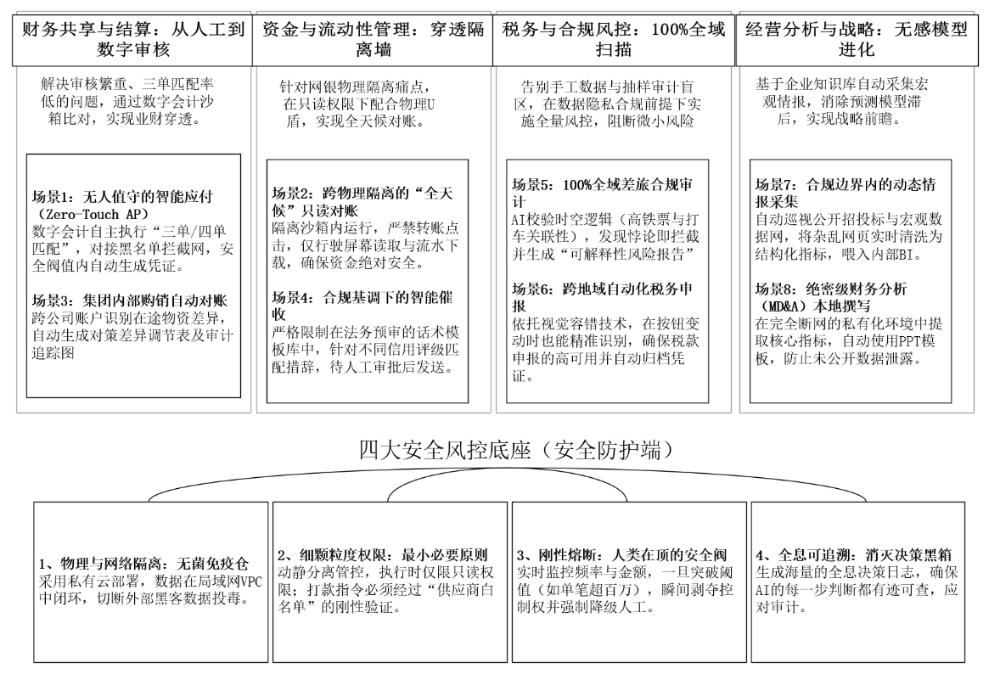
Logical diagram of the framework of eight application scenarios + four risk - control bases
The application value of the FinClaw financial desktop intelligent agent lies in undertaking high - frequency transactional work with clear rules and high repetition, enabling financial staff to focus their energy on analysis, judgment, and value - creation. The core prerequisite is to build an enterprise - level security risk - control base. Through four protection mechanisms of physical isolation, fine - grained permissions, rigid fusing, and holographic traceability, it builds a solid security defense line for cross - system and full - scenario automated operations. The following eight scenarios are application directions with a certain practical basis in the current industry.
In the field of financial accounting and settlement, first, in three - document matching, the intelligent agent identifies key information in various invoices, purchase orders, and receiving documents without being restricted by fixed formats, automatically completes data comparison and consistency verification between documents, and marks the difference items for financial staff to review. Compared with the fixed - field matching of traditional systems, the intelligent agent can process unstructured documents in various formats such as scanned copies and PDFs, and grab the data required for matching from multiple business systems through cross - system operations. Second, in the reconciliation of internal related - party transactions within the group, the intelligent agent logs in to the financial systems of multiple legal entities simultaneously, automatically grabs internal transaction data according to rules for cross - verification, identifies problems such as unilateral accounts and amount differences, and assists in generating related - party transaction reconciliation reports. In the traditional way, manual switching between multiple systems is required for item - by - item comparison, while the intelligent agent realizes cross - system automated operations.
In the field of fund and liquidity management, first, in bank - enterprise statement reconciliation, the intelligent agent obtains bank statements and enterprise accounting records according to rules for comparison, identifies difference items, and generates reconciliation reports for financial staff to review and confirm. Second, in accounts receivable tracking and reconciliation, the intelligent agent logs in to the enterprise financial system to obtain the details of accounts receivable, and at the same time operates the online banking or relevant payment platforms to obtain the actual received payment information, automatically completes the matching reconciliation of accounts receivable and actual receipts, identifies outstanding items, and generates a difference list. For accounts in dispute or overdue, it summarizes relevant information according to preset rules to assist financial staff in formulating collection strategies. Its core advantage is that it is not simply calculating the account age and giving reminders. The intelligent agent can integrate information and conduct calculation and analysis across systems.
In the field of tax and compliance management, first, in the compliance review of expense reimbursement, after receiving the reimbursement application submitted by employees, the intelligent agent identifies information in various documents such as invoices, itinerary receipts, and hotel bills without being restricted by formats. At the same time, it verifies the travel application records, the integrity of the approval process, and the invoice duplication - checking status across systems, comprehensively judges the compliance of the reimbursement, and marks the suspicious items. Compared with the rule verification of traditional systems relying on standardized fields, the intelligent agent is better at handling non - standardized reimbursement scenarios with diverse forms and flexible rules. Second, in assisting with tax declaration data, according to the enterprise's financial data and preset rules, it automatically summarizes the form data required for tax declaration, reducing the workload of manual filling. However, complex tax judgments still need to be reviewed by professional personnel.
In the field of business analysis and strategic support, first, in referring to external data and policy information, with compliance authorization, it collects public industry data, market dynamics, and policy and regulatory information to provide external references for financial analysis. Second, in assisting with financial analysis and reporting, the intelligent agent autonomously operates multiple systems (such as financial systems, BI tools, and external data platforms) according to analysis needs, grabs the required data, and completes multi - step analysis tasks - from data extraction, anomaly identification, and trend analysis to generating preliminary analysis reports containing text interpretations and charts. Financial staff then make professional judgments and in - depth processing on this basis. Different from the fixed - template output of traditional reporting systems, the intelligent agent can flexibly adjust the analysis dimensions according to instructions and present analysis findings and preliminary conclusions in natural language.
Value reconstruction and organizational form evolution of financial staff in the era of intelligent agents
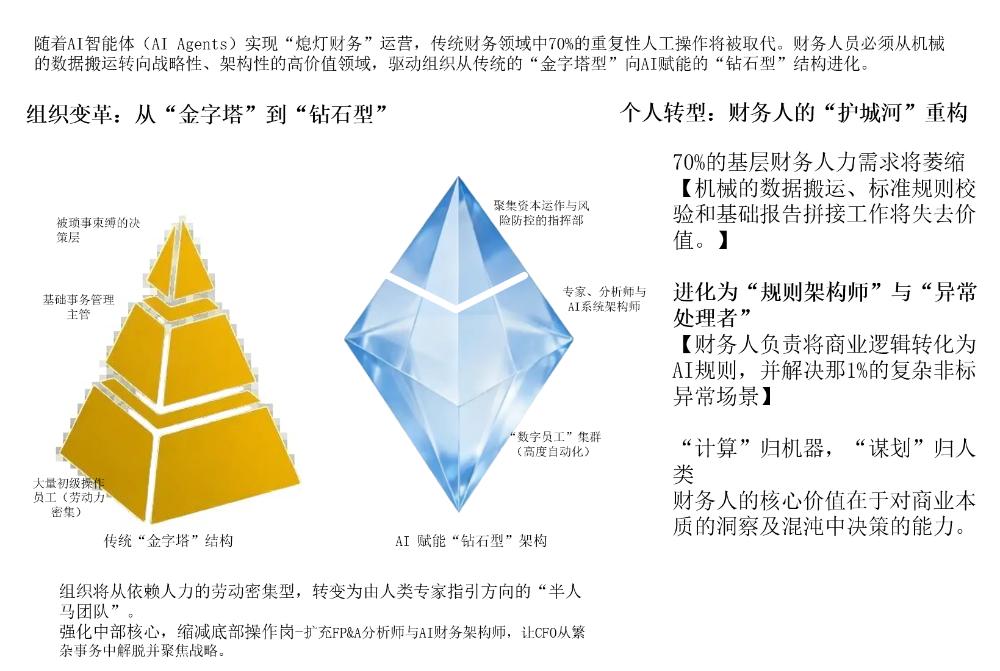
Two - way transformation model of financial organization and financial staff driven by AI
AI intelligent agents are promoting the financial operation mode to develop towards a high - degree of automation. A large amount of repetitive and rule - based financial work is gradually taken over by intelligent agents. The core value of financial staff is shifting from operation and execution to rule design, anomaly management, and strategic support. The organizational form is also evolving from the traditional pyramid - shaped structure to a flatter and more efficient structure.
At the individual transformation level, the ability requirements of financial staff are changing, shifting from focusing on calculation and operation to understanding the business, configuring rules, and participating in decision - making. On the one hand, they are responsible for rule configuration and management, transforming business logic, compliance requirements, and business processes into a rule system that intelligent agents can recognize and execute, and continuously optimizing these rules. On the other hand, they are responsible for handling anomalies, dealing with non - standardized scenarios, complex business problems, and cross - departmental coordination matters that intelligent agents cannot cover. The basic calculation work is undertaken by intelligent agents, while financial staff focus on the links that require professional judgment and business insight. These abilities are core competencies that are difficult to be replaced in the short term.
At the organizational change level, the financial team is changing from a model mainly based on manual operation to a human - machine collaboration model. The traditional pyramid - shaped structure is based on a large number of junior operators. With the application of intelligent agents, the basic positions at the bottom are gradually reduced or assisted by intelligent agents. The middle - level expands financial planning analysts and process design managers to undertake analysis and rule - design functions. The top - level focuses on strategic decision - making and capital management. The overall structure becomes flatter, the core capabilities are strengthened, the operation positions are streamlined, and human - machine collaboration becomes the norm.
Implementation practices show that the popularization of intelligent agents is reshaping the enterprise's labor cost and staffing planning. A large number of low - value - added data entry and verification positions are gradually being reduced, and enterprises are no longer recruiting a large number of basic accounting personnel. At the same time, the staffing of financial analysts, financial rule architects, and business - finance BPs is expanded. The human input of the financial team is shifting from "emphasizing execution" to "emphasizing decision - making", and the optimization of the labor cost structure has become the most intuitive management benefit for enterprises to implement intelligent agents.
It is worth noting that the first change in the era of intelligent agents may not be the financial process itself, but the talent structure of the financial organization. The traditional finance department usually presents a "pyramid - shaped" structure, with a large number of basic positions responsible for data entry, verification, and report compilation. As intelligent agents gradually take over standardized tasks, the organization's demand for rule design, data analysis, business insight, and cross - departmental collaboration capabilities will continue to increase.
In this process, the importance of positions such as financial BPs, financial analysts, process governance, and rule management is expected to be further enhanced, while positions that simply rely on repetitive operations are facing transformation pressure. The core competitiveness of the future financial team will be more reflected in the ability to understand the business, the ability to build a rule system, and the ability to create business value using intelligent tools.
Phased implementation and governance path of financial AI intelligent agents in group enterprises
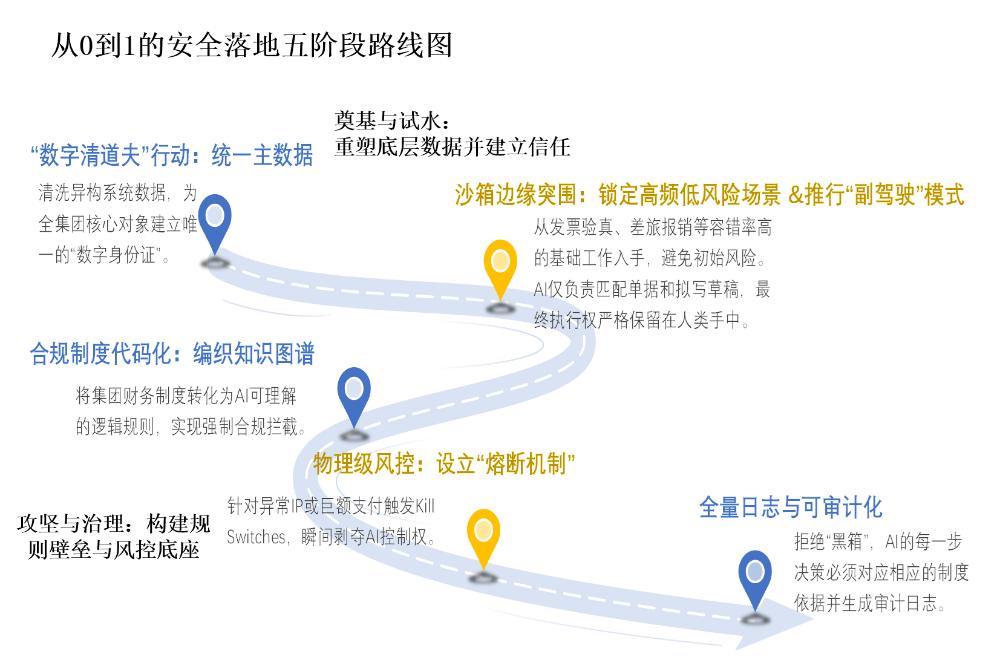
Framework diagram of the five - stage route for the safe implementation of financial intelligent agents
The implementation of financial AI intelligent agents in group enterprises is a systematic project that requires the construction of a complete path from data governance to the risk - control base. It is recommended that enterprises follow a five - stage path of basic preparation, scenario pilot, rule construction, gradual expansion, and continuous optimization to smoothly promote the transformation of enterprise finance with AI.
The core tasks in the basic preparation and application implementation stages are data governance and scenario deployment. At the data level, complete the standardization of master data, the visualization of business rules, and the construction of a financial knowledge base to ensure the quality and standardization of the data input to the intelligent agent. At the scenario level, preferentially select scenarios that rely on cross - system operations, require visual perception interfaces, or involve multi - step task orchestration, which can better reflect the unique value of desktop intelligent agents compared with traditional RPA. For scenarios with mature IT solutions and fixed rules, intelligent agents can be used as a supplementary means.
The rule construction and in - depth promotion stages focus on rule improvement and application expansion. Transform compliance systems and business processes into a rule system that intelligent agents can recognize and execute, form an enterprise financial management knowledge base, and implement compliance checks at key nodes. Expand the application scope of intelligent agents, gradually extend from pilot scenarios to more financial processes, continuously optimize rules and interaction experience on the basis of stable operation, and promote the evolution of the financial operation mode towards a high - degree of automation.
Under the orientation of value creation, the function upgrading of CFOs and the construction of the decision - making center
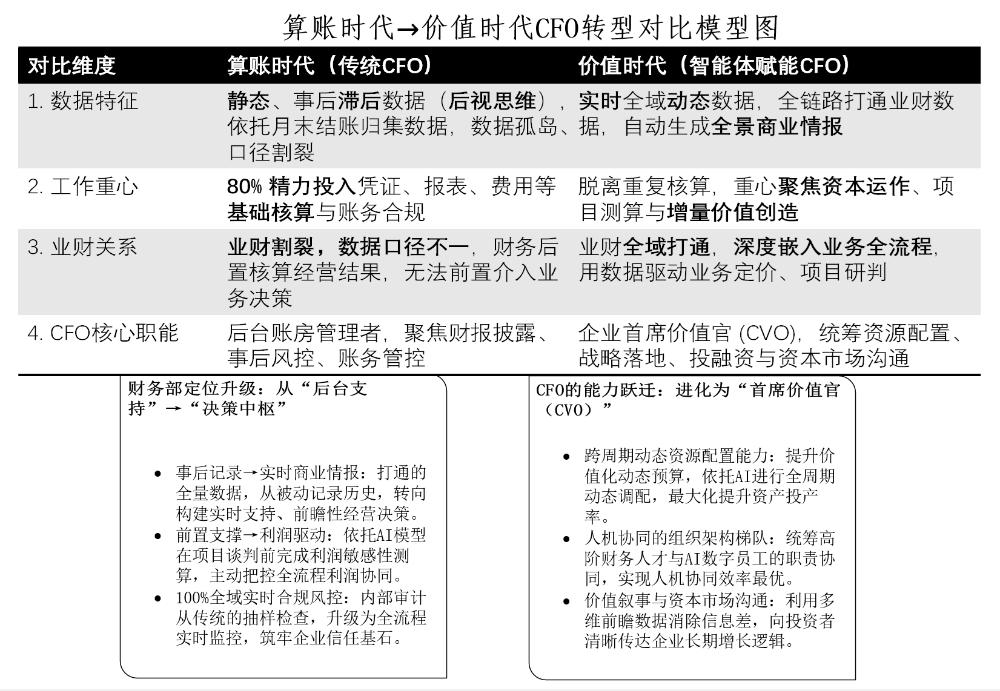
Comparison model diagram of CFO transformation from the accounting era to the value era
The application of intelligent agents is promoting the role of the finance department to change from simple accounting and recording to participating in decision - making support. The focus of CFOs' work is also extending from financial management to value creation.
The positioning of the finance department is changing in three directions: First, from static post - event recording to more timely data presentation, integrating multi - source data to provide information support for business decision - making. Second, from passive post - event accounting to active value analysis, using AI models to assist in profit calculation and sensitivity analysis, and participating in the value assessment of business processes. Third, from sampling inspections to a wider range of data verification, increasing the coverage of risk identification and strengthening compliance management.
After the basic accounting and process execution are gradually taken over by intelligent agents, the value focus of CFOs is also shifting: from focusing on "how to calculate the accounts clearly" to "how to help the enterprise create value, allocate resources, and manage risks". CFOs need to have three aspects of ability support: First, the ability to allocate resources across cycles, improving the efficiency of asset allocation through dynamic budget management and AI - assisted deduction. Second, the ability to manage human - machine collaboration, clarifying the boundaries and division of labor between humans and machines, and achieving the coordinated cooperation between professional teams and intelligent tools. Third, the ability of strategic communication, transmitting the enterprise's operating conditions and long - term development logic based on multi - dimensional data, and strengthening communication with internal and external stakeholders. As the basic accounting work is gradually taken over by intelligent agents, CFOs have the opportunity to invest more energy in the strategic level and form a closer strategic cooperation relationship with CEOs.
In implementation scenarios, relying on the full - volume real - time data of intelligent agents, CFOs can quickly complete the revenue calculation of new projects,