The dramatic short drama sector has suddenly plunged into a harsh winter, and this is no accident.
In May 2026, a screenshot caused a stir in the short drama creators' group.
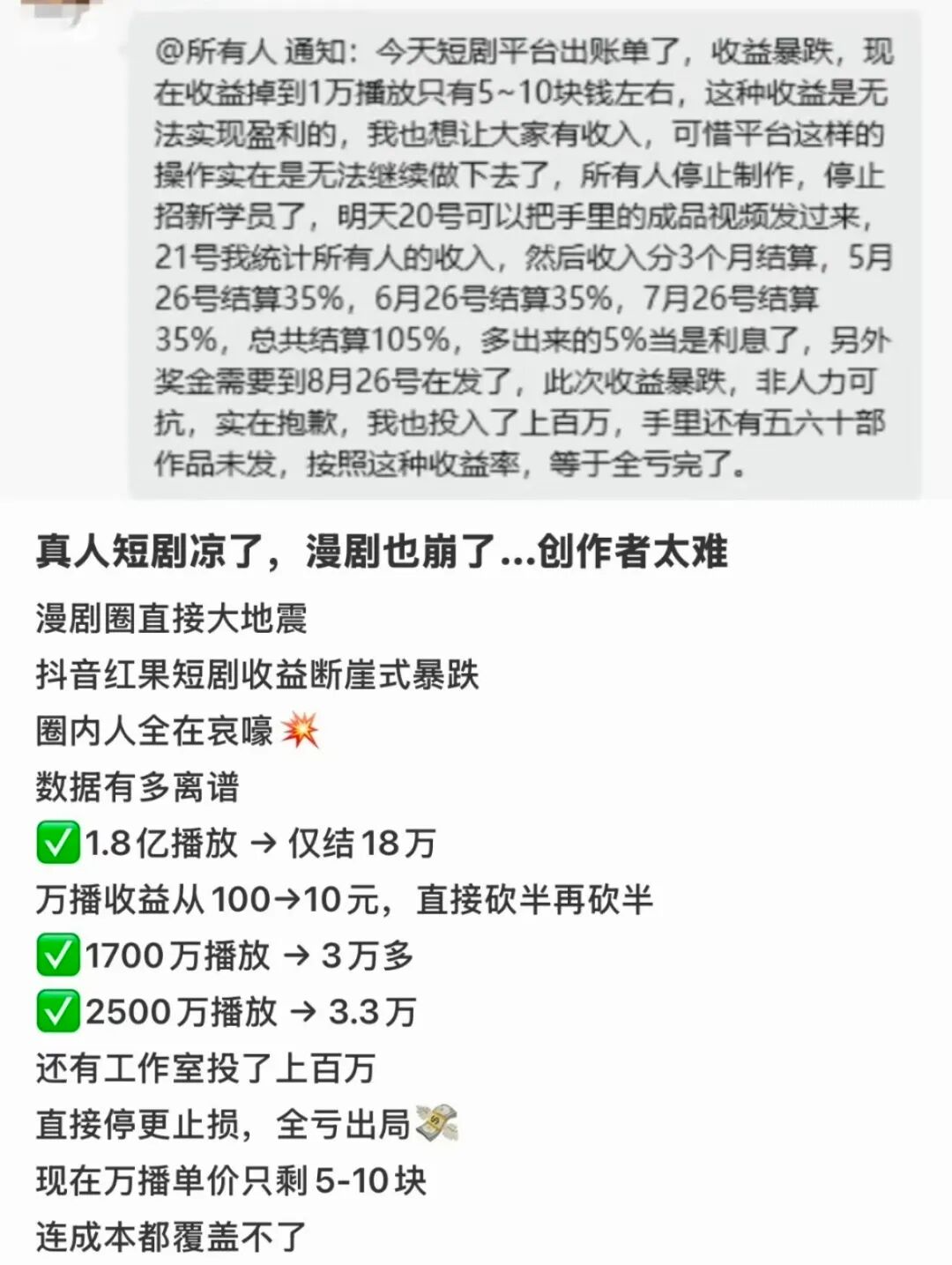
The screenshot was from the backend of Hongguo Short Drama. With 180 million views, the settlement was 180,000 yuan. With 25 million views, the settlement was 33,000 yuan. Calculated, the revenue per 10,000 views was only 5 to 10 yuan.
You know, just a year ago, this figure might still have been around 100 yuan.
From 100 to 5, a decline of 95%. A mid - tier actor who has worked in the live - action short drama field for three years said that his last time joining a production team was in February this year, and he hasn't received any invitations for live - action dramas since then. In March this year, Chengdu Zhongdu Technology announced that it was cutting off its live - action production business and all employees were turning to AI dramas. The reason given by the company's person - in - charge was very realistic. After the platform cancelled the guaranteed payment, there was almost no profit in live - action shooting, and continuing to shoot would only lead to continuous losses.
As soon as the news came out, the entire short drama industry fell into a slump. Why did the revenue drop precipitously? Is there still value in deeply cultivating the short drama track?
From the boom to the bubble in the short drama industry
Hongguo Short Drama was launched in August 2023. At that time, the short drama industry had already established a paid model. Users paid 2 to 10 yuan per episode to unlock, and the platform and the production party split the revenue equally. But the essence of this model is a traffic business. The cost of traffic investment is often five to ten times the production cost. Whoever is better at buying traffic will win.
In the second half of 2023, after ByteDance acquired Hongguo, it completely switched to the free model and made money through advertising. The logic of watching dramas for free and the platform being supported by advertising has been verified in the US FAST model.
Once the free card was played, the logic of user growth completely changed. Under the paid model, the platform cared about how many people were willing to pay. Under the free model, the platform cared about how much time people were willing to spend. The more time spent, the more advertising exposure, and the more money the platform would earn.
Hongguo took this logic to the extreme. It designed a mechanism to earn gold coins by watching dramas and also summarized a golden 5 - second rule: using AI to analyze massive user behavior data, achieving a first - screen retention rate of 68%, with an average of 3 hooks per minute, leaving no chance for users to swipe away.
On the content supply side, Hongguo was also quite generous. At the end of 2024, it launched the Guoran Plan, providing a guaranteed revenue of 200,000 to 350,000 yuan for a single drama, with a copyright - holder sharing ratio of 20% - 30%, and a buy - out price of 50,000 to 120,000 yuan for S - level scripts for screenwriters. For content providers, this was almost a sure - win deal.
As a result, Hongguo's DAU soared from less than 50 million to 245 million by the end of 2025, surpassing Bilibili and Youku to become the fourth - ranked online video APP, with its daily active users exceeding 100 million. In March 2025, the monthly content revenue sharing exceeded 500 million yuan, and more than 10 copyright - holders exceeded 10 million yuan in a single month.
At this stage, there was a relationship of jointly expanding the market between Hongguo and content providers. The high revenue of up to 100 yuan per 10,000 views and the guaranteed payment mechanism were the investment - promotion costs actively paid by the platform to quickly boost the supply side.
But the turning point came quickly.
In February 2026, ByteDance launched Seedance 2.0, which greatly improved the realism of videos. It could generate movie - level short films in 60 seconds just with text and pictures, with extremely low cost, completely opening the door to mass - production of AI short dramas. Hongguo then tilted its policies, and the sharing coefficient of AI - simulated human short dramas once reached as high as 60, ranking first among all categories.
Capital and creators took action upon hearing the news. According to data from the DataEye Research Institute, as of the first quarter of this year, there were about 180,000 AI dramas and animated dramas being broadcast natively on the Douyin platform, and the playback volume in March increased by 137.7% compared with that in January. Hongguo launched about 1,000 new short dramas every month, and cooperated with more than 600 content providers.
But there was a structural hidden danger here. After the supply side was unlocked by low - cost technology, the marginal cost of content approached zero, and the supply would expand infinitely until the scarcity was exhausted.
The homogenization of AI animated dramas became more and more serious. Similar aesthetic styles, similar plot templates, and similar themes of domineering CEOs and time - travel. Among the 1,000 dramas supplied every month, the top 20% of the dramas contributed more than 80% of the playback volume, and a large amount of content at the bottom had almost no exposure.
And Hongguo's advertising revenue would not double just because the content supply doubled. The upper limit of advertising revenue depends on user time and advertising unit price, not the quantity of content. The more content there is, the more the playback volume is diluted, and the revenue per 10,000 views of a single work naturally decreases. Even if the platform does nothing, this logic will run automatically.
The trend changed faster than expected. Hongguo directly cancelled the guaranteed payment for AI - simulated human scripts and completely changed to a 20% sharing cooperation. The script passing rate dropped from about 30% to 7.5%, leaving a large number of screenwriters and producers in an embarrassing situation of having no scripts to submit and no dramas to shoot.
The ultimate bearers of the industry's cold wave are the screenwriters, actors, and production companies who once believed that AI could change their fates, as well as their wasted investments and expectations.
Why does Hongguo dare to cut the revenue to 5 yuan per 10,000 views?
The rise of short dramas is essentially a product of attention inflation. But when AI reduces the cost of a single drama to a low level and enables batch replication, the content supply explodes exponentially, user attention is diluted, and the value of a single playback shrinks. Live - action dramas are in a survival crisis due to high costs, long production cycles, and declining competitiveness.
Facing over - capacity and profit pressure, most platforms have chosen one way: clearing out inefficient production capacity and competing for high - quality content.
In May, the Short Drama Copyright Center of Douyin Group clearly raised the sharing ratio of native live - action dramas. The sharing ratio of IAP content increased from 70% to 80%, and the budget for IAA content was also increased. In the same month, Kuaishou announced an investment of 800 million yuan to explore a diversified revenue - sharing model, 200 million yuan in cash to incubate high - quality dramas, and a 1 - billion - level exclusive traffic pool to support high - quality short dramas.
Long - video platforms are also taking action. In February, iQiyi completed a comprehensive upgrade of its revenue - sharing cooperation model. In April, Youku released the 2026 vertical short drama incentive rules, with a maximum reward of 100,000 yuan for a single cooperation party. Tencent Video said it would issue more than 30 million yuan in brand incentive funds throughout the year. Taobao also officially entered the market and launched the "AI Drama Million Incentive Plan".
On the one hand, Douyin, Kuaishou, iQiyi, Tencent Video, and Taobao are all increasing their investments, raising the revenue - sharing ratio, and supporting high - quality dramas. On the other hand, Hongguo is going against the trend and compressing the revenue of content providers to 5 yuan per 10,000 views and launching a VIP membership at 260 yuan per year, which is more expensive than iQiyi and Tencent Video.
Compressing the revenue of content providers on one hand and testing the boundaries of user payment on the other, Hongguo tightened both the supply side and the demand side in 2026. This action itself shows that it is trying to switch from the subsidy period to the profit - making period.
The figure of 5 - 10 yuan per 10,000 views is not determined randomly.
Hongguo has a monthly active user base of 245 million, with an average daily usage time of 120.5 minutes. Estimated by the eCPM of about 15 to 25 yuan in the short - video advertising industry, the monthly advertising revenue is in the range of 5 to 10 billion yuan. About 1,000 short dramas are launched every month. Assuming an average playback volume of 1 million times per drama, the total playback volume is 1 billion times. If the revenue per 10,000 views is 100 yuan, the total sharing would be 10 billion yuan, which is equivalent to the scale of advertising revenue, leaving almost no gross - profit space for the platform. If the revenue per 10,000 views is 5 yuan, the total sharing is 500 million yuan, which is basically consistent with the monthly revenue - sharing of 500 million yuan previously disclosed by Hongguo.
This is a very clear account. 100 yuan per 10,000 views is the investment - promotion price during the expansion period, and 5 yuan per 10,000 views is the market price during the profit - making period. The price difference in the decline is the economic source for the platform to make quick profits.
Neither content nor technology is a moat
Putting this matter in the context of past platform economies, the scenario is very similar. Platforms use excessive subsidies to attract ecological participants during the expansion period, and gradually compress the distribution ratio after completing scale accumulation, shifting the risks. The early traffic support for WeChat official accounts and the large - scale subsidies at the beginning of Didi are similar scenarios.
The difference is that the practitioners in the AI animated drama industry are more vulnerable. They bet on the dividends of low - cost technology, but the platform is the real controller of the scarce resource of traffic distribution. Technology has lowered the threshold of content creation, but not the threshold of traffic. Technology has led to an explosion of supply, but the explosive supply in turn dilutes everyone's revenue.
This is like the paradox of plenty. Farmers' incomes may decline in a bumper year. Under the prosperity of the platform, content providers may become more fragmented.
How will the industry evolve next?
Most likely, small and medium - sized teams will be cleared out more quickly, the head - effect will be strengthened, the revenue per 10,000 views will stabilize in the range of 5 to 15 yuan, and Hongguo will evolve into a platform similar to a long - video platform.
The 5 - yuan revenue per 10,000 views is a wake - up call for AI content entrepreneurs.
When technology enables everyone to produce content at low cost, content itself is no longer a moat. The real moat is whether you can create works that make users willing to stay, share, and come back in an environment of explosive supply.
The platform will always pursue lower costs and higher profits. This is its nature. The way for content providers to survive is not to complain, but to figure out one question: when everyone can use AI to make short dramas, where is your irreplaceability?
The answer may not lie in technology, but in the story. Not in cost, but in the users' emotions.
This article is from the WeChat official account “Yiou New Consumption” (ID: EO - Consumer), author: Du Xinyi, published by 36Kr with authorization.