Brain-computer interface: Can startups in all its subfields secure funding this year?
Only five months into 2026, brain-computer interface (BCI) technology has reignited the long-dormant medical venture capital circle.
Transaction data best illustrates this wave of enthusiasm. According to statistics from public information by Yixian Insight, in the first five months of 2026, there were as many as 33 financing events in China's BCI field, with a total financing amount exceeding 4.6 billion yuan. The number of transactions has exceeded the total number of financing events in this field for the whole year of 2025, and the total financing amount is nearly three times more.
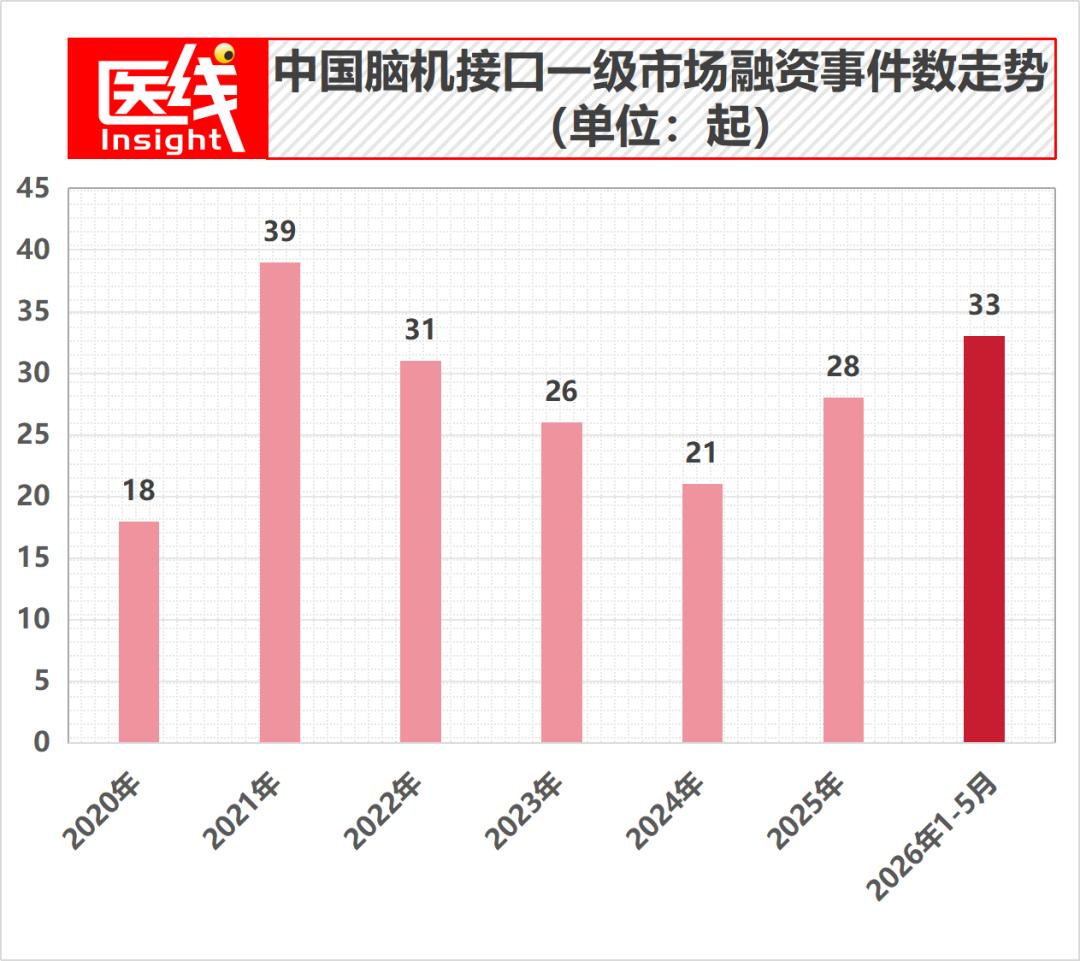
Data source: Public information from platforms such as IT Juzi, Jingzhun, and Arterial Network. The full list of financing enterprises from January to May 2026 is attached at the end of the article.
"Almost all BCI directions can secure financing at this stage," sighed a senior investor.
This is not an ordinary phenomenon.
On the one hand, the medical venture capital circle, which always prides itself on long-termism, has suddenly put aside caution and rationality and started competing to invest in BCI projects. The competition for some projects has even reached a white-hot stage.
On the other hand, after experiencing the capital winter in the past few years, investors have actually been taking a wait-and-see or even a contractionary attitude towards most sectors. However, they have been decisive and quite generous in investing in BCI. There have been numerous financing events worth hundreds of millions. For example, NeuroX Technologies completed a large-scale financing of 2 billion yuan at the beginning of the year, setting the second-largest financing record in the global BCI field.
When something seems abnormal, there must be a reason. Why have investors suddenly reached a consensus on increasing their investment in this cutting-edge BCI field? Why are they investing so heavily? Does this prove that the underlying logic of the industry has undergone a qualitative change?
The answers may lie in these successive financing events.
01 What's Driving the "Hype" around BCI?
In fact, as early as 2020, BCI had already attracted the attention of many capital parties.
That year, representative enterprises such as Brain-Land Technology, Rouling Technology, and Jialiang Brain Science completed their financing one after another.
However, this was just a small-scale capital trial. The main reason was that BCI was still in the conceptual stage at that time. The related technologies and products were more active in laboratories and research institutions and did not show many outstanding performances in the clinical and market sectors.
The real turning point occurred in 2025.
In this year, a large number of breakthrough achievements began to emerge intensively. For example, the world's first interventional BCI-assisted rehabilitation experiment for the motor function of the affected limb, the first domestic prospective clinical trial of invasive BCI, the first domestic prospective clinical trial of long-term implantation of an invasive BCI system in the human body, the world's first quantitative visual reconstruction experiment of complex graphics with colors, and the world's first interventional BCI-assisted rehabilitation experiment for the motor function of the affected limb and other milestone events took place one after another.
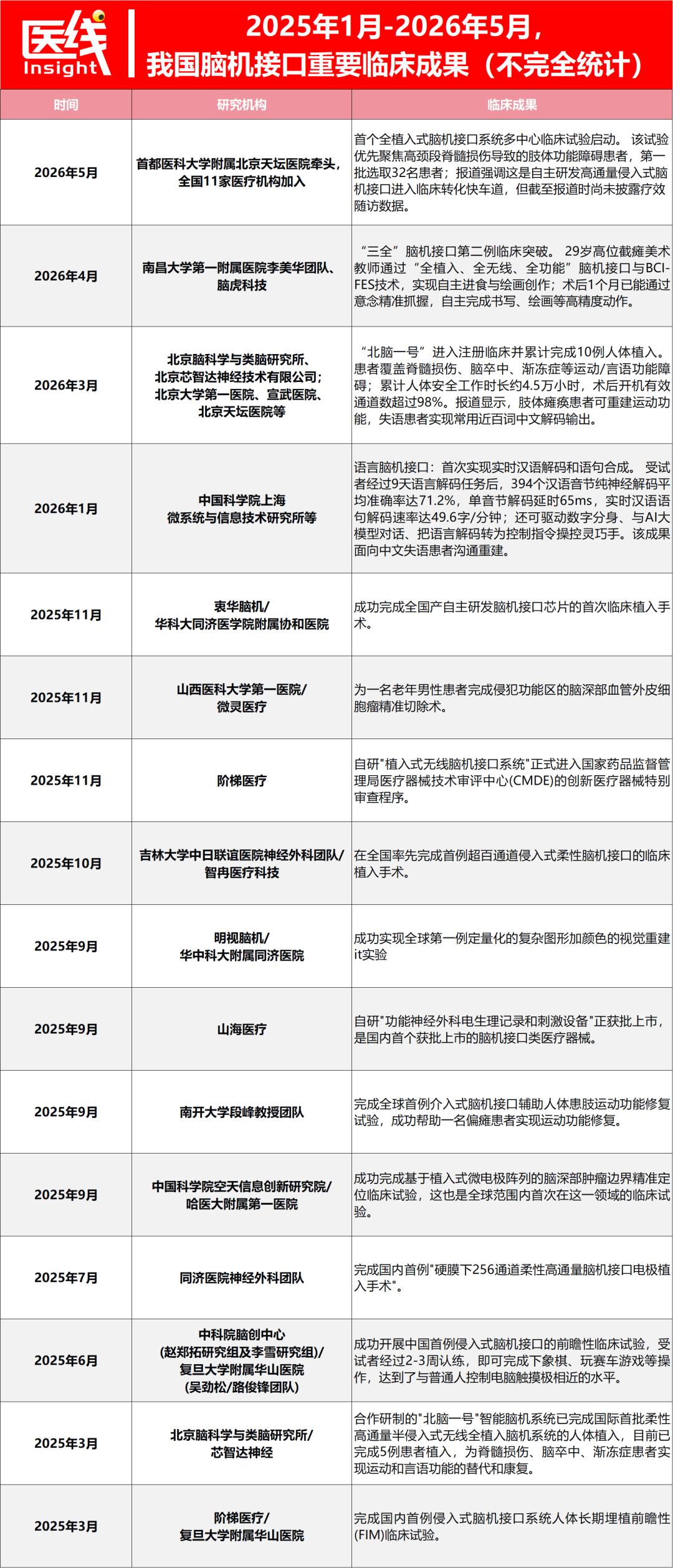
Data source: Public information from the Internet.
In March 2026, with the approval and listing of the first domestic invasive BCI medical device registration certificate by BrainCo, it further verified that the industrialization path of BCI from the laboratory concept to clinical application is accelerating, and it also marked that this cutting-edge field has officially entered a new stage of commercialization competition.
Coupled with the huge market prospect, the scarcity premium of technological breakthroughs, and the continuous policy support of BCI itself, investors have smelled the smell that the industrialization of this sector is on the verge of an explosion. Therefore, they have accelerated their investment pace, intensively invested in leading projects, and used real money to confirm this industry transformation and find more value points in the industry.
02 Who Gets the Money: Three Routes, Three Certainties
At the beginning of this year, a large-scale financing of 2 billion yuan by NeuroX Technologies instantly ignited the enthusiasm of the entire industry.
Conversely, why NeuroX Technologies? Why at this time and with such a large amount of "big money"?
Through multi-party research, Yixian Insight believes that the key lies in its precise grasp of the cyclical dividend of the BCI industry transformation.
First, after years of technological deep cultivation, NeuroX Technologies has long jumped out of the simple concept competition and has formed a mature technological barrier in the non-invasive BCI track. Its implementation ability has also been verified by the market.
Second, at a time when the industry focus is shifting towards clinical value and compliance implementation, NeuroX Technologies is simultaneously promoting two application scenarios: medical rehabilitation and consumer health. It not only has continuous clinical progress disclosures as a strong support but also has established a commercialization system that can be implemented and profitable, which breaks the inherent dilemma of the industry of "having technology but no application scenarios."
In addition, NeuroX Technologies is also at a critical stage of large-scale commercial implementation and global layout. The demand for investment in production, channels, and compliance system construction has increased sharply, so it also needs a large amount of funds to support the expansion of product pipelines, the development of overseas markets, and the continuous promotion of clinical trials, so as to consolidate its leading advantage during the industry transformation period.
Therefore, this large-scale financing is not only the capital's recognition of the comprehensive strength of the leading enterprise in the industry but also a typical microcosm of the industry's transformation from concept speculation to real industrial investment.
Taking this as an example, we can also summarize the collective portrait of the BCI enterprises that have obtained financing at present, that is, to find more certainties in industrialization.
For example, in the invasive BCI field, the certainty of investment mainly lies in completing clinical verification, proving the safety and effectiveness of the technology, and demonstrating the potential for large-scale commercialization.
Take Jieti Medical as an example. It attracted a total investment of 1.1 billion yuan in the past year. To a large extent, this is because it has made key breakthroughs in clinical verification. For example, it was the first in China to complete the clinical verification milestone of invasive BCI - not only successfully implanted flexible electrodes into the patient's brain and achieved long-term stable neural signal collection but also demonstrated clear therapeutic effects in key indications such as motor function reconstruction. This "from 0 to 1" clinical breakthrough directly addresses the most core safety concerns of the invasive approach.
In addition, in the semi-invasive BCI field, as a compromise solution between invasive and non-invasive, the certainty of investment mainly refers to the "data reading" ability and the progress of product approval.
Take BrainCo as an example. As one of the earliest enterprises in China to layout BCI, after completing its Series D+ financing in 2025, its valuation has reached 3.5 to 4 billion yuan, and it has officially submitted an application for listing on the Science and Technology Innovation Board.
The reason for its rapid progress is that its core advantage lies in achieving the best balance between signal quality and surgical trauma. In addition, in terms of market realization, it has also obtained the first domestic invasive BCI medical device registration certificate.
Finally, in the non-invasive BCI field, the certainty of investment is reflected in achieving large-scale, multi-scenario commercial implementation and having sustainable self-sufficiency ability.
Take NeuroX Technologies as an example. It currently has a complete product matrix covering three major fields: medical rehabilitation, education, and consumer health. It was the first in the world to achieve mass production of a high-precision BCI single product at the level of 100,000 units, forming a commercial closed-loop of "technology R & D - product mass production - market application" and building a clear competitive barrier and a sustainable profit path in the non-invasive BCI track.
In summary, the current investment targets in BCI have more certainties, and the "certainties" of the three technical routes have different focuses: for the invasive route, it is about clinical progress and long-term safety; for the semi-invasive route, it is about registration approval and data quality; and for the non-invasive route, it is about commercial realization and mass production ability.
03 Before the Hot Money Ebbs, Enterprises Need to Overcome Three Hurdles
Hot money will continue to pour in, but the industry will not automatically mature just because of the money.
The challenges facing BCI enterprises are still very specific.
The first hurdle is signal reception and processing.
Currently, the most advanced implantable device in the world - the N1 implant developed by Neuralink has 1,024 electrodes. However, the human brain has at least 86 billion neurons, and each neuron has thousands of connections. This is a huge network, and there is an order-of-magnitude gap between the existing electrode density and the scale of the brain's neural network, which is far from sufficient to support true whole-brain reading and writing and high-quality neural decoding.
The second hurdle is long-term safety.
The immune rejection reaction and electrode material degradation caused by long-term implantation are still core problems. Although the existing flexible electrodes can reduce acute tissue damage, they may still cause glial scar encapsulation after a few years, leading to signal quality attenuation or even complete failure.
At the same time, the power supply and heat dissipation problems of the implanted device have not been solved: the brain is extremely sensitive to temperature changes, and the efficiency loss of wireless energy transmission under the skull barrier may bring the risk of local overheating.
The third hurdle lies in the supply chain and large-scale preparation.
BCI is a complex systematic project that highly integrates multiple disciplines and fields. It involves a large number of key components and core raw materials such as high-performance electrode materials, biocompatible packaging substrates, ultra-low noise signal acquisition components, and flexible substrates.
Therefore, if it cannot make breakthroughs in large-scale preparation and cost control, it will be difficult to achieve the real leap of BCI technology from the laboratory to industrialization.
Therefore, for current BCI enterprises, in addition to finding as many industrial certainties as possible, whether they can solve more practical industry problems is also the key to whether they can stand out during the industry differentiation and bubble stage in the future.
In addition, it is also crucial to maintain calmness in the current investment boom.
Many industry insiders also admit that although BCI is a large-scale track with long-term value, the excessive enthusiasm of capital may also make the industry more chaotic, causing some enterprises to deviate from their original development rhythm and R & D direction, and ultimately overdraw the future of this technology.
Therefore, BCI enterprises still need to maintain strategic focus and focus on their own development.
On the one hand, they need to be stable internally and move forward steadily in clinical research, technological iteration, and industrialization; on the other hand, they should also strive to obtain core resources as much as possible to accelerate the positive development of the enterprise.
Only in this way can they build a real moat in the fluctuations of the technology cycle and the ups and downs of capital sentiment and transform short-term leading advantages into long-term structural barriers.
This is not only the core issue for enterprises but also the cognitive upgrade that current investors must complete.
Appendix: The Full List of Chinese BCI Enterprises' Financing from January to May 2026
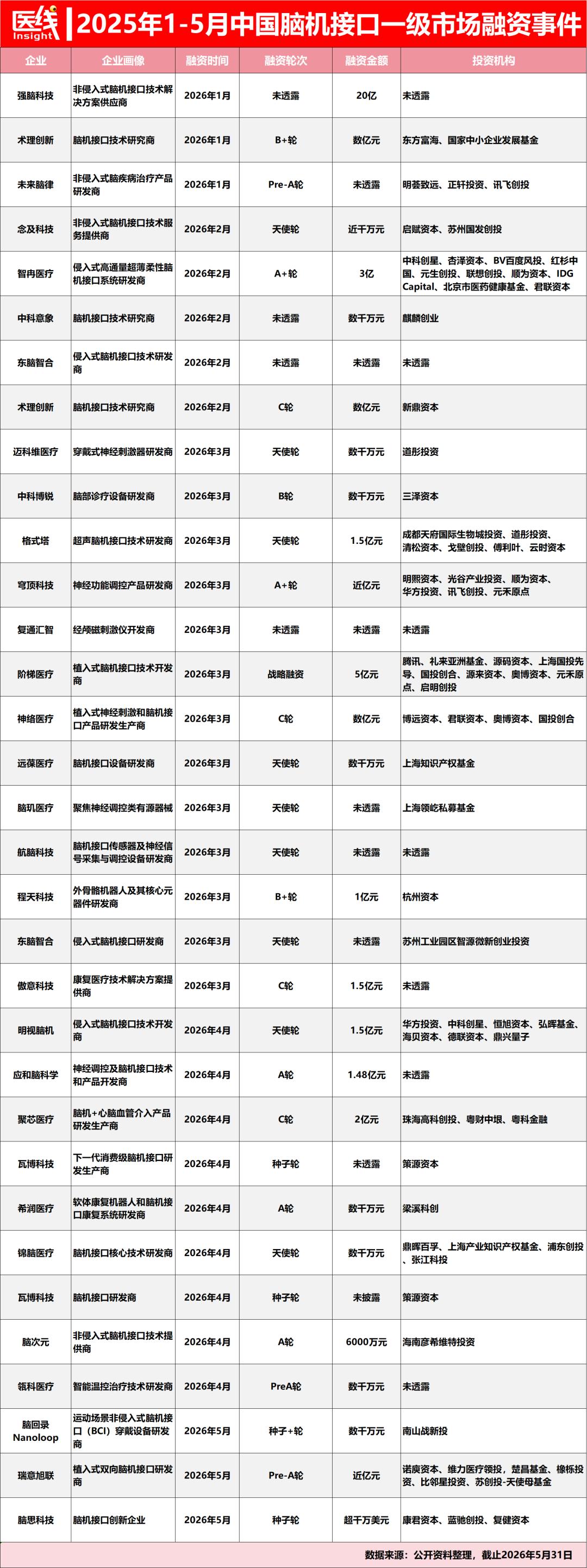
This article is from the WeChat official account "Yixian Insight". Author: Ke Lan. Republished by 36Kr with permission.