A Crazy Football Night Worth 2.4 Billion Euros: No Losers in the UEFA Champions League Final
In the showdown between Paris Saint - Germain and Arsenal, the biggest winner is not the champion, but the UEFA Champions League.
Early on May 31st, Beijing time, at the Puskás Aréna in Budapest. After 120 minutes of intense battle, the penalty shoot - out decided the outcome. The victorious Paris Saint - Germain players ran wild in the night breeze of the early Hungarian summer, their joy evident. The dejected Arsenal players collapsed on the pitch, their faces filled with unwillingness. This is all that television broadcasts can tell you.
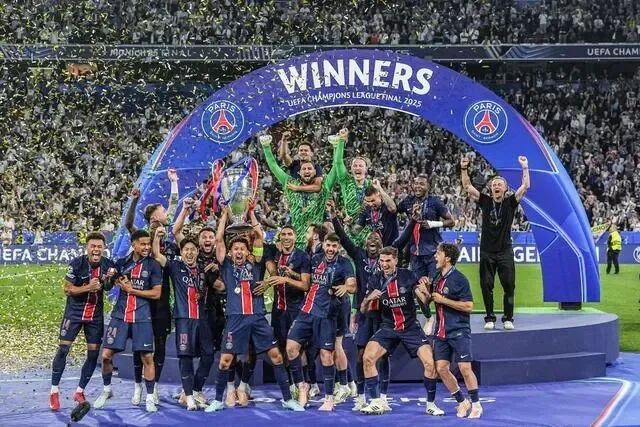
Now, turn off the TV and open Excel.
In this spreadsheet jointly compiled by Transfermarkt and Forbes, the score column of this final is empty - because it simply doesn't matter. What really deserves attention is another column of numbers: 2.45 billion euros. This is the total value of the first - team players of Paris Saint - Germain and Arsenal. In the history of professional football, there has never been a game where so many expensive assets have stepped onto the same pitch at the same time.
A 2.4 - billion - euro showdown
Let's shift our focus from the pitch to these numbers themselves.
According to the latest data from Transfermarkt in March 2026, the total value of Paris Saint - Germain's first - team is 1.21 billion euros, and that of Arsenal is 1.24 billion euros. What does 2.45 billion euros mean? It exceeds Estonia's annual GDP, can buy three and a half times the global box - office of "Avatar", or acquire the entire global business of Domino's Pizza.
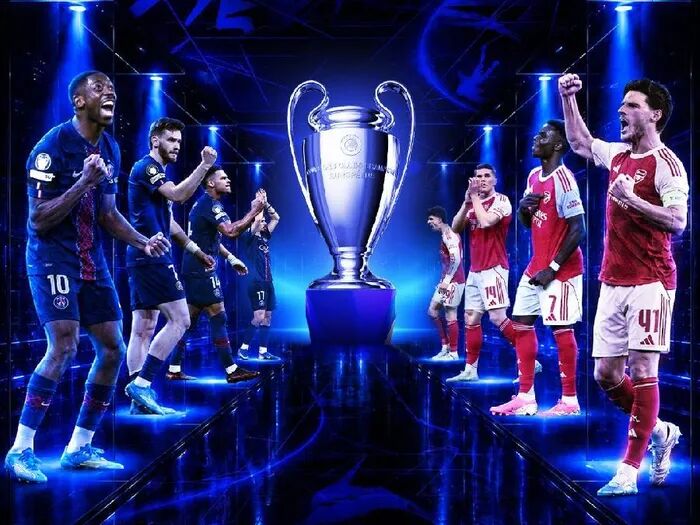
Looking closely, the value structures of the two teams present two completely different aesthetics.
In Paris, the star map has been redrawn in the post - Mbappé era. The two midfielders with the highest value in the team are Vitinha and João Neves, each worth 110 million euros. Right behind them is an attacking trio - Ousmane Dembélé, Khvicha Kvaratskhelia, and Randal Kolo Muani, each worth 90 million euros. Achraf Hakimi is worth 80 million, Nuno Mendes 75 million, and Pablo Sarabia and Balde 70 million each. There is no absolute superstar worth 200 million in this Paris team, but there are two core players worth 100 million and three worth 90 million. Luis Enrique has redistributed the tactical vacuum left by Mbappé's departure into a distributed attacking system.
Arsenal follows a different logic. Bukayo Saka and Declan Rice are tied for the highest value in the team, each worth 120 million euros. William Saliba is worth 90 million, Martín Zubimendi 80 million, Gabriel Magalhães 75 million, Jurrien Timber 70 million. Martin Ødegaard is worth 65 million, and Dominik Szoboszlai and Michael Olise are each worth 60 million. There is no player in this team with a value exceeding 200 million, but the value curve is amazingly smooth - most of the 17 players on the field are worth over 50 million euros, and only the young players Skelly and Mosquera, who were called up in an emergency, have values below this base (but they will soon exceed 50 million euros).
The club valuations are also astonishing. According to the Forbes 2026 list, Paris Saint - Germain is valued at 5.9 billion euros, ranking fourth globally, and Arsenal is valued at 5.4 billion, ranking seventh. The total is 11.3 billion euros - this is the market value of Spotify or the entire La Liga listed on the New York Stock Exchange.
Two games of capital
However, what is more interesting than the numbers are the two sets of capital logics behind them.
Paris Saint - Germain represents the "unlimited firepower" of sovereign funds. Since Qatar Sports Investments took over 14 years ago, the net investment has exceeded 1.8 billion euros. Their financial model does not pursue annual profit and loss - the Champions League broadcast rights, Ligue 1 championship bonuses, and jersey sales combined still cannot cover the payroll and transfer fee amortization. But that doesn't matter. What matters is that Paris is a sports symbol of geopolitics and the most eye - catching billboard in Qatar's national brand strategy. So when Mbappé left, they didn't scale back. Instead, they continued to spend money on Kvaratskhelia and Kolo Muani in the summer of 2025. Club president Nasser once said a sentence at a transfer press conference that is still being chewed over by UEFA's financial fair - play officials: "We are buying time."
Arsenal takes a different path. Owner Stan Kroenke, an American real - estate and sports tycoon with a net worth of $16.2 billion according to Forbes, doesn't burn cash; he burns models. Arsenal's transfer department operates more like a quantitative fund: a 50 - person data analysis team, a self - developed player valuation algorithm, and an ironclad rule - any transfer over 80 million euros must go through three rounds of stress tests. What's the result? In the past five seasons, Arsenal's net transfer expenditure ranks only fourth in the Premier League, but the appreciation rate of player assets ranks first. Ødegaard was bought for 35 million and is now worth 65 million; Saliba was bought for 30 million and is now worth 90 million; Zubimendi was bought for 50 million and is now worth 80 million. This is no longer just a football club; it's a portfolio of growth stocks with an amazing price - to - earnings ratio.
The two Spaniards on the coaching bench are the operators of these two capital logics. Luis Enrique, 56 years old, with an annual salary of 24 million, led Paris to defend the Ligue 1 title three rounds early this season. There is a saying hanging in his dressing room: "Ball possession is our private property." Mikel Arteta, 44 years old, with an annual salary of 17 million, led Arsenal to win the Premier League title on the last round this season. There are no slogans on his training ground, but each player's data is uploaded in real - time to a system called MatchIntel. Early the next morning, Arteta will have a 37 - page analysis report on his iPad.
Two capital philosophies, one common result: both have reached the battlefield at the top of Europe.
The three biggest winners
So the question is: Who won this final?
If you only focus on the score, you can only find one winner. But if you switch to the business perspective, you'll find that this night produced three winners. Paris won the legitimacy of its dynasty - after seven consecutive Ligue 1 championships, only the Champions League trophy can complete the investment logic of sovereign capital. Arsenal won a brand leap - from a valuation of 2 billion euros in 2019 to 5.4 billion today, the Champions League final is the coming - of - age ceremony for this unicorn.
But the real biggest winner is neither Paris nor Arsenal.
It's the UEFA Champions League itself.
Two weeks before this final, UEFA quietly announced a deal that shocked the sports marketing industry: Alibaba Group reached a new multi - billion - euro global top - tier partnership agreement with the UEFA Champions League. This is the largest single sponsorship contract in the history of the Champions League. According to the agreement, Alibaba Cloud will become the official cloud computing and AI partner of the Champions League, and Alipay and AliExpress will take over the exclusive e - commerce and payment rights of the Champions League in the Asian market.
Why did Alibaba choose to make a move at this time? Because they saw the signal represented by this 2.4 - billion - euro showdown: the Champions League is entering an unprecedented era of capital intensity. The global fan base has exceeded 2.2 billion, with nearly half of the growth coming from Asia. In Southeast Asia, China, and the Middle East, the viewership has increased by double - digits for five consecutive years. For Alibaba, which is competing head - on with Amazon and TikTok Shop in the global market, the Champions League is one of the few super - media that can cover Europe, the Middle East, Asia, and Africa at once. And this final at the end of May every year is the "Super Bowl moment" of this medium.
More importantly, this showdown between Paris and Arsenal will trigger a new round of arms race.
This is the most hidden and solid business logic of the Champions League: sky - high showdowns will drive up the price of broadcast rights, the price of broadcast rights will attract more capital into clubs, and more capital will create even more sky - high showdowns. Then sponsors will follow. Then the broadcast rights price will rise again. This is a self - reinforcing flywheel. When the boards of Barcelona, Bayern Munich, Manchester City, and Real Madrid see Paris and Arsenal spending 2.4 billion euros in Budapest, they won't sigh; they'll immediately pick up the phone and call their respective transfer directors. The arms race never ends; it only has short intervals - like the three weeks before the summer transfer window opens.
The UEFA Champions League sits at the center of this flywheel, collecting a "platform tax" on every capital flow. Alibaba's 6 billion is just the latest one. Next, there will be jersey sponsors, technology partners, regional betting partners, digital collectible platforms - every category is queuing up to enter. The commercial department of the Champions League is already preparing the sponsorship promotion materials for the next season, and the large - format photo on the cover is likely to be the night in Budapest.
Football is no longer just a game of 22 people chasing a ball. It's a super - financial product with clubs as the shell, players as assets, the emotions of global fans as the pricing anchor, and broadcast rights and sponsorship contracts as the monetization channels. In this product system, clubs burn money, stars make money, and fans pay - and the UEFA Champions League owns the copyright of the whole story.
After the lights at the Puskás Aréna go out, the real drama is just beginning. The summer transfer window will open in three weeks, and there will be more transfers worth over 100 million, more complex financial tools, and more sophisticated contract structures. There are no losers in Budapest. Because in the football world dominated by capital, the final whistle is never the end.
It's just the starting gun for the next round of bets.
This article is from the WeChat official account "Marketing Arena", author: Fei Renxing Liu. Republished by 36Kr with permission.