Universities are "flocking" to county towns
Universities are moving into county towns.
Tianjin University, University of Electronic Science and Technology of China, Beijing University of Posts and Telecommunications... These well - known names are no longer exclusive to first - and second - tier cities.
Public data shows that in recent years, at least 20 "Double First - Class" universities have established campuses or colleges in county towns.
According to SoftScience data, since 2025, about 18 counties and county - level cities have established or are in the process of establishing their first local universities, achieving a "zero breakthrough" in local higher education.
Public data shows that the sinking market, that is, cities below the third - tier, county towns, and rural areas, is home to 70% of China's population and accounts for 60% of the total retail sales of social consumer goods. It is an important node connecting urban and rural areas and facilitating circulation.
As the county - level economy becomes a national strategy and the "Government Work Report" clearly proposes to stimulate the vitality of the sinking market, a "two - way pursuit" between universities and county towns is quietly taking place.
Why are universities willing to "go down"? Can county towns really embrace this "huge fortune"? Can county - level universities truly become the engine of the county's knowledge economy?
From "Double First - Class" universities to vocational colleges, universities are flocking to county towns
Recently, Tianjin University released important news. The Sino - foreign cooperative education institution, Tianjin University Hainan International College, was officially unveiled, offering undergraduate and master's education programs.
Among them, the Tianjin University Reading University Henley International College (hereinafter referred to as "Tianjin University Henley College"), jointly established by the School of Management and Economics of Tianjin University and the Henley Business School of the University of Reading in the UK, is the first project to be implemented. It plans to recruit undergraduate students and master's programs nationwide in 2026.

Campus real - life view/Photo from the official WeChat account of the School of Management and Economics of Tianjin University
According to the official introduction, undergraduate students will be registered with dual student status at Tianjin University and the University of Reading in the UK upon enrollment. The teaching concept and original textbooks of the Henley Business School of the University of Reading are introduced, and English is the main language of instruction.
Students will complete their studies in Hainan within four years. Those who meet the requirements upon graduation will receive a bachelor's degree certificate from Tianjin University and the corresponding bachelor's degree certificate from the University of Reading, which are exactly the same as those issued by the main campuses of Tianjin University and the University of Reading.
Tianjin University is one of the first batch of key universities under the direct jurisdiction of the Ministry of Education and was included in the "211 Project" and "985 Project". The University of Reading was founded in 1865 and ranks among the top in the world in fields such as agricultural and forestry sciences, environmental sciences, and finance. Its Henley Business School is one of the less than 1% of business schools globally that have passed all three major international accreditations: AACSB, EQUIS, and AMBA.
However, this "ace combination" has chosen Lingshui, Hainan - an autonomous county with a permanent population of less than 400,000 - as the location for its campus.
Even more surprisingly, before Tianjin University, the Hainan Lingshui Li'an International Education Innovation Pilot Zone in this small county of Lingshui had already introduced well - known domestic and foreign universities such as the University of Electronic Science and Technology of China, Beijing University of Posts and Telecommunications, Communication University of China, Northeast Forestry University, and Queen Mary University of London.
The official website of the Hainan Lingshui Li'an International Education Innovation Pilot Zone shows that more than 20 universities have signed contracts to settle in. Among them, the domestic universities are those included in the "World - Class Universities" construction program or those with "World - Class Disciplines" construction disciplines, as well as overseas universities ranked among the top 100 globally or with disciplines ranked among the top globally.
Beyond Lingshui, in recent years, more and more county towns have established universities, including but not limited to introducing branch campuses of universities and independently establishing new universities.
In April this year, according to the news from "Feixi Release", the Anhui University Future College (new campus) project has made new progress. The pouring of the last batch of concrete for the C2 - E teaching and research building has been completed, which means that the project has officially entered the construction stage of the above - ground main structure.
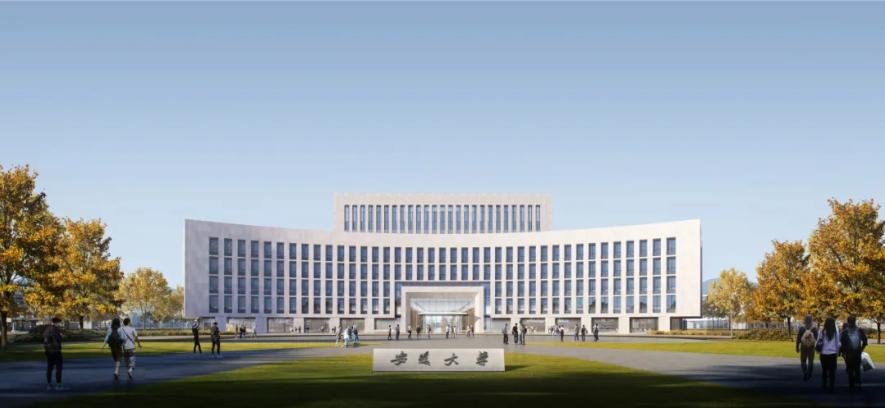
Rendering of the college/Photo from the official WeChat account of Anhui University
It is reported that the Anhui University Future College (new campus) project is located on the west side of Ziyun Lake in Feixi County, with a planned land area of about 1,100 mu and a total investment of about 5.5 billion yuan. According to the plan, it is expected to be completed and put into use in 2027. After completion, the college will have a student population of nearly 20,000 and will become the first "211 Project" university in Feixi County.
Meanwhile, another university project in Feixi County - the new campus of Anhui Medical University - is also under construction. Its planned area covers about 2,001 mu, and the estimated project investment is about 6.3 billion yuan.
New campus/Photo from the official website of Anhui Medical University
"The first - phase project has basically ended, and the second - phase project officially started last year. The first - batch projects of the second phase, two student apartment buildings, are expected to be completed in August this year, which will add a capacity for 1,800 more students to live on campus." Zhang Ling, the deputy director of the Logistics Support Department of Anhui Medical University, introduced. He also said that the science and innovation center in the second - phase project is in the preliminary design stage, and efforts will be made to start construction by the end of July this year, with an estimated construction period of two years.
It is worth noting that Feixi, relying on the radiation effect of the provincial capital Hefei, belongs to the "overflow - type" county - level school - running model from big cities; while Lingshui mentioned earlier is the "enclave - type" school - running model.
The different paths reflect the diversified exploration of county - level school - running.
Previously, "Double First - Class" universities such as Nanjing University of Science and Technology and Fuzhou University have also established campuses in county towns. According to a report by SoftScience in April this year, at least 12 "Double First - Class" universities have gone to county towns to build new campuses.
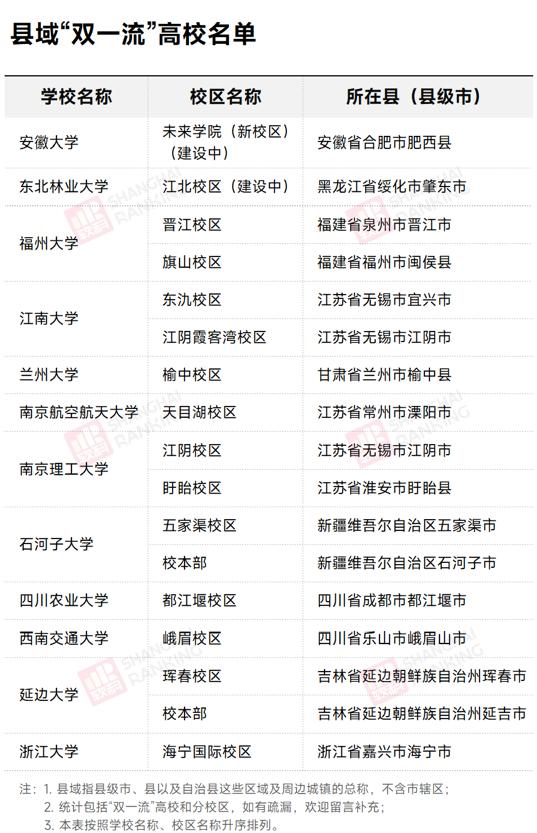
In addition, a large number of vocational colleges have established branch campuses in county towns, making up for the lack of higher education in county towns.
Recently, there is news that the Dongshan Campus of Zhangzhou Polytechnic will be officially put into use in September this year, achieving a "zero breakthrough" in higher education in Dongshan County.
Zhangzhou Polytechnic is a full - time public vocational college. It started to build a new campus in Dongshan County, Zhangzhou City, Fujian Province in 2023. According to public data, the Dongshan Campus covers a total area of 400 mu, with the first - phase project covering about 200 mu. At present, the first - phase construction of the project is coming to an end. The project has completed an investment of about 324 million yuan, accounting for 86% of the total investment.
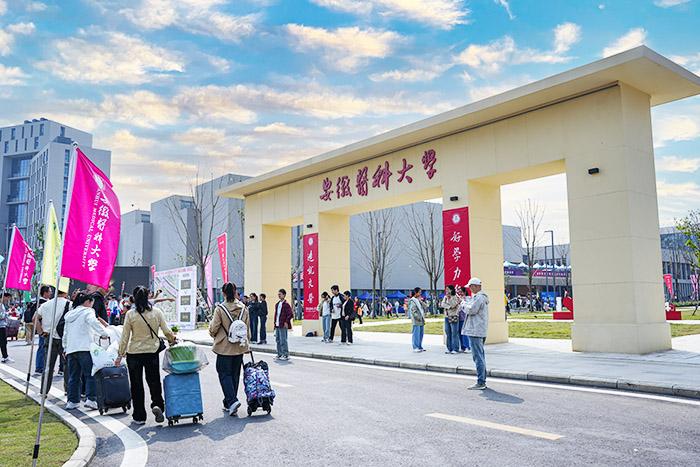
Previously, in November 2025, the Yiyang Campus of Shangrao Normal University held an unveiling ceremony and was officially put into use. This means that Yiyang County has welcomed a university at the undergraduate level for the first time. The campus is located on the north bank of the Ge River in Yiyang, covering an area of 109 mu and with a building area of nearly 50,000 square meters.
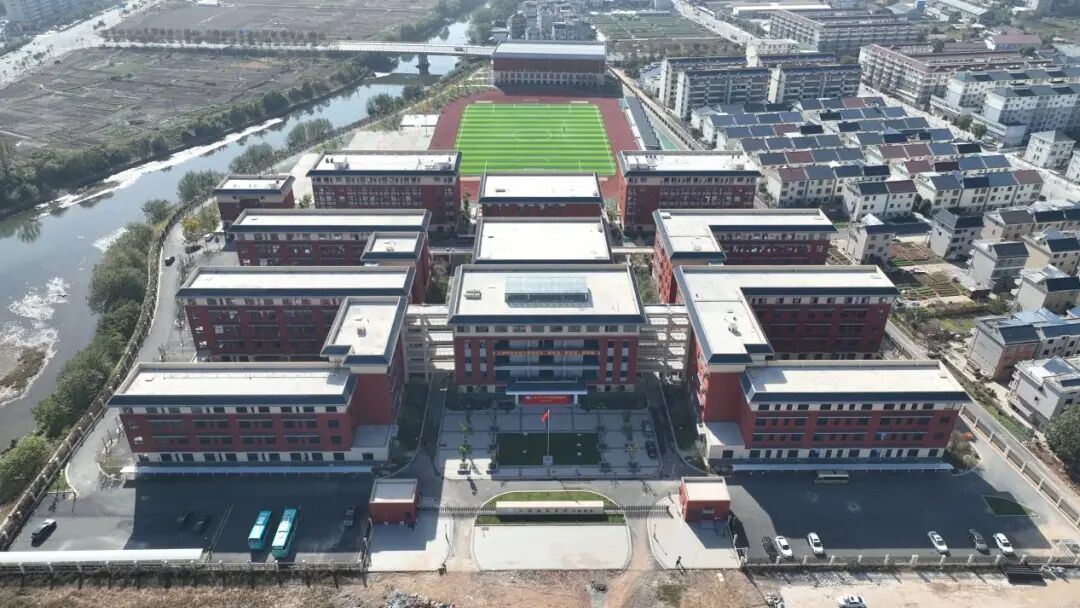
Campus real - life view/Photo from the official website of the Yiyang Campus of Shangrao Normal University
According to SoftScience statistics, since 2025, nearly 20 counties and county - level cities have established or are building their first local universities.
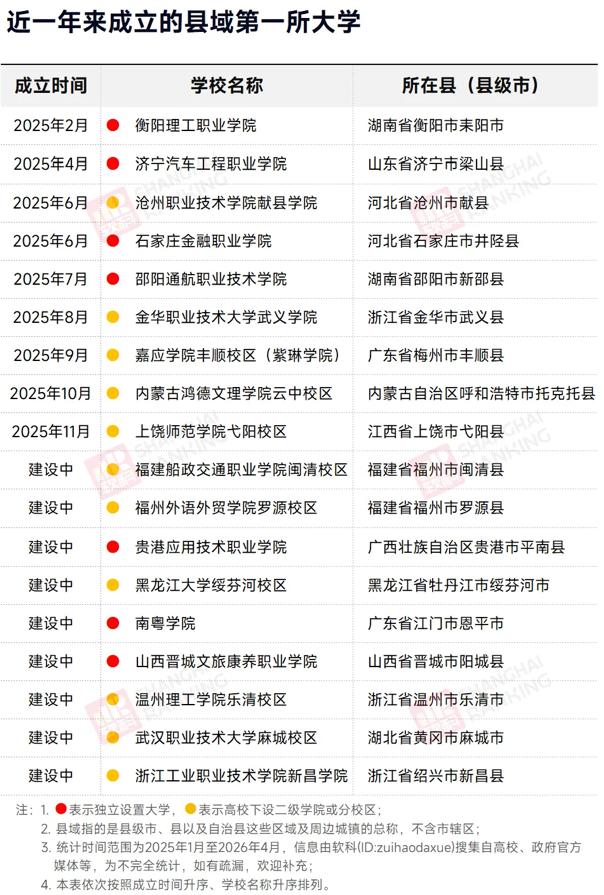
Policy dividends, cost advantages, and industrial needs: A win - win situation for all parties
The "downward movement" of universities cannot be separated from strong policy support.
The "Outline for the Construction of an Education - Powerful Country (2024 - 2035)" clearly proposes to promote the sinking of higher vocational education resources to cities and counties in areas with conditions. It encourages enterprises to run or participate in running vocational education and promotes in - depth cooperation between schools and enterprises in school - running, education, and employment.
Even earlier, in July 2024, the "Five - Year Action Plan for the In - Depth Implementation of the People - Oriented New - Type Urbanization Strategy" issued by the State Council mentioned promoting the sinking of high - quality higher vocational education resources to secondary vocational schools in county areas and carrying out integrated school - running through cooperation.
For county towns, this is a cost - effective "talent account" and "economic account".
The "China County - Level Economy Yearbook" once pointed out that a full - time university can directly create 3,000 to 5,000 local jobs and indirectly drive more than 10,000 jobs in the commercial service industry. Some surveys show that after the establishment of vocational colleges in some county areas, the housing prices in the surrounding areas have increased significantly.
The deeper dividend lies in industrial upgrading. Take Anxi, Fujian as an example. As the top tea - producing county in the country, 80% of the population is engaged in the tea - related industry. To solve the "talent bottleneck" in the tea industry, in 2011, the Anxi County Government signed an agreement with Fujian Agriculture and Forestry University to jointly establish the Anxi Tea College. At that time, the county government allocated 1,200 mu of land, provided an initial start - up fund of 30 million yuan, and introduced a reward system for donating to education.
Relying on this talent engine and combined with the local profound tea industry foundation, after years of development, Anxi has transformed from a poor county into a "top 100 county in the country". In 2024, its GDP increased by 6%, and it first entered the top 50 in the national comprehensive strength ranking. The brand value of Anxi Tieguanyin is as high as 144.3 billion yuan, ranking first in the brand value of geographical indication brands in the tea category in the country for ten consecutive years.
The same logic also applies to Xinchang County, Zhejiang. In recent years, by introducing universities, the local area hopes to fill the gap in higher education and build an innovation ecosystem with in - depth integration of "production, learning, research, and application".
The Xinchang College of Zhejiang Industry Polytechnic College is the first university to be built in Xinchang County, Zhejiang, and is also one of the "Thousand - Project and Trillion - Yuan" projects in Zhejiang Province. The project covers an area of nearly 600 mu (including 476 mu of construction land), with a total investment of 2.48 billion yuan. It is planned to be officially put into use in September 2026 and can accommodate 6,000 teachers and students after completion.
Its professional settings are precisely tailored to the county's pillar industries such as high - end manufacturing and digital economy. It offers teaching majors such as UAV application technology, digital media technology, industrial robot technology, and mechatronics technology, which are highly compatible with the local economy, and will provide precise talent support for the development of key industries in the county.
In addition, Xinchang County has also introduced the Xinchang College of Zhejiang Pharmaceutical University, which also carries the expectation of collaborative development between the school and the local area.
The total land area of this project is about 184.5 mu, and the total investment is about 900 million yuan. After completion, the college will have no less than 3,300 full - time students, including no less than 300 full - time undergraduates, filling the gap in local higher - level undergraduate education. The majors mainly cover disciplines such as pharmacy, pharmaceutical preparations, pharmaceutical engineering, and food engineering technology, focusing on the field of life and health, and will form a development synergy with the local pharmaceutical industry. It will become an "important base for talent training in the field of pharmacy in the Yangtze River Delta".
Chu Zhaohui, a researcher at the Chinese Academy of Educational Sciences, analyzed for Red Star Education Media · Oak Laboratory that China's higher education has entered the popularization stage. Talents do not necessarily have to stay in big cities. They can go to rural areas and any place in society. "We should not be overly worried about whether county towns need or can retain so many talents. Instead, we should encourage all kinds of talents to go to the positions where they are needed."
For universities, it is a practical "space account" and "cost account". The land prices in first - tier cities are high, and the space is saturated, while county towns can provide land at extremely low cost or even for free.
In July 2025, Fuzhou University of International Studies and Trade obtained 1,040 mu of educational land in Luoyuan County for 12