The global energy storage showdown: Who will have the last laugh?
In 2026, the energy storage track has become even more prosperous.
Recently, many mainstream media reported that China's energy storage industry is developing strongly, especially the exports have witnessed explosive growth, becoming a new chapter in foreign trade.
Correspondingly, the top 10 list of energy storage battery shipments is now entirely occupied by Chinese enterprises.
With the complex international situation and strong overseas demand, Chinese enterprises are undoubtedly the biggest winners. However, they still can't rest easy. On one hand, South Korean enterprises are constantly increasing their investment, and on the other hand, more and more domestic players are entering the market to grab a share of the pie.
So, where will the energy storage track go in the future?
The situation of attack and defense has long been reversed
Although photoelectricity, wind power, etc. are clean energy sources, they are also fluctuating power sources.
Zou Ji, the CEO and President of the China Region of the Energy Foundation, said: "When the proportion of power generation from fluctuating power sources in the entire power grid exceeds 20%, the pressure on the power grid cannot be solved by building a few transmission lines. The pressure on the power grid is at the physical level. The traditional grid stability mechanism that relies on rotational inertia is ineffective for fluctuating power sources such as wind and solar. New grid stability measures must be taken to hedge the problems brought by fluctuating power sources."
In a nutshell, in the process of new energy replacing traditional energy, energy storage is a must.
Looking back, foreign enterprises played the role of pioneers for a long time. Especially South Korean enterprises such as LG Energy Solution and Samsung SDI were once the well - deserved energy storage overlords.
However, with the increasing emphasis on the safety of energy storage power stations and the continuous iteration of Chinese enterprises' battery technology, Chinese enterprises have gone from following to catching up and then overtaking, and finally achieved comprehensive suppression.
Public data shows that in 2020, South Korea ranked first in the global energy storage battery shipments with 11GWh, accounting for as high as 55% of the global total, while China, which ranked second, only accounted for 17.5%. By the first quarter of 2026, Chinese enterprises such as CATL and Hithium Energy Storage had fully occupied the top 10 list of global energy storage battery shipments, and the sum of the proportions of these ten Chinese enterprises alone reached as high as 85.3%.
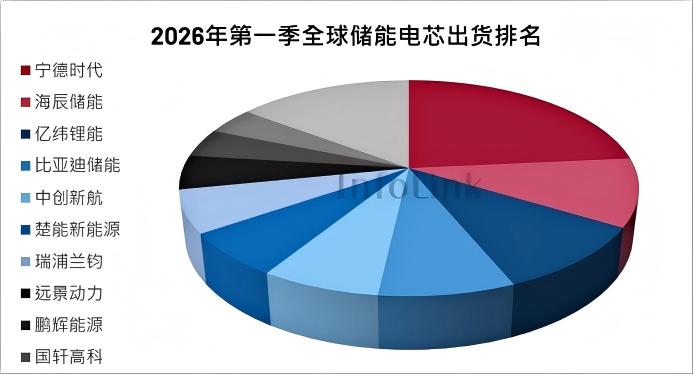
Image source: InfoLink
In this way, Chinese enterprises have changed from disruptors to controllers.
Against this background, energy storage has become a new calling card for China's exports. CCTV 2's "World Finance" reported that a tally company in Shenzhen, Guangdong, revealed that in the first two weeks of May 2026, the export volume of energy storage products was more than the total of the previous four months, and the products were mainly exported to ASEAN, Europe, and South America.
It is worth mentioning that in order to have a smoother overseas expansion, energy storage enterprises have chosen to take root in overseas markets. Among them, Hithium Energy Storage is currently the only Chinese enterprise with energy storage system production capacity in the United States.
However, the game between Chinese and foreign energy storage enterprises is not over.
LG Energy Solution, Samsung SDI, and SK On have all increased their investment in energy storage. They have even converted some power battery production lines into energy storage battery production lines, and their active expansion is obvious to the naked eye.
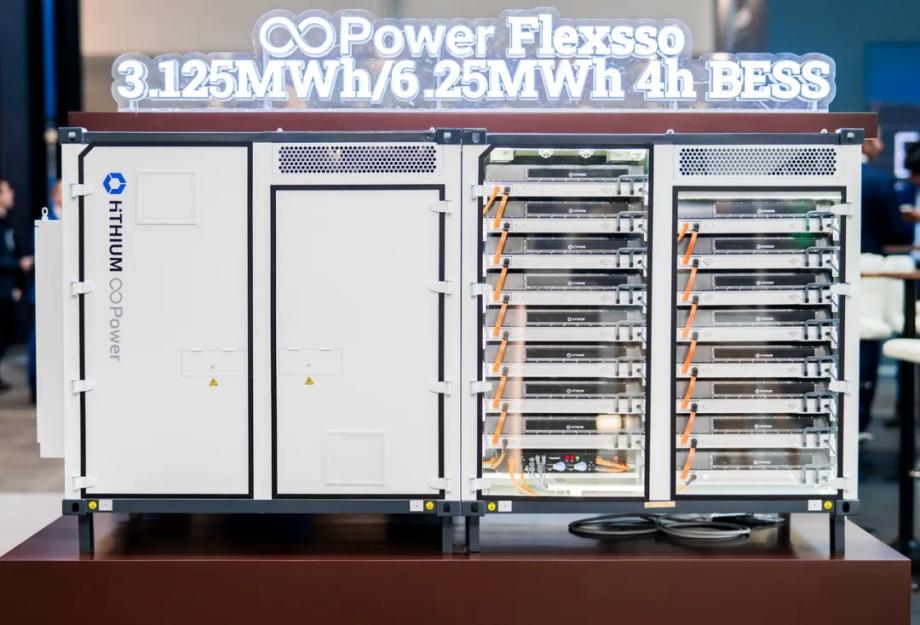
Image source: Hithium Energy Storage
In addition, Tesla is also a force that cannot be ignored.
In 2025, Tesla's energy storage shipments were 46.7GWh, a year - on - year increase of 49%; the operating income of energy storage was 1.277 billion US dollars, a year - on - year increase of 27%.
This is closely related to the commissioning of Tesla's Shanghai energy storage super factory.
Zhu Xiaotong, the senior vice - president of Tesla, said: "This factory not only represents another important move in Tesla's global energy storage layout, but also proves its key role in the global energy transformation trend."
AIDC pulls out the second growth curve for energy storage
It should be noted that in addition to established enterprises, more and more players who are envious of the high prosperity of the energy storage track are entering the market across industries.
For example, the century - old Ford announced an investment of 2 billion US dollars to transform its existing factories to produce battery energy storage system modules and 20 - foot DC containerized energy storage systems.
Another example is that GCL Technology, the leading enterprise in photovoltaic silicon materials, announced a strategic transformation, creating a product matrix with "silicon, lithium, and carbon" as the core, and officially included energy storage in its core growth engine.
Data from Morgan Stanley shows that since the end of 2025, the minimum internal rate of return requirements for energy storage projects by central and state - owned enterprises have been lowered from 6.5% to 5%. Central and state - owned enterprises are setting off a wave of energy storage construction.
As can be seen from the above, the competition in the energy storage track is intensifying.
What's more troublesome is that there are new fluctuations in the lithium carbonate market, and the price once exceeded 200,000 yuan per ton, which means that in less than a year, the price of lithium carbonate has increased by more than 200%.
Li Liangbin, the chairman of Ganfeng Lithium, said: "If the demand growth rate in 2026 exceeds 30%, or even reaches 40%, the supply cannot be balanced in the short term, and the price may exceed 150,000 yuan per ton or even 200,000 yuan per ton."
Although the price has dropped somewhat at present, it still hovers at a high level.
With the high price of lithium carbonate, the cost of energy storage batteries will also rise, so some projects in the downstream of the industrial chain have chosen to suspend to avoid being dragged down by price transmission.
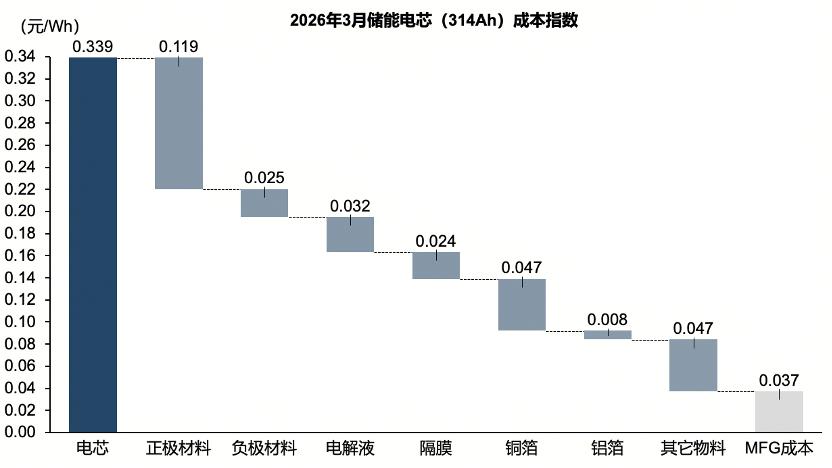
Image source: Mysteel New Energy
The "New Energy Industrialist" said: "When the capital market goes into a frenzy, traders hoard goods crazily, and the bulls and bears engage in a war of words, it is actually the downstream of the industrial chain that first feels the change in the situation."
Fortunately, there are solutions.
The AI era is accelerating the reconstruction of the technical paradigm and competition logic of the energy storage industry, especially reflected in the explosive growth of the emerging application scenario of AI data centers (AIDC).
This is because AI data centers have characteristics such as high pulse, strong fluctuation, and large load. Traditional UPS backup power supplies cannot meet the demand, and energy storage needs to be introduced to respond.
Data from AJ Securities shows that the power demand of a large - scale AIDC is generally over 100MW, and every 100MW data center is expected to drive a storage demand of 450MWh - 800MWh.
More importantly, the underlying logic of AIDC energy storage is different from that of traditional energy storage.
Traditional energy storage pursues cost - effectiveness and is particularly sensitive to price, while AIDC energy storage pursues high reliability and is particularly sensitive to stability.
An industry insider told Zinc Scale: "Whether it is Meta, Google, Microsoft, Amazon overseas, or Baidu, Tencent, ByteDance, Alibaba in China, they all favor AI data centers. The investment amount is astronomical. How much does the supporting energy storage battery cost? If a power outage causes work stoppage or equipment damage, the loss will be huge."
The "2025 China AIDC Energy Storage Industry Development Blue Book" shows that the global data center energy storage market is experiencing explosive growth. It is estimated that by 2030, the lithium - ion battery shipments for data center energy storage will exceed 300GWh, which is 20 times that of 2025.
Against this background, energy storage can pass on the price increase pressure downstream and significantly digest the cost of price increase.
In addition, the industry also has sodium - ion batteries as a Plan B. Under the same energy density, the volume of sodium - ion batteries is larger than that of lithium - ion batteries, which limits their application scenarios. However, energy storage has low requirements for volume, making it the most ideal application scenario.
Moreover, sodium - ion batteries have been continuously iterating in recent years and have met the conditions for large - scale industrialization, which is sufficient to replace lithium - ion batteries.
Wang Pengcheng, the founder and president of Hithium Energy Storage, said: "Sodium - ion batteries have a great advantage. Their production lines are compatible with those of lithium - ion batteries. Although there are some differences in the material systems, the basic large - scale systems are compatible. Therefore, it is not a simple replacement relationship but a complementary one."
In addition, air energy storage is also rising. Although its current proportion is not high, its momentum cannot be ignored.
Abroad, Google plans to deploy an iron - air battery energy storage system. With an investment of 1 billion US dollars, a super - long discharge capacity of 100 hours, and a total capacity of 30 million kWh, it has become the world's largest battery energy storage project.
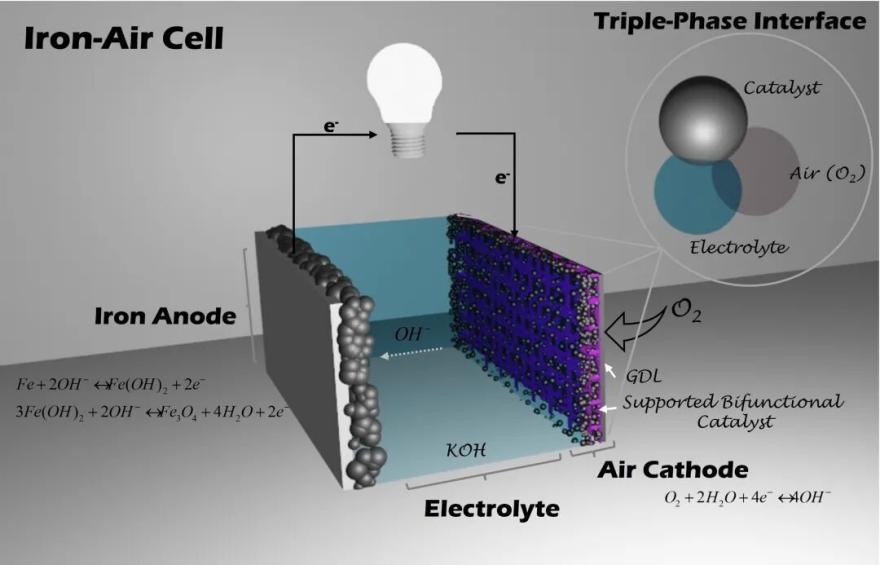
Structural diagram of iron - air battery energy storage
In China, the world's largest - scale compressed air energy storage project has been put into operation in Huai'an, Jiangsu Province. Its annual power generation will reach 792 million kWh, which can provide electricity for 600,000 households for a year.
All in all, as an emerging blue - ocean market, the future growth of energy storage is clearly visible, but the challenges cannot be ignored. On one hand, South Korean enterprises have not admitted defeat, and the end of the competition has not yet come. On the other hand, cross - border players are competing, the price of upstream lithium carbonate is rising, and air energy storage is disrupting the market. The competition pressure in the industry is obvious.
The only thing that is certain is that the strong will become stronger in the energy storage track.
This article is from the WeChat public account "Zinc Scale" (ID: znkedu). The author is Chen Dengxin, and the editor is Li Ji. It is published by 36Kr with authorization.