MSI's new handheld makes an appearance at COMPUTEX Taipei, but AI handhelds are still a false proposition for now
On June 2nd, the Taipei Computer Show officially kicked off. At the exhibition, industry titans like Jensen Huang took turns on stage to discuss the future of the computing industry. A variety of hardware products were on display, with chips and PC brands still taking center stage. The common denominator, of course, was AI. Almost every exhibitor was telling an AI-related story, including handheld console brands.
Well-known brand MSI launched the world's first portable gaming handheld console, the Claw 8 EX AI+, equipped with Intel's custom Arc G3 Extreme chip. Is it just a marketing gimmick to incorporate the AI concept into the product name?
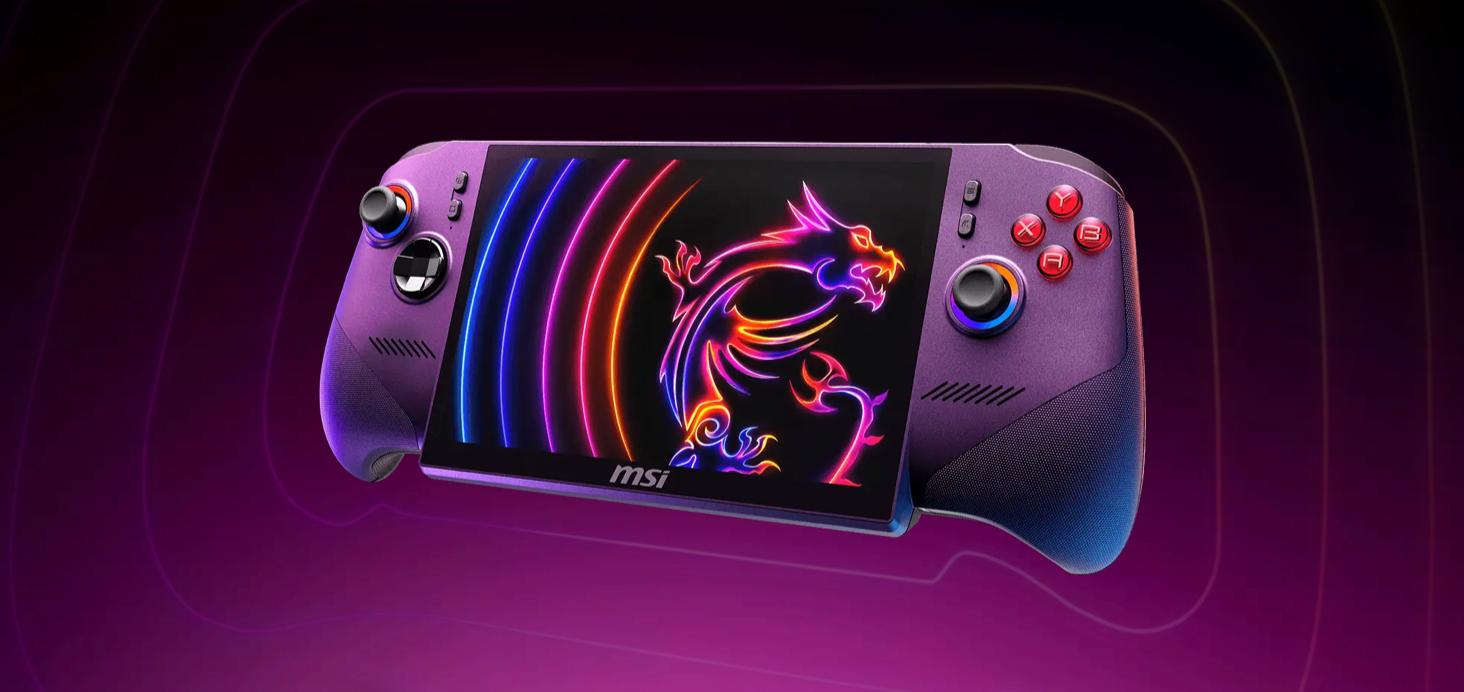
(Image source: MSI)
Intel and MSI Join Forces for a Powerful AI Handheld Console
The core configuration of the Claw 8 EX AI+ gaming handheld console is the custom Intel chip. In terms of parameters, the CPU of the Intel Arc G3 Extreme has 14 cores, specifically 2 performance cores + 8 efficiency cores + 4 low-power high-efficiency cores, with the architecture being the 3rd Generation Core Ultra. Compared with Intel's 338H, this chip has two performance cores removed from the CPU part and two efficiency cores added, while keeping the base frequency and turbo frequency the same. This design is mainly to control the energy consumption on mobile devices.
(Image source: Intel)
As a handheld console chip, the GPU is of utmost importance. The integrated graphics of the Intel Arc G3 Extreme is the B390, with 12 cores and a peak performance of 113 TOPS. Clearly, the GPU performance of the Intel Arc G3 Extreme is very strong, surpassing the 338H used in previous laptops in terms of parameters. In terms of gaming performance, this GPU can roughly reach the level of the mobile RTX4050. When running games at 800P resolution, most mainstream 3D games can be played smoothly.
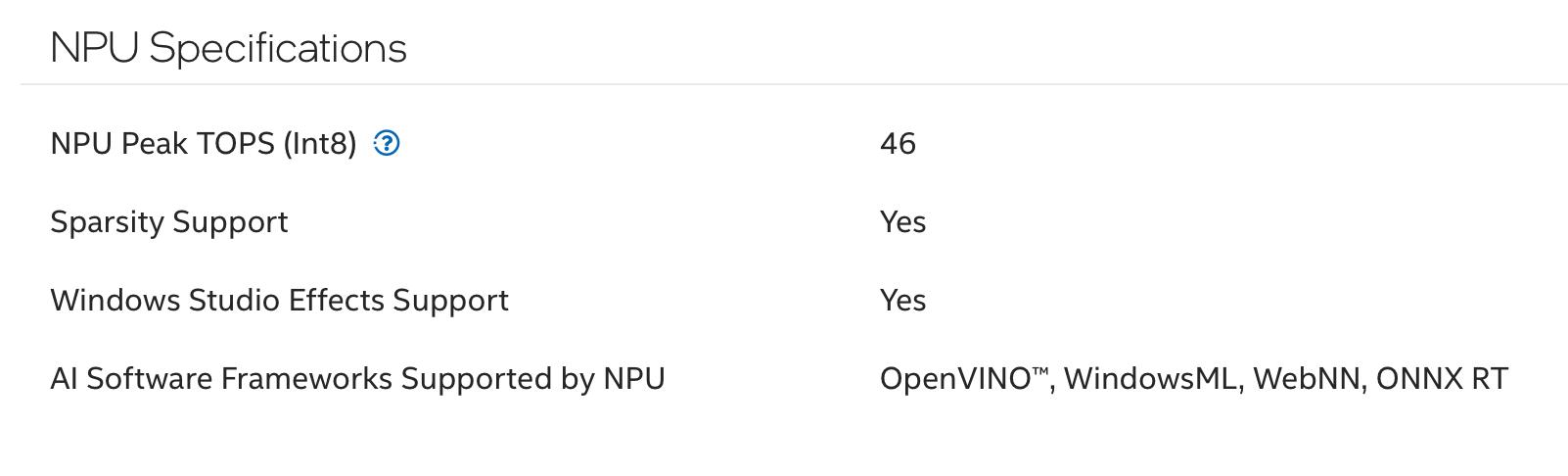
In terms of AI, the NPU integrated in the Arc G3 Extreme provides a peak local computing power of 46 TOPS. According to Microsoft's definition of an AI PC, one of the hardware requirements is that the local AI computing power should exceed 40 TOPS, and the Arc G3 Extreme just meets this threshold. In addition, the MSI Claw 8 EX AI+ is equipped with the Windows 11 system, which can directly provide some edge-side AI functions, including Recall and real-time subtitle translation.
(Image source: Intel)
Undoubtedly, the Claw 8 EX AI+ in the form of a handheld console is essentially a PC. Therefore, when its hardware and software conditions meet the standards, it can naturally transform into an AI PC. However, in our view, the core application scenarios of handheld consoles and regular PCs are completely different. If the AI+ handheld console cannot be connected to real-world usage scenarios, then the so-called AI selling point is likely to become a gimmick. After all, not many people will use a handheld console to watch videos and use the AI subtitle function, and even fewer will use it as a PC for office work.
The AI+ handheld console ultimately needs to be applied to the core gaming scenario.
Can AI Really Improve the Handheld Console Gaming Experience?
First is the AI enhancement of game graphics.
The Arc G3 Extreme is equipped with the Arc B390 integrated graphics with 12 Xe cores, which natively supports Intel's XeSS 3 technology. In the gaming scenario, it can achieve AI upscaling and multi-frame generation.
AI upscaling specifically refers to the device using an AI model to enlarge the low-resolution rendered image in real-time. For example, it can upgrade the 720P resolution to 2K, improving the image clarity while significantly reducing the device's graphics rendering load.
Multi-frame generation is also achieved through AI technology. Its principle is to use the GPU's computing power to predict and insert a new frame out of thin air by analyzing the data of the previous frame. In this way, low-frame-rate images can be upgraded to high-frame-rate images. For example, when running some high-performance-demanding game blockbusters, the native frame rate is only 30 frames, but after using the frame generation technology, it can reach 60 frames or even higher. For users, the image smoothness will be much higher, and the gaming experience will be more seamless.
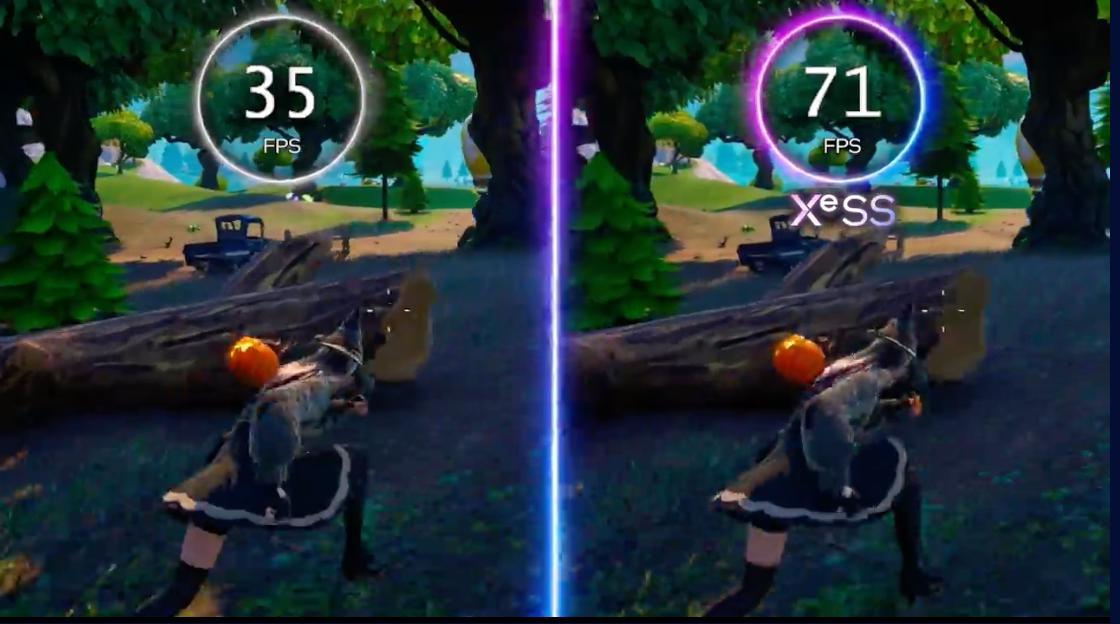
(Image source: Intel)
It should be noted that AI game graphics enhancement is ultimately just a "clever" method, and there will be some defects in the actual experience. For example, with AI upscaling technology, the AI's ability to process images is ultimately limited. For example, it is difficult for AI to provide accurate mathematical motion models for particle effects such as smoke, fire, blizzards, and flying sparks in games, resulting in a blurry image and reduced clarity.
The frame generation technology can seemingly improve the frame rate, but in actual gameplay, it often leads to a decrease in image clarity. Moreover, inserting AI-generated frames into the native frames will increase the latency, which will cause operation delays in FPS games, making it a bit of a trade-off.
Many players are repelled by AI graphics enhancement mainly because this technology is essentially a "compensation" for the insufficient performance of the native game and is a compromise solution.
Then there is the optimization of system scheduling.
There has always been a problem with handheld consoles, which is how to balance power consumption and performance. In theory, the stronger the chip performance, the better. However, a handheld console is essentially a portable device with a battery, so heat generation and battery life need to be considered. Therefore, the TDP of handheld consoles is generally much lower than that of laptops, usually not exceeding 35W, and there is an obvious power consumption bottleneck in the performance release when not connected to power.
The Arc G3 Extreme chip on the Claw 8 EX AI+ uses Intel's advanced process. Judging from the actual performance of chips of the same generation like the 338H, its energy efficiency will be very good. However, even so, in the handheld console scenario, it is still limited by strict heat dissipation and battery life. The device needs to supply power to a 14-core CPU, a 12-core GPU, and an NPU within a 35W power limit.
The power management scheduling at the system level also relies on AI algorithms. It can dynamically allocate power in milliseconds according to the load characteristics of the current game or software (for example, whether the current scenario requires CPU physical computing or GPU rendering). Combined with MSI's Cooler Boost Hyperflow cooling system, it can maximize the battery life of the 80Whr large battery.
AI Handheld Consoles Are Still in Their Infancy and Need Time to Evolve
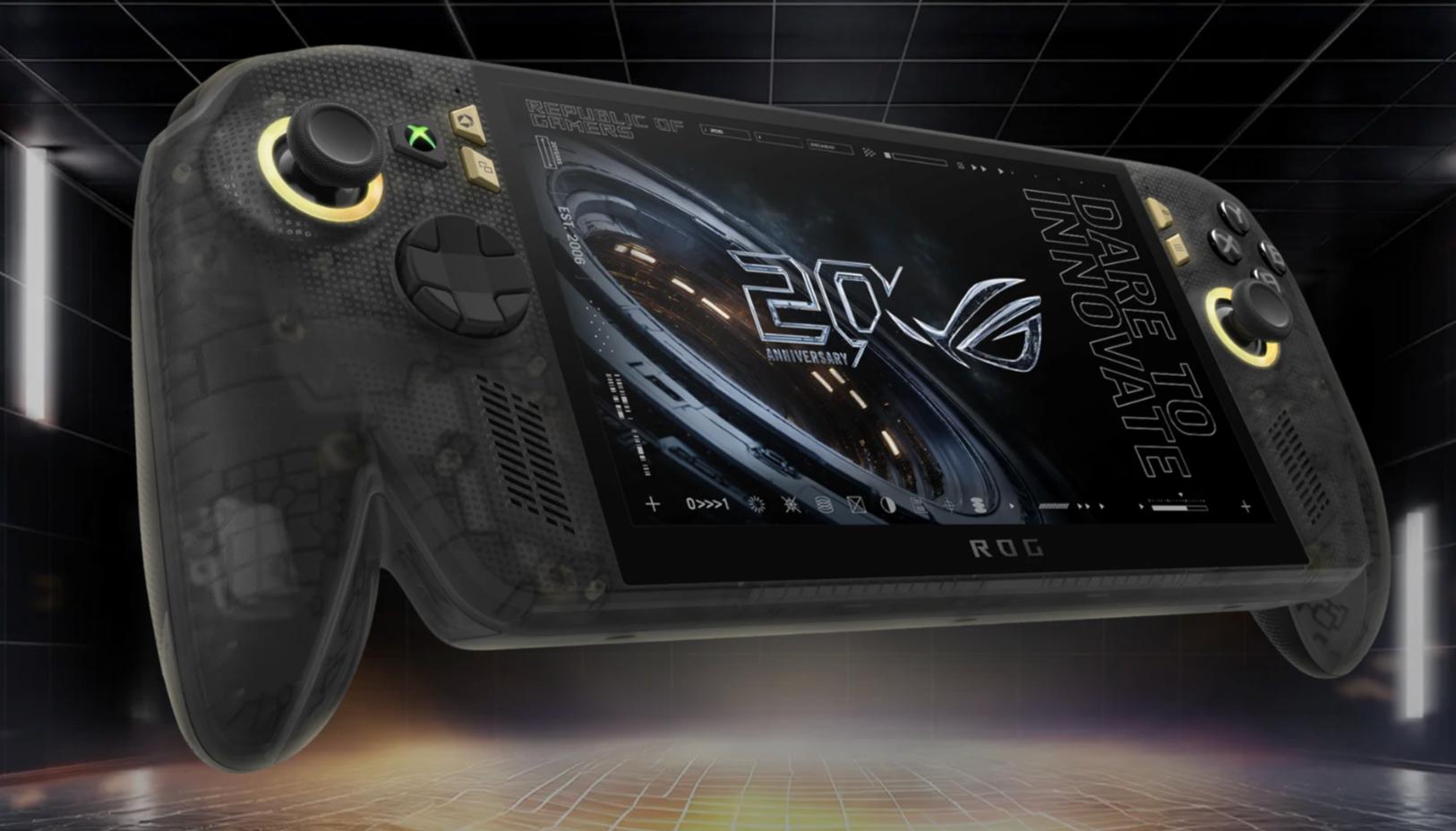
There were more than just MSI's handheld console at this year's Taipei Computer Show. Other brands also made an appearance. Acer brought the Predator Atlas 8 handheld console, which offers two chip versions, Intel ArcG3 and Arc G3 Extreme, and will be released in the third quarter. ASUS released the ROG XBOX Ally X20, which uses an AMD solution with the Ryzen AI Z2 Extreme chip. Its overall strength is weaker than that of the Intel Arc G3 Extreme.
Overall, these PC brands generally haven't told a good story about the AI+ handheld console. Or rather, the current AI scenarios on handheld consoles can't become the core selling point of the products. Of course, this can't be entirely blamed on MSI, ASUS, etc. If we want to turn handheld consoles into AI hardware, it requires the joint efforts of chip, system, and terminal brands.
In terms of the handheld console category, terminal brands haven't done much in the AI process. At most, they have built some AI software and functions into the system, while the more in-depth underlying AI capabilities still need to be provided by chip and system manufacturers.
Intel has been committed to the evolution of AI PCs. Its focus is mainly on the chip side, including providing local computing power for chips and improving the overall AI computing power of chips through heterogeneous computing of the CPU, GPU, and NPU. At the same time, it uses tools like OpenVINO to build an open AI ecosystem to attract AI developers.
AMD's strategy is similar to Intel's, as they are both currently challenging NVIDIA. At the system level, Microsoft's definition of an AI PC is closely related to Windows 11, and the implementation of relevant functions and scenarios is based on it. However, in our view, the numerous bugs and bloated size of Windows 11 have seriously hindered the AI transformation of the operating system. At present, the native AI functions on Windows 11 are still in their infancy and can't form a core advantage.
Windows 11 has higher hardware overhead. As an AI device, it is less efficient than Linux in terms of lobster and agent deployment. As a handheld console, its poor power consumption control and system interaction have been widely criticized, and the user experience is not as good as that of SteamOS based on Linux. At this stage, Windows is less compatible with AI and handheld consoles than Linux. However, due to the strong ecological compatibility advantage of Windows and its unshakable position in the PC industry chain, most of the handheld consoles launched by PC giants like MSI, ASUS, and Lenovo are still Windows versions.
(Image source: ASUS)
From a practical perspective, the most significant experience upgrade that AI brings to handheld consoles at present is the AI game graphics enhancement technology we mentioned earlier. Although it is not perfect, it can truly improve the image display effect, enhance the gaming smoothness, and relieve the performance anxiety of mobile chips under limited power consumption.
However, this is obviously far from enough. If we want the "AI handheld console" to truly get rid of the label of a marketing gimmick and completely change the industry's game rules like 3D graphics cards did back then, all parties in the industry chain need to complete the transformation from hardware splicing to ecological integration. To promote the maturity of AI handheld consoles, chip, system, and terminal brands all need to make more efforts.
Although the current hardware computing power has exceeded Microsoft's 40 TOPS threshold, the power consumption when running local large models on the edge side is still a major drain on the handheld console's battery. The key problem that chip giants need to solve is whether they can significantly improve AI performance within a 15W or even lower power limit, making edge-side AI truly practical.
The bloated size and disastrous handheld console interaction of Windows 11 have become the biggest shortcoming of the Windows camp. If Microsoft wants to maintain its market share, it must launch a customized Windows system that is thoroughly streamlined, supports native agent scheduling, and has a real console-level sleep function. On the contrary, SteamOS based on Linux, with its lower hardware overhead, may catch up with the Windows camp in the AI era if it can integrate more AI capabilities into the compatibility layer in the future.
PC manufacturers can't just be satisfied with buying the latest AI chips, putting them in a shell with joysticks, and labeling them as AI handheld consoles. They need to increase their participation. On the one hand, they need to use AI to improve the gaming experience and let users feel the changes brought by AI. On the other hand, they need to actively cooperate with upstream game developers to promote the implementation of AI game content, including game works driven by edge-side AI generation technology, breaking out of the limitations of traditional handheld consoles.
Conclusion
Let's go back to the original question: Is the AI handheld console a false concept?
As of 2026, it does have a strong marketing flavor. When players buy it home, most of the time it is still just a more powerful portable PC for playing Windows games. The so-called AI local computing power has little practical value in most traditional games and daily scenarios.
However, this doesn't mean that edge-side AI computing power is meaningless on handheld consoles. The implementation of technology often follows the pattern of hardware leading and software catching up later. The current Claw 8 EX AI+ and similar products are quite ahead of their time, as they have provided players with a stronger hardware foundation and computing power framework in advance.
The AI handheld console is a gimmick now, but it won't always be. When a unified edge-side AI software standard is established, more advanced processes bring a more disruptive energy efficiency ratio, and native AI games explode, it may evolve into the next-generation AI terminal that reshapes the handheld entertainment experience. Whether successful or not, MSI and Intel's eager attempt at this year's Taipei Computer Show will be a meaningful exploration.