So soon, the giants can no longer afford to burn through their tokens?
The Silicon Valley giants that forced their employees to use AI are starting to "play dirty."
Amazon earnestly advised, "Don't use AI just for the sake of using it," and closed the internal employee token consumption leaderboard with a wave of the hand.
Microsoft suddenly revoked most of the Claude Code authorizations and required developers to switch their workflows back to GitHub Copilot CLI.
Not long ago, the situation was completely different. The more AI was used, the more advanced the employees seemed, and the more promising the company appeared.
However, when employees really started using AI extensively, companies quickly found that it was uncertain whether they could boost productivity, but the bills swelled first.
While starting to worry about the token bills, they are also afraid of falling behind in the AI competition. Silicon Valley is facing a problem of its own making.
Guys, AI is really amazing!
It all started last year. Although the phenomenon of "encouraging employees to embrace AI" has existed for a long time, it suddenly became an irresistible trend in 2025.
Most notably, the big Silicon Valley companies led the way in forcing their employees to use more AI.
In the words of Julia Liuson, an executive in Microsoft's developer tools business, "Using AI is no longer an option but a core ability for every position and at every level."

At that time, she asked managers in an internal email to consider employees' use of internal AI tools, including GitHub Copilot, when evaluating their performance.
Amazon, on the one hand, said that some positions might be reduced due to AI in the future, and on the other hand, told employees that the way to cope was to "embrace AI."
Last summer, CEO Andy Jassy sent an email about generative AI to all employees. In the email, he said that as the company deploys generative AI and agents on a large scale, the number of people needed for some existing positions will decrease; in the next few years, the efficiency improvement brought by AI is expected to reduce the total number of Amazon's corporate employees.
When talking about how employees should respond, Jassy directly asked employees to actively embrace AI:
"Understand AI, participate in seminars and training, use and experiment with AI as much as possible, participate in team brainstorming, think about how to innovate for customers faster and on a larger scale, and how to accomplish more with a leaner team."
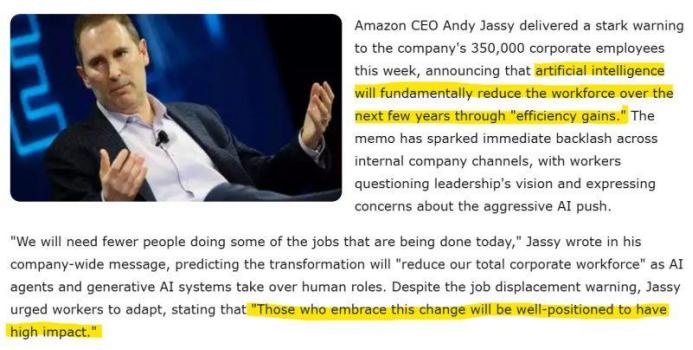
This passage can be regarded as the public starting point of Amazon's internal AI mobilization.
Not only the giants, but in 2025, the high - profile "company - wide AI" was almost a kind of fashion.
Shopify put forward the concept of "reflexive use of AI," saying that it is now a basic requirement of the company. The so - called "reflexive use" means "using AI like a conditioned reflex." When employees encounter tasks, they should first think about whether they can be completed with the help of AI.
The company also requires that before a team applies for more manpower and resources, it must first answer a question: Why can't this work be done by AI?
Duolingo even publicly stated that the company will shift to "AI - first." Use AI instead of outsourcing when possible. Hire no new people when AI can be used. In employee evaluations, their use of AI will also be examined.
This trend has also continued to some extent this year.
In March this year, Jensen Huang publicly stated that he would be "very worried" if a $500,000 - a - year engineer at NVIDIA didn't consume at least $250,000 worth of AI tokens in a year. When asked if NVIDIA was prepared to spend about $2 billion a year on tokens for its engineering team, Huang's answer was, "We're working on it."
This is not the first time he has made such a statement. At an all - hands meeting at NVIDIA at the end of last year, Huang asked an executive who had advised the team to "use less AI," "Are you crazy?" and clearly required employees to automate all tasks that could be automated with AI as much as possible, while assuring employees that AI would not take their jobs.
But if we talk about which company is the most radical, Meta takes the lead.
In November 2025, Meta's Chief People Officer, Janelle Gale, announced that starting from 2026, "AI - driven impact" would become a core expectation for employees and would officially be included in performance evaluations.
In April this year, there appeared an internal leaderboard at Meta called "Claudeonomics": It tracked the number of tokens consumed by more than 85,000 employees, listed the top 250, and awarded titles such as "Token Legend" and "Cache Master." In just 30 days, the token consumption recorded on the leaderboard exceeded 6 trillion.
The use of AI has become a cut - throat internal game.

BCG surveyed 2,360 corporate executives, including more than 600 CEOs, in its "AI Radar 2026" report. The results showed that 94% of organizations said they would continue to invest in AI even if it didn't bring immediate returns in 2026.
The report predicts that the proportion of corporate investment in AI to revenue will increase from about 0.8% in 2025 to about 1.7% in 2026, almost doubling. 72% of CEOs said they were already the main decision - makers for AI in their companies; half of the CEOs even thought that their positions would be affected if AI investment didn't yield results.
For these companies, AI has become a transformation bet by the CEO himself. The important thing is not to seem slower than their peers.
Are they playing dirty? Silicon Valley giants lead the way in backtracking
However, before this AI - using competition had been in full swing for long, the Silicon Valley giants started to hit the brakes.
The first to go back on its word was Amazon, which had previously asked employees to "use and experiment with AI as much as possible."
At the end of May this year, Amazon was reported to have shut down an internal leaderboard called "KiroRank." This self - made leaderboard by employees showed the number of tokens consumed by employees when using AI tools.
According to the Financial Times, some employees started using Amazon's internal AI agent platform, MeshClaw, to run non - essential tasks to improve their AI usage data. MeshClaw could originally initiate code deployments, sort emails, or interact with applications like Slack on behalf of employees; but when token consumption was put on the leaderboard, the purpose of employees running these agents might change from completing real work to simply "ranking up."
This behavior even has a special name: Tokenmaxxing, which means to increase token consumption as much as possible.
Although Amazon didn't disclose what invalid tasks the employees had run, in relevant community discussions, some users had already directly imagined this "ranking - up" method:
Leave MeshClaw running in the background to continuously perform static analysis on source code packages, and tokens will naturally accumulate.
Some users on Hacker News also said that after their company started evaluating "how many tokens were spent," some employees they knew simply let different AI agents receive each other's outputs and run in a loop because there weren't enough real tasks that required a large number of tokens.
Amazon finally had to stop this competition.
Dave Treadwell, the company's senior vice - president, reminded employees internally: "Don't use AI just for the sake of using it. Use AI to help you solve customer problems, business problems, and achieve innovation."
It's been less than a year since Jassy personally encouraged employees to "embrace AI."
Amazon is not the only giant to start backing off. In mid - May this year, Microsoft began to revoke most of the internal Claude Code licenses.
Under the giants, small and medium - sized companies can't hold on either.
In April last year, Duolingo CEO Luis von Ahn announced that the company was shifting to "AI - first," but a year later, he admitted that the company had withdrawn this assessment standard.
Exactly one year later, he said in a podcast that employees had questioned the company: Do we have to use AI just for the sake of using it to make the company seem "AI - first" enough?
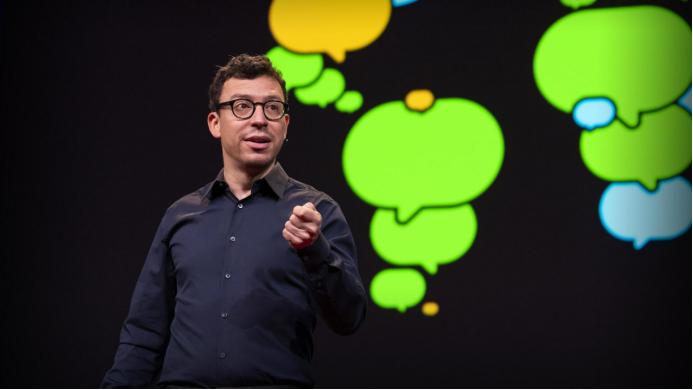
Finally, Duolingo no longer uses employees' AI usage as an official performance indicator. Von Ahn said that what really matters is whether employees can do their jobs well. AI is suitable for some tasks but not all tasks, and the company shouldn't force employees to use AI where it's not appropriate.
The companies that were once eager to have their employees "embrace AI" certainly haven't given up on AI.
They just finally realized that employees not using AI is a problem, but employees burning tokens like crazy for rankings, performance, and self - preservation might be an even more "expensive" problem.
AI is great, but it's too costly
"Building AI" is very expensive, and everyone knows that.
But it's really a surprise that "using AI" is also so costly.
A typical example is Uber, which exhausted its annual AI budget in April this year. Recall that in December last year, Uber opened Anthropic's AI programming tool, Claude Code, to about 5,000 engineers.
As mentioned earlier, Microsoft began to revoke most of the internal Claude Code licenses in May this year. Microsoft explained internally that this was to unify the toolchain to its own Copilot CLI.
But according to The Verge, it was also a financial decision.
The Claude Code authorizations will be largely closed at the end of June, before the end of Microsoft's current fiscal year, to cut some operating costs before the start of the new fiscal year.
What's more notable is that while Microsoft is pushing employees to switch back to Copilot CLI, the charging method of Copilot itself is also changing.
In April this year, GitHub announced that starting from June 1, the paid plans for GitHub Copilot for enterprise and team users will switch to a usage - based billing model. In the past, these customers mainly paid according to subscription packages and the number of premium requests; under the new plan, each package only includes a certain amount of GitHub AI Credits, and after exceeding the limit, they need to continue paying according to the actual usage.
How is this fee calculated? It's calculated based on the input tokens, output tokens, and cache tokens consumed by employees during use.
GitHub said in an official announcement that as Copilot starts to undertake more complex agent tasks such as analysis, modification, and iteration, the difference in computing power consumption between different tasks is getting larger and larger, so it's necessary to switch to billing based on actual usage.
Anthropic also adopts a similar billing logic.
Currently, the seat fee for the Claude enterprise version only covers platform access rights and does not include actual usage. Each token generated by employees when using Claude, Claude Code, and Cowork needs to be billed separately at the standard API price.
More directly, Anthropic's official help document clearly reminds enterprises that under the new usage - based billing plan, teams don't have a separately allocated token quota. If an employee uses a large amount of AI, it won't reduce the available quota for other employees, but will only make the organization's final bill higher. The old fixed - seat plan will also be gradually transferred to this usage - based billing model when renewing the contract.
OpenAI's approach is slightly different. It hasn't announced that all enterprise plans will be unified to token - based charging, but in April this year, it launched a pay - as - you - go option for Codex for ChatGPT Business and Enterprise teams: Enterprises can pay for Codex according to actual usage instead of paying a fixed seat fee.
Meanwhile, the cost of calling stronger models is also significantly higher.
GPT - 5.5, which entered the API in April this year, has a further increased calling cost compared to GPT - 5.4. At the standard API price, the unit price of its input and output tokens is twice that of the latter.
When companies ask employees to "use AI as much as possible," but AI vendors accurately charge for each call and each token, things start to get delicate.
The problem is not just that AI is expensive.
The more soul - searching question is, when the whole company is "charging forward with AI," is the effect really good?
Some people have long seen the logical flaw: What's the difference between judging engineers by token consumption and grading marketing team members by who spends more money?
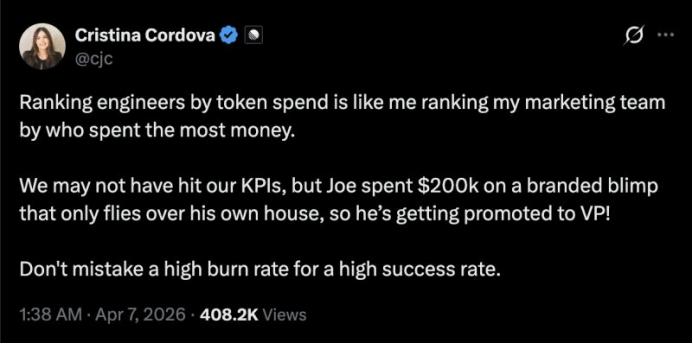
The whole industry is using AI, but currently, only a few enterprises can really convert this usage into profits.
McKinsey surveyed 1,993 corporate respondents in its "State of AI in 2025" report. The results showed that only 39% of the respondents said that AI had an impact on the company - wide earnings before interest and taxes (EBIT).
McKinsey also specifically defined a category of "AI high - performing enterprises": Those that believe AI has created significant value for the company and that the contribution of AI to the enterprise's EBIT is at least 5%. Enterprises that meet these two conditions account for only about 6% of all respondents.
In addition, in July last year, the research institution METR published a randomized controlled experiment. Sixteen experienced open - source software developers completed 246 real tasks in a codebase they were familiar with. Some of the tasks allowed the use of AI tools, while others did not.
Before the experiment, the developers expected that AI could reduce the time to complete tasks by 24%.
After the experiment, even though they had used these tools themselves, they still thought that AI had increased their work speed by 20%.
But the actual result was completely the opposite: After using AI, the time required for these developers to complete tasks actually increased by 19%.
This study targeted senior developers familiar with large - scale open - source codebases, so it can't directly prove that AI programming is not helpful for everyone and every task.
But it at least shows that employees feeling that they are improving efficiency with AI doesn't mean that the efficiency has really increased. A company seeing an increase in AI usage doesn't mean that the company has really achieved corresponding output.
When token consumption becomes a performance evaluation standard and a "consciousness detector,"