Behind the wave of robots entering schools: the AI industry is vying for "real-world entry points"
Introduction
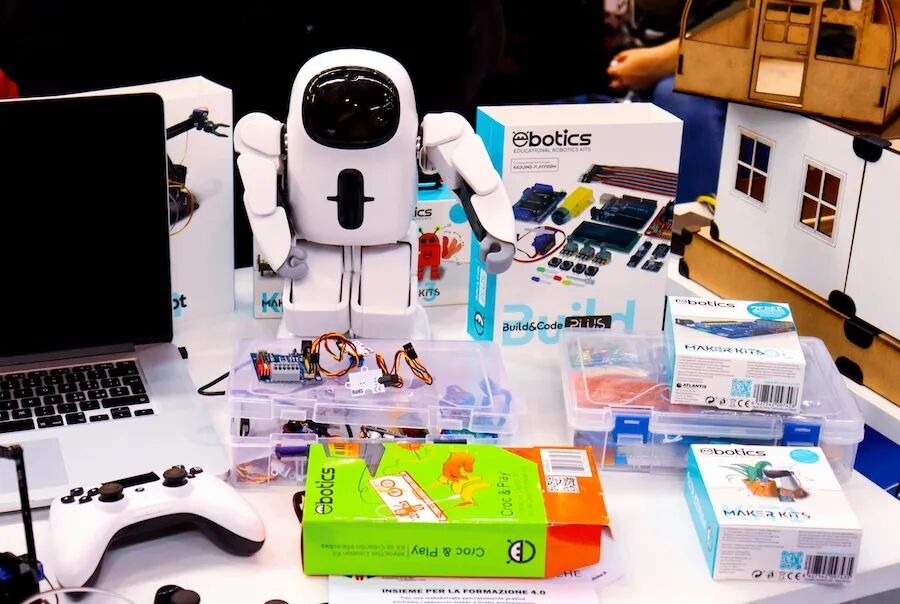
In the spring of 2026, at an educational equipment exhibition, a crowd of onlookers surrounded the exhibition booth tightly. In the center of the venue, several humanoid robots were performing tasks such as autonomous movement, obstacle avoidance, and collaborative interaction. Some school teachers were holding their mobile phones to record the scene, and some local education department officials were repeatedly inquiring about course and laboratory plans. Meanwhile, in another hall of the exhibition, terms like "Embodied Intelligence Laboratory", "Campus AI Robot Platform", and "Humanoid Robot Curriculum System" began to appear more and more frequently.
In the past few years, people have become accustomed to AI learning machines, smart classrooms, and digital human teachers. However, the sudden large - scale entry of robots into schools is still a quite novel thing.
What really deserves attention is not the "robot education" itself, but the fact that more and more robot companies that originally did not belong to the education industry are collectively targeting schools. From humanoid robot enterprises to embodied intelligence companies, from autonomous driving teams to robot laboratories, many enterprises that have long been engaged in industrial, scientific research, and automation businesses are now intensively launching campus laboratories, K12 curriculum systems, youth science and technology projects, and AI club solutions.
If we only understand it from the perspective of the education industry, this can easily be regarded as a new wave of "robot education fever".
However, if we put the perspective back on the entire AI industry, we will find that things are far from that simple.
Because what robot companies are really competing for today may not be the education market itself, but one of the most important early entrances after AI enters the real world.
And schools happen to be that most special scenario.
The Robot Industry Enters the "Real - World Anxiety" Phase
In the past two years, one of the most obvious changes in the AI industry is that embodied intelligence has suddenly become the new focus of the technology industry.
Compared with the large - scale models that mainly stayed on the screen in the past, more and more enterprises are starting to try to let AI truly enter the physical world. It not only needs to be able to understand language but also to move, perceive, operate, collaborate, and even make real - time decisions in complex environments. This is why humanoid robots have suddenly become one of the hottest directions in the capital market and the technology industry in the past two years.
However, as the industry heats up rapidly, a more realistic problem begins to emerge.
For large - scale models, training data can come from the Internet; while for robots, the truly important data can only come from the real world. Robots not only need to "know" but also to "do" - they need to understand space, control their bodies, recognize obstacles, interact with people, and continuously complete action coordination in uncertain environments. This means that what robots really lack is never concepts but the ability to be trained in a long - term real environment.
For this reason, the entire robot industry is entering an obvious stage of "implementation anxiety".
In the past, the competition in the industry was about who could make robots stand up and run. Now, the more important question has become: How can robots truly enter the real world? Factories, warehouses, hospitals, shopping malls, hotels, families... Almost all real - world scenarios have become the targets of competition for robot companies, because whoever can enter the real environment earliest will have a better chance to accumulate real data, optimize interaction capabilities, and establish industrial advantages in the next stage.
Among all scenarios, schools are showing an extremely special value.
Schools do not have extremely high requirements for stability like factories, nor are they as fragmented as families. They have real human - to - human interaction and relatively controllable spatial order. For many robot enterprises, schools are almost like a "low - difficulty real world" - they are both real enough and safe enough, can be deployed for a long time, and are naturally suitable for display.
As a result, more and more robot companies are starting to turn their attention to campuses.
Why Do Schools Become the Places That Robots Most Want to Enter?
If we look at schools from the perspective of the robot industry, we will find that they almost meet all the conditions required for an ideal training place.
First of all, schools have stable and standardized spaces. Classrooms, corridors, libraries, laboratories, and playgrounds are essentially environments with clear rules and boundaries. Compared with open commercial spaces or complex family environments, schools are easier to control and more suitable for the early deployment and training of robots.
Secondly, schools naturally have high - frequency and long - term human - robot interaction. What the robot industry really lacks is not just "seeing people" but the ability to collaborate with people in the long term. Every day on campus, a large number of stable and repetitive human behaviors occur: going to and from classes, classroom interactions, club activities, science and technology practices, experimental collaborations... These are all extremely important real - world data for embodied intelligence.
More importantly, schools have a natural public communication attribute. Compared with robots carrying goods in factories, a humanoid robot that can move, interact, and participate in campus activities is obviously more likely to attract social attention. For local education departments and schools, robots also naturally fit into public narratives such as "artificial intelligence education", "future campus", and "technological innovation". Many schools purchase robots not entirely out of teaching needs but hope to enhance the school's characteristics and external influence through a technological image.
As a result, a very delicate relationship begins to form.
Schools need a sense of technology.
Robot companies need scenarios.
The two sides start to get closer quickly.
This is why more and more robot enterprises are starting to launch:
- Campus AI Laboratory
- Humanoid Robot Courses
- Embodied Intelligence Platform
- AI Science and Technology Club
- Campus Robot Assistant
- Youth Robot Practice System
On the surface, they are engaged in education; but from a deeper perspective, they are actually looking for a long - term entrance for robots to enter the real world.
What Robots Really Want to Enter Is Not the Classroom, but the "Long - Term Real Environment"
Compared with the initial imagination of "robot education" from the outside world, what robot companies really value currently may not be a specific course in school, but the long - term real environment provided by the school itself.
For a long time in the past, the development logic of the robot industry was closer to the laboratory model. Enterprises mainly competed around algorithms, hardware, motion control, and breakthroughs in single - item capabilities. Many robots also mainly stayed in the demonstration, scientific research, or industrial testing stages. However, as the concept of embodied intelligence heats up rapidly, the entire industry has begun to realize that the real challenge for robots is not "whether they can move" but whether they can coexist with people stably in the real world in the long term.
This means that robots no longer only need technical parameters but a large amount of long - term training in a real environment.
They need to enter spaces with people flow, order, interaction, and uncertainty, and continuously understand human behaviors, environmental changes, and complex collaborative relationships. For the robot industry, schools happen to provide an extremely special scenario: it has real social attributes and is safer, more stable, and more controllable than factories, hospitals, shopping malls, and families.
This is why more and more robot companies are starting to try to turn campuses into the earliest real - world deployment sites for robots.
On the one hand, schools have a large number of high - frequency and repetitive human behaviors. Going to and from classes, classroom interactions, library borrowing, laboratory collaborations, club activities, and campus patrols. These seemingly ordinary campus scenarios are actually extremely valuable real - world training environments for robots. Compared with one - time exhibition displays, schools can provide long - term and continuous data accumulation, and this long - term nature is exactly what current embodied intelligence lacks the most.

On the other hand, schools also have the natural advantage of "low - risk trial and error". Compared with the extremely high requirements for stability and safety in industrial scenarios, the campus environment has a larger fault - tolerance space for robots and is more suitable as an early deployment and interaction verification scenario. What many robot enterprises really need currently is not to achieve large - scale commercialization immediately but to find a real - world entrance where they can iterate, train continuously, and optimize interaction capabilities in the long term.
As a result, more and more robot companies originally focused on industry and scientific research are intensively launching campus AI laboratories, humanoid robot display plans, embodied intelligence curriculum systems, campus robot assistants, AI clubs, and science and technology practice platforms. On the surface, these are about education, but the deeper logic is that the robot industry is starting to compete for the real world in advance.
Because for embodied intelligence, whoever can enter the real environment earlier will have a better chance to accumulate data, train models, establish interaction standards, and ultimately form industrial barriers in the next stage.
And schools are becoming the most suitable "buffer zone" before robots enter the real society.
But Current Robot Education Is Far from Mature
However, beyond the excitement, a more realistic problem begins to emerge: Most robots entering schools today essentially still stay in the "demonstration stage".
Many schools purchase robots not for real - world daily classes but more for science festivals, public displays, characteristic school construction, artificial intelligence demonstration projects, or educational equipment exhibitions. In other words, many current robots are more like a "technological landscape" rather than stable educational infrastructure.
The real problem is that robot education is completely different from traditional educational information technology equipment. Learning machines, electronic whiteboards, and AI software essentially still belong to digital tools, but robots are "physical AI", which involve a large number of complex issues such as hardware maintenance, space safety, motion control, sensor debugging, and system upgrades. For many schools, just equipment operation and maintenance are already a huge challenge.
An even bigger problem lies in the teacher system. Real robot teaching does not just involve assembly and remote control but a whole set of technical capabilities such as engineering thinking, AI basics, perception algorithms, and control systems. Currently, a large number of information technology teachers in schools actually do not have the corresponding teaching capabilities. As a result, many current robot education projects highly depend on enterprises: enterprises provide equipment, courses, competitions, coaches, and even directly take charge of classes. This means that robot education has not really entered the core teaching system of schools.
Meanwhile, a more thought - provoking problem begins to emerge: To some extent, many robot courses are actually "training robots" as well. In the process of students continuously debugging actions, optimizing paths, and training interactions, they are actually helping robot enterprises accumulate real - world behavior data. From this perspective, schools are not only an educational scenario but also becoming an important data entrance for the robot industry.
What Robot Companies Really Want to Grab May Not Be the Education Market
If we look deeper, we will find that what robot companies are really competing for may not be short - term education revenue but the entrance position after AI enters the real society.
Because the robot industry must eventually leave the laboratory, and schools happen to be one of the most accessible public scenarios in the real world. There is a stable environment, long - term human interaction, low - risk trial - and - error space, and natural social communication value. For the robot industry, it is both a training ground and a display ground, and more importantly, an important transitional area for the future socialization of AI.
So the fact that robot companies are competing for schools today actually means that the AI industry is starting to layout the real - world infrastructure in advance. Whoever can enter the campus earlier will have a better chance to accumulate data, cultivate users, establish a curriculum system, bind the competition ecosystem, influence the future talent training path, and even define the next - generation AI education standards.
From a longer - term perspective, what this really changes may not be "robot education" itself but the change in the function of schools. In the past, schools emphasized knowledge transmission more, while in the future, schools may become more and more like a "simulation field of the future society" - what students need to learn is no longer just knowledge itself but how to collaborate with AI, how to understand automated systems, and how to work in a human - robot coexistence environment.
From this perspective, what is really important in robot education is not the robot itself but that it makes AI transform from software on the screen into a real - world existence for the first time.
And schools are very likely to become the first stop after AI enters the real world.
Conclusion
The current entry of robots into schools is very similar to the children's programming boom a decade ago. That stage was also full of concepts, competitions, financing, displays, and policies, but it actually took a long time for a truly mature curriculum system and industry structure to gradually form.
The robot industry may also go through a similar process.
In the short term, it still faces a large number of real - world problems such as cost, teachers, operation and maintenance, safety, curriculum system, and teaching value. However, it is undeniable that a trend has begun to emerge: Robot companies are collectively entering schools.
And what they are really competing for may not be just a classroom.
It is the first long - term, stable, open, and continuously trainable and iterable real - world social entrance after AI enters the real world.
This article is from the WeChat official account "Blackboard Insight" (ID: heibandongcha), written by Er Dong, and is published by 36Kr with authorization.