Leapmotor's monthly deliveries exceeded 80,000 units, NIO overtook Li Auto, and the fierce battle is only just beginning in June.
On June 1st, new - force car manufacturers announced their delivery results for the previous month as usual.
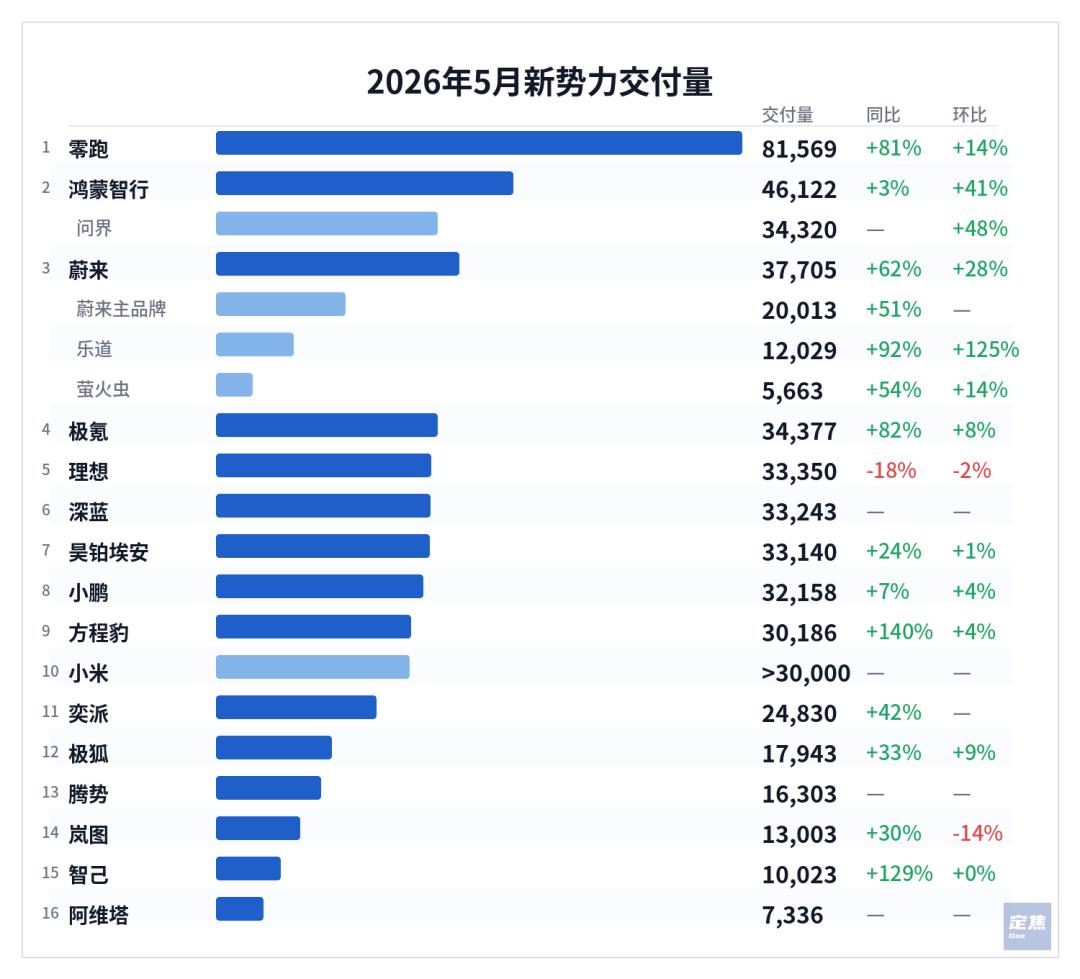
Let's first look at the ranking of the top six new - force car manufacturers.
Leapmotor reached 81,000 units, setting a new monthly high and leading the second - place by 35,000 units. The remaining five all fell in the range of 30,000 to 40,000 units. The gap between the second - place Hongmeng Zhixing (46,122 units) and Xiaomi (over 30,000 units) was less than 16,000 units.
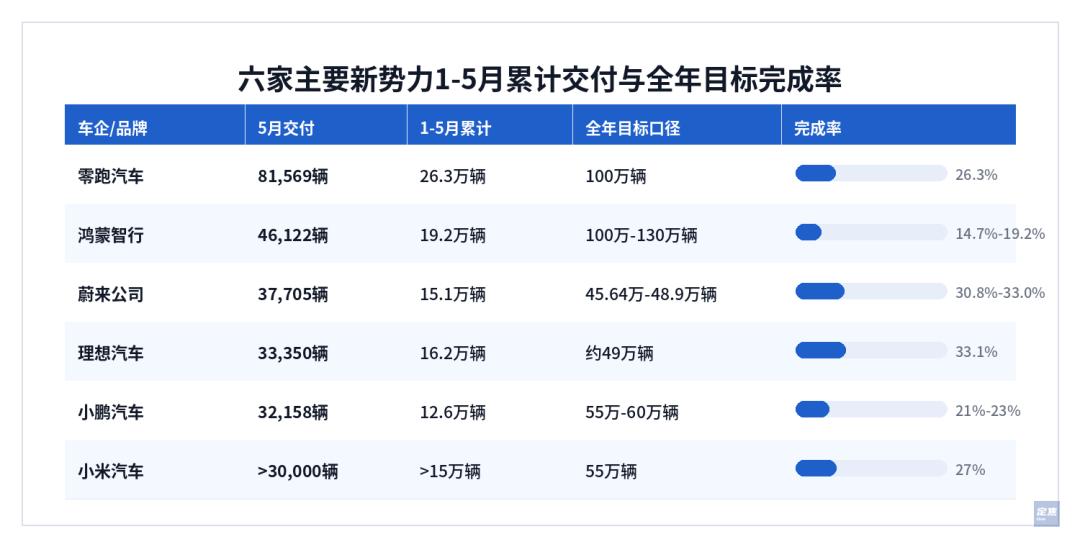
Looking at the first five months, the differentiation in the completion rate of the annual goals of each company is more obvious than the monthly ranking. The completion rates of NIO and Li Auto are about a little over 30%. Xiaomi's is about 27%, Leapmotor's is about 26%, XPeng's is a little over 20%. If calculated based on the million - level goal, Hongmeng Zhixing's completion rate is less than 20%.
The completion rate shows two points. Firstly, being in the top position doesn't necessarily mean safety. Leapmotor's 26.3% completion rate means it still needs to reach an average of 105,000 units per month in the remaining seven months, which is quite a pressure. Secondly, if Li Auto and XPeng, whose cumulative year - on - year sales are declining, don't reverse the situation as soon as possible, they will face greater pressure in the second half of the year. Each company has its own problems.
Now let's look at traditional car manufacturers and their sub - brands. BYD sold 383,000 units (including 330,000 units in the Dynasty and Ocean networks, 30,186 units of Fangchengbao, 16,303 units of Denza, and 286 units of Yangwang; over 160,000 units were exported overseas); Geely Automobile sold 238,000 units.
The "second - generation startups" and new brands of traditional car manufacturers are also vying for positions. ZEEKR (34,377 units), Fangchengbao (30,186 units), Hyper (33,140 units), and Deepal (33,243 units) have caught up with the last four of the new - force car manufacturers. The 30,000 - unit level in May was more crowded than in April.
Further down, Dongfeng Yipai (24,830 units), BAIC ARCFOX (17,943 units), VOYAH (13,003 units), and IM (10,023 units) are clustered between 10,000 and 20,000 units. Avatr (7,336 units) has not exceeded 10,000 units.
The pattern of one dominant and multiple strong players has been further strengthened, but the ranking competition remains intense, and the uncertainties in the next few months are likely to increase.
01. Leapmotor Reaches 80,000, Hongmeng Still Relies on AITO
Let's first look at the top two in the new - force list in May, Leapmotor and Hongmeng Zhixing.
The keyword for Leapmotor is scale. It delivered 81,569 units in May, a year - on - year increase of 81% and a month - on - month increase of 14%.
Within the new - force car manufacturers, it is nearly 1.8 times the total delivery of Hongmeng Zhixing. In the larger passenger - car market, this volume has exceeded the domestic retail volume of traditional joint - venture brands such as GAC Toyota and Dongfeng Nissan in that month.
Leapmotor's biggest increase in May came from the A10. According to Lan, an investor who focuses on new - force car manufacturers, this entry - level SUV with a starting price of 65,800 yuan had over 20,000 units delivered in May, contributing nearly 30% of Leapmotor's sales.
The logic of this car is simple: in the market below 100,000 yuan, it makes lidar and high - level intelligent driving standard configurations. Lan believes that in the past, consumers at this price level mainly considered space, energy consumption, and price, and had no concept of intelligent driving. Leapmotor has brought the configurations of the mid - to - high - end market to the entry - level market, making users who originally planned to buy A0 - class fuel cars or low - price electric cars start to re - compare what they can buy with the same budget.
This is also the key to Leapmotor's growth this year, packaging "affordability" in a way that is more perceptible to users. With the same budget, users get more lidar and more space.
Whether it can continue to increase sales depends on production capacity. The A10 started double - shift production in May, with a daily production capacity exceeding 1,000 units and a monthly production capacity of over 26,000 units. Lan mentioned that many new - force car manufacturers have a large number of orders but cannot deliver the cars, and Leapmotor has at least not dropped the ball in this regard.
However, Leapmotor's problem is also obvious. The cost of increasing sales with low prices is low profit. The gross profit margin in the first quarter has dropped to 9.4%, and the net loss is 390 million yuan. "The gross profit margin of the whole vehicle is expected to be even lower (lower than the company's overall gross profit margin)," Lan added. Leapmotor can only expand externally and upgrade.
Leapmotor exported over 40,000 units in the first quarter, a four - fold year - on - year increase, accounting for 37% of the total sales in that quarter. In May alone, it exported over 20,000 units. The cumulative export in the first five months was 75,000 units, and about half of the adjusted annual overseas target of 150,000 units has been achieved. Leapmotor's cooperation with Stellantis is also deepening. According to the plan, it will start the local production of the B10 SUV at the Zaragoza factory in Spain in the third quarter and is also evaluating the acquisition of a factory in Madrid.
The D19 (starting at 219,800 yuan) and the upcoming D99 are two key products for Leapmotor to break through the profit ceiling. Leapmotor previously disclosed that the D19 received over 13,000 orders in May. A research report from Deutsche Bank estimated that about 7,000 units were delivered in May.
Fortunately, the guidance from the management in the second quarter is not overly pessimistic. According to the sales guidance of 240,000 to 250,000 units, the monthly sales in June need to reach 88,000 units. The key is that the gross profit margin guidance has recovered to 12% - 13%.
However, there is still considerable pressure to achieve the annual goal. Leapmotor has cumulatively delivered 263,000 units in the first five months, a year - on - year increase of 52%. This pace is a test for manufacturing, after - sales, channels, and quality control.
Leapmotor has replicated its "high - configuration, low - price" strategy from the market below 100,000 yuan to the market above 200,000 yuan and then to overseas markets. Hongmeng Zhixing is replicating the "Huawei" label from AITO to Zhijie, Xiangjie, Zunjie, and Shangjie. If Leapmotor's problem is profit, then Hongmeng Zhixing's problem is balance.
Hongmeng Zhixing delivered 46,122 units in total in May, a month - on - month increase of 41%, mainly due to the concentrated launch of multiple new models. However, the contributions among the brands are still imbalanced: AITO delivered 34,320 units, a month - on - month increase of 48%, accounting for 74.4% of the total, higher than 69% in January and 64% in February; Xiangjie delivered 3,418 units, and Zhijie, Zunjie, and Shangjie together delivered about 8,384 units, only about one - third of AITO's total.
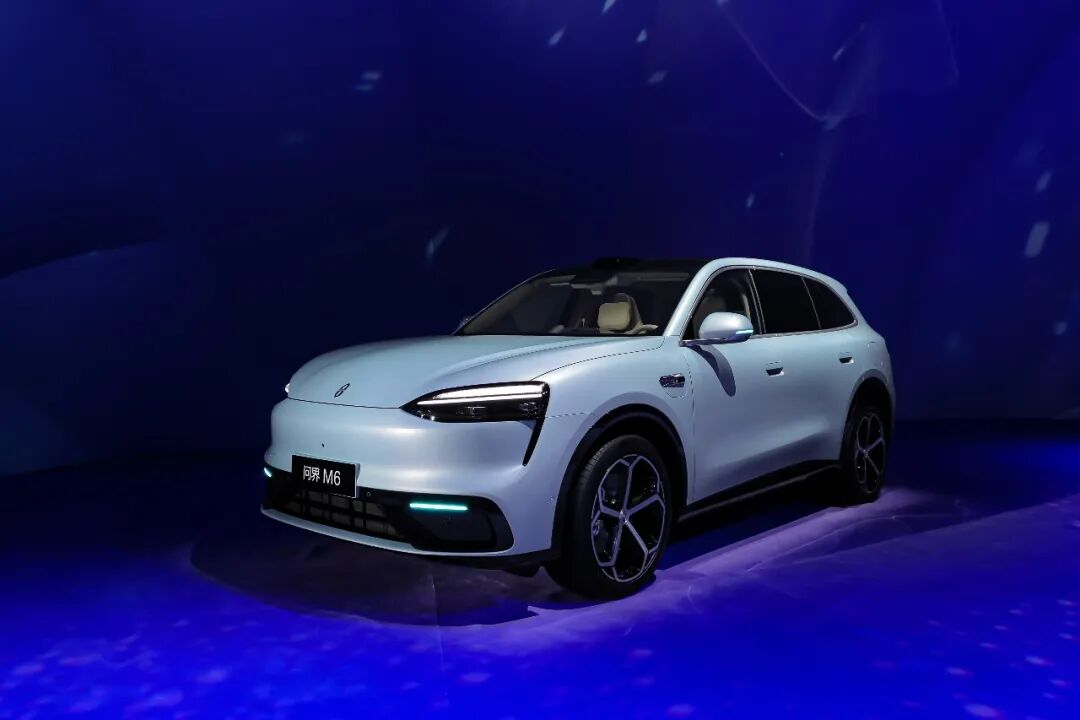
Image source / AITO Automobile's official Weibo
The main models this month were still the new AITO models. In the first month of the M6's launch (from April 22nd to May 22nd), over 20,000 units were delivered. The price ranges from 260,000 to 300,000 yuan, targeting Li Auto's L6, which is also the main price range for mid - sized SUVs in the highly competitive domestic market. A channel insider said that the M6 can not only inherit the recognition of AITO's old users but also attract some new users who are interested in Huawei's intelligent driving but have a limited budget.
The situation where AITO takes the lead is difficult to change in the short term, but the order data in the high - end market at least shows that the appeal of the Huawei label is not a problem. The starting price of the new M9 is 479,800 yuan, and the cumulative pre - orders have exceeded 60,000 units. The Zhijie V9 is priced from 389,800 to 519,800 yuan. It is Hongmeng Zhixing's first high - end MPV, and over 10,500 units were firmly ordered within 48 hours of its launch. In addition, the Shangjie Z7 is positioned between 220,000 and 300,000 yuan. Mass delivery started on May 30th, and over 2,000 units were delivered in two days.
There is indeed room for both upward and downward development. Optimistically, if the three new models, the M9, V9, and Shangjie Z7, increase sales simultaneously, it will be an opportunity for Hongmeng Zhixing to reach the 50,000 - unit mark or even higher. However, the simultaneous development of multiple brands and models will bring up issues such as supply - chain coordination and channel - resource allocation.
The prices of the Zhijie V9 and the AITO M9 overlap, and the target audiences of the Shangjie Z7 and the AITO M6 intersect. The stronger AITO is, the more the other brands need to prove their existence. How to make consumers perceive the differences among the five brands is an issue that Hongmeng Zhixing cannot avoid in the next stage.
02. NIO Bounces Back, Li Auto Declines
Both NIO and Li Auto are at a critical stage of product transition, but they are going in opposite directions: NIO seems to be climbing out of the trough, with improvements in sales, gross profit, and new - product rhythm; Li Auto's orders are not bad, but the delivery volume has not increased, and its profit is also affected by the product structure.
NIO delivered 37,705 units in May, a year - on - year increase of 62.3% and a month - on - month increase of 28.4%. In the first five months, the cumulative delivery was 150,526 units, a year - on - year increase of 68.7%. In April, NIO was still in the last place among the six. After the popularity of the ES8 subsided, the sales volume dropped to a low level. One month later, it ranked third, with the highest growth rate among the six.
The structure is also healthier than before: the main brand delivered 20,013 units, still the high - end basic market. Among them, the ES8 delivered 11,475 units, accounting for 57% of the main - brand delivery volume; LeDao delivered 12,029 units, a month - on - month increase of 124.8%, mainly due to the two new models, the L80 and the new L90; Firefly delivered 5,663 units, remaining stable in the high - end small - car segment.
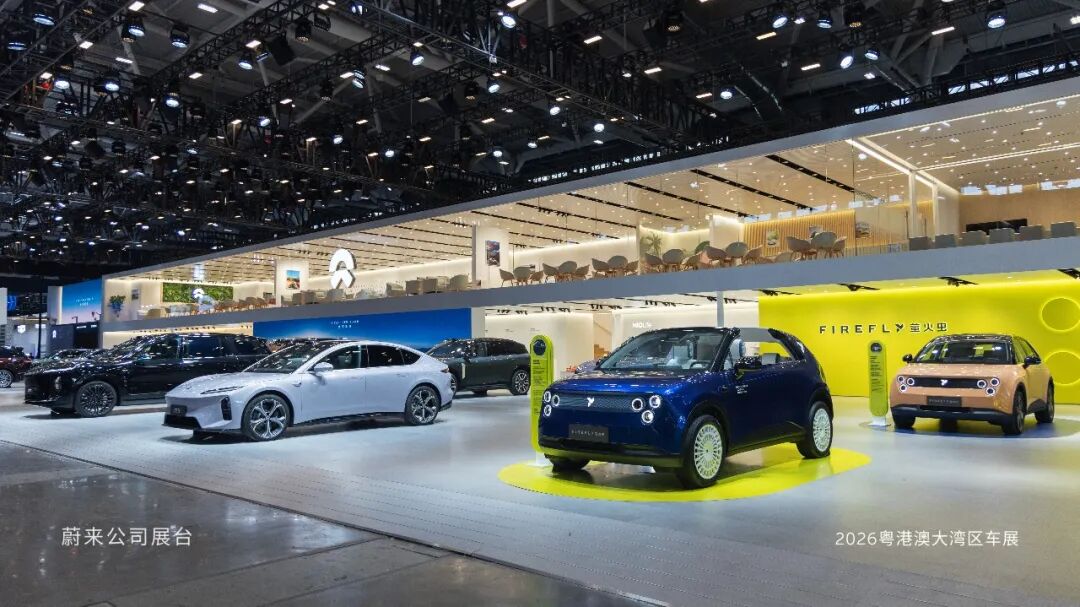
Image source / NIO's official Weibo
In the first five months of this year, NIO's main brand was relatively stable, with an average monthly sales volume of approximately 19,000 to 22,000 units; Firefly remained stable at around 5,000 units; LeDao, which had the largest fluctuations, doubled its sales this month.
The delivery guidance for Q2 is 110,000 to 115,000 units. About 67,000 units were delivered in April and May. Over 43,000 units need to be delivered in June. Considering that June is the first full - delivery month for the four main models, the new ES6, new EC6, new ET5, and new ET5T, which are priced between 300,000 and 400,000 yuan, and the higher - positioned ES9 starts delivery and the new LeDao L60 starts pre - sale, this goal is not too difficult.
NIO's financial situation is also improving. The operating profit in the first quarter was 66.8 million yuan (Non - GAAP basis), making it the only new - force car manufacturer among the top players to achieve operating profit (Non - GAAP basis) in that quarter. The comprehensive gross profit margin increased to 19%, and the gross profit margin of the whole vehicle was 18.8%.
However, the cost - side pressure is still significant. The management mentioned at the Q1 earnings conference that the cost pressure per vehicle exceeded 10,000 yuan, and the prices of chips, lithium carbonate, and copper were all rising. At the same time, NIO and LeDao are accelerating their pace, and it still takes time to verify whether the SKY store model can allocate resources effectively.
Li Auto's situation in May was rather awkward: it delivered 33,350 units, a year - on - year decrease of 18.3% and a month - on - month decrease of 2.2%. Against the background of the general year - on - year growth of the top new - force car manufacturers, it was the only one with both year - on - year and month - on - month declines. In the first five months, Li Auto cumulatively delivered about 162,000 units, also a slight year - on - year decrease of 3% because it was in the transition period between old and new products.
Range - extended vehicles are Li Auto's basic market