One Year Into the Food Delivery War: Meituan Can't Go Back, Alibaba Can't Stop
On June 1st, Meituan released its financial results for the first quarter of 2026.
In this quarter, Meituan achieved revenues of 91 billion yuan, a year-on-year increase of 5.6%. Its operating loss decreased from 16.1 billion yuan in the previous quarter to 6.5 billion yuan. Among them, the operating loss of its core local business was 2 billion yuan, which continued to narrow compared with the previous quarter.
As the last player among the top three food delivery giants to release its financial report, Meituan's financial data this quarter further confirmed the main line of reducing losses in the food delivery war.
Not long ago, Taobao Flash Delivery and JD.com also achieved a narrowing of losses. Among them, Taobao Flash Delivery further clarified in a conference call that it is confident to achieve a positive unit economics (UE) before the end of the new fiscal year.
This represents that the food delivery sector has officially crossed the intense first half and entered the second half of stabilizing market share and optimizing efficiency. And the battle for instant retail has just begun.
Therefore, at this juncture, we believe it is necessary to take a broader view and conduct a periodic review of this battlefield that has been ablaze with activity in the past year, and take stock of the costs and achievements of each player.
Meituan: Maintained half of the market share, but profits and valuation won't return to the previous level
After the release of the first-quarter financial report, we can roughly calculate Meituan's investment in the food delivery war so far.
In 2025, the core local business where its food delivery business is located had an operating loss of 6.9 billion yuan. In 2024, it had a profit of 52.4 billion yuan, a decrease of 59.3 billion yuan in profit. In the latest first quarter, Meituan's core local business had a loss of 2 billion yuan, while in the same period last year, it had a profit of 13.5 billion yuan, with a difference of 15.5 billion yuan.
With an investment of hundreds of billions, Meituan has maintained half of the market share.
A report titled "Focus on China's Internet" released by Goldman Sachs on April 2nd pointed out that Meituan's market share in food delivery has dropped significantly from 75 - 80% before the food delivery war, and is expected to stabilize in the range of 50% - 55% in the long term. The market structure of the food delivery industry has changed from a monopoly to a two-horse race.
Behind the structural changes on the demand side, there is also an adjustment in the supply pattern.
QuestMobile data shows that the monthly active users (MAU) of the Taobao Flash Delivery merchant version increased by 30.4% year-on-year, the merchants of JD Instant Delivery increased by 71% year-on-year, and the MAU of the Meituan Food Delivery merchant version increased by 3.4% year-on-year. Omnichannel operation by merchants has become the norm.
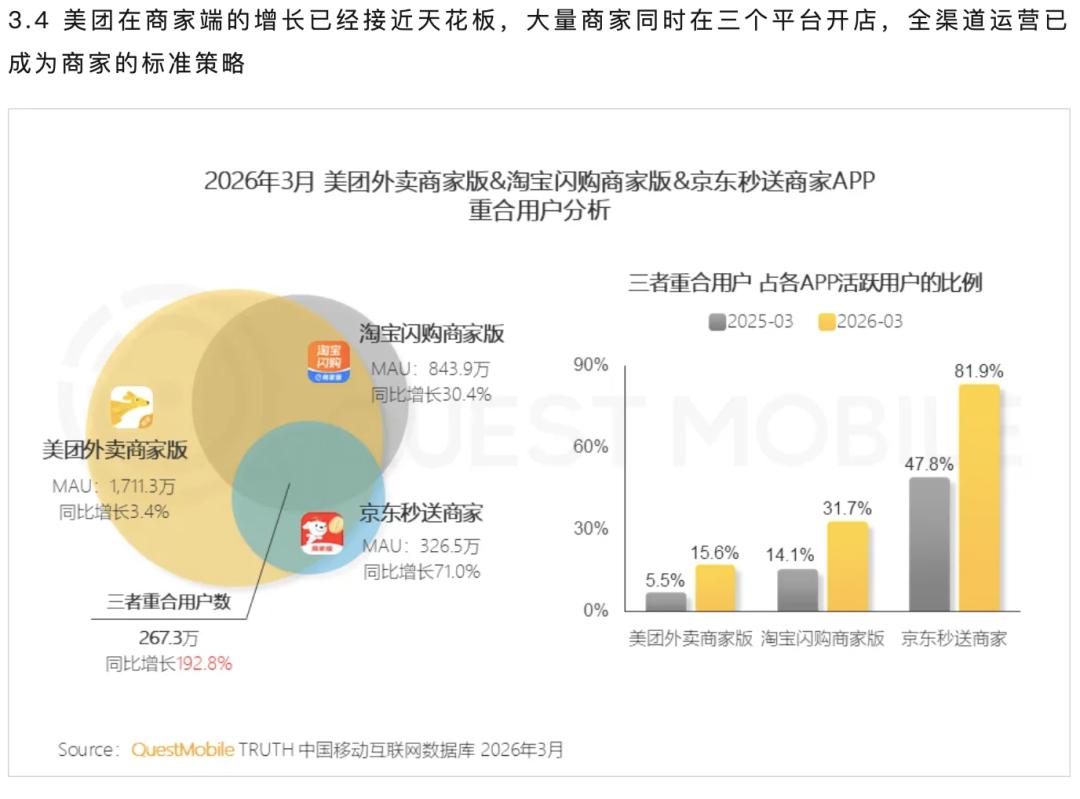
After the adjustment of the market structure, Meituan's long-term profit margin has been inevitably and significantly compressed.
Before the food delivery war, Meituan's UE had actually reached 1.5 yuan, and it was estimated to gradually increase to 2 yuan in the long term, which was the profit per food delivery order. After the food delivery war, the official long-term guidance is to earn 1 yuan per order.
Without the food delivery war, based on a UE of 2 yuan and a daily order volume of 100 million, the annual profit of food delivery and flash delivery could reach 70 billion yuan. After the food delivery war, with the decline of UE and the decrease of order volume, this part of the profit is estimated to be 30 - 40 billion yuan less per year.
The capital market votes with its feet. When you face a more intense competitive environment, the market will require you to have a higher safety margin. Before the war, some institutions gave Meituan a valuation of 20 times PE, which is now a thing of the past. Meituan's stock price has actually shrunk from a market value of over one trillion yuan to less than 500 billion yuan.
However, after the industry structure of food delivery stabilizes, compared with these directly lost profits and losses, what may be more worthy of attention in the future is the opportunity cost caused by the distraction of Meituan's main business.
Douyin's local services seized the opportunity last year and achieved a payment GMV of over 850 billion yuan, and set a target growth rate of 50% for this year. It is reported that Meituan's in-store business fell short of its target last year.
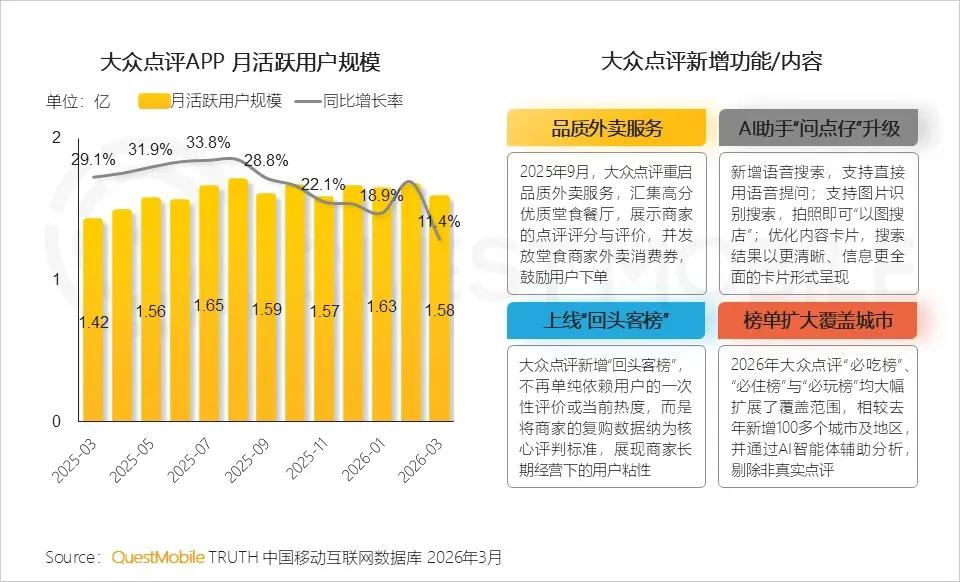
The "2026 Local Life Consumption Insight Report" by QuestMobile pointed out that in March this year, the traffic pressure on the Dianping App increased, and the year-on-year growth rate of monthly active users declined by 11.4%. Meanwhile, the user scale of Douyin's newly launched independent group-buying App, Dousheng, continued to grow, and its daily active users have recently increased to 16 million.
Meituan's internationalization may also be indirectly affected by resource constraints. Meituan's management also mentioned in a communication meeting in March that they are confident and determined about internationalization, but it does not mean that all businesses should be carried out simultaneously; the Brazilian market has great value, but blind expansion should be avoided.
The situation is similar in the field of AI.
Wang Xing seems to have a strong interest in AI. At this year's management communication meeting, he said that "the changes brought by AI will be much greater than those brought by the entire Internet." At the same time, he also believes that Meituan has unique advantages, and that the digitalization of the physical world will be a very important foundation for AI.
However, AI requires a huge amount of capital expenditure and cannot support the main business in the short term.
This is the real constraint that Meituan faces.
Wang Puzhong revealed that Meituan's investment in AI is in the tens of billions of yuan. Compared with ByteDance, Tencent, and Alibaba, which invest hundreds of billions of yuan, after burning 60 billion yuan in the food delivery war, Meituan has relatively limited resources to allocate to AI.
Meituan's self-developed large model, LongCat, was launched in 2023 and was only made public at the performance meeting in March 2025. Meituan's open-source large model has not entered the service pool of the industry's mainstream call platform, OpenRouter, and the total number of stars on Github is only about 5,000, with relatively little influence in the industry.
Some media have counted that Meituan's AI programming tool, CatPaw, has only been updated four times since its release last year, while Alibaba's programming tool, Qoder, was updated 13 times in March alone, and ByteDance's TRAE was updated 10 times in the same month, all with high-density updates and iterations.
In terms of C-end products, the AI life assistant "Wen Xiaotuan", Agent Xiaomei, and the AI browser Tabbit have received little attention. Among them, Tabbit was once involved in a plagiarism scandal. The incident of Meituan App privately deleting users' photos also raised market concerns.
In the past, the capital market often regarded Meituan as a high-certainty local life profit machine. Now, Meituan is more like a local consumption platform fighting on multiple fronts: it needs to defend against Alibaba and JD.com in food delivery, against Douyin and Gaode in in-store services, and also needs resources for overseas expansion and AI.
Alibaba: Invested more than Meituan, but obtained new chips
Now let's look at Taobao Flash Delivery.
As the attacking party, Taobao Flash Delivery's overall investment is greater than Meituan's.
Alibaba's full-year financial results for the fiscal year 2026 show that from April 1, 2025, to March 31, 2026, the adjusted EBITA of its China e-commerce group where the food delivery business is located was 107.5 billion yuan, compared with 193.2 billion yuan in the same period last year, a decrease of 85.7 billion yuan in profit.
However, it should be noted that although both Meituan and Taobao Flash Delivery have invested hundreds of billions of yuan, their logics are opposite. Meituan's focus is on reducing losses, while Taobao Flash Delivery's is on increasing chips.
After the strong growth of its market share, the industry structure has changed from a monopoly to a two-horse race, which has basically achieved the strategic goal for Taobao Flash Delivery.
Disclosed in Alibaba's earnings conference call on May 13th, from January to March, the overall order volume of Taobao Flash Delivery reached 2.7 times that of the same period last year, and the non-food retail volume reached three times that of last year. In terms of market share, Taobao Flash Delivery has basically stabilized at around 45% from 20% before the war.
At the same time, the information that the UE will turn positive in the new fiscal year completely exceeded market expectations.
But apart from the direct market share, Alibaba has also obtained three strategic assets.
First, it is the admission ticket to instant retail
Taobao Flash Delivery, Tmall Supermarket, and Hema constitute Alibaba's instant retail landscape.
With the establishment of Taobao Flash Delivery's order volume and market share, its subsequent path is clearer - it is confident to achieve a positive UE before the end of the fiscal year 2027, the overall transaction volume of instant retail will exceed one trillion yuan in the fiscal year 2028, and the instant retail business segment will achieve overall profitability in the fiscal year 2029.
Alibaba's annual report released recently disclosed that Hema's total GMV has exceeded 100 billion yuan, of which the contribution of online transactions exceeds 60%, and it has achieved a positive adjusted EBITA for two consecutive years.
The management has repeatedly pointed out in earnings conference calls that Taobao Flash Delivery has significantly driven relevant categories, especially in food, fresh produce, and health categories, and has continuously promoted the accelerated development of instant retail businesses such as Hema and Tmall Supermarket.
A three-fold increase in scale in one year shows that Taobao Flash Delivery has changed from a follower in the instant retail market to a leading player.
Scale itself is very important because the economic model of instant retail highly depends on density. The denser the orders, the more room there is for optimization in fulfillment; the more supply there is, the more basis there is for user retention; the higher the user frequency, the stronger the synergy with the main website.
Second, it has strengthened the mental positioning of the Taobao Super App
Currently, Taobao Flash Delivery's daily active users (DAU) are stable at over 100 million, and its MAU is nearly 300 million. These users have formed a clear mental model of instant retail.
According to the QM report, in March 2026, the monthly active users of the Taobao App were 957 million, leading JD.com and Meituan. In the same period, the number of overlapping users of the three increased from 331 million in March 2025 to 361 million, reaching a stage peak.
This shows that users who originally ordered food on Meituan have included Taobao as a common choice for instant consumption.
Instant retail is an important extension of the service capabilities of the Taobao Super App, which further consolidates Taobao's "all-powerful" user mental model.
The "2026 Local Life Consumption Insight Report" by QuestMobile shows that the in-depth penetration of the food delivery business has reshaped the user behavior patterns of e-commerce platforms. In March 2026, the usage frequency of the main websites of Taobao and JD.com both maintained a year-on-year growth of over 10%.
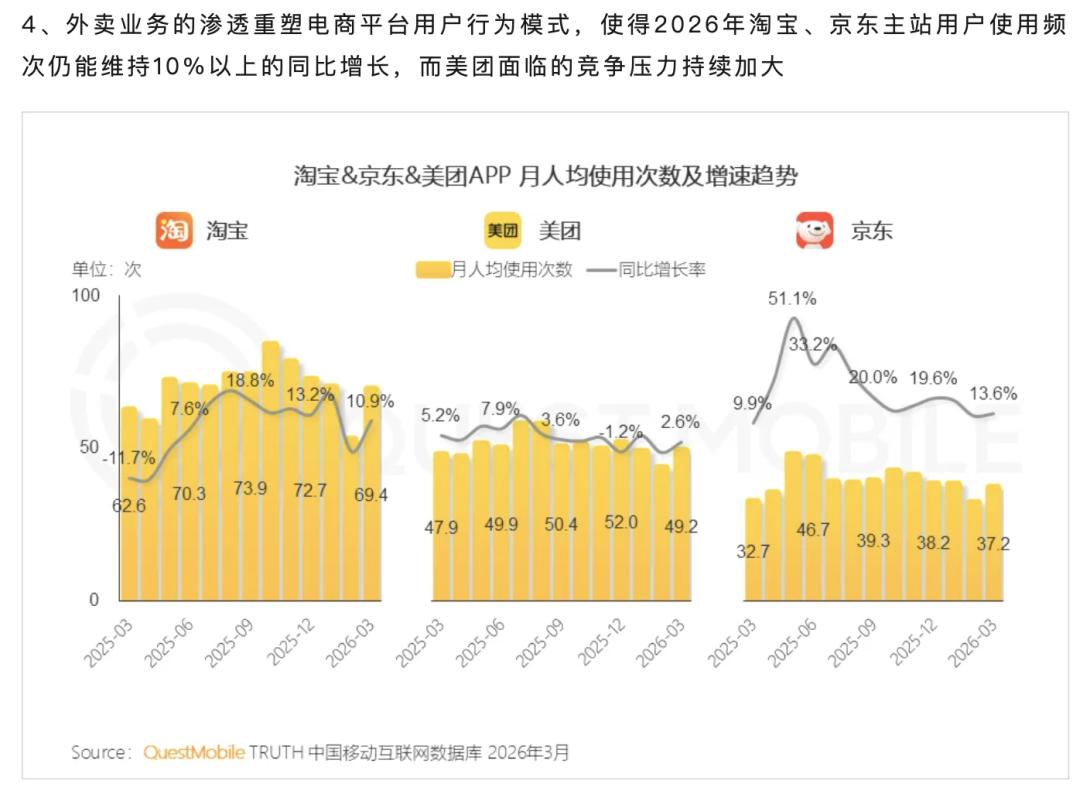
Taobao has a huge amount of traffic on its main website and a large supply of goods, but it has not had a strong presence in local instant consumption in the past. After Taobao Flash Delivery was connected to the main website, food delivery, supermarkets, and non-food instant retail began to support the main website. What Alibaba has made up for through Taobao Flash Delivery is exactly the high-frequency entry that traditional shelf e-commerce has been most lacking in the past few years.
Third, it is the suppression of potential retail competitors of the same level.
Meituan has been continuously investing in the direction of instant retail in the past few years. If Meituan is allowed to continue its unilateral expansion in near-field retail, it may become a long-term threat to Alibaba's retail hinterland. This battle of Taobao Flash Delivery has directly changed this trend. Alibaba has brought local instant consumption back to the Taobao system with high investment, and turned Meituan's unilateral offensive in the near-field retail into a stalemate.
Actually, Meituan has long been the fourth-largest Chinese concept stock in terms of market value, posing a threat to Alibaba in terms of scale. Therefore, Alibaba's investment of hundreds of billions of yuan is also a strategic suppression of potential competitors of the same level. If this money is not spent, Meituan's scale may gradually approach Alibaba, forming direct competition in multiple aspects such as e-commerce and local life.
In this regard, spending hundreds of billions of yuan, this competition is a more cost-effective strategic investment for Alibaba.
Meituan spends money to maintain its existing profit pool, while Alibaba spends money to buy market share, the path of instant retail, and a large consumer entrance. Taobao is advancing from traditional shelf e-commerce to a complete consumption system of "far-field e-commerce + near-field instant retail", which is a victory in terms of strategic position.
JD Food Delivery still has a long way to go
Finally, let's look at JD.com. Starting from scratch, JD Food Delivery has been able to obtain a single - digit to low double - digit market share in about a year, which objectively proves JD.com's ability and