Disassembling the "physical body" of demolition robots, mass production and supply chain: After completing a somersault, it still needs to learn to catch a falling leaf
On June 1st, Unitree Technology's application for IPO on the Science and Technology Innovation Board successfully passed the review of the Shanghai Stock Exchange's listing review committee. Not long ago, Unitree also released its first manned transformable mech. How far are we from the real implementation of robots?
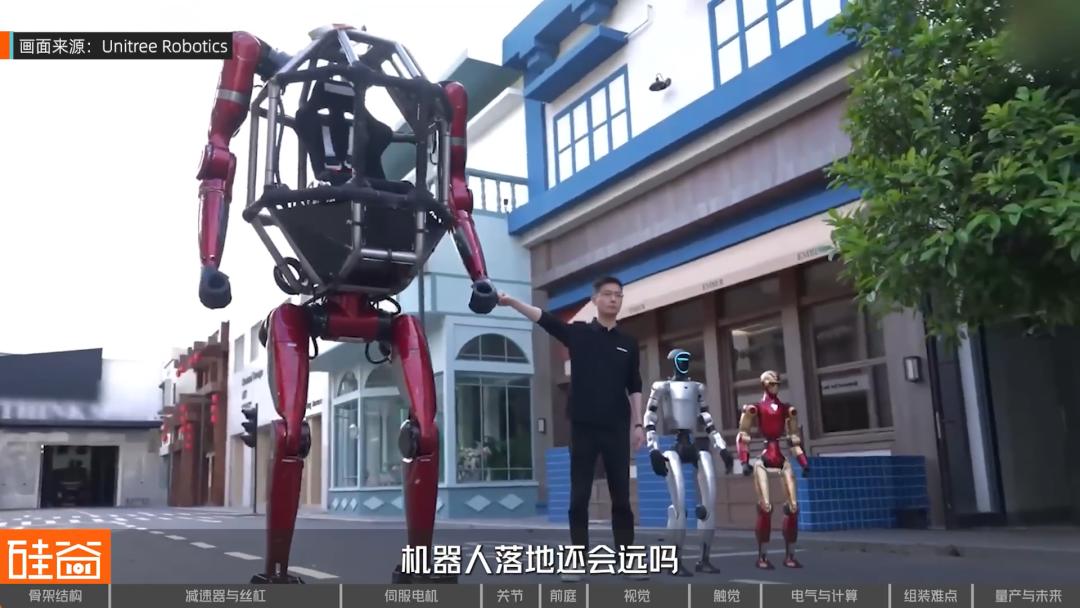
During last year's Spring Festival Gala, robots were still twirling handkerchiefs and doing yangko dances. This year, they have advanced to performing high - difficulty somersaults and martial arts. Nowadays, even robots made by mobile phone manufacturers can break human records on a half - marathon. Why has the evolution of robot bodies been so rapid in the past two years?
To further understand the evolution of robot bodies, we visited some leading robot companies and talked to some industry insiders: What are the difficulties in building robots? Is the threshold for manufacturing robots really not high? What exactly is the moat of robot companies?
In this article, we will break down each part of a robot in detail. I believe that after reading it in full, you will be able to assemble a robot by yourself.
01 Skeleton Materials: Balancing Lightweight and Impact Resistance
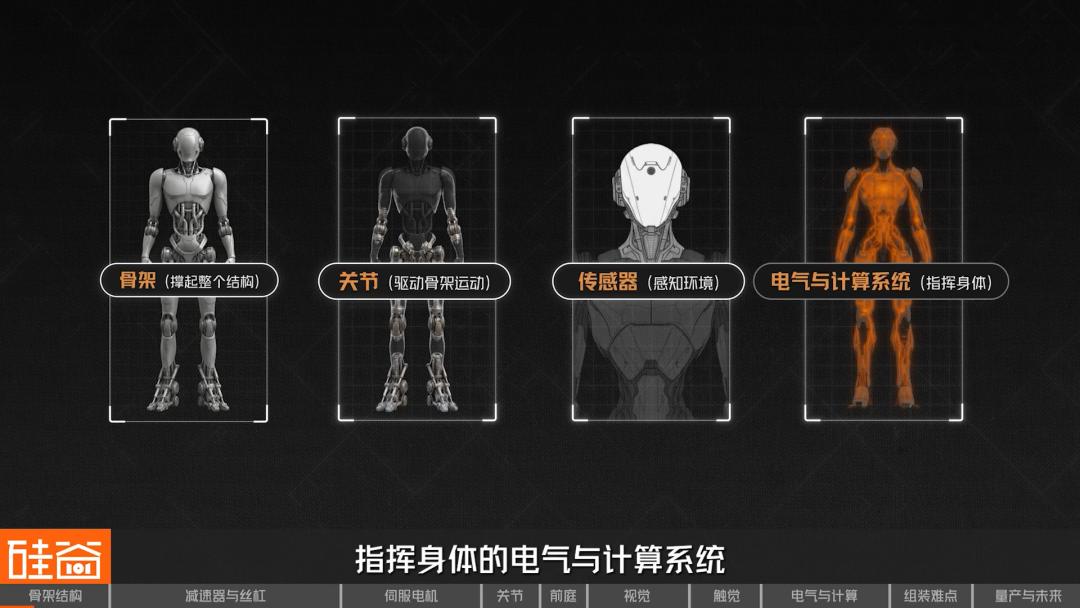
There is a wide variety of hardware on a robot. We can roughly divide it into four systems: the skeleton that supports the entire structure, the joints that drive the skeleton to move, the sensors that perceive the environment, and the electrical and computing systems that command the body. Let's start with the skeleton.
If a car hits a dummy at a speed of 60 kilometers per hour, due to the huge impact force, the dummy will fly out and break into pieces. For humanoid robots, withstanding such an impact force has become a "daily routine".

Wang Chuang
Partner/Senior Vice President/President of the General Business Department at Zhipu
Every time a robot lands after a somersault, the acceleration it withstands on its body is dozens of g, which may be higher than that of cars and aerospace, similar to the acceleration when a car hits a wall.
This poses a challenge to the structural materials of robots: to perform somersaults, the body needs to be light enough, and it also needs to have high strength to withstand such a large impact force. Otherwise, a single somersault might cause the parts to fly out. So the first challenge for robots is to explore skeleton materials.
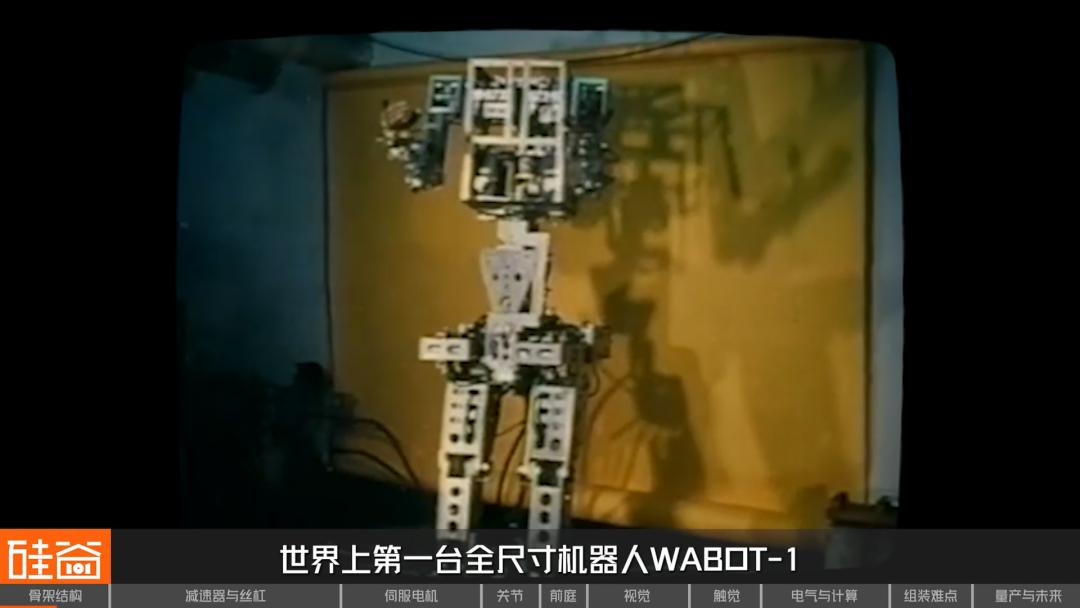
The world's first full - size robot, WABOT - 1, was mainly made of steel and weighed about 160 kilograms. It might leave a dent in the floor with just a jump, let alone do somersaults.
Later, from Honda's ASIMO, the early hydraulic version of Boston Dynamics' Atlas to the first - generation Tesla Optimus, aluminum alloy became the mainstream. Its density is only one - third of that of steel.
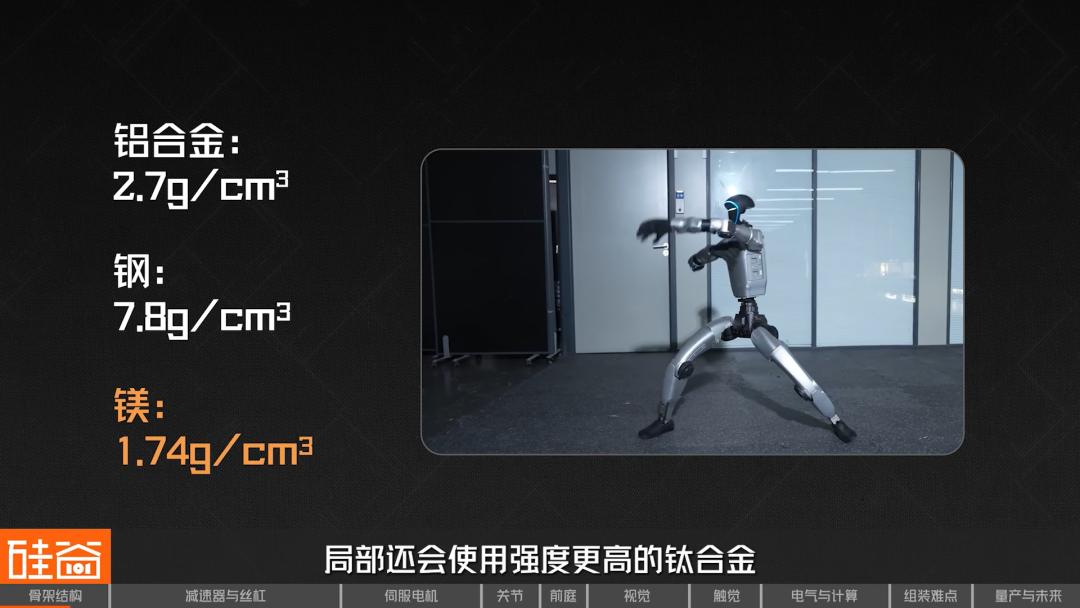
Now the industry has begun to explore more materials, such as magnesium alloy, whose density is one - third lower than that of aluminum. Titanium alloy with higher strength is also used locally, such as in the knee joints and ankles that often need to withstand impacts.
Interestingly, these hard skeletons bear the impact for robots, but suppliers seem to earn only a "hard - earned fee".
A former procurement director of a robot company
After removing the metal content and the discarded waste from the final selling price of the skeleton, the ratio is actually very, very low. The skeleton is finally sold at the cost of metal plus processing fees. Most of the cost is still the metal inside, and there is no room for price reduction. Its processing fee is still within a reasonable range. If the volume increases, the processing fee will approach a very low level because there is not much of a threshold.
In addition to these core skeletons, the appearance parts of robots can be divided into two categories:
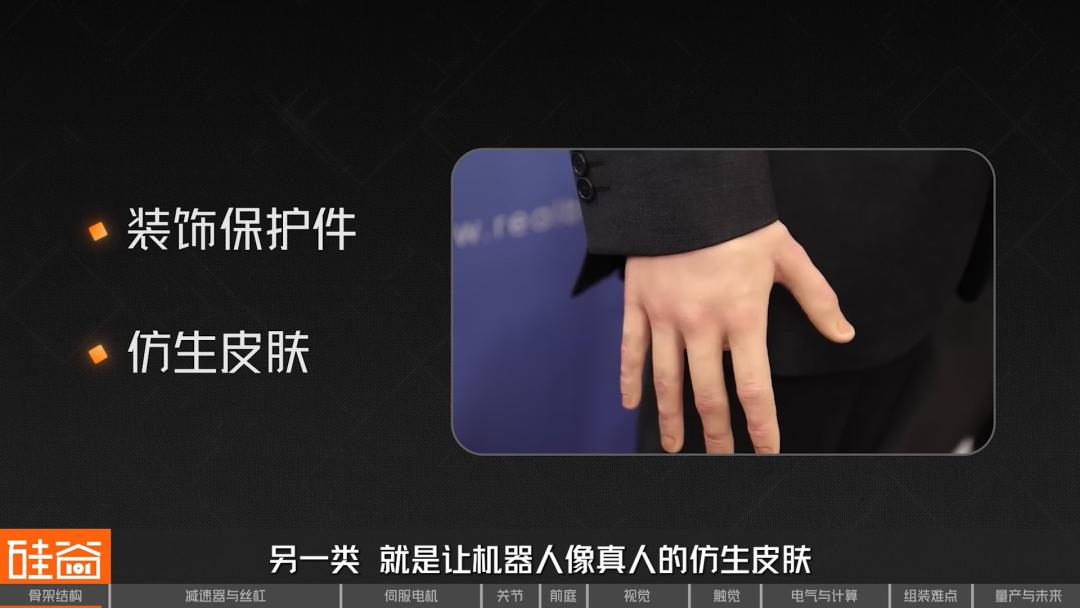
One type is decorative and protective parts, which are mainly used on the chest, back, and head. The materials range from plastics, imitation leather TPU to fabrics. Their main purpose is to reduce wear and make the touch more friendly. Although some robots seem to have a metal body, in fact, they have a plastic shell with a layer of metal paint.
The other type is the bionic skin that makes the robot look like a real person. This skin not only needs to feel like human skin but also needs to have tactile sensors implanted under the skin.
Beyond the skeleton and skin, it is the joints that truly enable robots to perform various extremely difficult actions. This is also the most costly, technologically intensive, and story - filled part of the entire robot hardware.
02 Disassembling the Actuator: The Joints Are the Most Expensive and Difficult Part
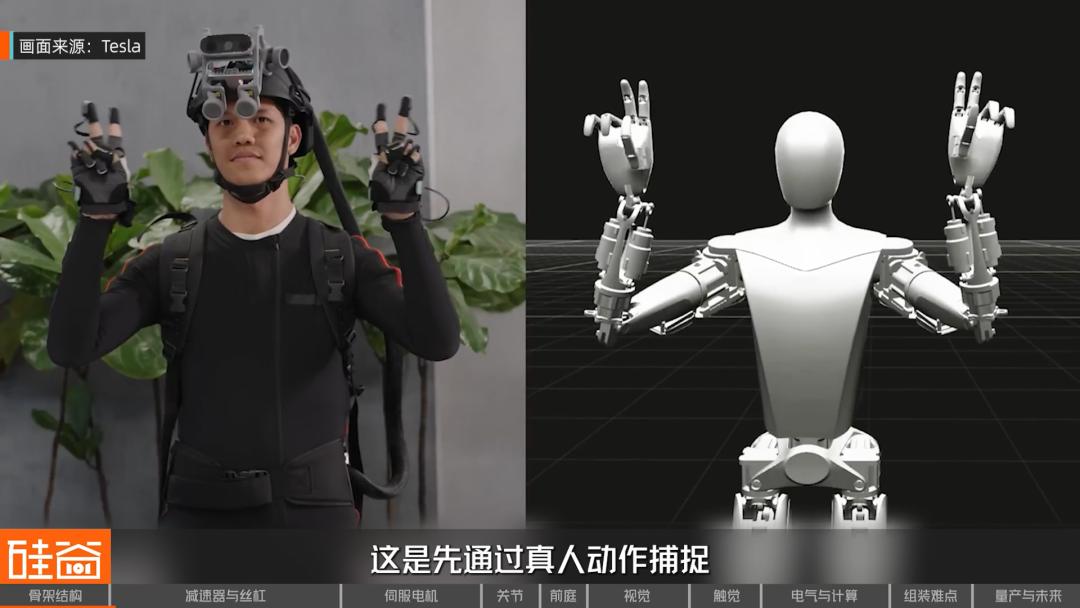
Surely you have seen many videos of robots dancing and doing somersaults. These are achieved by first capturing human movements, then training models, and finally mapping them to the robot's limb movements.
A few years ago, when we saw Boston Dynamics' Atlas do a backflip, we were very surprised. But now, it may seem commonplace to everyone. The reason behind this is that the joints of robots have undergone a transformation from hydraulic systems to motors.
Wang Chuang
Partner/Senior Vice President/President of the General Business Department at Zhipu
Previously, we couldn't build such powerful joints. At that time, the performance of joints was very poor, and it was very difficult to do somersaults. In the past one or two years, the technology of joints has made great progress.
Joints are called actuators in the industry and are mainly divided into rotary actuators and linear actuators. Let's take the shoulder as an example to see how they drive the body to move.
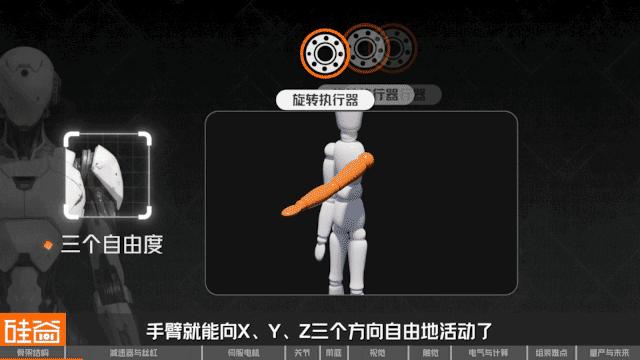
The shoulder has three degrees of freedom: forward - backward swing, up - down lift, and internal - external rotation, which are called pitch, roll, and yaw. In essence, these movement modes are all rotations. So, through the combination of three rotary actuators, the arm can move freely in the X, Y, and Z directions.
For the knee joint, generally only one degree of freedom is needed, so a rotary actuator or a linear actuator can be used. The linear actuator is like the human muscle, which drives the upper and lower bones to move through stretching.
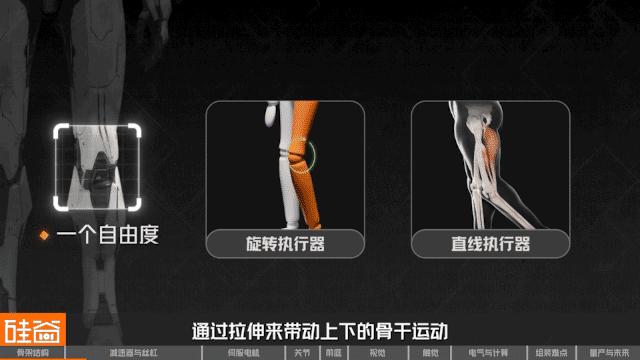
To perform an extreme action, dozens of actuators throughout the body need to work closely together. If any part fails to respond in time or there is a slight deviation in force, the result will be a fall.
What is the structure inside these actuators? Both rotary actuators and linear actuators have a servo system, which consists of a motor, an encoder, a driver, and a sensor. The biggest difference between them is that the rotary actuator is a servo motor plus a reducer, while the linear actuator is a servo motor plus a lead screw.
Let's start with the reducer.
Chapter 2.1 Rotary Actuators and Reducers
Perhaps you have heard of this device. When the first gear rotates 10 times, the second gear rotates only once, and the third rotates only 0.1 times. There are a total of 100 gears, and so on. If you want the last gear to rotate once, the first gear needs to rotate a googol (1 followed by 100 zeros) times, and the required energy exceeds the total energy of the entire universe.
This is a large - scale reducer, which is essentially a huge lever that sacrifices speed for power. Why do robot joints need reducers?
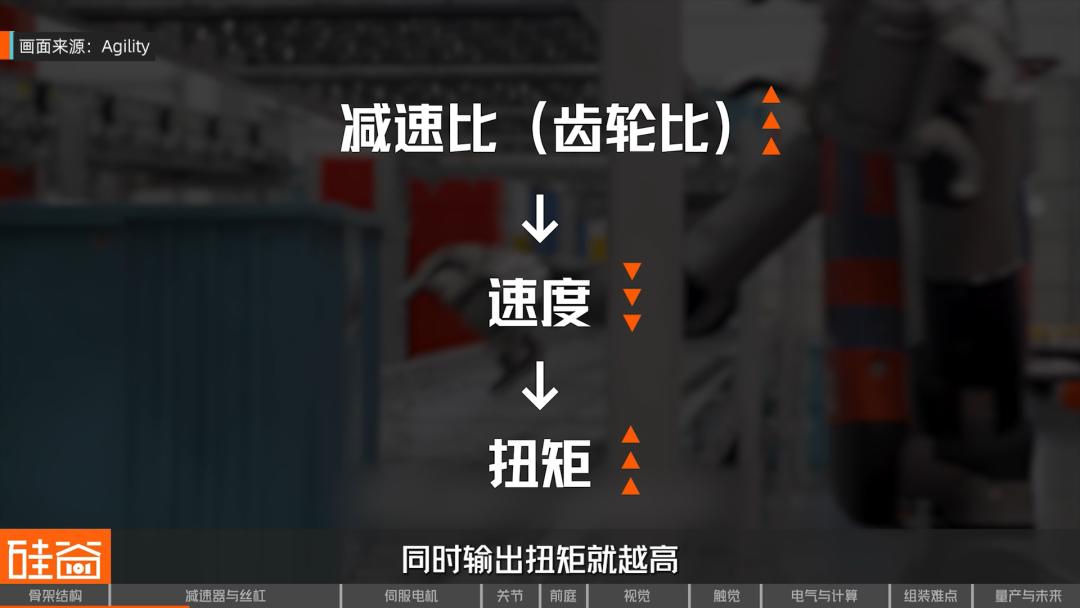
Because motors are inherently "high - speed, low - torque": they can easily reach speeds of tens of thousands of revolutions per minute, but the output torque is relatively small. Robot joints require precise control. It is very difficult for a motor to rotate only a few degrees while being able to move very heavy objects. So, a reducer is needed to reduce the speed and increase the torque. The larger the reduction ratio (i.e., the gear ratio), the more the speed is reduced, and the higher the output torque.
There are three types of reducers most commonly used in the industry: planetary reducers, harmonic reducers, and RV reducers. Let's use models to explain them to you.
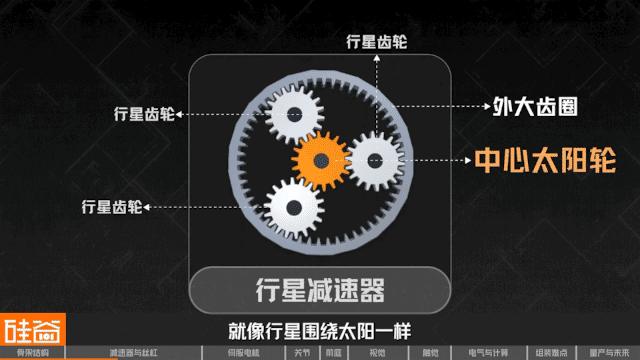
First is the planetary reducer. Its name is very vivid: the motor is connected to the central gear, which drives three planetary gears, and the planetary gears then drive the outer large gear to rotate, just like planets orbiting the sun. It has a small structure and low cost, but a relatively small reduction ratio. With the same motor speed, the output torque is lower, so it is commonly used in hand joints.
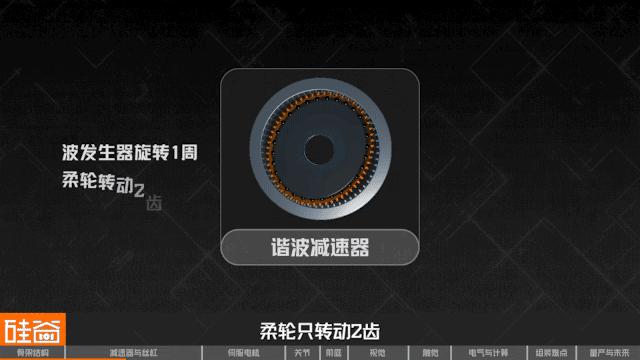
When a greater output force is needed, the harmonic reducer is used. The center of it is a wave generator, which stretches the sandwiched flexible gear into an oval shape. Generally, there is only a difference of 2 teeth between the flexible gear and the fixed steel gear on the outside. The flexible gear only meshes with the steel gear in two symmetrical areas. So when the central wave generator rotates one week, the flexible gear only rotates 2 teeth, so the reduction ratio can be very large.
The harmonic reducer has a strong output torque and high precision, and is commonly used in the elbow and shoulder joints of robots to achieve precise control of the arms.
As mentioned earlier, when a robot does a backflip, the force it withstands is equivalent to that of a car collision, which also poses a great challenge to the reducers in specific parts. However, the flexible structure of the harmonic reducer also means poor impact resistance. At this time, the RV reducer is needed.
The RV reducer consists of a first - stage planetary gear and a second - stage cycloidal pin gear. After the first - stage speed reduction, the eccentric cam drives the cycloidal disc to do eccentric motion. The cycloidal disc meshes with the pin teeth on the housing, pushing the housing to rotate.
In this way, not only is the reduction ratio large, but because multiple teeth of the cycloidal disc mesh at the same time, it has good rigidity and stronger impact resistance. It is commonly used in the hip, knee, and waist joints of robots that need to withstand impacts.
