The OPCs are too busy to care about the doubts. They want to make good use of AI rather than being replaced by it.
In 1996, Na Rongyu pushed his phone over. The screen showed a row of alarms set for two or three o'clock in the morning. "It's not good to work when you're sleepy. It's better to take a nap and then get up." This is one of his rules for scientific overtime work.
In fact, he also has a complete set of methodologies: eat only protein in the morning, eggs and coffee, so that blood sugar won't rise and you won't feel sleepy; eat only vegetables at noon to continue preventing blood sugar from rising; carry a "small medicine bottle" with him to supplement vitamin D and B6, and also get more sun exposure to stabilize his mood. He joked about himself, "I'm also an AI."
Na Rongyu is the founder of Suyuan Matrix, working in the field of AI + materials, trying to build an AlphaFold in the materials field. After returning to China for one year, they signed orders worth nearly 30 million yuan.
There have always been doubts about OPC, that is, "One - Person Company" in the market. Many voices say that this model won't last long and one person can't achieve much. But when we got in close contact with OPC entrepreneurs in Haidian, Beijing, we found that no one really cared about these doubts. They only had their own products in mind and were determined to forge ahead.
Obviously, this is a wiser attitude. It would be a pity not to make good use of the technological dividends brought by AI and the various support policies introduced by local governments.
The most creative people have set off with the lowest cost
Wang Yubo had worked as a developer and product manager in several large companies. One day in 2025, she tried using ChatGPT to make a webpage at home. To her surprise, just by chatting with the AI, she got it done in one afternoon.
This engineer, who used to follow the traditional programming methods, was greatly impacted. Considering that her current job in advertising risk control didn't match her personal development direction, she chose to quit her job without a new one lined up.
Subsequently, Wang Yubo studied photography and helped her friends with an audit project. Finally, she found that she could combine her love for traditional Chinese music with AI. She has been learning traditional Chinese music since childhood. After starting work, she would still participate in an orchestra in the evenings while working during the day. Now AI has given her an opportunity to turn her hobby into a career. Then she settled in the Zhongguancun AI North Latitude Community and officially started her business.
Her current daily routine is as follows: 95% of the code is written by Claude, data analysis is handed over to Codex, and operation copywriting is processed by Doubao. "The execution layer is all done by AI. I mainly do verification and direction adjustment." She set the direction last November, and in April this year, she launched her first product, the "Shengxu Intelligence" mini - program, whose main functions include converting sheet music from staff notation to numbered musical notation, one - click key change, voice part splitting, etc.
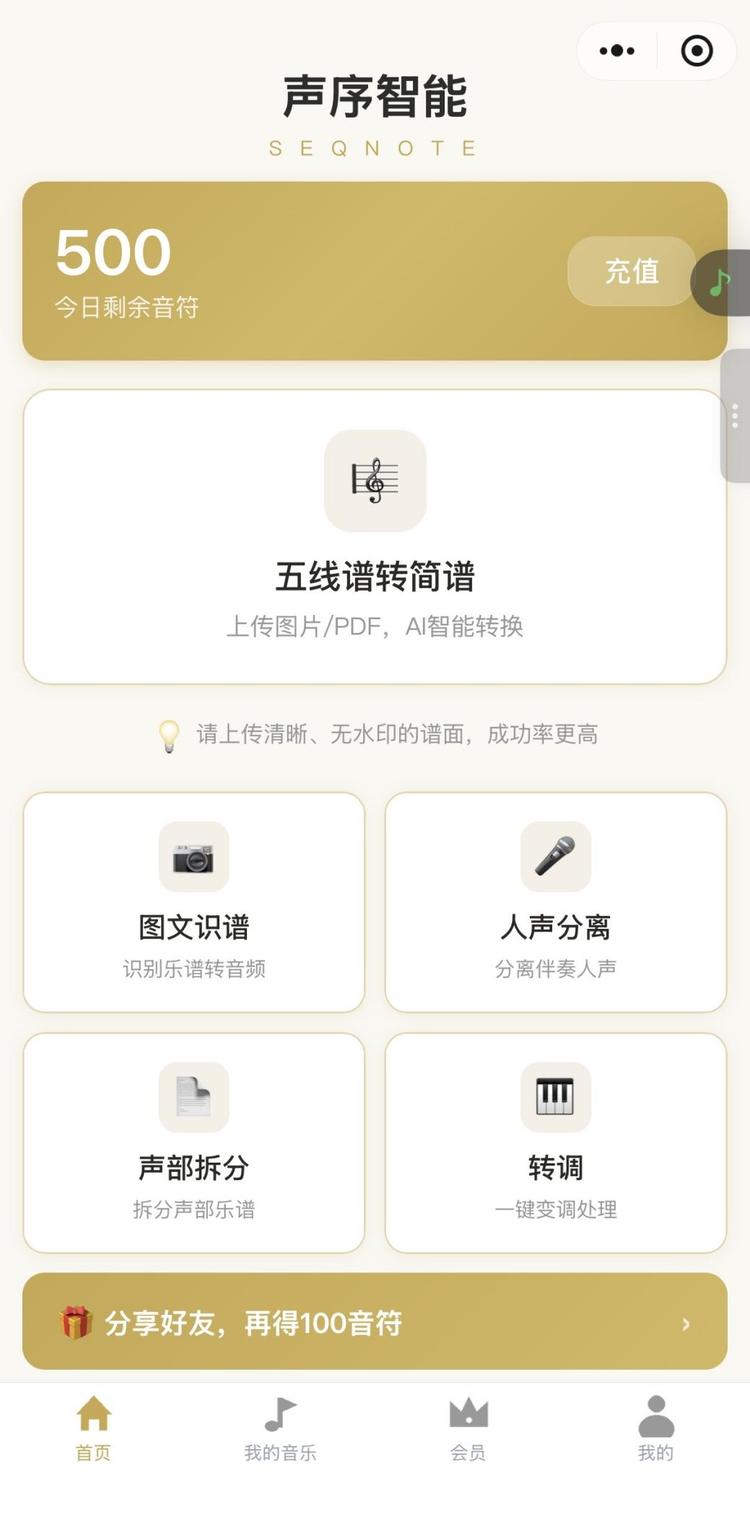
Shengxu Intelligence mini - program
The demand here is that there are 60 million users learning traditional Chinese musical instruments in China, 80% of whom can only read numbered musical notation, while 90% of modern music is in staff notation. This huge mismatch between supply and demand has created a precise entrepreneurial opportunity. After the launch of this mini - program, through word - of - mouth, it achieved a 38% payment rate.
It seems that Wang Yubo's entrepreneurship is full of excitement and fun. This is very different from her state in large companies before. Without AI, it would be difficult for Wang Yubo to realize her ideas. The same is true for the other three OPC projects we contacted.
Zhu Yangyang, who also quit his job to start a business, developed an AI diary product called Lumos Diary. Although diary - type products don't seem new, Zhu Yangyang attaches great importance to it. In his opinion, ordinary people rarely have the opportunity to have their own history. He hopes that Lumos can play the role of a "personal historian".
It can not only record text but also multi - modal information such as voice, photos, and location. Its goal is to allow users to review their past behavior patterns, infer future decisions, and handle their current emotions. Lumos can generate visual "emotion petals" from people's emotions and provide companionship and emotional value through built - in AI pets and other AI characters.
Zhu Yangyang's team only has two people in total, and they make full use of AI. Inside the company, they are developing a PAL (Product Agentic Loop) system, trying to let the intelligent agent autonomously complete the cycle of product iteration. This includes product pre - research, task planning, subsequent design, development and testing, as well as later product launch and operation, all of which are attempted to be completed through AI.
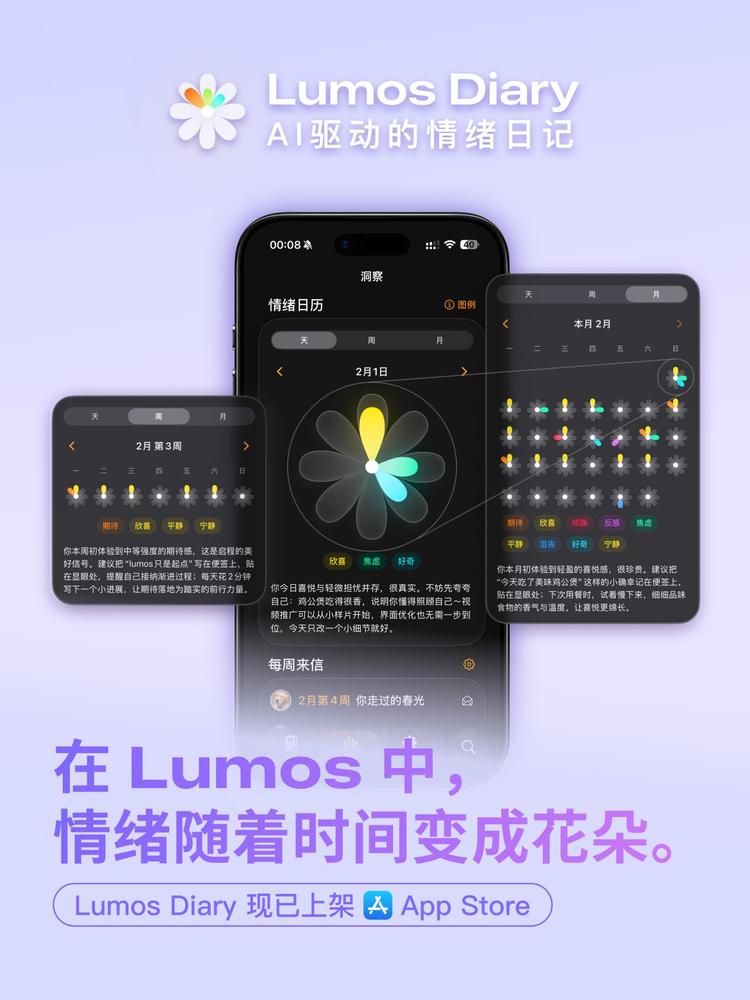
Emotion petals of Lumos Diary
The other two projects target the B - side market.
Guo Jilong is a doctoral student at Beijing Zhongguancun College. His entrepreneurial project, CasePilot, is an intelligent recommendation platform for supply - demand matching. Many enterprises want to carry out AI projects but can't clearly state their requirements and can't find suitable external teams. CasePilot can transform the enterprises' vague goals into structured tasks, then match reliable expert teams, and automatically archive meeting records, documents, and delivery materials during the project.
Na Rongyu's direction is the most hardcore. Their Suyuan Matrix is focused on the materials field. On the one hand, it can use AI to understand the process, predict quality, reduce waste, and improve the yield rate to optimize the existing material production process. On the other hand, it can also use AI to develop new materials.
Obviously, these four directions are very different. But when putting these projects together, the outline of OPC becomes clearer. The so - called "One - Person Company" is not limited to a certain industrial direction or "one person". It is more like a new way of starting a business. Many projects used to consume a large amount of manpower. Now, with the help of AI, small teams can start with low costs. And various support policies make OPC entrepreneurship smoother.
Take Haidian as an example. The first article in the "Several Measures of Haidian District on Comprehensively Building an OPC Entrepreneurship Ecosystem" issued this year states: Encourage scientific and technological talents of various types, such as scientific research personnel from universities and research institutes, current students, alumni within 5 years of graduation, and technical talents from key enterprises, to establish OPCs around the "1 + X + 1" modern industrial system direction. After being recognized, eligible enterprises will be given 50,000 yuan of entrepreneurship funds annually for 2 consecutive years.
All four entrepreneurs noticed this article, which greatly lowered the first threshold for everyone to transform their ideas into entrepreneurial projects.
Haidian also provides housing security for OPC talents, further reducing the burden of entrepreneurship. For young founders of recognized OPC enterprises, they can be allocated talent - guaranteed housing in a targeted manner and enjoy a 50% discount on rent for a maximum lease term of 3 years. Those who are not allocated talent - guaranteed housing can apply for a monthly housing subsidy of 2,000 yuan for a maximum of 2 years. Those who rent houses in the northern rental market of Haidian will be given an additional monthly housing reward of 1,000 yuan.
Therefore, in Haidian, as long as people have ideas and are willing to try, they can start their own businesses with the lowest cost.
Although demos are everywhere, good products can be sold
However, product implementation is only the first step. How to make customers willing to try and pay is still a challenge that must be overcome.
In fact, the biggest doubt faced by OPC is commercialization. Many demos remain just demos and can't turn ideas into income. Wang Yubo found a niche demand of a relatively niche group and quickly achieved payment conversion, but this situation is not common. However, if a product can truly solve the unmet needs in the market, it is at least easier to realize its value.
Suyuan Matrix is the most convincing example. In their view, the first priority of entrepreneurship is to get things done and verify success. With verification results, commercialization can naturally be promoted.
The practical difficulty of this project is as high as its imagination space. Different from consumer - oriented applications, the industrial field is not just about users clicking to try. So at the specific implementation level, Suyuan Matrix divides its business into two steps. They are not in a hurry to develop new materials but first use AI to optimize the existing material production system.
In traditional processes, many links rely on the experience of senior workers. Slight changes in temperature, pressure, flow rate, and raw material status will cause changes in quality and yield rate. Na Rongyu judged that at least 30% of the value of a material is wasted in the production process. So using AI to produce existing materials well already has enough value.
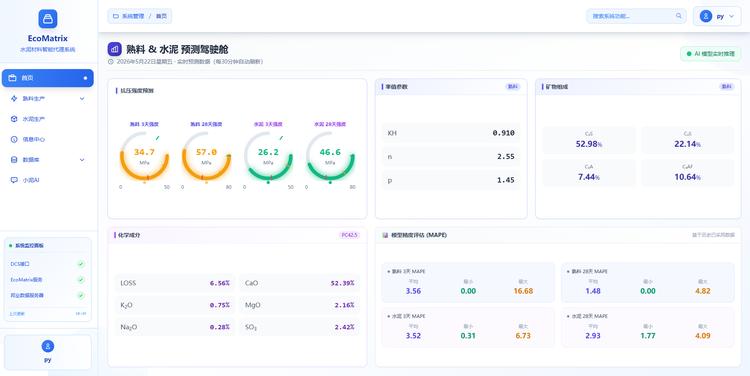
Suyuan Matrix's intelligent agent system for cement materials
Enterprises' demand in this aspect is also increasing. The "15th Five - Year Plan" requires AI and intelligentization. Material enterprises need to find ways to combine AI with core processes and core production links. And we represent a brand - new technology. However, it also takes some effort to win customers.
Before they can really enter the production line, Suyuan Matrix proves its ability by predicting production quality. They use AI to predict the strength, tensile strength, and corrosion resistance of materials and then compare the results with the laboratory test results. If the error is small, it means the AI's ability is real. And the efficiency improvement is quite significant. Na Rongyu introduced that the traditional method requires 300,000 sets of data for relevant predictions, while they only need 300 sets on their own model.
In this way, Suyuan Matrix gained the trust of enterprises. Although the company has only been established for a little over a year, it has won orders worth nearly 30 million yuan. And in addition to the orders, they also have the opportunity to get additional rewards.
In the measures of Haidian to support the OPC entrepreneurship ecosystem, Article 7 is worth mentioning separately. It encourages OPCs to achieve commercial breakthroughs. For OPCs with a cumulative order amount of 20,000 yuan or more within one year of establishment, a one - time reward of 20,000 yuan will be given; for OPC enterprises with a cumulative order amount of 1 million yuan within two years of establishment, a reward of 100,000 yuan will be given; for OPC enterprises with a cumulative financing amount of more than 1 million yuan, a one - time reward of 100,000 yuan will also be given.
It pushes the evaluation standard of OPCs one step forward, from "whether you have started a business" to "whether you have customer recognition". And this exactly hits the lifeline of OPCs. Orders not only mean a single income but also a market calibration. Only when someone is willing to sign a contract, pay, and try the product can the project truly pass through the earliest door of entrepreneurship.
Wang Yubo and Guo Jilong also have the opportunity to get rewards from this policy.
Guo Jilong's product has also achieved commercialization, with a single order worth about tens of thousands of yuan. Although the amount is not large, it shows the feasibility of the product direction. However, as a B - side project, subsequent promotion is not easy. And he and his entrepreneurial partner are both doctoral students, so they don't have to worry about accommodation. The financial support at the initial stage can make them more at ease to promote their subsequent plans. They have set two long - term goals. On the one hand, they want to increase the number of users on the demand side. On the other hand, they are actively expanding the expert team to obtain more data resources from the supply side.
From a practical point of view, funds are indeed the most indispensable support.
For early - stage OPCs, money is not just a subsidy but also means a buffer during the product verification period. Especially for B - side projects, the customer decision - making chain is long, the trial period is long, and trust is established slowly. A project from demand communication, plan polishing, POC verification, to contract signing, delivery, and acceptance often consumes a lot of time, money, and energy.
Haidian focuses its support on key nodes such as order breakthroughs and financing. This not only encourages entrepreneurs to move from demos to the real market but also helps them survive one more verification and complete one more customer process, thus increasing the possibility of expanding their business.
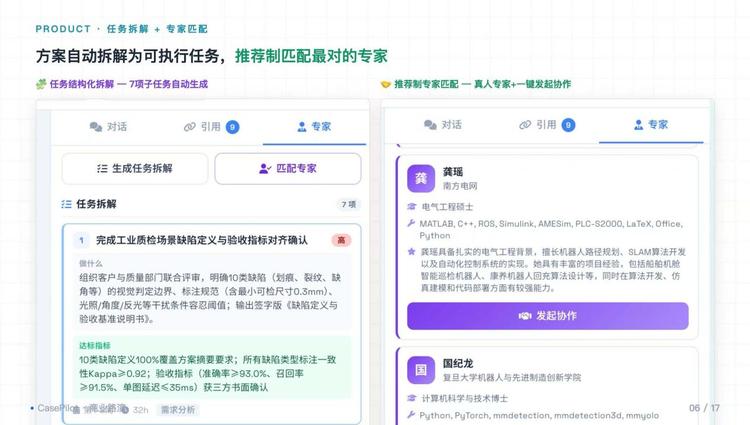
CasePilot uses AI to help enterprises disassemble tasks and match experts
Instead of waiting to be replaced by AI, stand with AI
Now, Wang Yubo plans to expand her product chain. She hopes that ordinary people who are completely unfamiliar with traditional Chinese music, music lovers, and professional groups can be served by different products.
After the "Shengxu Intelligence" mini - program, she developed the "Zhiyin Xia" in one afternoon. This product analyzes data such as the user's schedule and meeting frequency in the computer, perceives the user's emotions in real - time, and then intelligently recommends music to adjust the user's physical and mental state. Subsequently, "Zhiyin Xia" evolved into a music art installation. If you provide a piece of text, picture, or video, it will display the corresponding traditional Chinese music skills, compose music with strangers, and provide NFC physical cards as a memory keepsake. With the help of the ecological service staff in the Zhongguancun AI North Latitude Community, this installation will appear at the Aranya Drama Festival Migratory Bird 300 event in June.
From this, we can also see the potential of OPC. However, as the ideas increase, the "One - Person Company" will reach its limit.
Looking back at the OPC model itself, Wang Yubo believes that OPC can be a starting point but definitely not an end. She now needs partners in hardware and marketing because as the business develops, she can't do development, operation, and event organization alone. In her opinion, a company with one to ten people can be called an OPC, and the state of having ten people may be the most prosperous period for an OPC.
Similar judgments can also be seen from other entrepreneurs.
Lumos Diary was initially developed by Zhu Yangyang in his spare time. Then partners joined to share the back - end and technical architecture. Guo Jilong believes that one or two people can handle a project, and the cost is much lower than that of a team of ten or twenty people. But in many cases, OPC is more like a transitional stage. As for Na Rongyu's Suyuan Matrix, the project is the most complex, and they have already set up a small team of more than ten people.
Many doubts about OPC focus on the "number of people", but this kind of focus is meaningless. If you only focus on "exactly how many people", you will miss the era dividends brought by AI.
In fact, the real change brought by OPC is not to simplify the "company" to one person but to allow a person's good ideas to germinate and develop smoothly. This idea can be advanced by one person all the time and finally grow into a small and beautiful flower field; or it can gather like - minded companions to cultivate together and finally have the opportunity to become a forest.