Meituan Suffers Heavy Losses in Q1. Can Its Advantage in High-Value Orders Last?
Perhaps the food delivery industry is in a more difficult situation than the new energy vehicle industry.
Since JD.com entered the food delivery industry aggressively at the beginning of last year, the cut - throat price competition in the food delivery field has lasted for nearly a year. The game of burning money to increase order volume has intensified, while the profitability of the industry has been declining. Almost all major platforms have presented dismal performance.
In the fiscal year 2026, the adjusted EBITA (Earnings Before Interest, Taxes, Depreciation, and Amortization) of Alibaba's China e - commerce group was 107.509 billion yuan, a year - on - year decrease of 44%, mainly affected by large - scale investments in Taobao Flash Purchase and other initiatives.
In contrast, Meituan has clearly suffered a great deal. This once - dominant industry leader in the food delivery industry for many years has felt the chill for the first time. According to the financial report, Meituan directly suffered a net loss of over 23 billion yuan last year, which not only devoured most of the previous year's profits, but also led to a significant loss in its core local business segment, with a loss of 6.87 billion yuan.

However, when the entire industry is trapped in the vicious cycle of "the more subsidies, the more losses; the more losses, the more subsidies", Meituan has held on to a seemingly solid position. According to Meituan itself, it still holds nearly 70% of the market share in orders with a high customer unit price of over 30 yuan. The average order revenue and the UE model continue to outperform its competitors.
The high - customer - unit - price track is a niche business scenario that is easily overlooked by the outside world. This high - customer - unit - price position is regarded by many as Meituan's last trump card against the low - price involution.
To be frank, the trump card is not omnipotent. Multiple signs indicate that competitors are approaching this core position with more abundant resources and a more complete ecosystem.
Thus, a question arises: Is Meituan's advantage in high - customer - unit - price orders an indestructible moat or just a temporary buffer zone? As instant retail enters a stage of rapid development, the battle for high - value users will influence the future pattern of the food delivery industry.
The scale is under pressure, but the high - customer - unit - price advantage remains
If we only look at the performance, most people would think that Meituan's results have many flaws. The root cause is not only the money - burning problem caused by the "triple - way competition" in the food delivery industry. Looking deeper, the food delivery industry has long bid farewell to the golden age of high - speed growth, and the cruelty of the stock competition is fully emerging.
That is to say, affected by factors such as "reaching the user ceiling, subsidy involution, high costs, rational consumption, and stricter supervision", the growth rate of the food delivery industry has dropped from the previous high growth of 20% - 50% brought by natural traffic to single - digit growth from 2024 to 2025. The peak of 151 million orders per month last year was mainly the result of a short - term stimulus from the price war, rather than a real industry dividend.
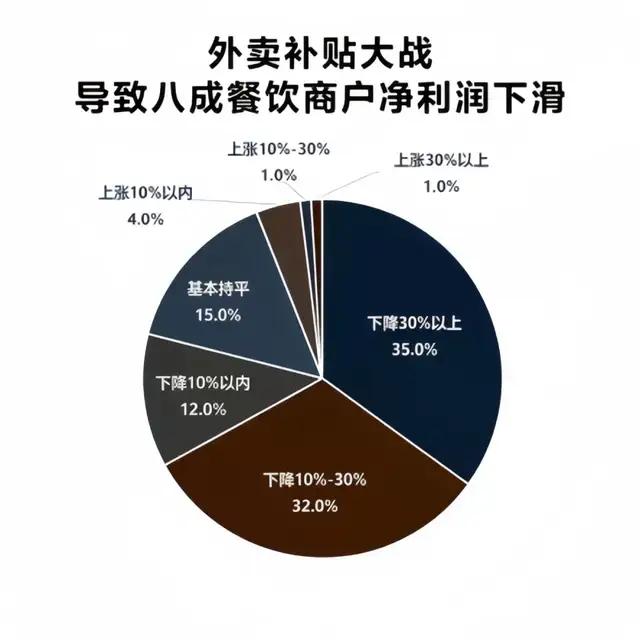
Data released by Lixin Consulting shows that since the food delivery war, the net profit of 80% of catering merchants has declined, and 35% of them have a decline of more than 30%. 74% of merchants have experienced a decline in the customer unit price, among which 53% have a decline of more than 10%, and only 5% of merchants have achieved an increase in the customer unit price.
In this context, Meituan no longer has the advantage of a market share of over 70% as before, and the entire industry has entered a tripartite situation. Interestingly, in the food delivery field, Meituan has stably maintained a GTV market share of over 60% with a much lower loss than its competitors, and has an absolute advantage in the medium - and high - customer - unit - price dinner market, accounting for about 70% of the market share in orders with a high customer unit price of over 30 yuan.
This shows that even if the peers are in a fierce involution, the low - price war can quickly increase the order volume, but it cannot bring real profitability. Some platforms seem to have a rapid increase in order volume, but in fact, they are just making noise and losing real money.
Meituan's hold on the high - customer - unit - price market essentially means holding on to the basic market for the industry's upward development. Therefore, further analyzing Meituan's market strategy in this field will help the outside world better understand the actual situation of industry competition and the real competitiveness of different players.
Are high - value users Meituan's trump card?
From an industry perspective, food delivery users are indeed accelerating their differentiation. Some users are extremely price - sensitive and will go wherever there are more subsidies. The other part of users value quality, taste, and fulfillment experience more and don't care about a few yuan of discounts. The latter naturally become the industry - recognized high - value users. They have a high average monthly consumption frequency, with a stable customer unit price of over 30 yuan, covering all scenarios such as dinner, afternoon tea, midnight snacks, and instant retail, and can bring incremental value to the platform's profits.
This group of users has become Meituan's core buffer zone against low - price involution. Of course, Meituan's advantage in high - customer - unit - price orders is the result of an active strategic choice, long - term accumulation on the supply side, and the bonus of instant retail.
A person familiar with the food delivery business emphasized that the first advantage of high - customer - unit - price orders comes from Meituan's reasonable subsidy investment compared with Taobao and JD.com, as it has not continuously invested in subsidies for low - price products. Meituan has optimized some low - quality orders and concentrated its resources on the core market. To meet the needs of low - price users, Meituan mainly undertakes through its Pinhaofan business, which is conducive to allocating more resources to the key competition track. The logic is that although the peak order volume of the Pinhaofan business exceeded 35 million during the food delivery war last year and its strategic position has become more prominent, the rapid growth has been accompanied by controversy, especially the doubts from small merchants: the order volume has increased, but the profit is thin.
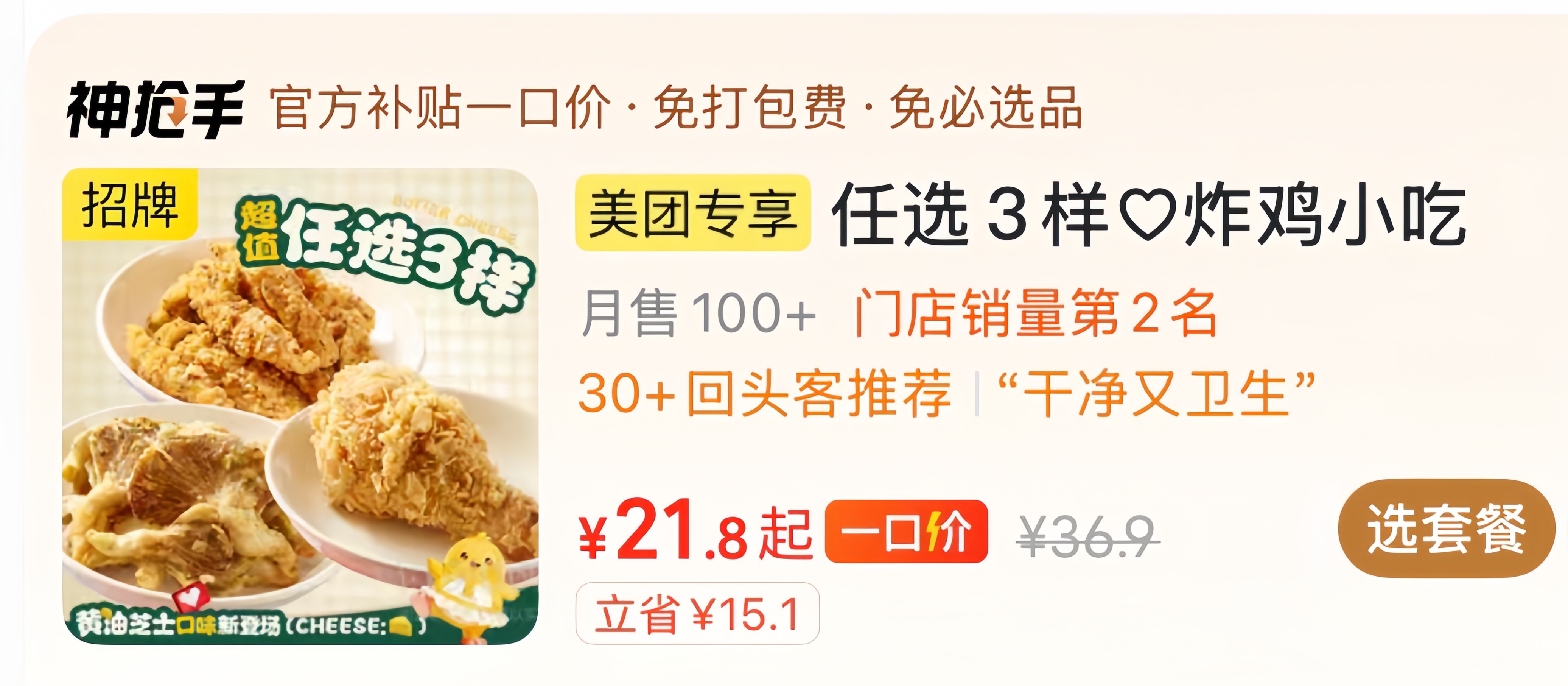
Relevant people said that Meituan used to leverage and consolidate high - end users through the "Sharpshooter" fixed - price product, allowing merchants to add more coupons and the company to make additional subsidies on a certain basis. The platform hopes to better meet the needs of high - quality users with resources.
Meanwhile, the advantage on the supply side has also become a core factor in building Meituan's high - customer - unit - price barrier. Last year, the "2025 White Paper on the Development of China's Catering Chainization" jointly released by the China Chain Store & Franchise Association and Meituan in Chengdu showed that in 2024, the number of brand stores in the scale range of 500 - 1000 increased by 93.6%, becoming a new growth engine for the industry. This is not only due to the flexible expansion of the franchise model but also reflects the rising potential of local regional brands. Meituan has benefited a lot from this. Most of the leading catering brands have settled on Meituan. These brands have their own traffic and good reputation, attracting a large number of users who pursue quality.
Observers familiar with Meituan emphasized that the above phenomenon shows that Meituan's long - standing leading position in the food delivery industry determines that its supply quality and quantity are still ahead of the other two platforms, and many high - customer - unit - price supplies will also give priority to developing on Meituan.
He also mentioned that Meituan has higher user stickiness and quality than other platforms. In the food delivery war, most users on other platforms are just looking for freebies, with weak user stickiness. Some customers will return to Meituan after the subsidies stop, indicating that customers have higher stickiness and dependence on Meituan than on its competitors.
Therefore, the user habits accumulated over the years have formed a strong momentum. Many consumers' first reaction when they want to order food delivery is to open Meituan. For some consumers, once this habit is formed, it is indeed difficult to change it because of a few yuan of discounts.
Meanwhile, the rapid development of instant retail has further increased Meituan's overall customer unit price. For example, Meituan has promoted the "30 - minute everything home" service from food delivery to various categories such as daily necessities and 3C digital products through innovative models such as brand official flagship lightning warehouses and self - operated front - end warehouses, which has become an important driving force for the growth of the customer unit price. Meituan has reached in - depth cooperation with leading retail brands such as Walmart, Yonghui, and Watsons, which has strengthened consumers' trust in the platform's quality to a certain extent.
It is obvious that many factors have indeed bought valuable time for Meituan with high - customer - unit - price orders. However, on the other hand, this advantage is not static. When competitors target the high - customer - unit - price market, Meituan will also face pressure.
The high - customer - unit - price moat will also be under pressure
Focusing only on the order volume and ignoring the customer unit price is the biggest misunderstanding in the food delivery industry. The order volume only reflects the scale, while the customer unit price is the measure of value. A high customer unit price means that users are willing to pay for the quality, convenience, and service provided by the platform, which is the foundation for the platform to build a sustainable business model. On the contrary, low - price involution will force merchants to cut corners on ingredients, production processes, and packaging to control costs.
The core needs of high - customer - unit - price users are quality and experience. Retaining this group of users requires continuous investment from the platform. For example, from the screening and empowerment of merchants, to the training and management of delivery staff, and then to the improvement of the after - sales system, every link requires real - money investment. Once the investment decreases, the user experience will decline, and users will vote with their feet.
Looking back at Meituan, its high - customer - unit - price moat may also face challenges. The basis is that the data of the Taobao Flash Purchase platform previously showed that with the support of platform subsidies and traffic policies, since mid - 2025, the business efficiency of Taobao Flash Purchase catering merchants has been significantly improved: the average store order volume has increased by 90% year - on - year, and since 2026, the average order price of merchants has increased by about 10%.
Meanwhile, at the recent Taobao Flash Purchase City Business Partner Summit, Taobao Flash Purchase said that in the new year, its food delivery business will focus on high - value orders, and its near - field retail will focus on building three high - frequency and essential scenarios: convenience stores, fresh food, and medicine. It should be noted that Alibaba had a good momentum in this track last year. According to the financial report, in the fourth quarter of fiscal year 2026 (as of March 31), its instant retail revenue in a single quarter was 19.99 billion yuan, a year - on - year increase of 57%. The order volume reached 2.7 times that of the same period last year, and the non - food instant retail part increased by 3 times year - on - year. The number of 88VIP members exceeded 62 million, with a double - digit year - on - year growth.
More importantly, Alibaba has established an integrated large - scale consumption ecosystem. Taobao, Tmall, Ele.me, Taoxianda, and Hema have formed a complete consumption closed - loop, which can provide users with full - scenario services from online shopping to local life.
Previously, Alibaba also clarified its 2026 strategy, increasing investment in Taobao Flash Purchase to strive for the absolute first place in the market. For Alibaba, there is bound to be a "want - it - all" gene. In addition to quickly eroding the market share of its competitors, it will also invest corresponding resources in the high - customer - unit - price business track.
On the JD.com side, JD.com's food delivery business aims to achieve a 30% market share in 2026. Moreover, JD.com has a rich supply of high - quality supply chains. From JD.com's home appliance stores and JD MALL, to the Qixian supermarkets and Qixian Kitchens that have been densely laid out in the past two years, and then to vertical stores such as JD.com's medical aesthetics and traditional Chinese medicine, these will be the foundation for JD.com's food delivery business to gradually gain momentum in the high - customer - unit - price market.
It is obvious that Alibaba and JD.com are making a strong impact in the high - customer - unit - price market. Although Meituan has a first - mover advantage in these scenarios, with the entry of the Alibaba ecosystem, assuming that the number of existing users is limited, there is a possibility that high - customer - unit - price users will be diverted.
Moreover, Alibaba and JD.com do have more substantial financial resources. This financial gap allows them to wage a long - term war in the high - customer - unit - price market.
If Alibaba and JD.com continue to increase their investment in the high - customer - unit - price market, the pressure on Meituan will undoubtedly increase. In the past, Meituan's competitors only focused on the low - price market. In the future, the competitors are likely to extend the war to Meituan's core position.
Looking back, the competition in the food delivery industry has shifted from a battle for order volume to a battle for quality. The low - price war is just a stage in the industry's development. Ultimately, what determines the pattern is who can create higher value for users. How long can Meituan's advantage in high - customer - unit - price orders last? The market is looking forward to it.
This article is from the WeChat official account "Yidu Pro", author: Yidu Pro, published by 36Kr with authorization.