2026 China Cross-border E-commerce SaaS Market Industry Report
China's merchandise export trade has maintained overall growth, and China's cross - border e - commerce exports have continued to grow at a high - speed rate, becoming a key force driving the optimization of the export structure and the high - quality development of foreign trade. Currently, Chinese sellers going global are facing market changes such as geopolitics, fluctuating trade policies, diversified competition among e - commerce platforms, and the accelerated application of innovative technologies. Cross - border e - commerce SaaS service providers use full - link digital tools to solve the operational problems of sellers going global. The ERP system is at the core of the cross - border e - commerce SaaS system, playing the role of the "business brain" for sellers going global.
Development Background of China's Cross - border E - commerce SAAS Industry
Underlying Support of the Global Macroeconomy
The resilience of global trade is prominent, and residents' income continues to grow, laying a solid foundation for the development of cross - border e - commerce
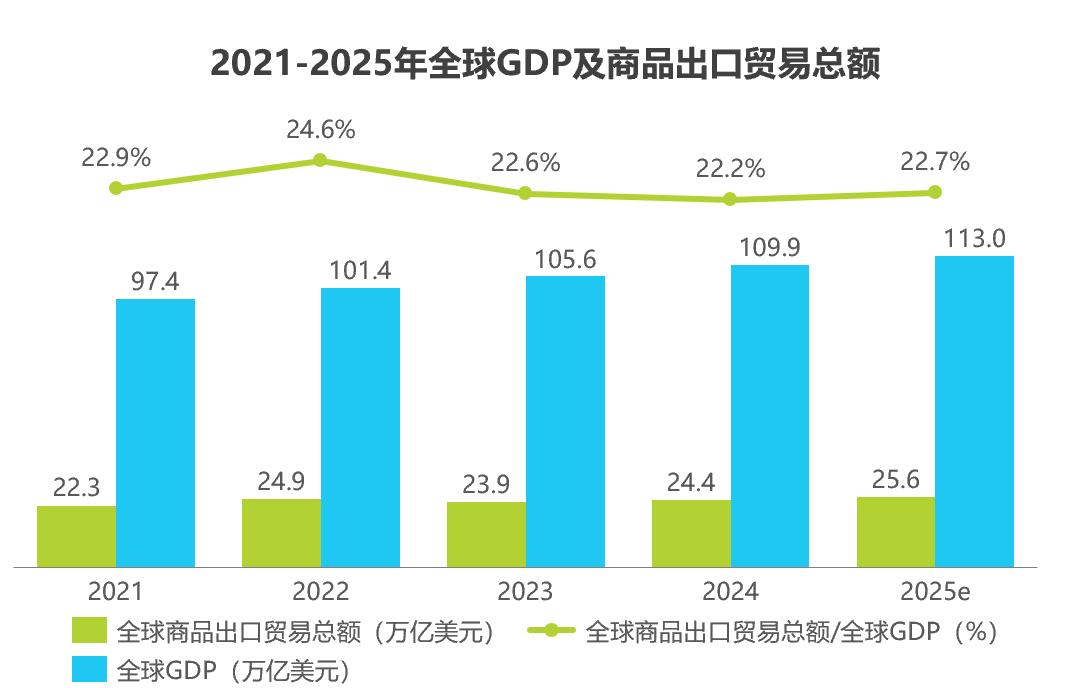
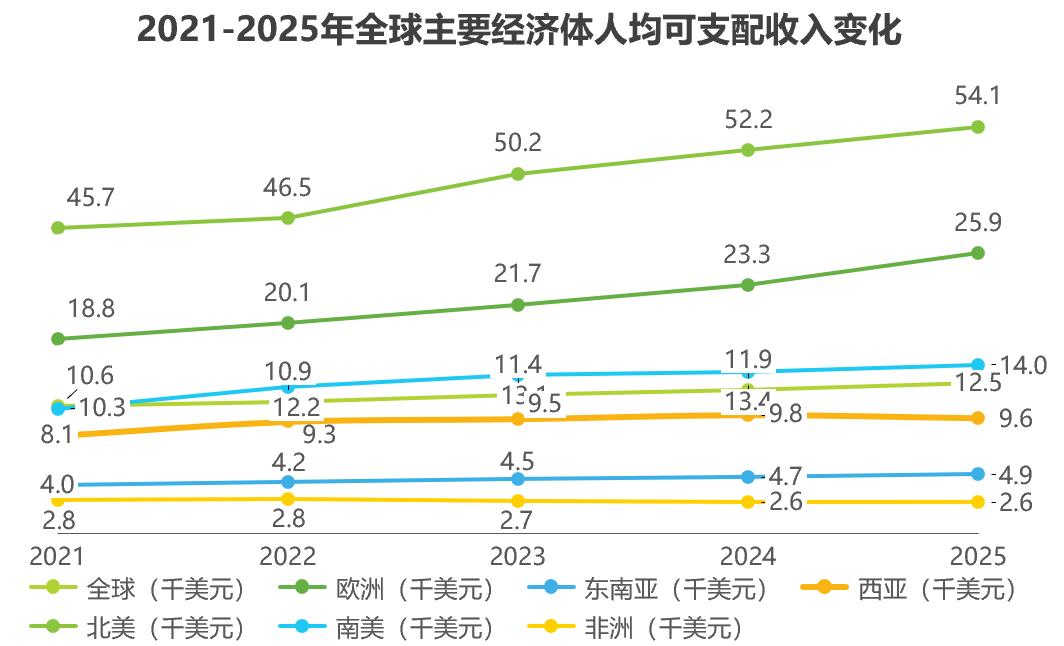
The global macroeconomic fundamentals provide underlying support for the development of the cross - border e - commerce industry. From the perspective of trade and growth, the global GDP scale has continued to expand from 2021 to 2025, steadily increasing from $9.74 trillion to $11.30 trillion in 2025. The total global merchandise export trade volume has also increased synchronously, and the proportion of trade volume to global GDP has remained stable in the range of 22% - 25%, rising to 22.7% in 2025, demonstrating the resilience of global trade and the vitality of cross - border circulation, and providing a solid market foundation for the expansion of cross - border e - commerce scale. From the perspective of consumer - side dynamics, the per capita disposable income of major global economies has shown a continuous growth trend: the income levels in mature markets such as North America and Europe remain at a high level. In 2025, the per capita disposable income in North America will reach $54,100, and in Europe, it will reach $25,900; the income growth rates in emerging markets such as Southeast Asia, South America, and West Asia are remarkable, with the per capita disposable income in Southeast Asia increasing from $4,000 to $4,900. The structural improvement of global consumption capacity has continuously released cross - border consumption demand, creating favorable conditions for the cross - border e - commerce to upgrade from scale expansion to brand - building and high - unit - price products, and has become the core driving force for the long - term development of the industry.
Source: IMF, UNCTAD, self - research and mapping by iResearch Institute.
Source: Statista, self - research and mapping by iResearch Institute.
The global market volume is expanding moderately, the regional growth rotation is intensifying, and structural differentiation has become the new normal
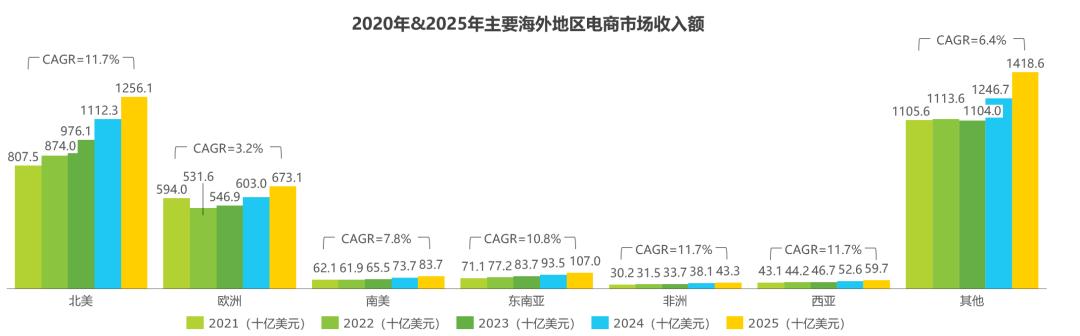
In the past five years, the major global regional markets have achieved a steady increase in total volume amid fluctuations, but the growth momentum has shifted from "advancing side by side" to "intensified differentiation". Mature markets (North America and Europe) have a large scale, with co - existence of consumption upgrading and stock competition; emerging markets (Southeast Asia, South America, Africa, etc.) have obvious growth rates but a low base, with both potential and volatility amplified. In addition, other regions have contributed a non - negligible incremental share, becoming a new fulcrum in the global trade map. From a macro perspective, this pattern of "stable mature markets and fast - growing emerging markets" means that the global economy is entering a structural dividend stage from a general growth stage. The differences in population structure, digital penetration rate, and infrastructure perfection among different regions will shape the flow direction of goods and services in the long term. For any multinational business entity, understanding the rhythm of regional growth rotation is more strategically valuable than simply focusing on the global total volume. The underlying support of the macroeconomy is no longer an overall upward trend like "a rising tide lifts all boats", but a complex system driven by multiple gears with different rotation speeds. Grasping the structural opportunities behind regional differentiation is the key to surviving economic cycles.
Source: Statista, self - research and mapping by iResearch Institute.
Basic Situation of China's Cross - border E - commerce Going Global
China's cross - border e - commerce is accelerating its diversified layout, stabilizing its scale, exploring emerging markets, and continuously enhancing its risk - resistance ability and global resilience
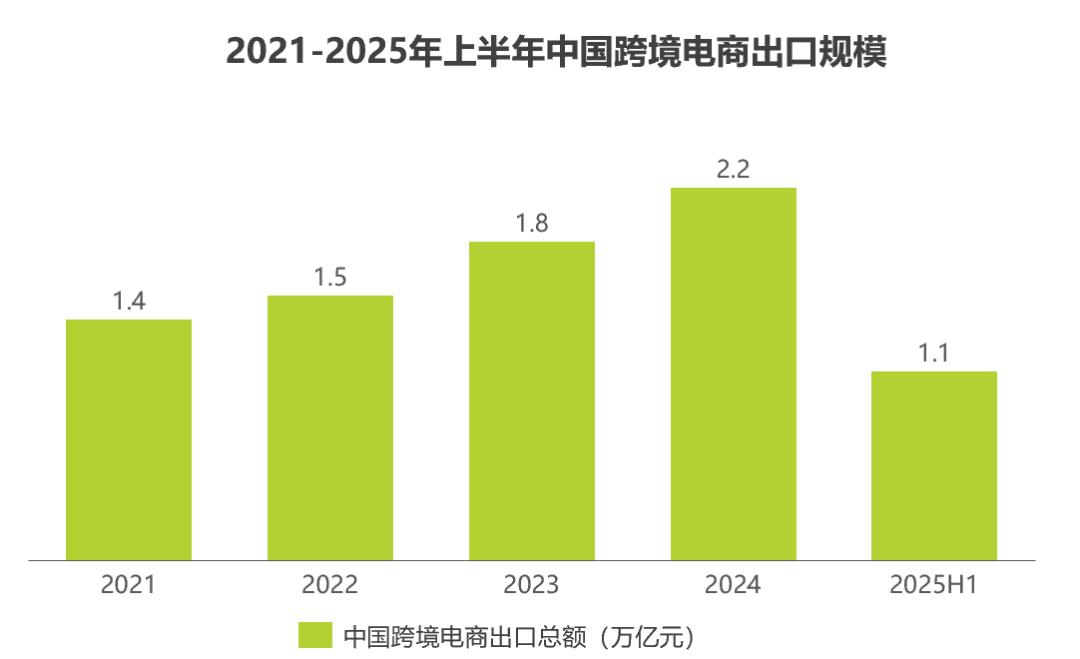
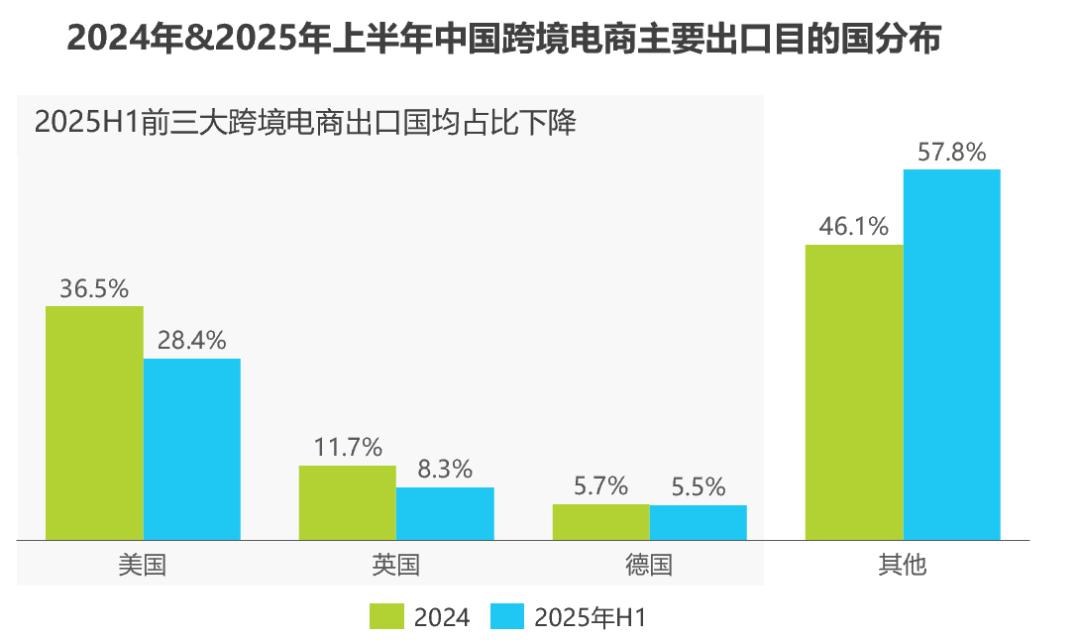
According to the data from the General Administration of Customs, the scale of China's cross - border e - commerce exports has continued to expand, increasing from about 1.4 trillion yuan in 2021 to about 2.2 trillion yuan in 2024. In the first half of 2025, the exports reached 1.1 trillion yuan, and its contribution to the economy has been steadily increasing. In terms of the market pattern, although the United States is still the main export destination, its share has decreased from 36.5% in 2024 to 28.4% in the first half of 2025; while the share of emerging markets represented by Southeast Asia, Latin America, and the Middle East (the "other" regions in the figure) has jumped significantly from 46.1% to 57.8%, becoming a new growth engine. This structural change indicates that China's cross - border e - commerce is accelerating the implementation of a market diversification strategy. While maintaining its scale advantage, it effectively disperses risks by exploring emerging markets, demonstrating stronger development resilience and global layout capabilities.
Source: The data on China's cross - border e - commerce export volume is from the General Administration of Customs. National Bureau of Statistics, General Administration of Customs, self - calculation, research and mapping by iResearch Institute.
Source: General Administration of Customs, self - research and mapping by iResearch Institute.
The vitality of Chinese cross - border e - commerce enterprises is rising, regional agglomeration is prominent, and the industry is moving towards a new stage of high - quality cluster - based going - global
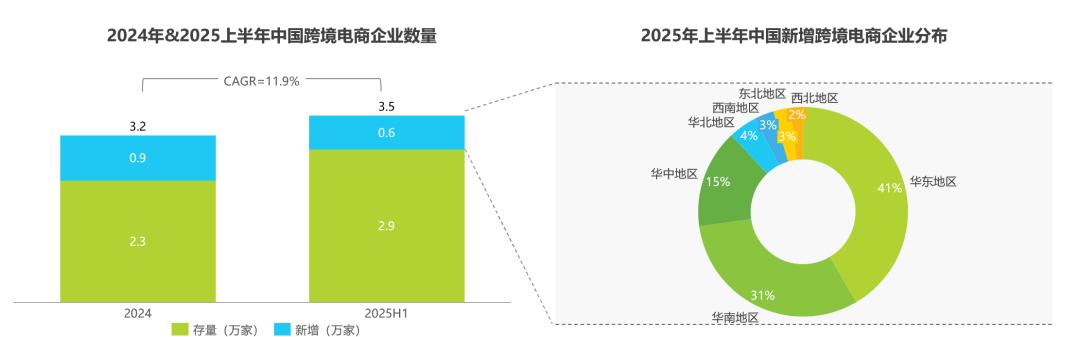
As of the first half of 2025, the number of Chinese cross - border e - commerce enterprises has reached 32,000, a net increase of 3,000 compared with the whole year of 2024, with a half - year growth rate of 11.9%. The vitality of market players has continued to increase, and the industry's prosperity has been rising. In terms of regional distribution, the newly - added enterprises are highly concentrated in the eastern (41%) and southern (31%) regions with strong industrial bases, with the combined share of the two regions exceeding 70%. They fully rely on the mature supply chain systems in the Pearl River Delta and the Yangtze River Delta to accelerate the transformation of manufacturing advantages; the central region (15%) follows closely, and regions such as the northern and southwestern regions are gradually catching up, forming a gradient development pattern. The rapid growth of the number of enterprises and the strengthening of regional agglomeration effects have jointly promoted the cross - border e - commerce to move from scale expansion to cluster - based development, injecting strong impetus into the high - quality going - global of Chinese manufacturing.
Source: Qichacha, self - research and mapping by iResearch Institute.
Changes in the Global Trade Pattern and China's Going - Global Environment
Geopolitics drives the regional transformation of the supply chain and reconstructs the underlying logic of cross - border e - commerce logistics
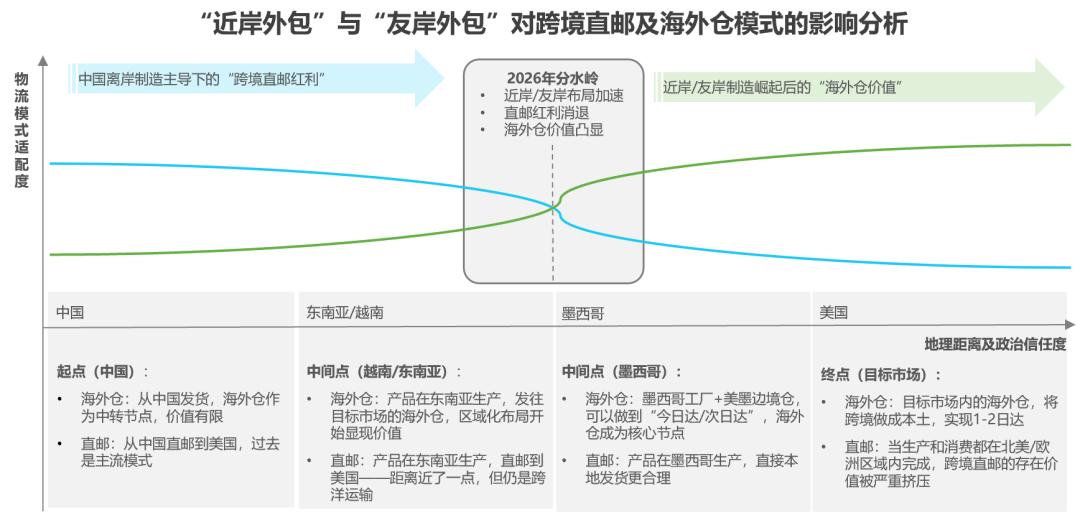
With the intensification of geopolitical frictions and the reconstruction of global tariff policies, the supply chain layout is undergoing a fundamental shift from "global efficiency - first" to "regional security - first". Near - shore outsourcing and friendly - shore outsourcing are accelerating, and regional manufacturing centers such as Mexico, Vietnam, Poland, and Morocco have continued to become hotspots for global manufacturing investment. The share of global direct investment flowing to near - shore and friendly - shore countries has exceeded that of traditional off - shore manufacturing locations for the first time. This change has a profound impact on the logistics model of cross - border e - commerce: cross - border direct mail faces double challenges of timeliness and cost, and consumers' expectation of rapid delivery forces inventory pre - placement; the strategic value of overseas warehouses has become unprecedentedly prominent. Turning cross - border e - commerce into local e - commerce and using certain local inventory to deal with uncertain cross - border risks has become the core cornerstone for sellers to resist industry cycle fluctuations. The regional reconstruction of the supply chain is redefining the underlying logic of cross - border logistics.
Impact on overseas warehouses: Opportunities are prominent
As the production locations get closer to the consumption locations, the value of overseas warehouses is increasing: The strategic value has jumped from a "warehousing node" to a "regional fulfillment center"; The "China + 1" model drives the expansion of the warehouse network: The demand for overseas warehouses in Mexico, Vietnam, Eastern Europe and other places has increased sharply; Inventory pre - placement has become a necessity: Use certain local inventory to deal with uncertain cross - border risks; The compliance buffer function has been strengthened: Overseas warehouses can assist in handling local compliance matters such as tariffs, taxes, and certifications.
Impact on cross - border direct mail: Challenges are intensifying
As the production locations get closer to the consumption locations, the value of cross - border direct mail is decreasing: Timeliness pressure: The core advantage of near - shore production is to shorten the physical distance, and the "long - distance delivery" of direct mail goes against this; Cost pressure: The cost of trans - ocean transportation is high, and near - shore transportation is more economical; Compliance pressure: Many countries have cancelled low - value tax exemptions, and the complexity of direct mail customs clearance has increased; Demand for supply chain visibility: Consumers require full - track tracing, and it is difficult to make the direct mail link transparent.
Channels and Paths for Chinese Sellers to Go Global
The platform pattern for Chinese sellers to go global in the mainstream model is diversifying, and multi - platform collaboration and comprehensive strength have become the core of competition
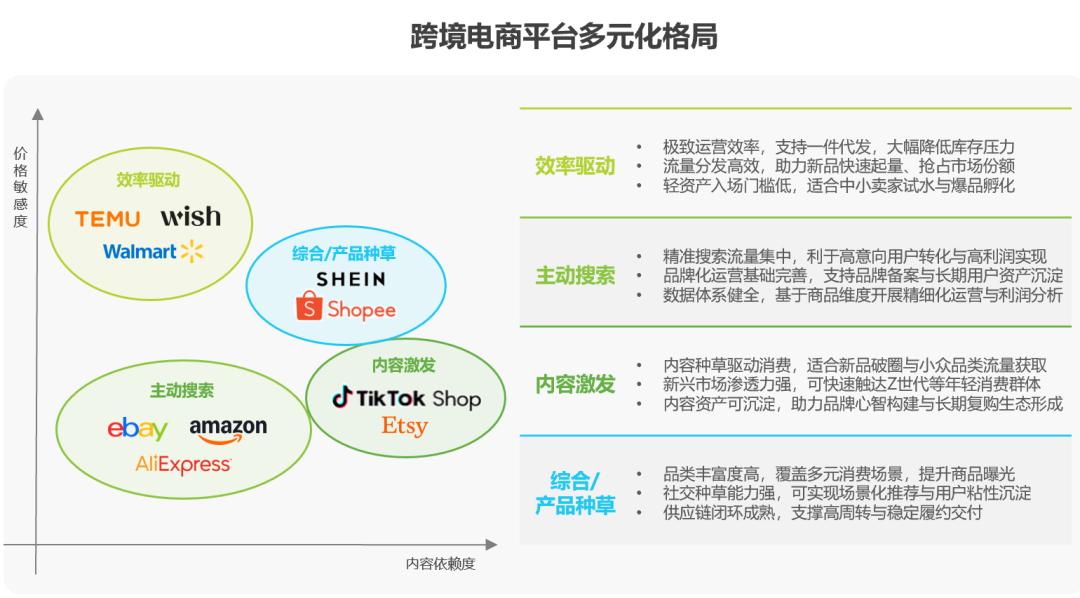
In 2026, the platform pattern for Chinese sellers to go global has shifted from "Amazon's dominance" to "stratified configuration and diversified co - existence". Amazon remains the core position for in - depth brand building. Temu has quickly caught up in market share with its extreme operational efficiency. TikTok has reconstructed the traffic distribution logic with content. Regional local platforms have built competitive barriers based on their local advantages. As the growth model of "extensive expansion and homogeneous competition" in cross - border e - commerce in the past decade has reached its peak, platform competition has been comprehensively upgraded from simple traffic competition to a comprehensive competition of supply chain efficiency, operational ability, and compliance system. Now, the core of competition is no longer the skills of advertising placement, but the in - depth understanding of platform rules, the solid foundation of compliant operation, and the ability to achieve multi - platform collaborative operation through systematic capabilities. For sellers, this means that they need to accurately layout products according to the ecological positioning of different platforms to achieve optimal efficiency at the overall operational level.
Analysis of the limitations of cross - border e - commerce platforms and the complementarity of multi - platforms

Evolution of the Core Demands of Sellers Going Global in 2026
Profit - orientation replaces scale - orientation, with refined accounting of financial costs, logistics optimization, and advertising ROI
In 2026, the cross - border e - commerce industry is shifting from "scale worship" to "profit return". The real profit of a single ASIN on the Amazon platform requires comprehensive accounting of multiple costs such as commissions, advertising, procurement, logistics, manpower, and capital occupation. Some costs can be accurately attributed, while others need to be reasonably allocated according to rules. In the context of the increasingly complex cost structure, relying on experience to judge profit and loss can no longer support stable operation. Unclear profit accounting is no longer just a financial issue, but will directly create strategic blind spots for enterprises. Only by upgrading from traditional periodic reconciliation to refined and real - time profit accounting can enterprises accurately identify their profit status and optimize advertising placement, inventory turnover, and platform layout strategies. Having the ability of accurate profit management has become the key for sellers to survive industry cycles and achieve sustainable development.
