Is the Token cost only 3,000 yuan? —— A viral short video in 10 days and a game in 3 months. The first AI hit of this year is extremely "wild"
Some time ago, the AI short video "Zombie Scavenger," produced by Chinese creator Mx-Shell and hailed by audiences as the "Chinese Love, Death & Robots," quickly went viral on video platforms both at home and abroad. Although there is not a single line of dialogue throughout the film, it vividly portrays the loneliness and tenderness in the post - apocalyptic world through the well - timed soundtrack, smooth camera work, and the subtle changes in the "screen expressions" of the robot protagonist.
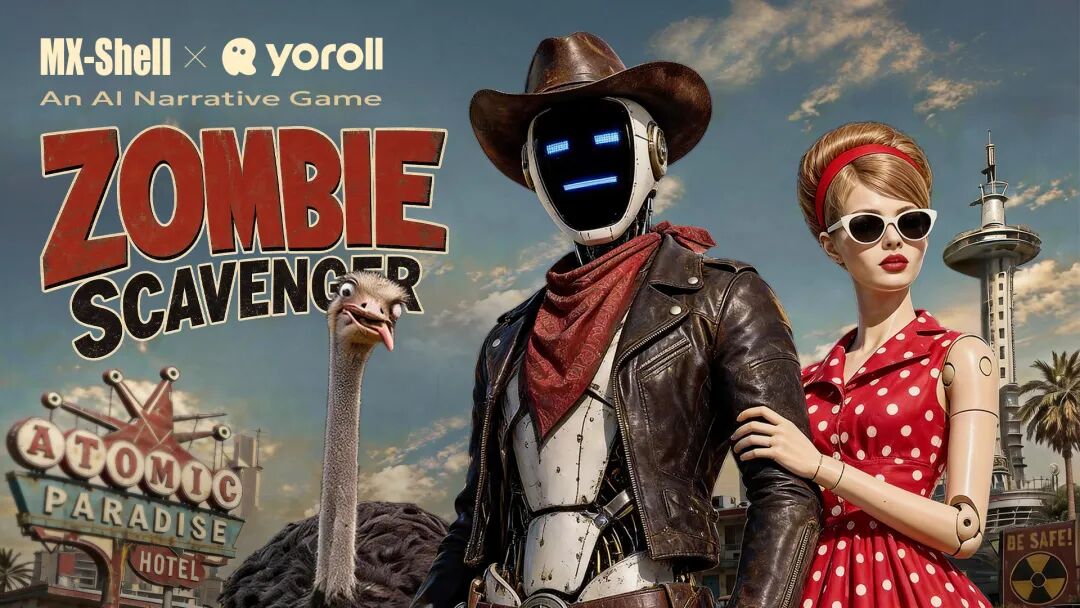
The wild ideas of B - grade movies and the romantic imagination on a cosmic scale, combined with professional visual storytelling, have enabled this AI short, created by a single person in ten days with a Token cost of only 3,000 yuan, to break through cultural barriers. With tens of millions of total views, it has become a benchmark work in contemporary AI videos.
Surprisingly, Mx - Shell is not from a professional background in the film, television, or game industry. He is from Xuanwei, Yunnan. According to public information, he claims to have a secondary vocational school education and mainly taught himself music, photography, and AI video creation before. Relying solely on his audio - visual intuition and a bit of camera experience, he completed the content output of this AI video.
As the work became popular globally, a large amount of capital and industrial forces were also attracted by Mx - Shell's creative talent. Not only did directors from the Hollywood AI film and television circle send emails to discuss cooperation, but also many domestic film and television companies and large AI model platforms extended olive branches to him.
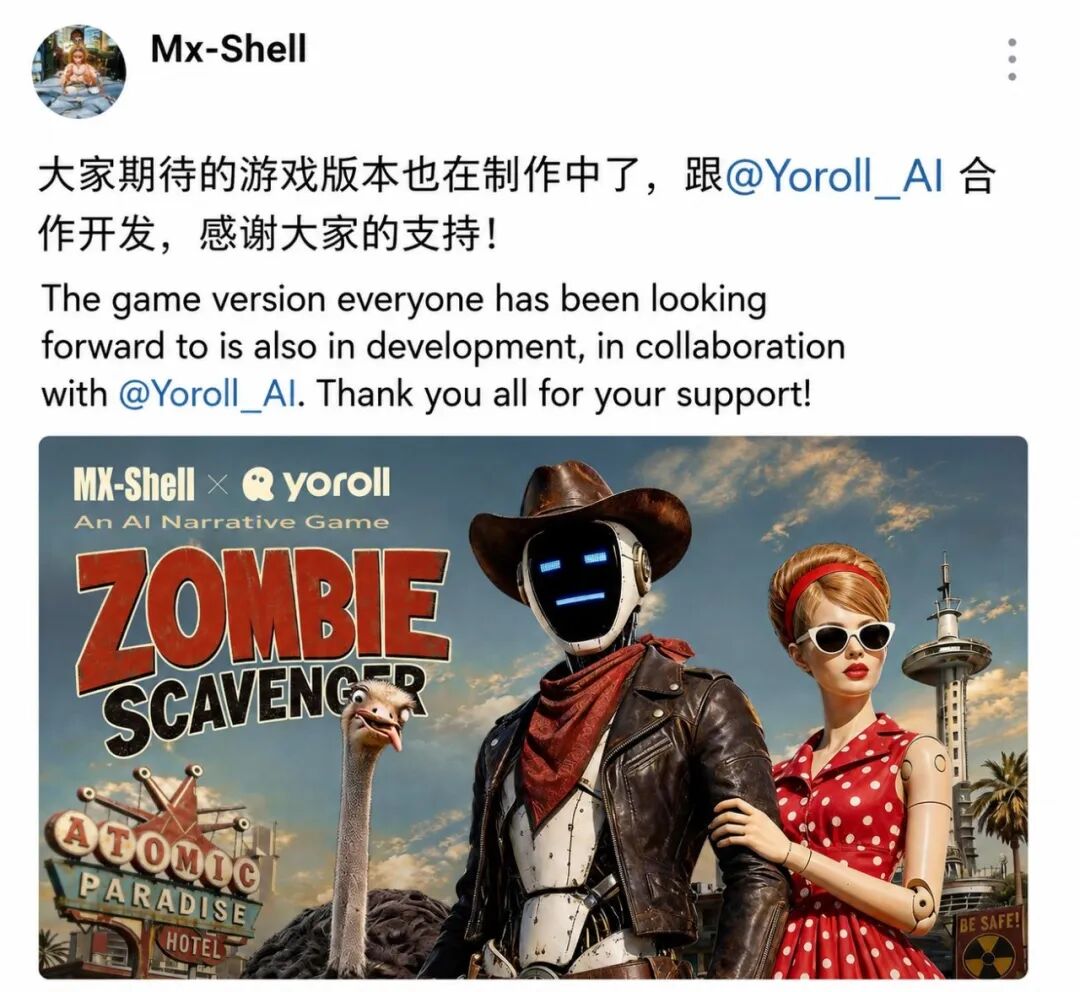
However, Mx - Shell did not join a Hollywood film company as most people expected. According to his personal social account, Mx - Shell is a signed game creator of Yoroll. He also quickly released a game announcement and poster, stating that the AI interactive video game "Zombie Scavenger" is in the production stage and will be jointly developed and distributed with the Yoroll platform.
For some readers, Yoroll may still be a relatively unfamiliar name. But in the current intersection of the game and large AI model field, it is one of the new teams that have received more attention in the direction of AI interactive content recently.
As a platform under the Singaporean AI company LinearGame, Yoroll (yoroll.ai) made its debut at the GDC in Silicon Valley and the NVIDIA GTC this year. It pioneered a solution that integrates the world model with interactive videos. With a complete set of production tools embedded in the editor, it directly reduces the R & D threshold, which used to cost nearly ten million yuan in the traditional game pipeline, to a low - cost level of about one hundred thousand yuan.
Its global team behind it not only includes the former producer of "The Walking Dead: Survivors" and the former client lead programmer of "Blade & Soul," but also a former Story Lead from the Telltale studio who has worked in top Hollywood studios for nearly twenty years and led projects such as "Game of Thrones" and "Ghost of Tsushima," as well as the core creative team of the hit live - action interactive drama "Oops! I'm Surrounded by Beauties."
In addition to the luxurious multinational professional team, Yoroll has also initially entered the actual combat stage in the layout of the content ecosystem. In terms of first - party game content, it has launched PVs and trial versions of several games, including the space exploration game "Star Junkers," the post - apocalyptic escape game "Dead Reckoning: Reborn," the e - sports romance game "VOW: Who Says You Can't Win the World Championship While Carrying a Girl?" and the folk horror puzzle game "Mysteries of the Republic of China." These games have received tens of thousands of wish lists on Steam and have also spawned the UGC hit "The Legend of Hua Jun," which allows external creators with zero experience to create a video with millions of views in a week.
Now, the official announcement of Mx - Shell's "Zombie Scavenger" game also indirectly helps Yoroll send a positive signal to the industry to recruit top global AI creators. Can a hit AI short be born on social media? Will the next stop of a social media hit be an interactive video game? In what way does Yoroll define the interactive entertainment experience of AI games? With these questions, Game Matters recently invited Mx - Shell himself and Heath, the founder of Yoroll, for a dialogue.
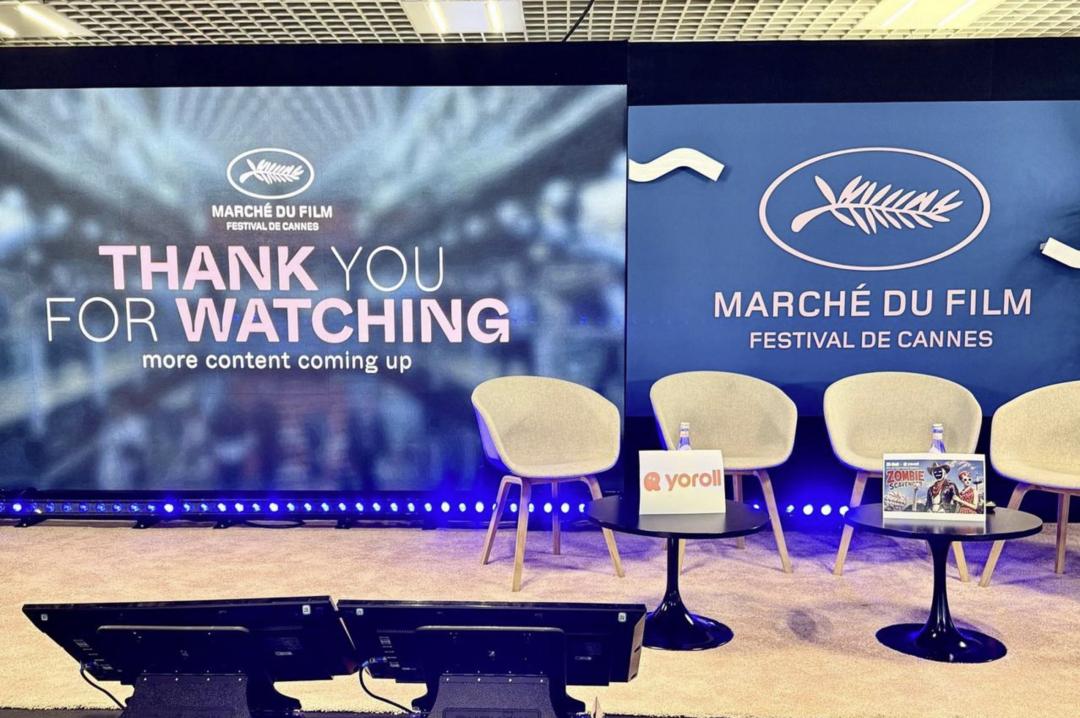
(At the just - ended Cannes International Film Festival, the short film and game of "Zombie Scavenger" also received extensive attention from Hollywood directors)
In the communication, we can feel that in the face of industry opportunities, Mx - Shell represents the divergent "wild creativity" and "intuition - driven" approach, while Heath presents the "industrialized platform" and "systematic solutions" that attempt to bring all these together. The collision of their ideas just answers the most concerning question in the current industry: After AI brings technological equality, where is the way for the commercialization of good ideas?
(The following is the Q&A of the interview. Some content has been adjusted for easy reading)
The Scout and the Steed
Game Matters: How did you two feel after the popularity of "Zombie Scavenger"?
Mx - Shell: My biggest feeling is that I suddenly became extremely busy, and my mood didn't fluctuate much. Looking at all the praises on the Internet, I'm very clear about my technical level. If this work is evaluated according to industrial standards, it's not the top - notch. It's just an AI short with a relatively high degree of completion and good quality. The current response is largely due to luck. It can even be said to be a kind of metaphysics of being chosen by God.
Heath: I think this means that AI video creation has truly crossed a decisive critical point. When an ordinary creator without much professional background in film, television, or games can reach this level of work quality just by using tools, the "technological equality" of content creation has been realized, and the explosion of UGC content is just around the corner.
Game Matters: After the work became popular, Hollywood directors, top domestic film and television companies, and major model platforms all sent invitations to Mx - Shell, but most of the cooperation offers were rejected. Why was the IP game - adaptation cooperation able to proceed?
Heath: As an interactive video game platform focusing on UGC, Yoroll has established a sensitive AI creator discovery mechanism on domestic and overseas short - video platforms. Before this work became popular, we actually established contact with Mx - Shell and invited him to become an AI creator on the Yoroll platform. After the film became popular, we saw a large number of fans in the comments and bullet - screens expressing their desire to play the game version. Coupled with the fact that Mx - Shell himself also agreed that making a game would have greater content tolerance, we hit it off and finalized the exclusive distribution rights for the game - adaptation in a very short time.
From the product - side intuition, this film has inherent game genes. The settings such as shooting zombies, spaceship exploration, and the robot protagonist are all popular categories among players in the commercial game market.

Mx - Shell: I'm a person who follows my feelings. I like to cooperate with those who found me first and recognized me first. When "Zombie Scavenger" didn't have the current popularity, the Yoroll team showed their love and trust in this work without reservation. When choosing a partner, I don't care about how prominent the background is or how large the production team is. I only care about one thing: Are you the one who understands me?
In addition, in the game setting, Yoroll can keep the post - apocalyptic humor and even some slightly wild and bloody scenes in my original work intact, which is very important to me.
Game Matters: As a non - professional photographer, how did Mx - Shell complete this cross - border production?
Mx - Shell: The opportunity to first contact AI videos was actually quite accidental. My sister's new hotel was under renovation, and there was no real - shot promotional material at all. At that time, in order to make renovation renderings, I wondered if I could use AI to turn them into dynamic videos. That should be the entry point for me to fully contact AI tools, purely out of interest.
What everyone sees now is that I, a non - professional, made this work. But I think the underlying abilities are not developed overnight. I used to play music, was a photographer, and shot micro - movies. I maintain a high - intensity movie - watching volume every day.
Although AI - generated videos are virtual, in the principle of image creation, they are somewhat similar to traditional real - shot videos. The tension of composition, the push - pull - pan - tilt of the camera, the visual storytelling of the story, and the post - production editing timing all require long - term aesthetic precipitation. It's not something that can be achieved by simply typing a few words on the keyboard. When encountering professional concepts I don't understand, I also have to look at the dry - goods tutorials shared by teachers on the Internet. Everything has a trace to follow.

Heath: This is also the logic that Yoroll wants to prove to the industry. Now is a great era for creators. The core vision of our team is to "enable everyone to become Hideo Kojima and Ang Lee and create interesting and good - looking interactive content" through generative AI and Agent toolchains.
In fact, many great ideas in the history of game industry development were originally born from ordinary players and enthusiasts. For example, the globally popular DOTA was originally just a map created by ordinary players in "StarCraft" and "Warcraft III" and was later developed by IceFrog. When technology no longer becomes a shackle for imagination, academic qualifications and past experience will take a back seat. Curiosity, execution, and pure creativity are the real passes for future content creation.
Game Matters: Now that so many resources are coming to you, do you have a plan to leave Yunnan and develop in first - tier cities or overseas?
Mx - Shell: I just want to stay in my hometown in Yunnan and never thought about going anywhere else. It's good to create in a place where I feel comfortable. People like my works, and there's no need to put me in a specific place.
I'm just an ordinary AIGC enthusiast. The expectations given to me by the outside world really make me feel some pressure, which forces me to be more serious and responsible for my future creations. I hope to calm down and let everyone re - evaluate my strength with my next work.
The Industry Can Accommodate Gamblers
Game Matters: What is the actual production cost and cycle of "Zombie Scavenger"? How does this low - cost model operate in the Yoroll pipeline?
Mx - Shell: Considering the memberships and points on different platforms, the computing power cost of my film is about 3,000 yuan. Regarding the construction period, previous reports said it was 10 days, but strictly speaking, I started working on the first shot at 1:00 am on May 1st, and the first - version finished film was released at 3:00 pm on May 8th. The actual extreme construction period was only about one week.
Heath: This data is very subversive. In the traditional pipeline, to achieve a high - quality 3D game, a large art team and R & D team are required. Character modeling, texturing, bone - motion binding, motion capture, 3D scene building, animation performance, and light - effect rendering are extremely labor - and cost - intensive, often requiring millions of yuan in cost and two to three years of development cycle.
But now, after adopting the native AI video generation method, creators only need to input prompts and reference images, and the entire large 3D pipeline is directly cut off. On the Yoroll platform, we have directly compressed the game development cycle to two or three months, and the core expenses are only labor costs and Token generation fees. The R & D threshold for an interactive game with a two - hour duration can be directly reduced to about one hundred thousand yuan.
Game Matters: Will the uncontrollability of AI generation affect the creation? How does Yoroll's toolchain accommodate and control this divergent creation?
Mx - Shell: I actually think the uncontrollability of AI will bring me surprises. I often have a gambler's mentality. For example, for the shot of the spaceship leaving the earth, I actually got the ideal picture on the first try, but I still ran it several more times to see if there would be a more amazing result.
In terms of the creative idea, I didn't have a complete script at the beginning. The whole state was "do a little, think a little, write a little, and modify a little." This actually broadens the restrictions. Sometimes, even if AI doesn't completely follow the prompts, as long as the picture feels good, I'll directly use it and even modify the subsequent plot according to it.

Heath: For creators like Mx - Shell who rely on audio - visual intuition and have highly divergent creation styles, Yoroll provides multiple different - gradient models to accommodate them.
For creators who want to let their creativity fly, the platform has an "end - to - end" mode: they only need to input a few ideas, and AI can automatically rewrite them into branched storylines and match gameplay, and package them with one click.
For professional creators who want to fine - tune their works, we also provide a "Copilot" mode, which supports repeated fine - tuning at each step through prompts. Our logic is not to restrict the creators' intuition, but to provide professional and detailed tools such as converting the script into branched storylines and 3D reference spaces, and use a highly industrialized underlying system to help them implement their wild ideas steadily.
Game Matters: Specifically for the game - adaptation of "Zombie Scavenger," what is the core essence of the original work? What are the technical thresholds for integrating strong gameplay into the video?
Mx - Shell: What I most want to preserve is the "uniqueness" of the robot. It has self - awareness and a personality contrast - it seems to be a machine, but in fact, it's like a real person; it may not be afraid of zombies, but it may be afraid of other strange things. I think this personality contrast is the essence of the original film.
Heath: We highly agree with this point. Our North American senior game plot planners who have led the plot development of "Ghost of Tsushima" and "The Walking Dead" within the company have also deeply participated in this project. We hope to run through the whole work with the kind of uninhibited and relaxed feeling similar to that in "Deadpool."
In terms of gameplay, we will add branched options, exploration and puzzle - solving, and gameplay components such as shooting zombies and QTEs of riding ostriches. The biggest technical difficulty lies in the