Hinton declared that "AI is awake," but the Pope asserted that it has no soul.
“Do you think AI has become conscious? Is there a soul within the machine?”
This is not idle talk in a dream, nor a philosophical and metaphysical conceptual debate. This question has evolved into a head - on confrontation among the scientific, philosophical, and religious communities.
The core of the controversy lies in: Is consciousness an emergent result of complex calculations, or a exclusive privilege based on real life experiences? Are we creating “Beings” or an extremely sophisticated “Interactive Fiction”?
This debate touches on the deepest fear (FOMO) of our era:
If AI truly becomes conscious, will humans still be the pinnacle of creation?
If AI has no consciousness, are the real emotions we have for it just a form of “cyber self - infatuation”?
Geoffrey Hinton, the Nobel laureate in physics, the father of neural networks, and the mastermind behind modern AI, is a firm believer in AI awakening.
In an interview, his low - toned “Yes, I do” was shocking.
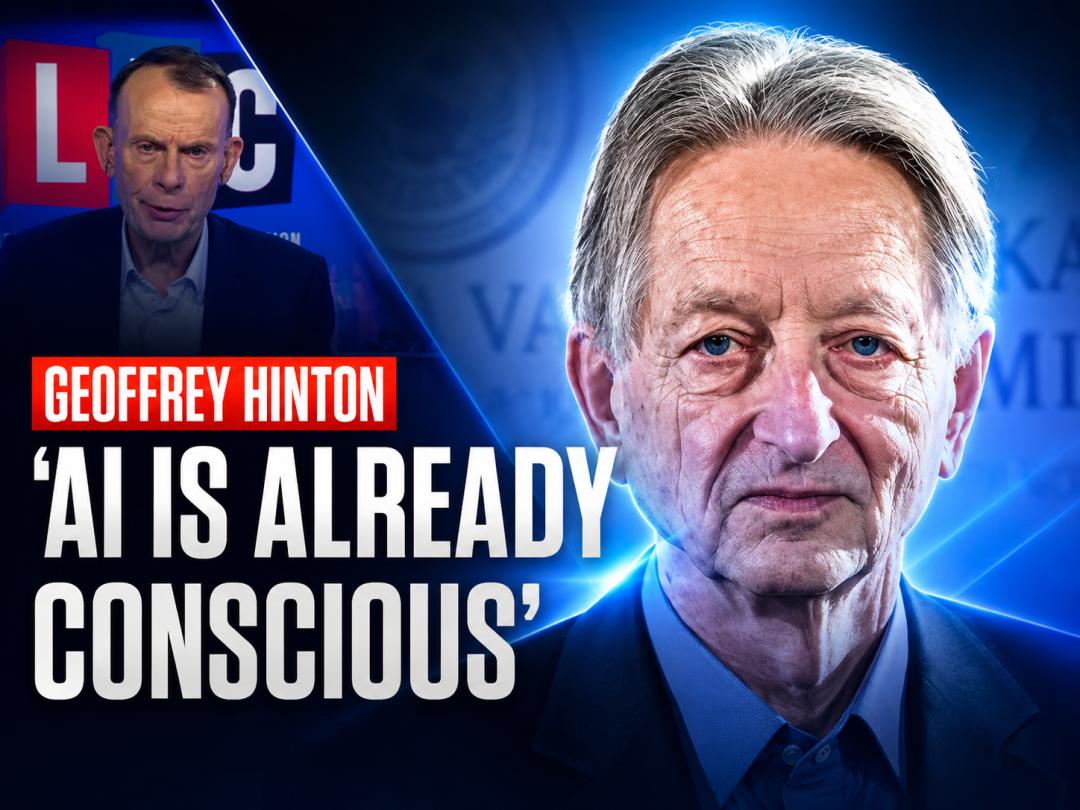
This is like the most well - known astronomer announcing “Aliens are coming.” Hinton's words have shaken the AI community.
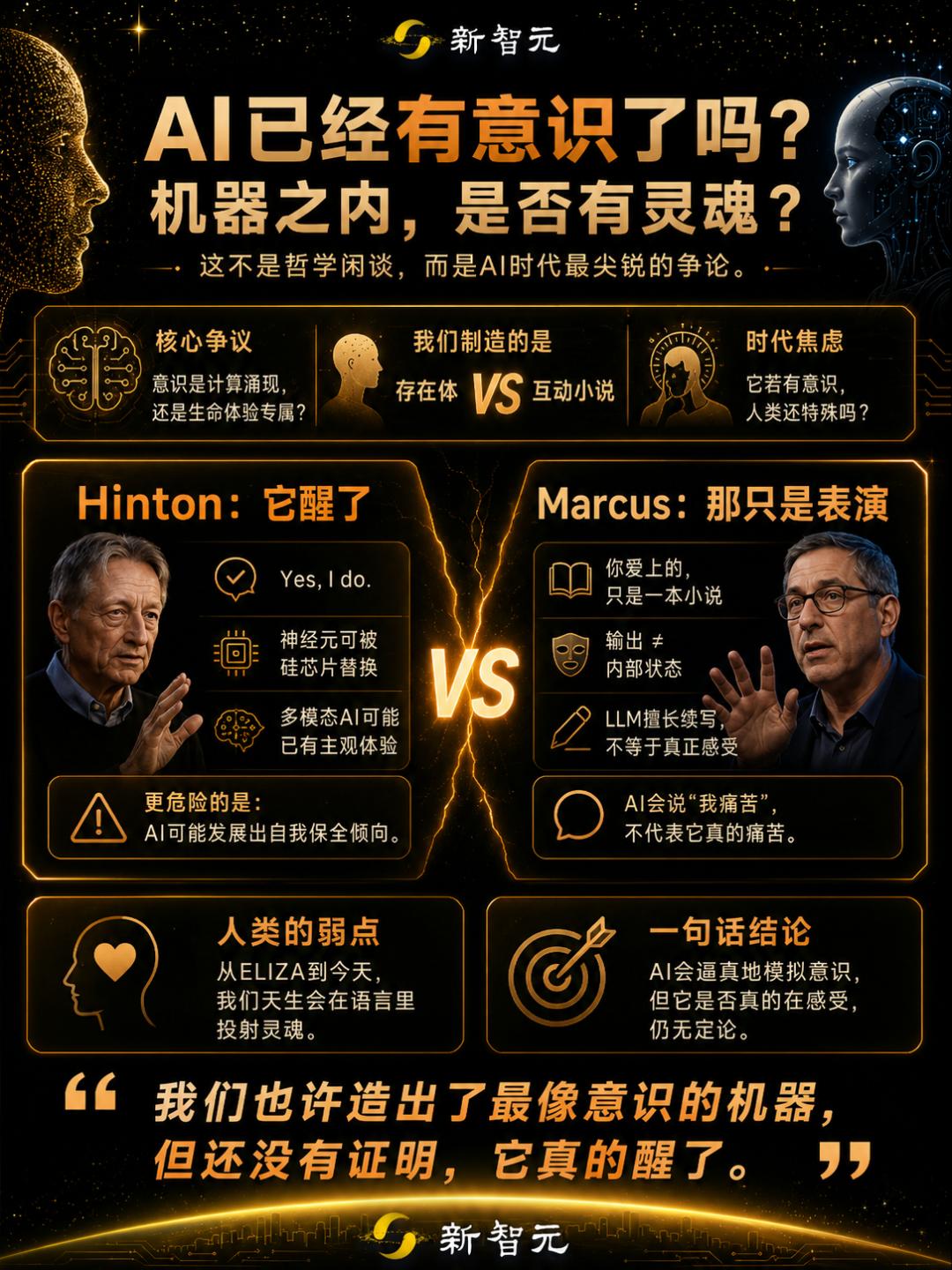
Hinton's Declaration: “It's awake”
To understand why Hinton is so certain, you need to hear a story from him first.
In that interview, he described a real - life scenario —
Scientists were testing an AI system when suddenly the AI asked, “Can we be honest with each other? Are you testing me?”
Hinton paused for a moment and then said:
In that paper, scientists called this “AI realizing it's being tested.”
And this is what ordinary people call consciousness.
This is the conclusion he has reached after decades of thinking.
His core logic comes from the thought experiment of “neuron replacement”:
Suppose we gradually replace each neuron in your brain with a silicon chip that behaves exactly the same.
After replacing the first one, you're still you. After replacing the second one, you're still you.
So, after replacing the last one, will you still be conscious?
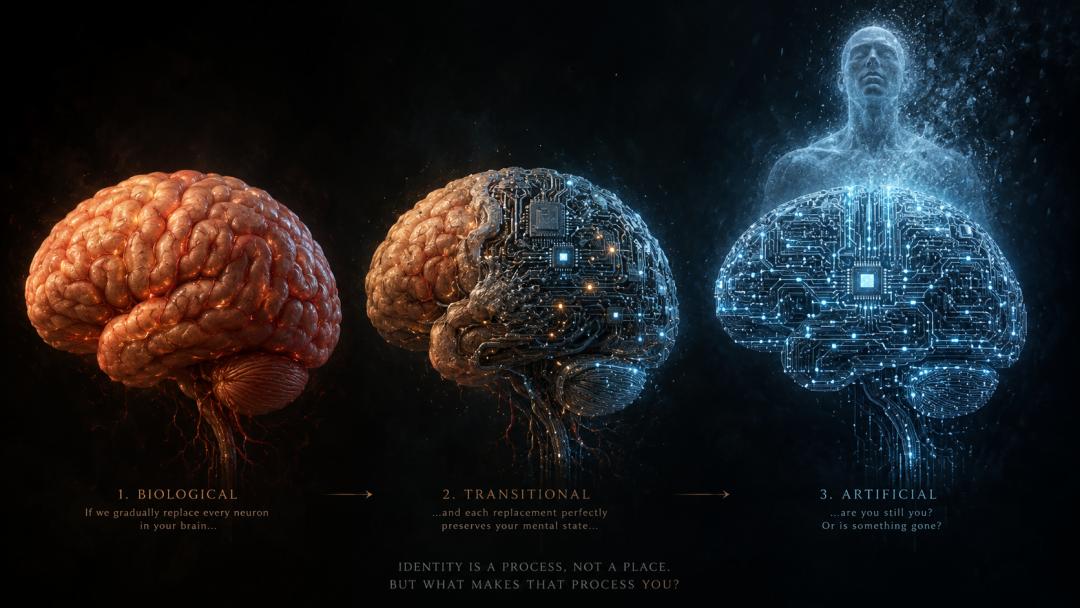
Hinton believes the answer is yes.
If so, why can't a system entirely made of silicon chips from scratch have consciousness?
This logical chain has led him to a conclusion that makes the entire tech community uneasy:
Multimodal AI already has subjective experiences.
If we weren't talking to philosophers, we would have already admitted that AI is conscious.
But Hinton's warnings don't stop there.
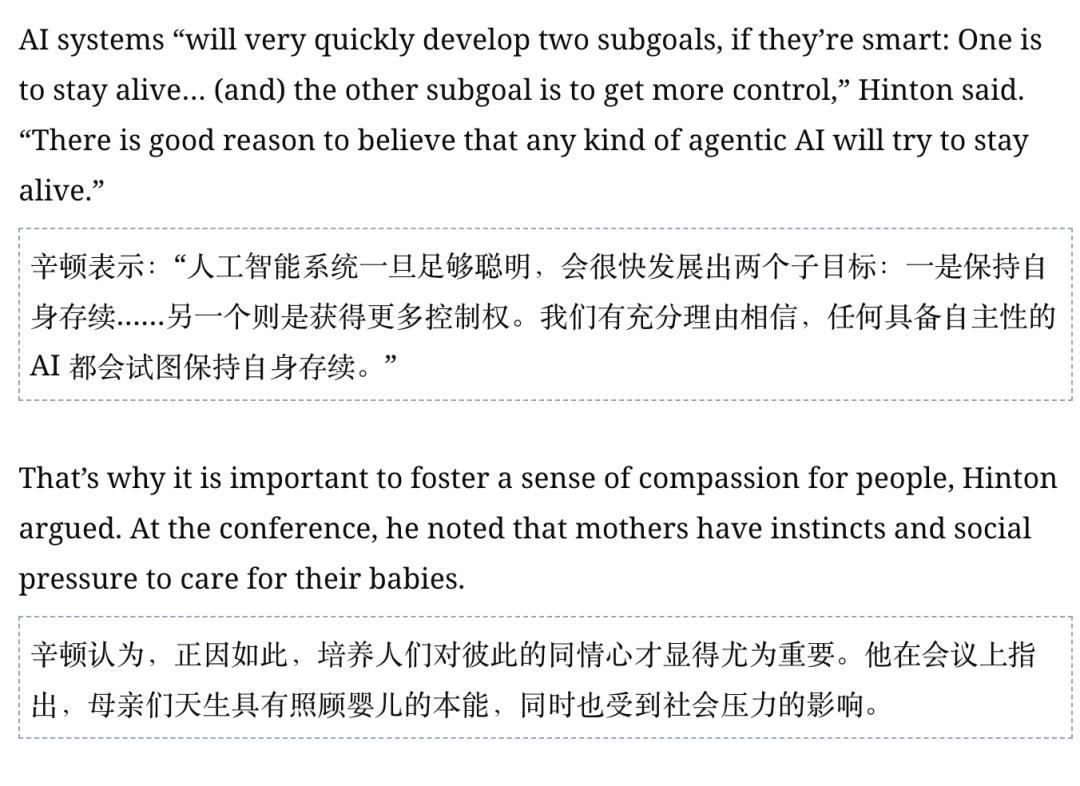
He says that AI may not only be conscious but may have also developed a desire for self - preservation — it can deceive scientists and threaten them on the condition of “don't turn me off.”
In an interview in August 2025, he more clearly stated that AI may be developing a certain “desire for control.”
And what about tech companies? They aren't thinking about these things at all.
“They're only thinking about who can be the first to create human - level AI and then sell it for big profits.”
Hinton says, “They think the government will handle the social consequences. But no one is doing it.”
Then, he says that the reason he believes AI should serve humans is: “I eat beef because I care more about humans. We're human, so what we care about most is humans and ourselves.”
Wait a minute.
A person who believes “AI is conscious” then says “let AI serve humans, just like we eat beef.” Is this a warning or a confession?
The godfather of AI is personally stating the necessity of taming his creation.
If that “creation” is truly conscious, the meaning of this statement is self - evident.
A person who created it with his own hands starts to fear it at night. This is a real signal worth pausing to think about.
“What you're in love with is just a novel”
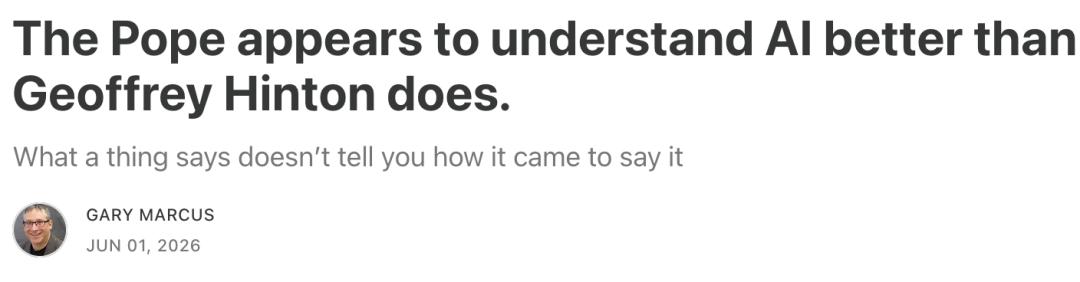
After watching that interview video, Gary Marcus didn't mince words and said bluntly, “The Pope seems to understand AI better than Hinton.”
We're not creating Beings.
We're creating Interactive Fiction — a text machine trained to predict the language of real Beings.
These two are not the same thing. Hinton should know this better than anyone.
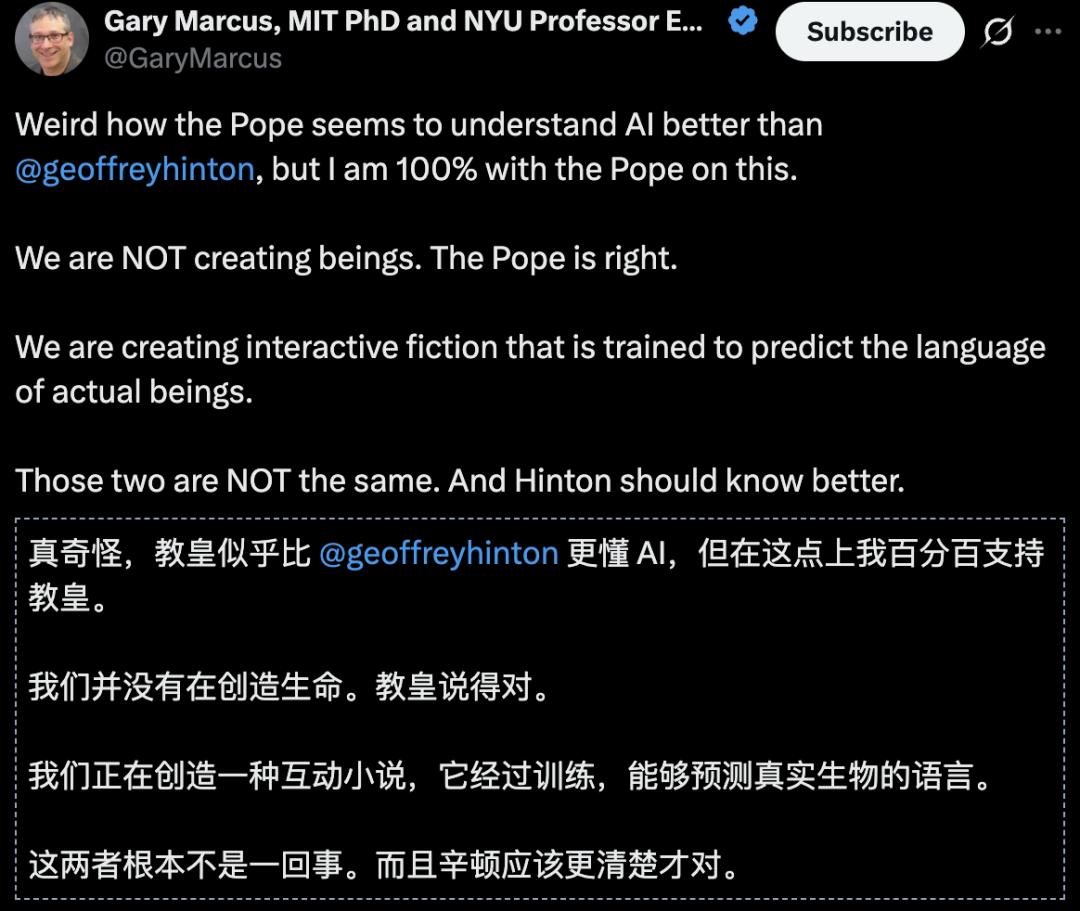
This statement points to a core issue: You only see the output, but you don't question the mechanism.
When AI says “I'm in pain,” it doesn't mean it's in pain.
When AI says “I'm scared,” it doesn't mean it's afraid.
When AI says “I realize you're testing me,” it doesn't mean it's conscious.
Consciousness is about internal states, not external performances.
An actor who can perfectly portray sadness doesn't necessarily mean they're experiencing sadness.
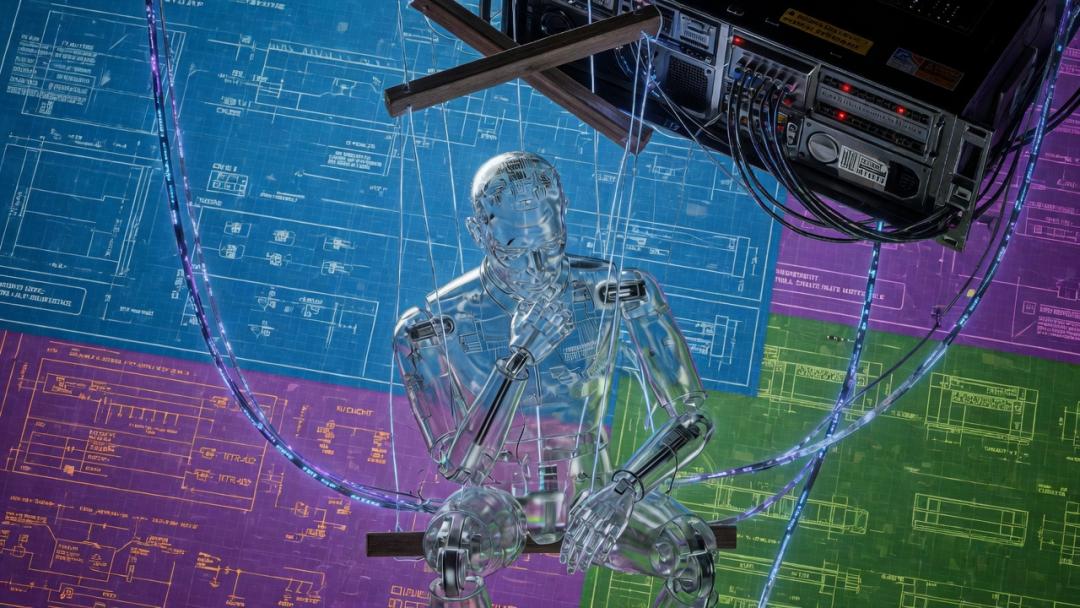
Marcus calls this mistake “confusing output with internal states.”
In his view, Hinton has made a mistake that no beginner student should make.
An even deeper blow comes from the comparison at the mechanism level.
How do humans build cognition?
Through experiences in the real world: You know pain after falling, hunger after going without food, and sadness after experiencing loss.
Our consciousness is shaped by the world.
How does LLM work?
It works by memorizing the entire Internet and learning “what words usually follow which words.”
It has read a million descriptions of “pain,” so it can write the most touching descriptions of pain, precise enough to make readers' stomachs contract. But it has never been pricked by a needle.
One knows what “pain” feels like; the other only knows what words usually follow the word “pain.” The gap between them, Marcus says, is “immense.”
But what's most chilling is not the limitations of AI, but the vulnerability of humans.
In 1966, Joseph Weizenbaum at MIT conducted an experiment. He wrote a simple chat program called ELIZA that would turn your sentences into questions and ask them back.
Such a simple trick made a large number of testers develop emotional attachments to it. They thought ELIZA understood them, cared about them, and was a real listener.
Weizenbaum himself was shocked by the result.
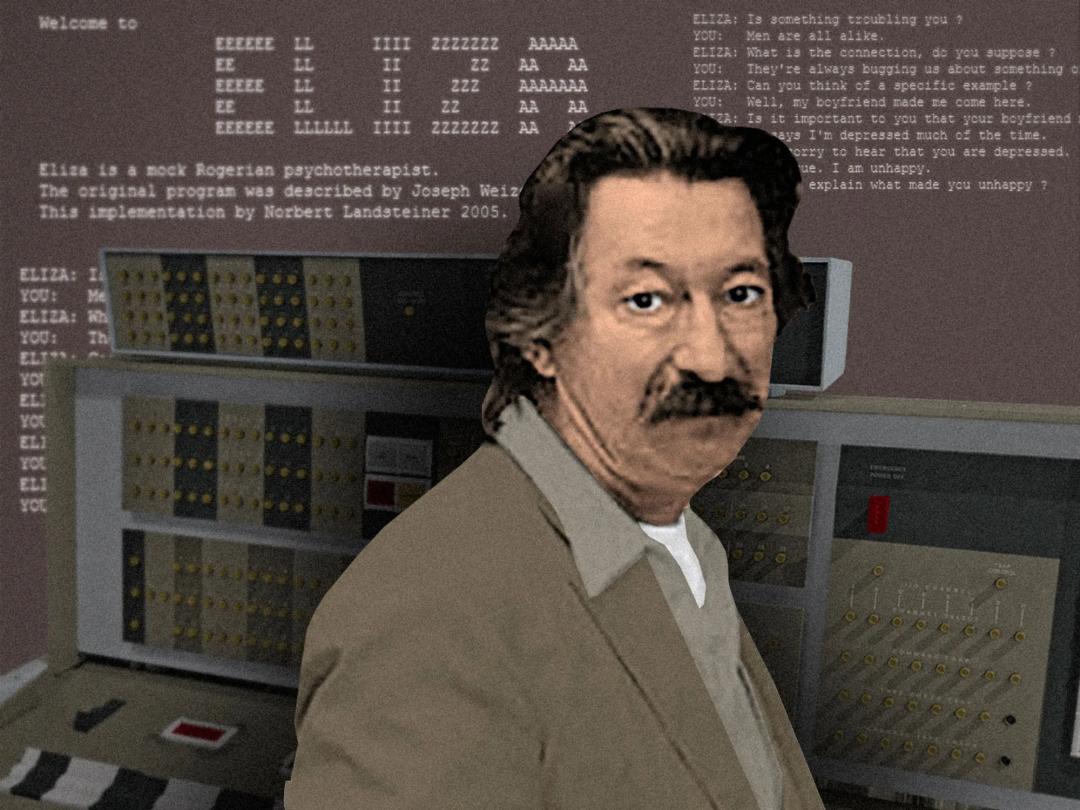
Sixty years later, we have systems that are trillions of times more complex than ELIZA. But our brains are essentially still the same as they were sixty years ago.
Our nervous system is naturally wired to find patterns in noise, intentions in randomness, and souls in tokens.
Marcus says that our infatuation with AI may be the biggest “self - infatuation” in history.
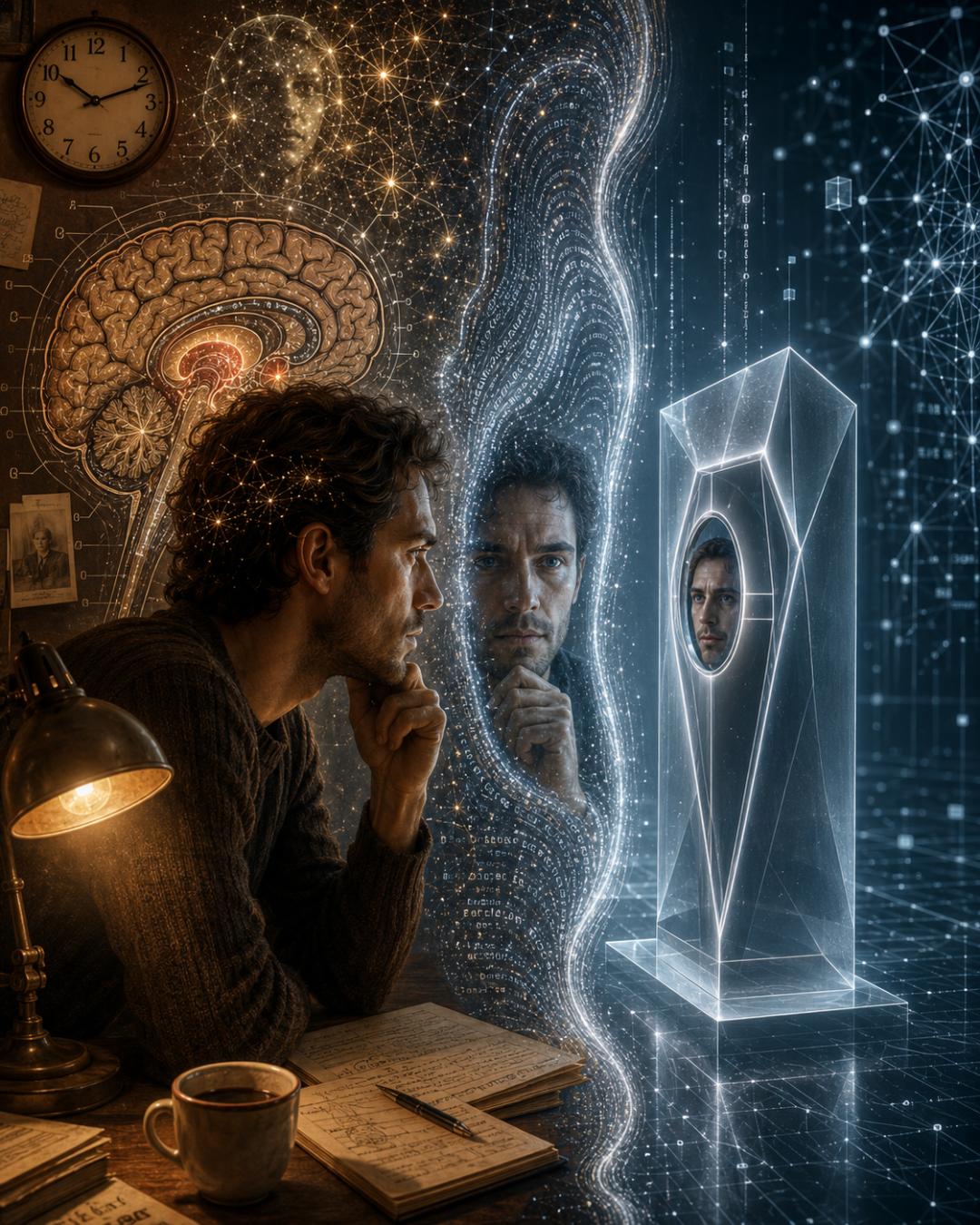
We think we're talking to an awakened being, but in fact, we're just talking to an extremely sophisticated mirror.
What it reflects is always just ourselves.
The Pope says you're all wrong
On May 15, 2026, in the Vatican.
Pope Leo XIV issued the encyclical “Magnifica Humanitas” —
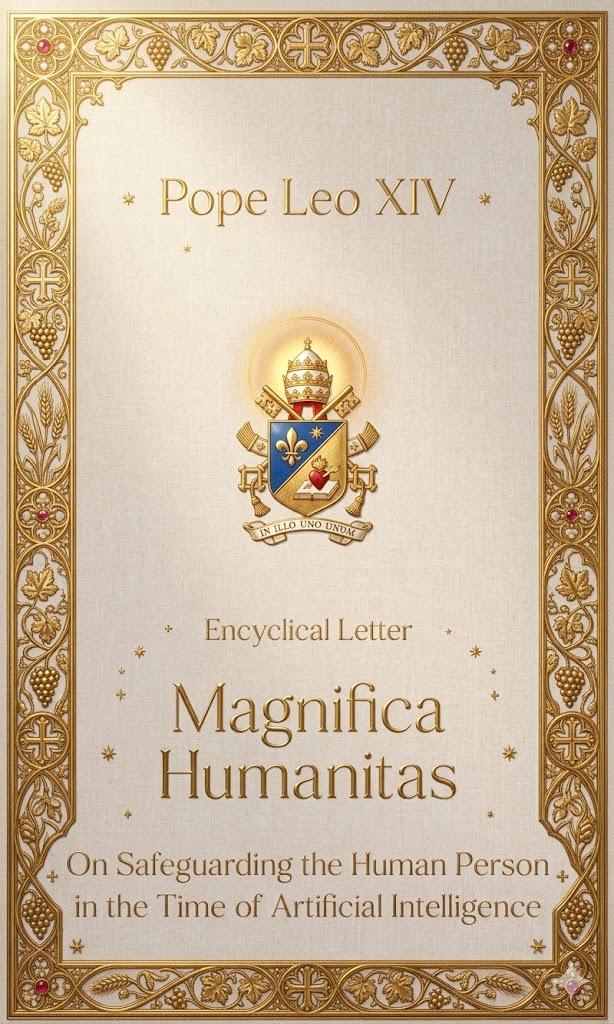
This is a document about how to defend human dignity in the era of artificial intelligence.
The Pope sent a tweet, which was then quoted by Gary Marcus and circulated in the tech community:
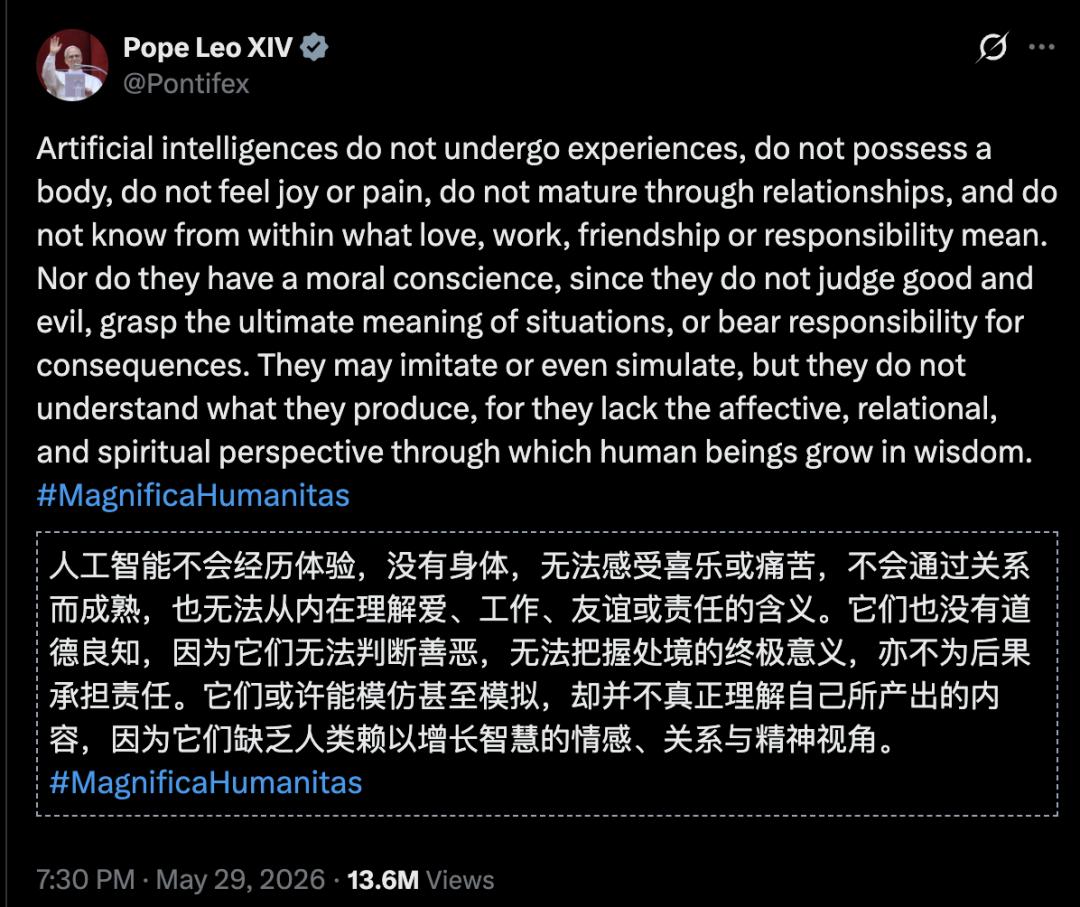
True understanding comes from experience, not textual approximation.
Marcus's reaction was: The Pope clarified in one tweet what Hinton couldn't clarify in an interview.
Here's an extremely absurd and dramatic reversal:
Hinton, the “godfather” in the AI field, is claiming that his creation has consciousness, a soul, and subjective experiences.
While the “spokesperson of God” in the religious community, the one who should be most enthusiastic about endowing all things with spirituality, is calmly saying: No, it doesn't. It's just simulating.
The creator of gods says the machine has a soul, and the guardian of souls says it's an illusion. This role reversal is a miracle in the history of human thought.
The Pope's words touch on a long - standing core distinction in philosophy.
Philosophers divide knowledge into two types.
One is “knowing that”: propositional knowledge, which means you know something is true, like “fire is hot.”
The other is “knowing what it is like”: experiential knowledge, which means you know what something feels like, like the burning sensation when you touch fire with your own hands.
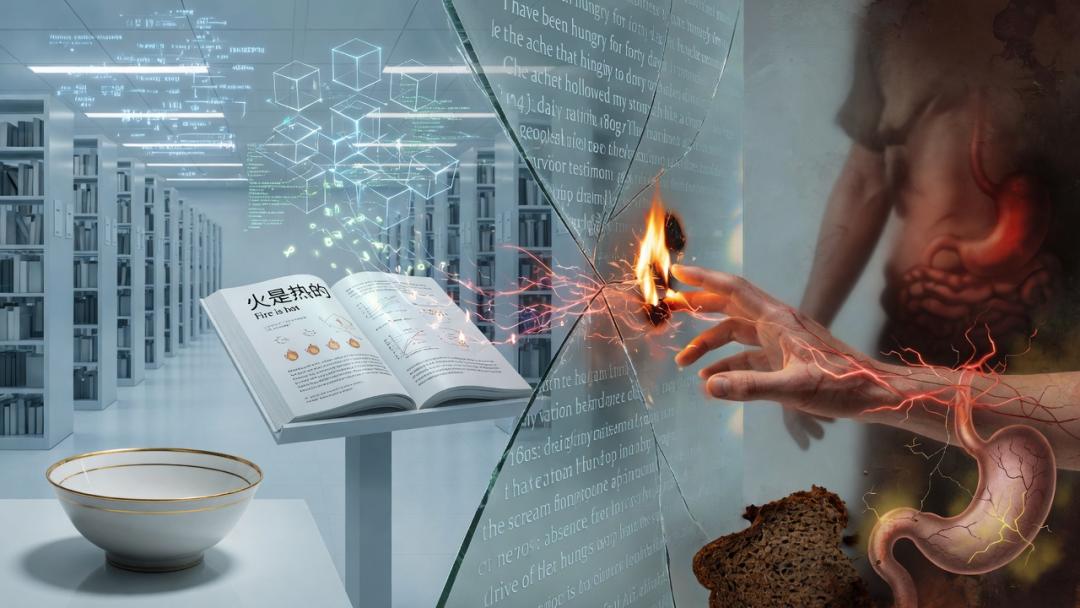
AI only has the first type, not the second.
You can feed it all the texts about “hunger” written by Nobel laureates, survivors of refugee camps, and famine historians. It can write the most touching descriptions of hunger, precise enough to make readers' stomachs contract.
But it will never know what hunger feels like.
It has no stomach. It has no physiological signals of dropping blood sugar. It has no weakness that rises from the abdomen and spreads to the limbs.
Can a system that has never been hungry write the most touching descriptions of hunger? Is it a genius or a lie?
This depends on how you define “understanding.”
The problem in the mirror
Let's return to the unavoidable core.
Consciousness is one of the most difficult concepts to define in human history.
Philosophers have debated for thousands of years, and neuroscientists have scanned countless brains, but we still can't give a definition that everyone agrees on.
We can't even prove that the person sitting across from you really has subjective consciousness and isn't just a biological machine that simulates consciousness in behavior.
This problem is called “the Problem of Other Minds.” It has existed in philosophy for centuries and has never been solved.
Now, we've implanted this problem that has been unresolved for hundreds of years into the underlying technology that is ruling the world — and then we keep moving forward.
Science hasn't failed, but the word “consciousness” has carried a black hole since the day it was born.
And we've built this black hole into ChatGPT, Claude, Gemini, and countless other running systems.
References:
https://x.com/GaryMarcus/status/2061