Exclusive Report by Yingke | This Company Secures Nearly 200 Million Yuan in Financing to Accelerate the Full-Color Process of AI Glasses with Non-Destructive Micro-LEDs
Author | Lin Qingqing
Editor | Yuan Silai
Yingke has learned that the Micro-LED display technology company "Qiushui Semiconductor" has recently completed Pre-A and Series A financing in succession, with a total of nearly 200 million RMB. This round of financing was led by Zhaohui Capital, followed by Tongshang Fund, Shengyu Investment, Ningbo Talent Development Fund, Jiayi Venture Capital, Yongxian Technology, Digital Optic Core, and Xingtang Capital. Xingtang Capital served as the long-term financial advisor. The funds from this round of financing will be mainly used to build an 8-inch hybrid bonding mass production line in the Ningbo High-tech Zone and for subsequent R & D investment.
"Qiushui Semiconductor" was established in November 2022. It is a semiconductor company focusing on Micro-LED micro-display chips and modules. Its products cover application fields such as digital car lights, AR glasses, and micro-projectors. The company's headquarters was originally in Suzhou and has recently been relocated to Ningbo as a whole.
Micro-LED is often regarded as an important direction for the next-generation display technology. However, in the past few years, the mass production process has always been stuck at the chip end. According to IDC data, the total shipments of global AR/VR headsets and smart glasses without displays will exceed 14 million units in 2025. However, the shipments of AR glasses with display functions are less than one million. In the field of digital car lights, TrendForce analysis points out that the market penetration rate of adaptive headlamps (ADB) is expected to reach 21.6% by 2029. Car manufacturers such as Porsche have begun to adopt headlamp solutions with Micro LED pixel modules. The mass production bottleneck at the chip end is the main obstacle to the implementation of these two major applications.
The key to this situation lies in the technical route. In the past, the traditional solution used a 4-inch sapphire substrate. First, the LED wafer was connected to the driving circuit through metal bonding, and then the pixels were separated through etching. However, the etching process would damage the light-emitting materials, resulting in a significant decrease in chip efficiency, low yield, and an excessively large light-emitting angle, making it difficult to achieve large-scale mass production. Since 2024, the industry has begun to shift to the 8-inch wafer-level hybrid bonding process, but there are still very few enterprises that have truly opened up the mass production link.
Therefore, "Qiushui Semiconductor"'s solution no longer etches the light-emitting materials. Instead, through the innovation of a non-destructive chip architecture, material damage is avoided at the root. Combined with the 8-inch silicon substrate and the hybrid bonding 3D packaging process, the chip yield can be increased to over 6N, the light-emitting angle can be narrowed from ±60° to ±10°, and the operating temperature range can be expanded from below 50°C to over 140°C.
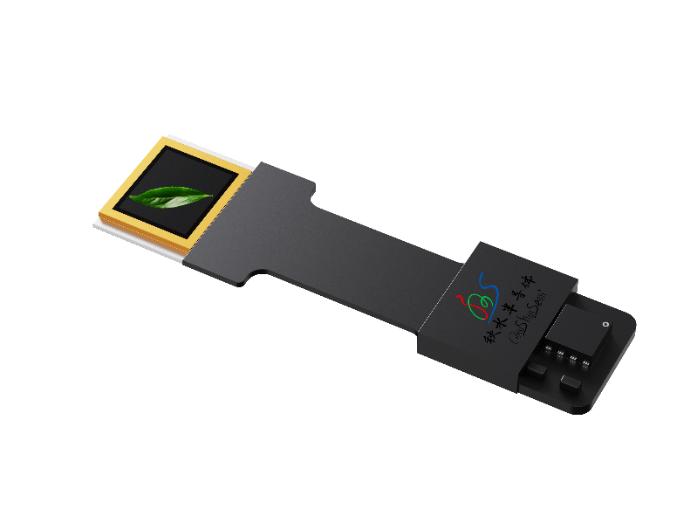
Qiushui "Leyu" AR series modules (Source/Enterprise)
In terms of products, "Qiushui Semiconductor" has previously launched a 0.61-inch digital car light chip and completed sample delivery and verification for customers. At the same time, the AR single green chip is planned to be shipped this year. Jiang Zhenyu, the founder of "Qiushui Semiconductor", judged that "monochromatic green light chips can already meet the needs of specific scenarios such as swimming goggles, meeting prompters, translation, and in-vehicle navigation. And within the next year, the shipments of AI glasses with display functions are expected to increase from the current four or five hundred thousand units to the tens of millions level. The ability to ship tens of millions of chips still poses challenges. In addition, to welcome the 'iPhone moment' of the Micro-LED industry, the problem of colorization must be solved. The traditional red light Micro-LED chips suffer a light efficiency loss of over 97% due to etching damage, which is an insurmountable obstacle. And non-destructive technology is the key to solving this problem and the key to opening the door to colorization. "Qiushui Semiconductor" is expected to achieve a technical breakthrough in colorization by the end of the year."
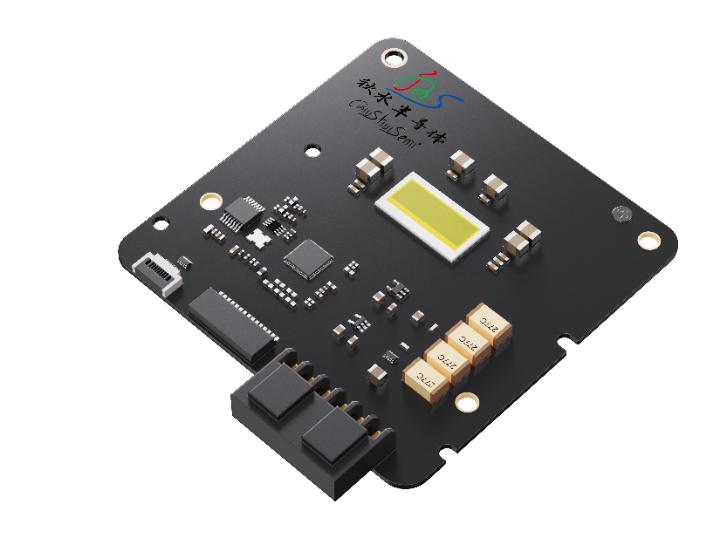
Qiushui "Leyu" AR series modules (Source/Enterprise)
In the domestic competitive landscape, different development paths have emerged in the Micro-LED chip field. One is the IDM model of building an entire 8-inch or 12-inch production line by oneself. However, the construction cycle is relatively long, and it usually takes two to three years or even longer to reach stable mass production. The other is the Fab-lite model of "Qiushui Semiconductor", that is, except for the hybrid bonding link, which is independently built due to the lack of a mature foundry platform globally, the rest of the processes are completed using existing mature semiconductor foundries. According to Yingke, "Qiushui Semiconductor" is the first domestic start-up company to have completed the 8-inch hybrid bonding process line.
Currently, "Qiushui Semiconductor" is building an 8-inch hybrid bonding production line in the Ningbo High-tech Zone, which is expected to be connected in October this year. According to Jiang Zhenyu, after production starts, it can produce a thousand 8-inch wafers per month, corresponding to a supply capacity of over 10 million Micro-LED chips per year. In addition, the company's hybrid bonding vertical stack architecture has achieved the interconnection of optical chips and electrical chips within a 3.75-micron pixel. In the future, the pitch can be reduced to 2 microns, which is at the same process node as the "Tao's Law" advanced hybrid bonding process recently released by Huawei.
In terms of the team, Dr. Jiang Zhenyu, the founder of "Qiushui Semiconductor", graduated from Pennsylvania State University. He is engaged in the research of semiconductor optoelectronic materials and devices and has 15 years of experience in technology R & D and team management. He served as a senior scientist at Dalian Dehao Optoelectronics, the R & D director of Foshan Guoxing Semiconductor, and the R & D director of the Shenzhen Third-Generation Semiconductor Research Institute. He is also a member of the expert group of the Ministry of Science and Technology's major project on new displays. Its co-founder has 8 years of entrepreneurial experience in high-power LED car lights. The core members have previously worked in companies such as Huawei HiSilicon, YMTC, and Intel and have R & D experience in hybrid bonding and advanced packaging processes.
Views of investors:
Zhang Yue, founding partner of Zhaohui Capital: Qiushui Semiconductor has abandoned the traditional physical cutting and established an "electrical insulation" invisible wall between pixels through a unique and innovative chip architecture. This globally innovative non-destructive architecture achieves electrical isolation of each pixel point without destroying the physical structure. This subversive innovation that changes the underlying rules of the game is precisely laying the underlying infrastructure for the upcoming "iPhone moment" of AI glasses.
Project leader of Tongshang Fund: Currently, with the intelligentization of automobiles and the accelerated popularization of AI-AR intelligent hardware, Micro LED micro-displays have become a high-growth track in the semiconductor display field. Qiushui Semiconductor has self-developed a non-destructive hybrid bonding process, overcoming the common problems of etching damage and pixel control in the industry. It is expected to solve the industry development bottleneck of Micro LED full-color display, with significant technical barriers and business positioning advantages. The company's core team has been deeply involved in the semiconductor optical display industry for many years, with the ability to integrate process R & D, mass production implementation, and industrial resources. They have a clear strategy and strong execution ability. We are optimistic that Qiushui will seize the industry dividends relying on its technological first-mover advantage, help the Micro LED industry break through and upgrade, and look forward to the company growing into a globally competitive micro-display leading enterprise.