Is the population inflection point approaching for the trillion-yuan cities in the Yangtze River Delta?
The population pattern of top cities is being reshuffled at an accelerating pace.
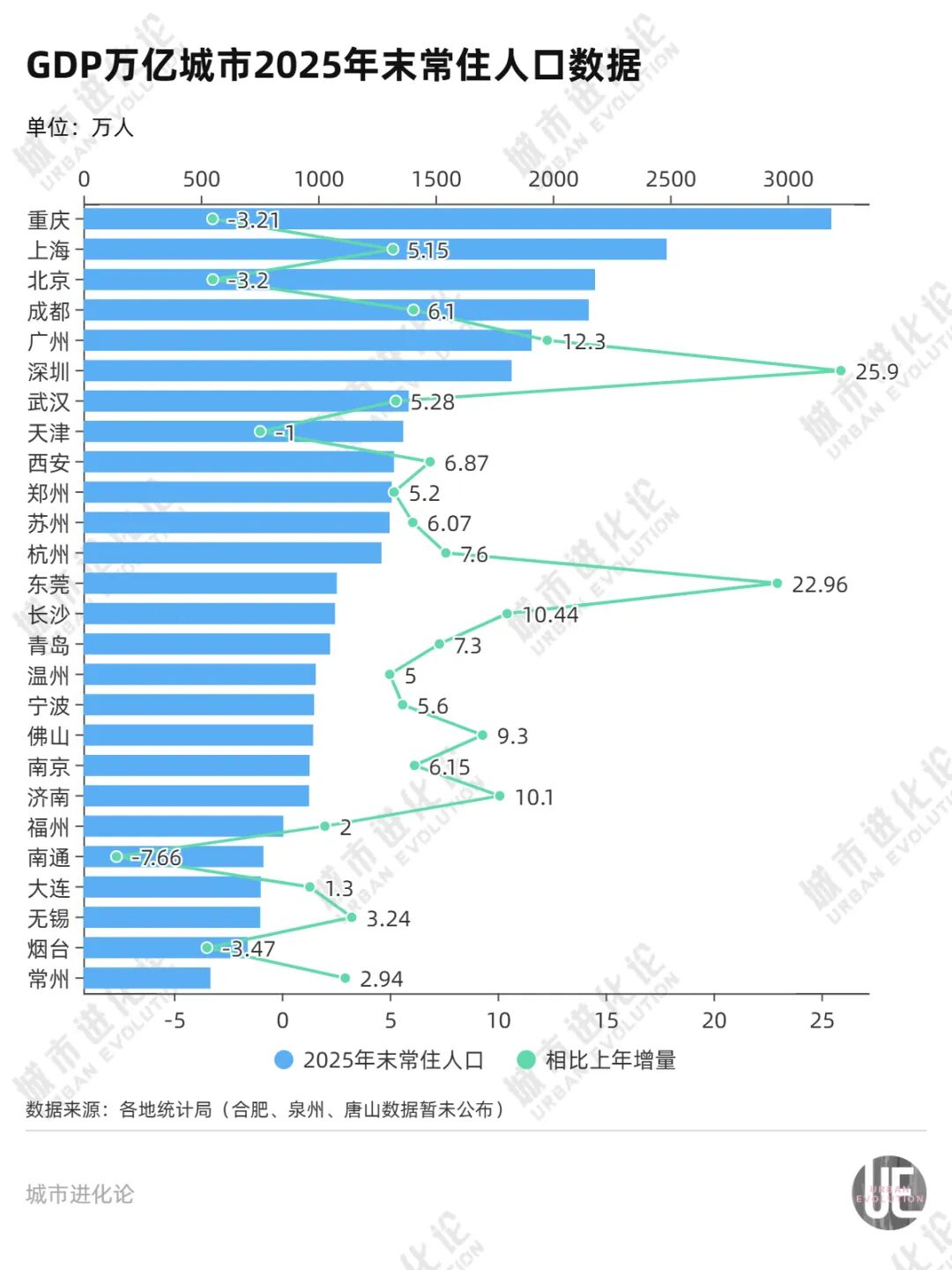
Recently, the population data of trillion - level cities in 2025 have been gradually released. The permanent population of many cities, including Chongqing, Beijing, Tianjin, Nantong, and Yantai, has shown negative growth.
According to the currently released data, Nantong has the largest population decline among trillion - level cities and is the only trillion - level city in the Yangtze River Delta with negative population growth.
In fact, as the fourth - largest economic city in Jiangsu, Nantong has witnessed a continuous negative growth trend in its registered population for many years. In recent years, the slight increase in the permanent population has mainly been maintained by mechanical population growth.
Currently, Nantong has experienced negative population growth for the first time in more than a decade. To some extent, this means that the net inflow of its population is no longer sufficient to make up for the double gap caused by natural population decline and outflow.
More importantly, in the Yangtze River Delta, the Shanghai Metropolitan Area is breaking through barriers and achieving synergy at an unprecedented speed. Behind the historic opportunity of regional reshaping, there also lurks the crisis of accelerated "blood loss".
A speech material at a special meeting previously released by the Nantong Political Consultative Conference pointed out that "Nantong lags behind the average level of the metropolitan area in indicators such as the proportion of the active population, the proportion of R & D investment, the number of high - tech enterprises, and the number of invention patents per 10,000 people, which does not match Nantong's 8.6% share of the total economic output in the metropolitan area..."
Nantong, which has already set its sights on the "next trillion", what can it rely on to gain a foothold in this "world - class" metropolitan area full of strong competitors?
Crisis
The 2025 statistical bulletin released by the Nantong Statistics Bureau shows that the city's GDP reached 1,280.15 billion yuan for the whole year, a year - on - year increase of 5.3%.
Different from previous years, this statistical bulletin did not release data related to the total permanent population, its increment, and growth rate. Only in the "Comprehensive" section did it disclose that calculated by the permanent population, the per - capita GDP was 166,000 yuan, a year - on - year increase of 5.5%.
If we calculate based on the formula "Per - capita GDP = Total GDP ÷ Annual average permanent population (the average of the permanent population at the beginning and the end of the year)", the annual average population of Nantong in 2025 was about 7.7117 million. By calculating back from the permanent population of 7.75 million at the beginning of the year (the end of 2024), we can conclude that the permanent population of Nantong at the end of 2025 was about 7.6734 million.
This population figure represents a decrease of more than 70,000 compared with the previous year, the largest decline among the trillion - level cities with released data.
Not long ago, Jiangsu announced that its permanent population in 2025 was 83.18 million, a decrease of 80,000 compared with the previous year. This is the first negative population growth in Jiangsu, the second - largest economic province in the country, since 1978, making it another major economic province that has reached a population turning point after Shandong, Henan, and Sichuan.
In contrast, the total population decline in Nantong last year was almost the same as that of the whole province, and the situation is not optimistic. Meanwhile, among the other four trillion - level cities in Jiangsu except Nantong - Suzhou, Nanjing, Wuxi, and Changzhou - their populations still showed positive growth last year, with increments of 60,700, 61,500, 32,400, and 29,400 respectively.
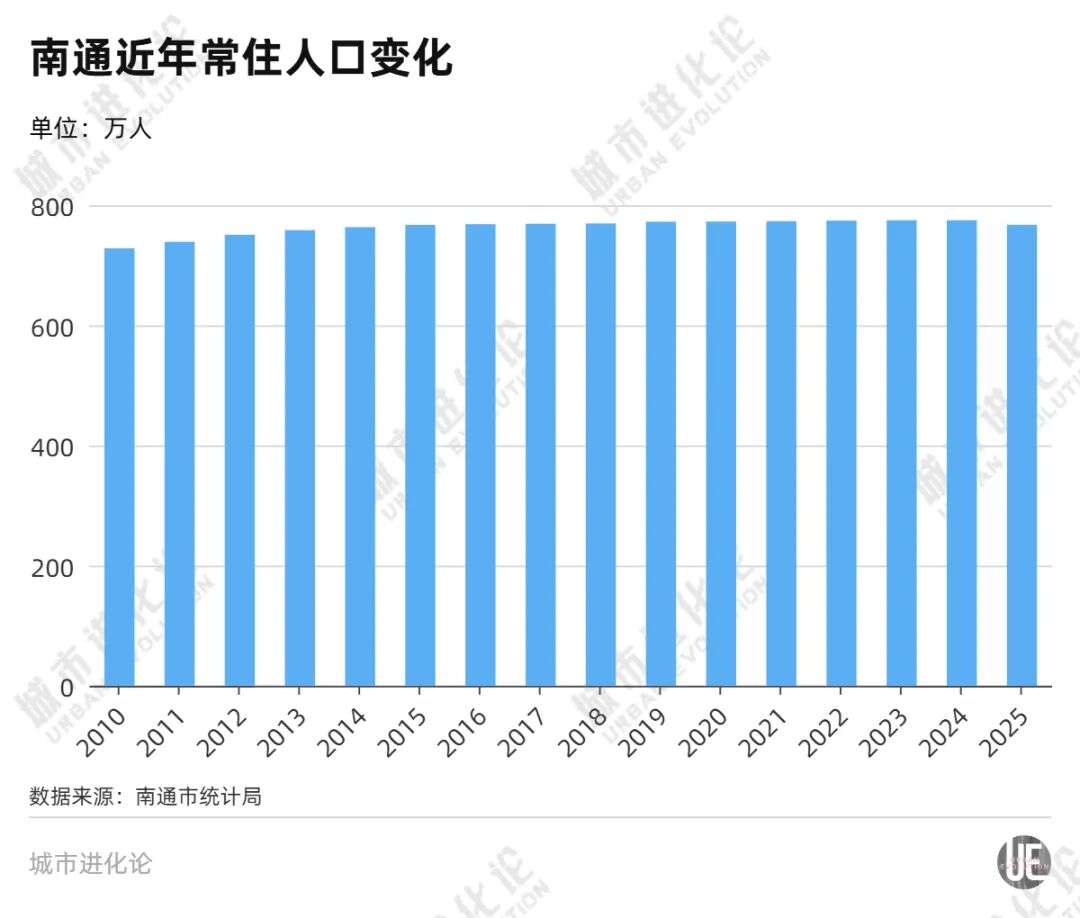
It is worth noting that this is the first time since 2010 that Nantong has experienced negative growth in its permanent population.
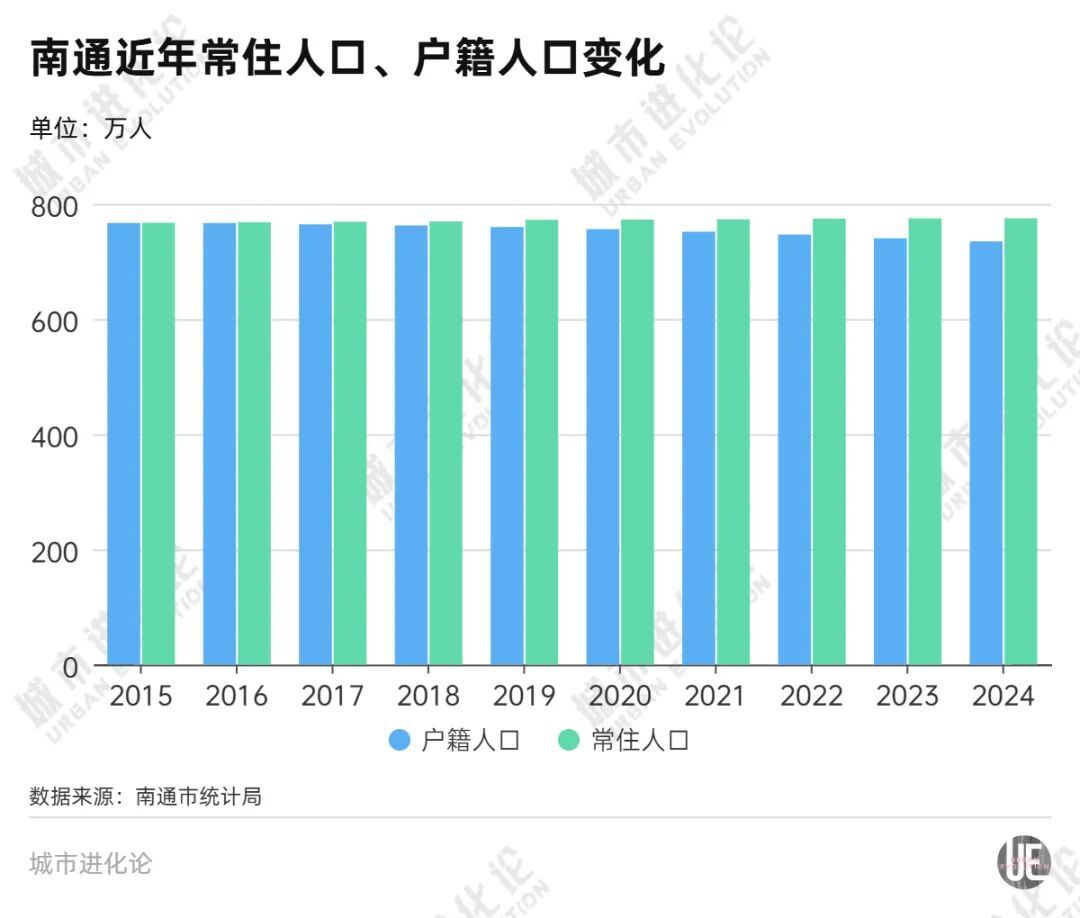
The data from the local statistical yearbook shows that Nantong's registered population has been experiencing continuous negative growth since 2015, dropping from 7.6677 million to 7.3483 million in 2024, a decrease of more than 310,000. Its permanent population exceeded the registered population for the first time in 2015 and has maintained a slight increasing trend over the years, with the population increment mostly hovering between 5,000 and 10,000.
Why did the continuous slight population growth trend turn negative last year?
By deeply analyzing Nantong's population growth structure, for a long time in the past, the natural population growth has been negative, and only with the mechanical population growth could the net population growth be barely maintained.
As the prefecture - level city with the highest degree of aging in the country, Nantong entered the aging society in 1982, 17 years earlier than the whole country. The trends of large - scale, rapid development, a large number of empty - nest elderly, and high - age population are obvious.
The data from the Seventh National Population Census shows that there are 2.3187 million people aged 60 and above in Nantong, accounting for 30.01% of the permanent population. As of the end of 2024, the number of registered elderly people aged 60 and above in Nantong reached 2.668 million, accounting for 36.33%.
What does this mean? It means that in Nantong, one out of every three people is an elderly person aged 60 and above.
The super - high aging combined with the low birth rate has led to a continuous decline in the natural population growth rate. Data shows that from 2020 to 2024, the natural growth rate of Nantong's registered population dropped from - 4.03‰ to - 6.47‰, and the total natural population decrease was more than 200,000.
During the same period, the annual increment of Nantong's permanent population was between 15,000 and 105,000. The huge gap behind this is due to the increasing "natural attrition".
Weakness
However, in the era of overall negative population growth, there are many cities that mainly rely on mechanical population growth to maintain their population growth. Attracting migrants through policies, industries, and employment opportunities has long been the main battlefield for top cities to "compete for talents".
Located in the Yangtze River Delta, a natural population "magnet", why is Nantong the first trillion - level city to reach the "turning point"?
Going back a few years, when Nantong officially announced its entry into the "trillion - club" in early 2021, it raised external doubts. Some media analyzed the newly - promoted "trillion - level cities" and compared data such as area, population, general budget revenue, and industrial output value. They found that Nantong was the only city with a net population outflow.
"Lack of popularity" has almost become an inescapable "weakness" for this economic powerhouse in the Yangtze River Delta.
Image source: Xinhua News Agency
Regarding the issue of the mismatch between the economic volume and the population, some experts have analyzed that it is related to Nantong's special industrial structure. As a well - known "hometown of construction" in the country, the number of construction workers in Nantong once reached about one million, and its construction projects are spread all over the world. However, in statistics, most of them are classified as "out - flowing population".
Obviously, there are also deeper reasons.
Looking at Nantong's industrial map, traditional industries represented by construction and textiles play a crucial role. Statistics show that traditional industries account for more than half of Nantong's industrial volume, contributing 60% of the output value and profits.
Among them, Nantong's construction industry completed a total output value of 1,247.66 billion yuan in 2024, ranking first in Jiangsu Province. However, in recent years, facing the downward pressure of the real estate industry, the construction industry has encountered unprecedented difficulties and challenges, and Nantong has also been severely hit. According to the data from the Nantong Statistics Bureau, in the first quarter of this year, the total output value of Nantong's construction industry decreased by 12.9% year - on - year, and the real estate development investment decreased by 7.7% year - on - year.
Meanwhile, this industrial town that occupies more than half of the global home textile product market is also experiencing the pain of transformation caused by a lack of product innovation, insufficient brand premium, and squeezed profit margins.
The urgent need for "renewal" of traditional industries and the insufficient drive of emerging industries have jointly become the drag factors on Nantong's economic situation.
In 2025, Nantong's GDP was 1,280.15 billion yuan, with an actual growth of 5.3%, but the nominal growth rate was only 3.1%, ranking last among the 13 cities in Jiangsu. In the first quarter of this year, Nantong's GDP was 317.11 billion yuan, with an actual growth of 5.5%, 0.5 and 0.1 percentage points higher than the national and provincial levels respectively. However, in terms of the nominal growth rate, the GDP increment in the first quarter was only 4.58 billion yuan, with a nominal growth of 1.5%, ranking third from the bottom among the 29 trillion - level GDP cities and last again in the province.
On the other hand, cities such as Suzhou and Shanghai across the river are continuously increasing their siphoning effect on the surrounding population through their promising emerging industry layouts and employment opportunities, further intensifying Nantong's population pressure.
Turning point?
According to the recently released "Ranking of China's Urban Talent Attraction: 2026", Nantong ranks 30th among the "Top 100 Most Talented Cities in China in 2025". Suzhou, Nanjing, and Wuxi are all among the top ten, and Changzhou ranks 22nd. Nantong ranks last among the five trillion - level cities in Jiangsu.
Now, new challenges are coming one after another.
Some viewpoints point out that with the accelerated progress of the Shanghai Metropolitan Area, the Yangtze River Delta cities, including Nantong, will face a critical window period to rewrite their "fate". Will they "take off" with the trend or experience accelerated "blood loss"? Whether they can quickly find their own differentiated breakthrough path is the key to taking the initiative in the future.
Nantong has set its sights on "developing towards the sea" and regards it as the biggest increment for reaching the "next trillion". Behind this strategic layout for the future, there are in - depth considerations.
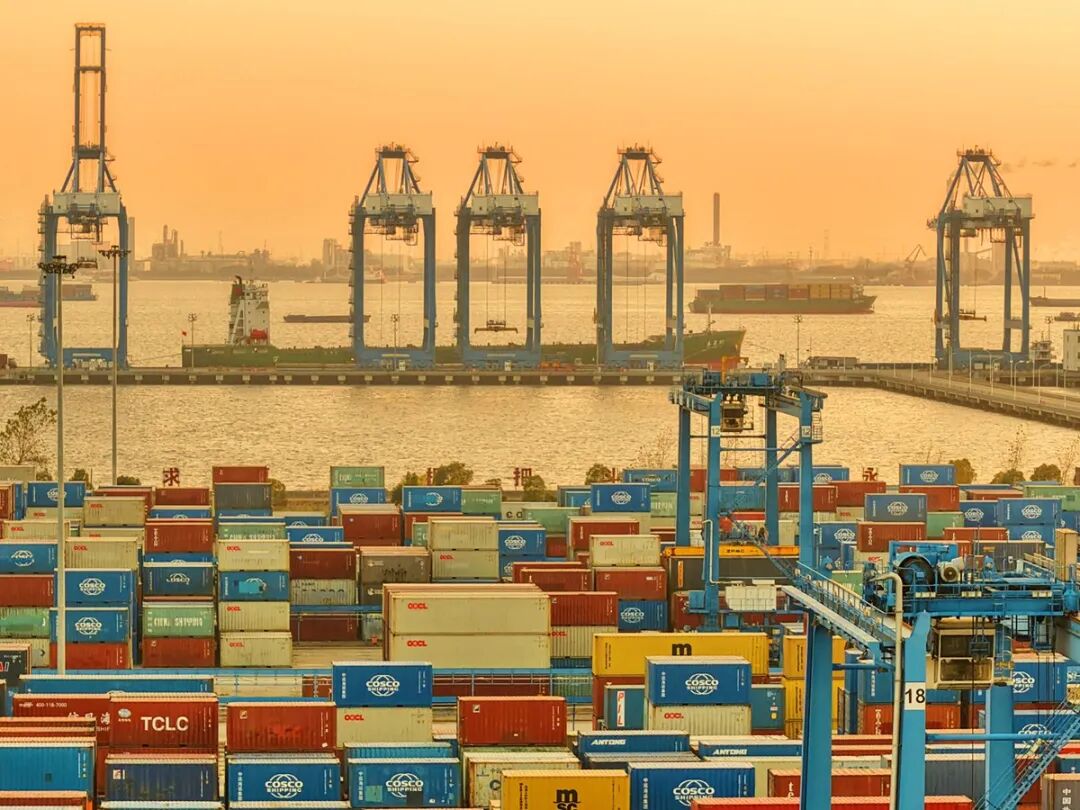
Image source: Xinhua News Agency
Geographically, as the only city in Jiangsu that borders both the Yangtze River and the sea, Nantong faces Shanghai and southern Jiangsu across the river. It became one of the first 14 coastal open cities in the country in 1984 and is at the hub position of land - sea linkage and east - west mutual assistance. In recent years, major strategies such as the development of the Yangtze River Economic Belt and the integration of the Yangtze River Delta have superimposed and intersected here. "Benefiting from both sides" and "being close to the river, the sea, and Shanghai" have once been the proud development advantages of the local area.
In terms of development space, Nantong has a sea area of 8,949.19 square kilometers, accounting for about 1/4 of the whole province of Jiangsu, a coastal line of 276.44 kilometers, accounting for about 1/3 of the province, and the total scale of unused coastal construction land is nearly 130,000 mu, with a development intensity of less than 20%.
In terms of industrial foundation, Nantong's marine GDP reached 260.6 billion yuan in 2024, accounting for 1/4 of the whole province of Jiangsu; in 2025, the scale of the city's marine - related industries exceeded one trillion yuan. In recent years, billion - level projects such as Zhongtian Green High - quality Steel, PetroChina Blue Ocean New Materials, and Wison Offshore & Marine have successively settled in, and major marine - related projects with a total investment of nearly 250 billion yuan are accelerating.
In this context, Nantong has issued the "Several Measures for Deeply Promoting the High - quality Development of the Marine Economy", taken the lead in establishing the Marine Development Bureau, and built a "3 + 2+2 + X" modern marine industrial system, focusing on creating three marine - related industrial landmarks: the capital of marine equipment, the blue ocean of advanced materials, and the green island of new energy.
Among them, the shipbuilding and offshore engineering industry is highly expected.
Public information shows that Nantong has been making continuous efforts in the field of shipbuilding and offshore engineering in recent years, and has formed a complete industrial ecosystem of coordinated development from ship repair and building, high - tech ships to offshore equipment and high - end supporting facilities. It has successively built and delivered a number of "world - largest" and "globally first - built" heavy industry equipment such as the heavy self - propelled cutter - suction dredger "Tiankunhao", the 24,000 - TEU ultra - large container ship, the polar expedition cruise ship, and the intelligent FPSO.
In 2025, the total output value of Nantong's shipbuilding and offshore engineering industry exceeded 220 billion yuan, a year - on - year increase of 6.6%. The scale of the shipbuilding and offshore equipment industries accounts for 1/8 and 1/3 of the national total respectively.
Striving for success towards the sea, Nantong's "ambition" is to promote this industrial landmark to the "world - class" level.
According to the previously issued "Special Action Plan for Promoting New - style Industrialization in Nantong in 2