The company that was once most like "China's OpenAI" has started making money from the government.
Li Kaifu, the former global vice president of Google and president of Greater China, made a decision that "goes against his ancestors."
He doesn't plan to keep sticking to the orthodox route of large models.
According to the Silicon Valley AI narrative, the story that a star large model company should tell is about technological leadership, general models, developer ecosystems, and finally leading to AGI. OpenAI is the standard answer for this kind of story.
When Lingyi Wanwu was first established, the outside world almost understood it according to this template: "AI evangelist" Li Kaifu entered the field, the Yi series of open - source models became well - known, and its valuation exceeded $1 billion in just eight months. Everything seemed to be the start of a "Chinese version of OpenAI."
But now, Lingyi Wanwu has changed its direction.
Recently, there has been news that the company will go public on the Hong Kong Stock Exchange in 2027. The new achievements Li Kaifu presented are no longer model parameters and benchmark rankings, but 1.5 billion yuan in orders, B2B commercialization, and the goal of becoming "the first profitable AI 2.0 company in China."
More importantly, Lingyi Wanwu has merged most of its pre - training teams and AI underlying infrastructure teams into Alibaba Cloud, and then turned to serve government and enterprise customers, develop industry models, and deliver intelligent agents.
This also means that a company once expected to be the "Chinese version of OpenAI" has now put aside the most money - burning and most imaginative foundation models and started to do down - to - earth business: helping governments and enterprises use AI and then getting the money back.
AI influencer Lan Xi once posted on Weibo and complained: "I doubt that there is anyone in the world who can clearly explain what Lingyi Wanwu is doing in one sentence, including Li Kaifu himself..."

What on earth does Lingyi Wanwu want to do?
Two Radical Shifts
Actually, Lingyi Wanwu, which seemingly has "gone against its original intention," has experienced two radical strategic shifts.
The first shift is to withdraw from the most money - burning area.
In January 2025, Lingyi Wanwu made a decision that shocked the industry: it merged most of its large - model pre - training teams and AI underlying infrastructure teams into Alibaba Cloud, and actively gave up the research and development of ultra - large foundation models with trillions of parameters and the long - term exploration of AGI. By March, the company officially announced that it would fully focus on B2B business, co - build an industrial large - model joint laboratory with Alibaba Cloud, and shift to lightweight and implementable industrial customized large models.
This is not just a minor adjustment like changing a department or a product line. For a large - model company, the pre - training teams and underlying infrastructure are basically the most valuable and money - burning assets. They support the technological ambition and the valuation imagination.
By handing over this part, Lingyi Wanwu has already taken a completely different path from OpenAI.
There are of course practical considerations for doing this. General foundation models are very expensive. Training costs money, inference costs money, and so does talent. What's more troublesome is that although the model capabilities are becoming stronger and stronger in the competition, the difficulty of commercialization and monetization in the industry has not decreased. If Lingyi Wanwu really continues to go down this path, it will not just face one competitor, but will be caught in the entire industry's computing power arms race.
From this perspective, it's not embarrassing for Lingyi Wanwu to withdraw. But the real problem is what the company can rely on to prove its value after withdrawal.
So Lingyi Wanwu's second shift quickly followed.
This time, Lingyi Wanwu no longer focuses on selling standardized large - model tools, but shifts to delivering quantifiable business results to government and enterprise customers: instead of selling "stronger model parameters" in the past, it now helps customers integrate AI into real business processes, and finally achieves visible efficiency improvement and cost reduction.
It is this new direction that makes its subsequent product lines closer to government and enterprise customers.
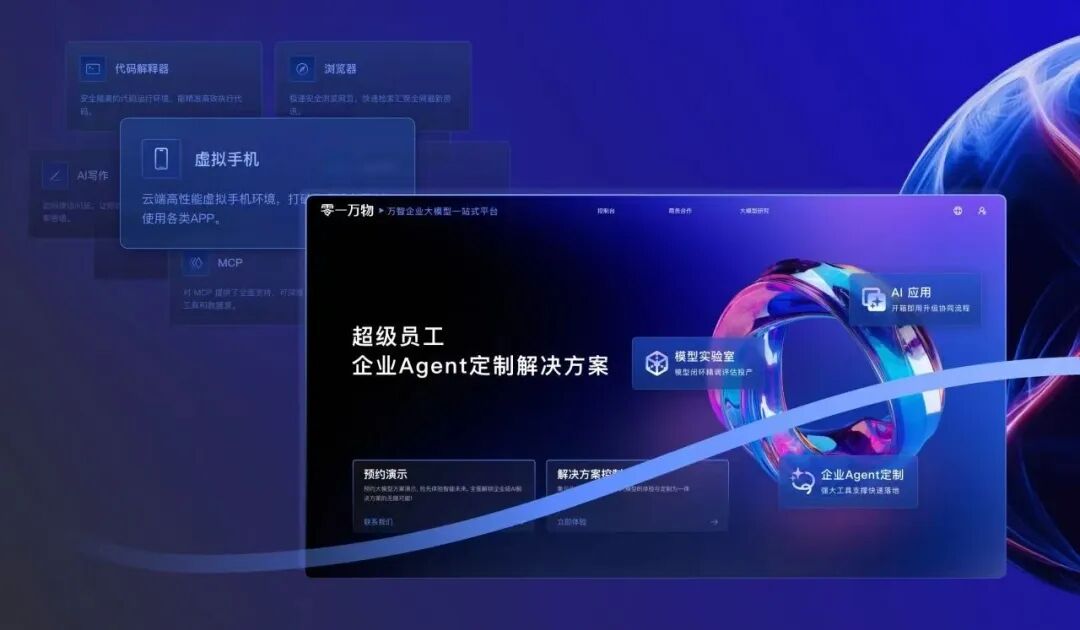
The Wanzhi Enterprise Large - Model One - Stop Platform serves the needs of private deployment, multi - model compatibility, and fine - tuning for government and enterprises; the Wanzai Intelligent Agent enters the front - line office scenarios, and according to the company's disclosure, it can improve the efficiency of patent writing and other work by 300% - 500%; the Kaifu AI Agent exclusive for senior executives has 19 sub - intelligent agents built - in, aiming at the problem of the disconnection between decision - making and execution in large enterprises.
The overseas business also develops along the same line. Lingyi Wanwu jointly launched a hardware - software integrated intelligent computing node with AMD and implemented a national - level large - model project in Kazakhstan, trying to enter the overseas sovereign AI market.
When we put all these actions together, Lingyi Wanwu's new route is very clear: it no longer chases the general - model story of OpenAI, but turns to making AI into projects that government and enterprise customers can purchase, deploy, and accept.
Even Li Kaifu's personal involvement as a "salesperson" is also in service of this route.
Lingyi Wanwu proposed the "No. 1 Project," bypassing the enterprise's regular IT procurement department. Li Kaifu serves as the chief AI strategy officer for customers and directly connects with the decision - making level of government and enterprises, focusing on vertical industries such as government affairs, finance, and industry, concentrating on strategic orders worth hundreds of millions of yuan, and giving up scattered small orders and free pre - sales consultations.
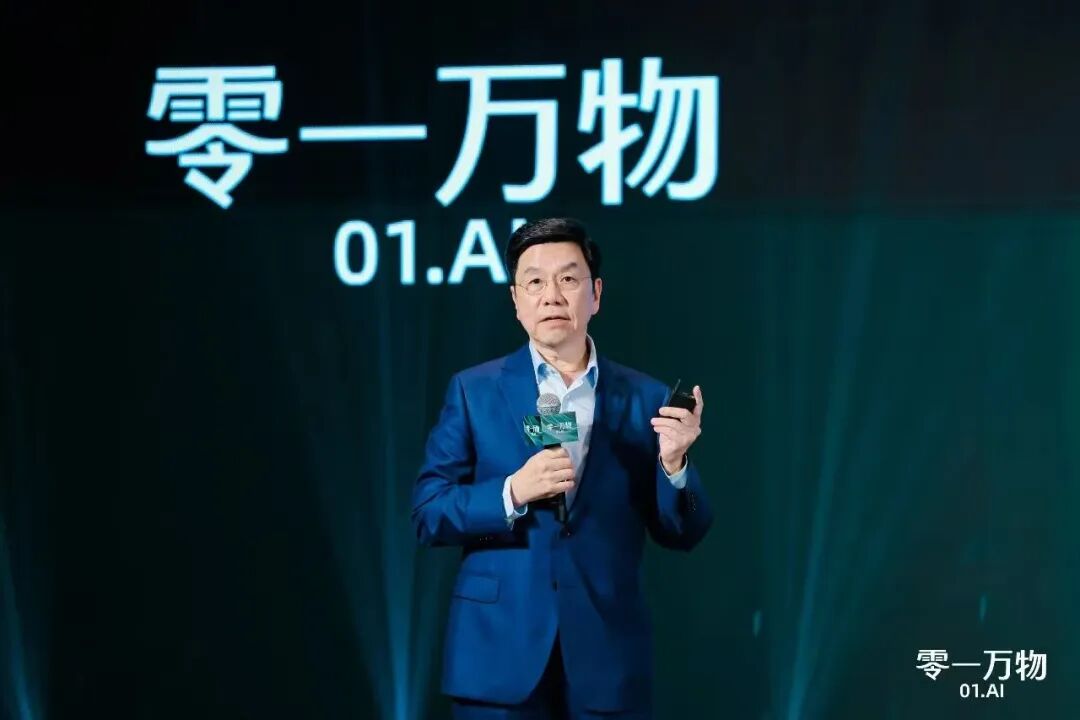
Li Kaifu has his reasons for doing this. After all, when large enterprises buy AI, they often value more than just buying a tool. The real difficulty lies in whether to change the business process, data system, and budget framework, and these things may not be promoted by the regular IT department. Only when the top leader approves can the project become a strategic project.
With Li Kaifu's personal involvement, it is more likely to elevate a technology procurement into a high - level cooperation.
However, after the two shifts, Lingyi Wanwu also faces some new problems.
Withdrawing from the foundation models can indeed reduce the computing power and R & D pressure; shifting to government and enterprise delivery can also make it easier to get revenue. But under these two routes, the most valuable part of an AI company - imagination - is also weakened at the same time.
Trillion - parameter models, AGI, and the domestic OpenAI - like concept may seem a bit illusory, but they are all excellent factors for boosting a company's valuation.
So, since Lingyi Wanwu is going to sprint for an IPO as an AI company in 2027, Li Kaifu needs a new story.
That is AI 2.0.
Is AI 2.0 a Gem or a Gimmick?
To understand AI 2.0, we first need to figure out what AI 1.0 looks like in Li Kaifu's eyes.
He used the power industry as an analogy: AI 1.0 is the invention of electricity, and AI 2.0 is the construction of the power grid.
From 2012 to 2022, the AI industry was driven by traditional architectures. It could do face recognition, voice transcription, and industrial quality inspection, but each function was an isolated plug - in - it could improve efficiency when installed, but couldn't form a system and couldn't change how a company operates.
After ten years, AI proved its usefulness but failed to become anyone's underlying ability. It was difficult for the industry to achieve large - scale implementation, and the overall industry continued to suffer losses.
After 2022, large models changed the situation.
General foundation models can complete self - supervised learning based on massive unlabeled data. They can not only do perception and recognition but also understand text, generate content, and process multi - modal data. With the addition of intelligent agents, AI has the opportunity to enter deeper positions in enterprise operations such as government affairs approval, financial risk control, and supply - chain management.
This change is essentially the evolution of AI from an independent tool to a systematic ability. Up to this point, what Li Kaifu said is still in line with the industry consensus, and no one would object.
But he did a more "sneaky" thing: he turned AI 2.0 from an industry trend into a proprietary business framework for Lingyi Wanwu.
His logic is built layer by layer.
Starting from technology: large models already have general understanding and autonomous reasoning abilities, and can adapt to the complex business of enterprises as a whole without patching each link separately.
To put it simply, in the era of AI 2.0, the competition is not about whose model has more parameters, but about who can integrate model capabilities into real business. And this means that Lingyi Wanwu's decision not to do foundation models is not falling behind, but unnecessary.
After establishing the technological foundation, he then elevated the company's choice to the business level: since AI can be integrated into business, the standard for measuring it should also change.
Instead of looking at model benchmarks, look at how much money customers save and earn after using it. The core of Lingyi Wanwu's AI - native business reconstruction is measured by the real changes in customers' financial reports.
This layer actually answers the question of "how to price without doing foundation models?", and the answer is to price based on the financial improvement of customers.
After finishing the business - level explanation, Li Kaifu takes it one step further.
He defines AI 2.0 as the third - generation platform revolution after the PC Internet and the mobile Internet, which is expected to reconstruct the entire industry's application software and open up a market space ten times larger than that of the mobile Internet.
At this level, it's like drawing a big pie for the IPO - going public on the Hong Kong Stock Exchange in 2027, the title of "third - generation platform revolution" carries more weight.
From a reasonable technological judgment, to a bold business redefinition, and then to directly proclaiming a platform revolution, after these three steps, Li Kaifu has constructed a narrative of AI 2.0 based on the development process of AI, making all of Lingyi Wanwu's choices reasonable.
This is understandable. After all, this is a company that has actively given up pre - training of trillion - parameter models and long - term exploration of AGI. If it continues to tell the old story, it will only be interpreted by the market as "falling behind."
However, no matter how much it is gilded and polished, it is still a set of localized business terms created by Li Kaifu based on the overseas Software 2.0 concept - there is no unified academic standard and no clear boundary.
Industry models can be called AI 2.0, intelligent agents can be called AI 2.0, multi - modality can be called AI 2.0, and government and enterprise customized delivery can also fit into this framework. The framework is big enough to hold anything.
So for Lingyi Wanwu, AI 2.0 is both a strategic judgment and a survival tactic. However, the term AI 2.0 itself cannot prove anything.
The only thing that can prove the success of Lingyi Wanwu's route is: how much of the 1.5 billion yuan in orders can actually become money on the books.
The High - Stakes Gamble for AI B2B Survival
After telling the narrative of AI 2.0, it's time to do the math.
Lingyi Wanwu's achievements are actually not bad. As of May 2026, the orders have exceeded 1.5 billion yuan. In 2025, the audited revenue was 250 million yuan, and the external window for IPO is open - Zhipu and MiniMax have successively listed on the Hong Kong Stock Exchange, and the Chapter 18C channel has been proven.
But there is an iron law in the B2B government and enterprise business: orders do not equal revenue.

Lingyi Wanwu's own data has already shown this: in 2025, the orders were 500 million yuan, but the final recognized revenue was 250 million yuan, with a recognition rate of 50%. Calculated at the same ratio, the recognizable revenue corresponding to 1.5 billion yuan in orders is probably between 700 million and 800 million yuan. Moreover, the acceptance cycle of many government and enterprise projects is long, and most of the revenue needs to be recognized across years. The 1.5 billion yuan on paper will be a different figure in the financial report.
However, while the revenue is discounted, Lingyi Wanwu's cost cannot be discounted. According to industry estimates, the annual labor cost of a top - notch AI team of more than 200 people is estimated to be 200 million to 300 million yuan. Although the pre - training computing power expenditure has been cut, the investment in inference and fine - tuning is still necessary.
Coupled with the common demand creep in government and enterprise customized projects - customers keep adding requirements during the project implementation, and the implementation cost keeps increasing - it doesn't seem as easy as expected for the company to make a profit.
What Li Kaifu said about "achieving quarterly break - even in 2026" probably refers to the adjusted profit after excluding equity incentives and other expenditures according to industry practice, which is different from the net profit under the general accounting standards required for listing on the Hong Kong Stock Exchange.
Beyond the balance sheet, there are several deeper concerns. After the pre - training team was completely merged into Alibaba Cloud, Lingyi Wanwu no longer has its own self - developed foundation models, and its technological iteration depends on external open - source, which weakens its moat.
Since its establishment three years ago, at least six co - founders and core executives, such as Gu Xuemei, Dai Zonghong, and Pan Xin, have left one after another. Such frequent changes in the management are not a plus for a company preparing for an IPO. The orders are highly concentrated among a few top - tier government and enterprise customers, and any problem with a large order will cause significant fluctuations in performance.
However, fortunately, although Lingyi Wanwu faces many risks, it also has some advantages. Nearly half of the 1.5 billion yuan in orders is ARR (Annual Recurring Revenue), which is quite rare in the domestic B2B AI industry - most of its peers are still doing one - time project - based delivery. The subscription model at least has the potential for long - term compound interest in terms of structure, and its light - asset nature allows it to reach the profit line earlier than its peers.
However, being in the lead doesn't mean reaching the finish line. After losing the technological