Just now, Jensen Huang announced the full-scale production of Rubin. 40,000 engineers participated in its construction, and the most powerful CPU in history was unveiled simultaneously.
Just now, at the NVIDIA GTC conference in Taipei, China, NVIDIA CEO Jensen Huang once again focused the topic on the development direction of the AI industry.
Different from the focus on the generative AI wave two years ago, this time Jensen Huang gave a new judgment:
"Generative AI has arrived, and practical AI has arrived."
The era of practical AI has arrived
In his view, the biggest change in the AI industry in the past few years is not the continuous growth of model parameter scale, but that AI has begun to become a real production tool and directly affect economic activities.
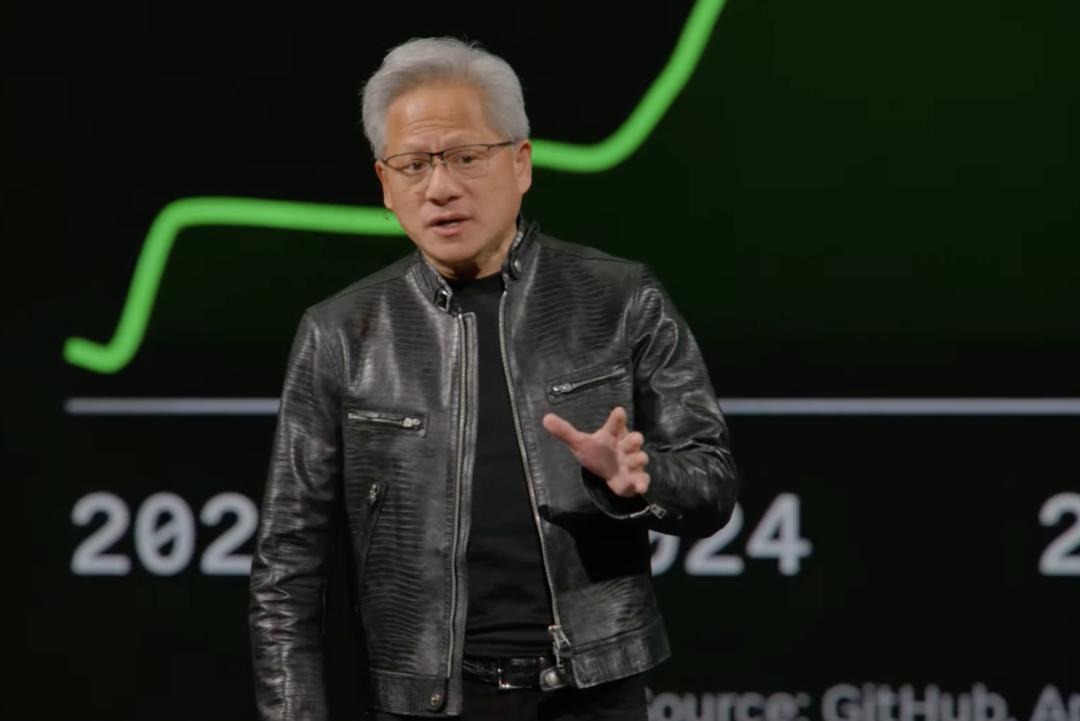
To illustrate this change, Jensen Huang first showed a set of data from the code hosting platform GitHub. He pointed out that software development is one of the earliest fields where generative AI has been implemented, and it is also one of the largest groups of knowledge workers in the world. Currently, there are about 30 to 40 million professional software engineers around the world who rely on programming work, and there are also hundreds of millions of students and amateur developers involved.
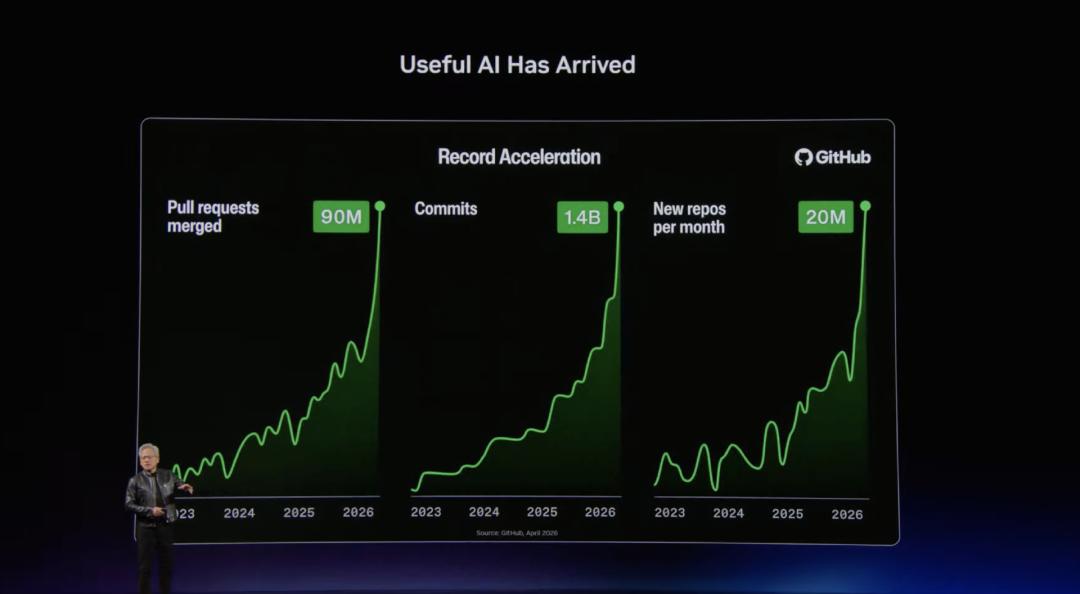
In his speech, the number of code submissions on GitHub was used as an important indicator to measure the change in AI productivity:
- In 2023, the number of code submissions was about 300 million;
- In 2024, it increased to 400 million;
- In 2025, it reached 500 million;
- And the data in the first few months of 2026 has already shown a several - fold increase compared to the previous level.
Jensen Huang believes that these numbers reflect that AI - assisted programming tools are significantly improving the efficiency of software development.
"Software engineers around the world create a salary value of about $3 trillion." He said, "And these software further support global economic activities worth nearly $100 trillion."
According to his calculation, if AI can increase the productivity of software developers several times, the economic value released will far exceed the software industry itself.
In recent years, with the rapid development of code - generation tools, "whether programmers will be replaced by AI" has always been the focus of industry debate. In response, Jensen Huang gave a clear answer in his speech.
He believes that the development of AI will not reduce the number of software engineers, but will stimulate enterprises to recruit more developers. The logic is simple: if an engineer can create higher output with the assistance of AI, enterprises are more likely to increase R & D investment rather than reduce the size of the R & D team.
"Some people say that AI will reduce employment. That's complete nonsense." Jensen Huang said.
In his view, what really determines the scale of employment is not the unit labor cost, but the ability of unit labor to create value. When software engineers can complete more work with the help of AI, the market demand for software and digital capabilities will further expand.
Jensen Huang then turned the topic to AI infrastructure. He pointed out that as AI moves from the laboratory to the actual production environment, the industry's focus has shifted from model capabilities to Token output capabilities.
In the past, Token was just a technical indicator in the model operation process; now, Token has become a unit that can directly generate revenue. In other words, AI companies are not producing software products in the traditional sense, but continuously generating Tokens.
Whoever can generate more Tokens at a lower cost and higher efficiency will have stronger commercial competitiveness.
"Because Token has now become a profit - making unit - Token is now a profit - making unit that can bring in revenue. Just because it can now make a profit, AI companies want to build more Tokens, generate more Tokens, and build more AI factories. That's why the demand for computing power in Taiwan, China has skyrocketed. And that's why all of you are so busy and your businesses are doing so well. In fact, just look at some of your stock prices." Jensen Huang said.
This is also an important reason why the construction of data centers around the world is heating up continuously and the demand for AI computing power in Taiwan, China is growing rapidly.
In his description, the AI factory (AI Factory) is gradually replacing the traditional data center and becoming the core of the new round of computing infrastructure construction.
From the application era to the agent era
However, in Jensen Huang's view, the bigger change is not just the improvement of model performance, but the change in the computing paradigm itself.
In the past few decades, computers have followed the pattern of: application → code → operating system. Users complete tasks by clicking on the interface and entering commands.
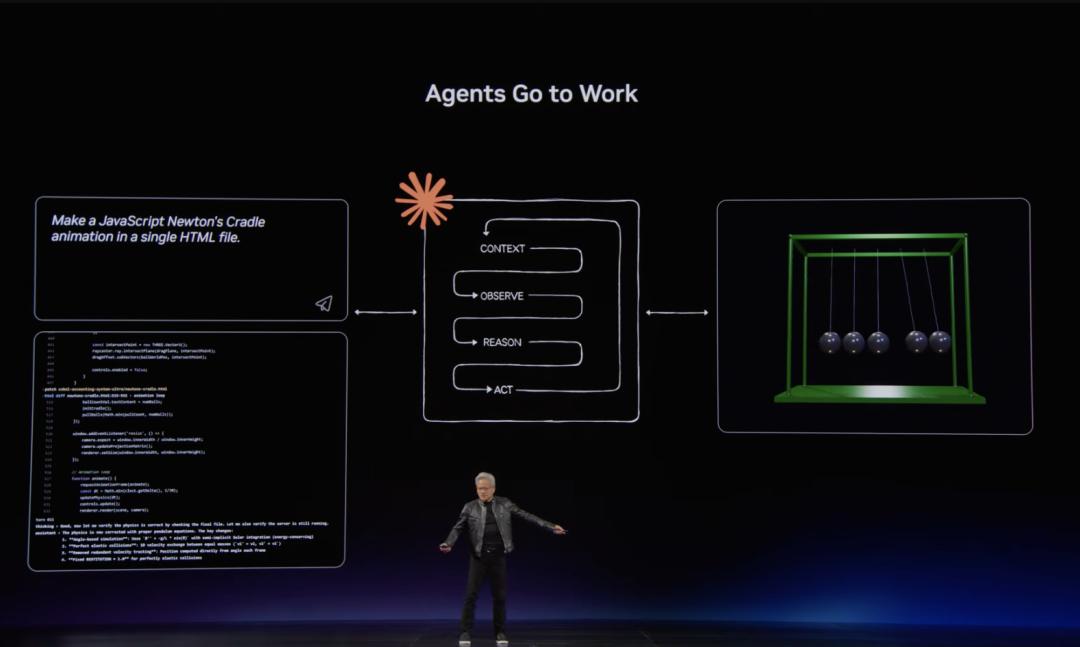
In the AI era, a new architecture is taking shape: Agent → large - language model → tool system.
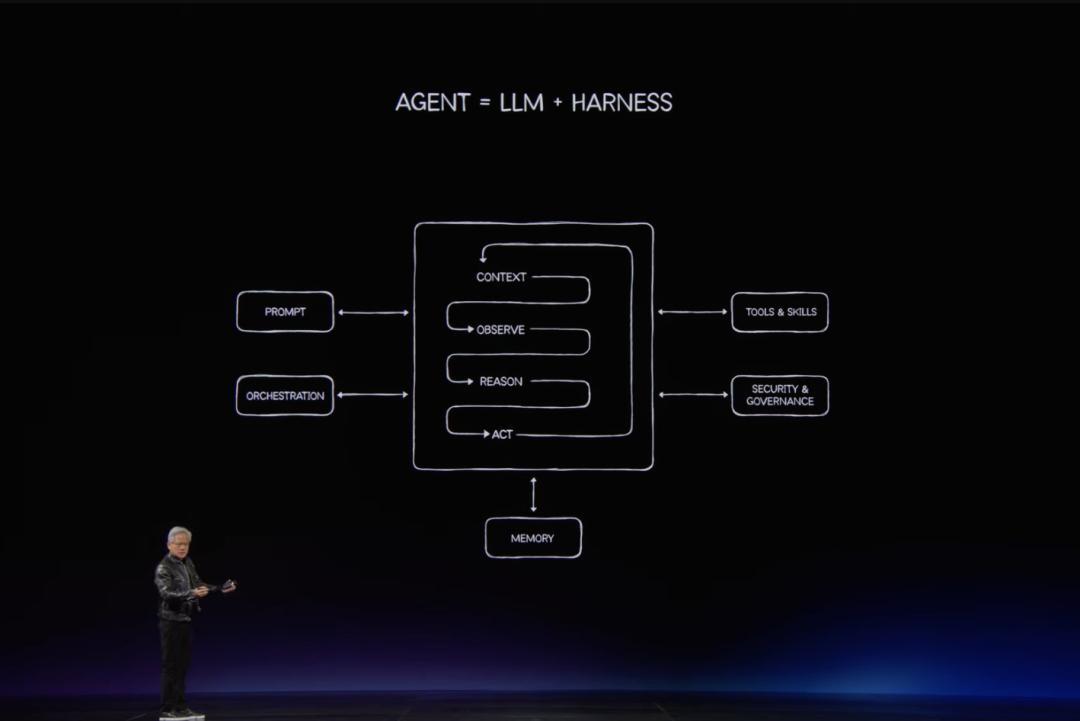
Jensen Huang showed a typical architecture diagram of an Agent system.
In this architecture, the large - language model is responsible for understanding problems, reasoning, and planning; the peripheral framework is responsible for managing context, invoking tools, coordinating task execution, and managing long - term and short - term memory. To complete tasks, the agent can invoke browsers, databases, spreadsheet tools, data analysis engines, CAD design software, and various enterprise systems.
The whole process is more like a digital employee rather than traditional software. "In the past, we started applications, clicked buttons, and entered content." Jensen Huang said, "In the future, we only need to explain our intentions to AI." Then AI will automatically write code, invoke tools, and complete tasks.
The rise of agents has also sparked another controversy: if AI can complete work, will software companies be eliminated?
Jensen Huang's answer is the opposite.
He believes that the Agent era will give rise to far more software systems than today. The reason is that the number of digital agents is no longer limited by the population size. In the future, every enterprise process, every business link, and even every personal task may have its own exclusive agent. And these agents need to call a large number of external tools and services to complete their work.
Therefore, software will not disappear, but will need to exist in a form that can be called by AI.
"This is one of the best times for the software industry." Jensen Huang said.
In this context, NVIDIA's long - accumulated CUDA ecosystem will also welcome new opportunities.
In the past, the CUDA library was mainly for developers; now these capabilities can be directly called by agents and become a toolset when agents perform tasks. In a sense, the message Jensen Huang is trying to convey is very clear: in the generative AI era, we discuss what the model can do, while in the practical AI era, we discuss what work the model can complete.
When AI starts to generate revenue, drive GDP growth, and can perform complex tasks by invoking tools through agents, it is no longer just a chatbot, but is becoming a new computing platform.
"NVIDIA is first and foremost a software company"
After talking about the computing paradigm change brought about by agents, Jensen Huang once again emphasized a view he has repeatedly mentioned in recent years:
NVIDIA is essentially a software company.
Subsequently, Jensen Huang explained the core architecture and operating logic of AI agents.
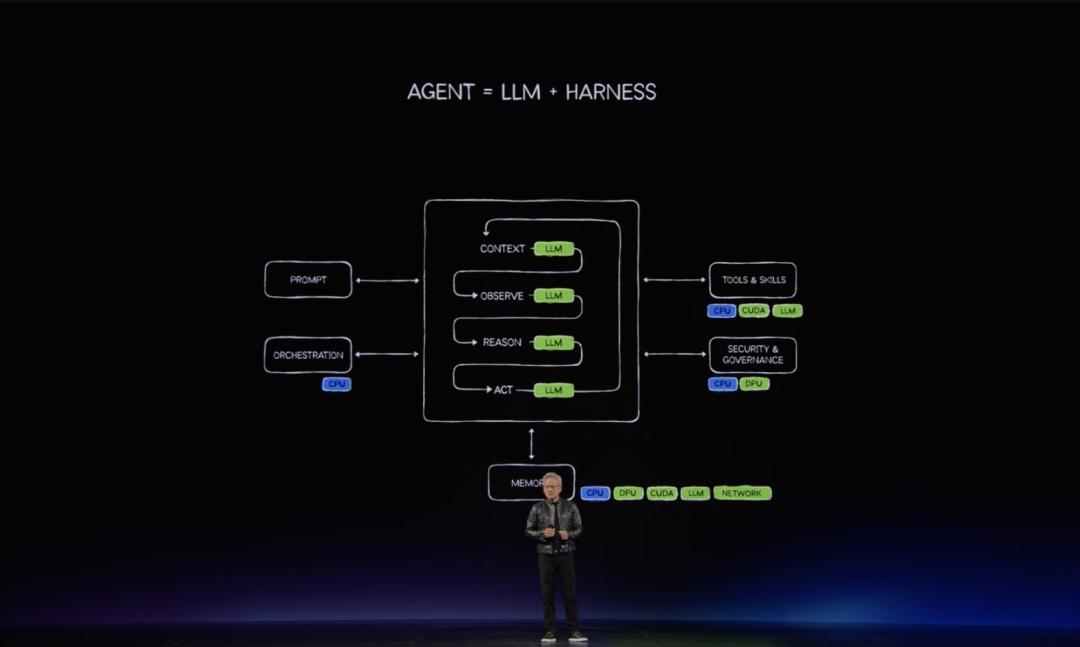
He said that the agent is the ultimate decoupled and distributed computing model, which needs to mobilize a large number of different computing units to run collaboratively. A complete AI agent consists of five core parts: model, framework, tools, skills, and runtime. Each component runs dispersedly on different nodes in the data center. He vividly compared it to a working individual: the model is the "brain" of the agent, responsible for thinking and decision - making; the framework is the "body", carrying the overall operation; the runtime is like an exclusive studio, supporting the implementation of various tools. The whole system completes computing power scheduling and task execution in an ultra - large - scale mode.
According to his introduction, each work process of the agent is split into different modules of the computer and completed step by step. Among them, the large - language model undertakes core intelligent tasks such as thinking, context processing, environmental perception, logical reasoning, plan planning, and action execution. This process will activate the Grace Blackwell NVLink 72 computing power cluster in batches. In the process of the agent invoking tools, the CPU undertakes the computing work and can be adapted to C compilers, Python, JavaScript, and various accelerated computing tools.
Jensen Huang believes that the tool application ability of current AI agents is still in its primary stage, and it will be upgraded to be more professional and proficient in the future. For this reason, NVIDIA's CUDA X library has undergone an important upgrade. The entire series of library products will be accompanied by exclusive AI skill manuals, which can be used by AI agents to learn independently and master the use methods of tools, greatly improving the ability of agents to solve various core industry problems. In the future, the computing power value and application potential of agents calling CUDA X tools will be greatly released.
In the entire agent computing power system, various hardware and functional modules have clear divisions of labor. Tool computing tasks are completed collaboratively by the CPU, GPU, and large - model; the security protection framework is deployed on the CPU and NVIDIA BlueField DPU security processor to ensure the overall operation safety; the overall task scheduling and orchestration work is uniformly led by the CPU, forming a heterogeneous computing system with clear levels and clear divisions of labor.
In his speech, Jensen Huang specifically mentioned the core pain point of AI computing - the memory system. He said that the working memory of the agent is realized through the KV cache, covering complex operations such as memory retention, data compression, information retrieval, matching of structured and unstructured data, and sorting out the logical relationships and ontological associations of various data. The overall processing process is extremely difficult and complex. He predicted that the iterative upgrade of the AI - specific memory system will drive a revolutionary change in the global storage system.
Comparing with the traditional software operation mode, Jensen Huang emphasized that the new computing paradigm represented by AI agents has essential differences. In the past, most software was a centralized operation mode where a single binary file was adapted to a single operating system. In contrast, agents adopt a new computing logic of decoupling, distribution, and heterogeneity. This is also the core motivation for NVIDIA to devote itself to the research and development of the next - generation Vera Rubin platform.
Regarding the new Vera Rubin platform, Jensen Huang emphasized that it is by no means a single chip or an ordinary GPU product, but a complete end - to - end revolutionary system. The platform takes the GPU as the core starting point, integrates core hardware such as GPUs, Vera, and NVLink 72, relies on multiple CPUs to complete global task orchestration, and is equipped with an iteratively upgraded revolutionary storage system to build a full - link computing power base. At the same time, the platform integrates CX - 9 hardware, the DOCA software stack, and a built - in security processor, which can encrypt data throughout the process of static state, transmission, and use, and comprehensively protect the security of high - value AI model data based on the confidential computing architecture.
Jensen Huang said bluntly that Vera Rubin is NVIDIA's most ambitious R & D project in its development history. All 40,000 engineers of the company are involved in the project, and at the same time, it brings together the strength of industry partners to implement it. It is an extremely complex system that has been comprehensively polished and reconstructed from scratch. He admitted that NVIDIA has long completed the strategic transformation from a single GPU manufacturer to a full - stack system manufacturer. The currently launched Vera Rubin system is the most complex and complete AI computing power system designed in the industry so far.
When talking about the ultimate industrial needs and the enterprise transformation direction, Jensen Huang said that the core demands of customers and partners are not simply to obtain computer hardware, but to build a mature and efficient AI factory. Based on this industry trend, NVIDIA is starting a new round of strategic transformation. Currently, NVIDIA's core technologies have been fully implemented in infrastructure - level application scenarios, and at the same time, it links with various industrial ecological partners such as power plants, cooling systems, and power grid suppliers to build a complete AI industrial ecosystem.
In the future, NVIDIA will continue to build a full - stack computing power system to provide core support for global customers to build large - scale, high - performance AI infrastructure.
It is worth noting that in this speech, Jensen Huang elaborated in detail on NVIDIA's new industrial positioning and formally proposed the "new paradigm of the AI factory ecosystem", clearly stating that NVIDIA's development focus has been comprehensively upgraded from the traditional computing ecosystem to a factory - based ecological system serving the trillion - level AI infrastructure.
Jensen Huang distinguished between NVIDIA's old and new ecological forms. In the past, NVIDIA took the computing ecosystem as the core and deeply integrated its computing layer, software, and computing stack into various enterprise platforms and third - party libraries, widely empowering the digital computing power needs of all industries.
Now, the newly built AI factory ecosystem has formed a clear upstream - downstream industrial closed - loop: industry partners are the upstream foundation support for NVIDIA, and NVIDIA relies on its own full - stack technical capabilities to output a complete AI factory ecosystem to the downstream. The core goal is no longer simply to output GPU chips or computing power systems, but to help customers build ultra - complex and ultra - large - scale AI factory infrastructure.
He said bluntly that the AI factory has entered the stage of large - scale implementation with extremely high investment and high thresholds. Currently, the construction cost of a single 1 - gigawatt (GW) - level AI factory continues to rise, from the initial $20 - 40 billion to the current $50 - 60 billion, and it will soon exceed $80 billion or even $100 billion in the future. The investment of hundreds of billions of dollars in a single project means that the AI factory has extremely high requirements for implementation stability and operation reliability. It must be built once and put into normal production immediately. Its capital investment cost and system construction complexity have reached an unprecedented level in the industry.
To solve the problem of building an ultra - complex AI factory, NVIDIA relies on Omniverse's digital simulation ability to achieve a full - process innovation. Different from the traditional computer R & D mode - first designing the chip and then simulating the system operation in the device - now all the AI factory infrastructure of NVIDIA can be built, simulated, tested, and optimized in advance on the Omniverse digital platform. Through the empowerment of the digital simulator and digital architecture, the industry can complete the full - process deduction of the ultra - large - scale AI system before breaking ground and investing huge amounts of money, completely avoiding implementation risks and realizing the industry's long - standing technology implementation vision.
Jensen Huang specifically introduced the core system DSX that supports the implementation of the AI factory ecosystem, forming a complete infrastructure layout corresponding to NVIDIA's existing product matrix. Among them, the RTX series corresponds to GPU hardware, DGX corresponds to the integrated computing power system, and the new DSX platform is precisely targeted at all scenarios of AI infrastructure. Relying on the core capabilities covering the system, software, and full technical stack, NVIDIA can empower small and medium - sized enterprises to quickly build world - class AI cloud service capabilities.