New AI trend in US stocks: Can the "old seven" outperform the "Magnificent Seven"?
Micron, Texas Instruments, Cisco, Intel, Dell, Nokia, Lenovo...
Most of these well - known names were once the shining stars during the dot - com bubble era at the turn of the century. Subsequently, as the bubble burst and a new generation of tech upstarts emerged, they gradually faded from the center of the stage. However, thanks to the frenzied and unabated wave of artificial intelligence (AI) capital expenditure, these veteran tech companies are making a strong comeback in the form of an "Avengers Alliance."
In fact, throughout May, the popularity of these "old seven tech giants" even outshone the "Magnificent Seven" in the US stock market, represented by NVIDIA, Apple, etc...
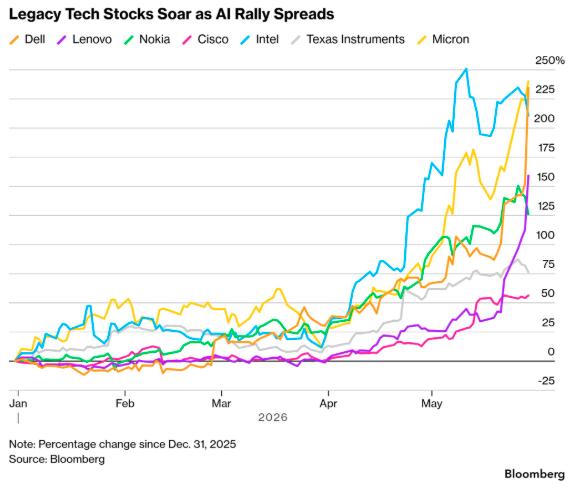
The enthusiastic pursuit of building AI infrastructure has led to a surge in demand across all fields, from computer servers, storage components, network devices to traditional chips. This has triggered a frenzy in stocks globally that have any connection with these fields.
The latest wave of sky - rocketing prices has even awakened memories of distant investment portfolios in the minds of some veteran Wall Street traders: for example, the "Four Horsemen" - yes, this portfolio has rarely been mentioned in the past decade or so because, in the eyes of many, only Microsoft among the "Four Horsemen" can still be considered to be keeping up with the technological development trend.
However, recently, the once - forgotten and even mocked "Three Horsemen" of the "Four Horsemen" - Cisco, Intel, and Dell - have seen their share prices far outperform Microsoft...
In addition to these "Three Horsemen," other high - flyers from the Internet era that have reignited investors' enthusiasm this year include Micron Technology, Texas Instruments, Nokia, and Lenovo. In total, the average price of these seven stocks has skyrocketed by 158% in 2026, with a combined market value increase of $1.7 trillion.
"About six months ago, we began to realize that the scope of AI infrastructure construction was expanding significantly, while the supply was severely insufficient, especially in those 'boring' hardware fields - the production capacity expansion in these fields has been very limited in the past few years," said Yan Taw Boon, a portfolio manager at Neuberger Berman. "And now the demand is surging - from 'boring' CPUs to network devices, passive components, and then to storage and memory, without exception."
From bulky mobile phone manufacturers to self - reinvented computer producers, here are the latest examples of "an old man showing youthful spirit" in the US stock market:
Micron
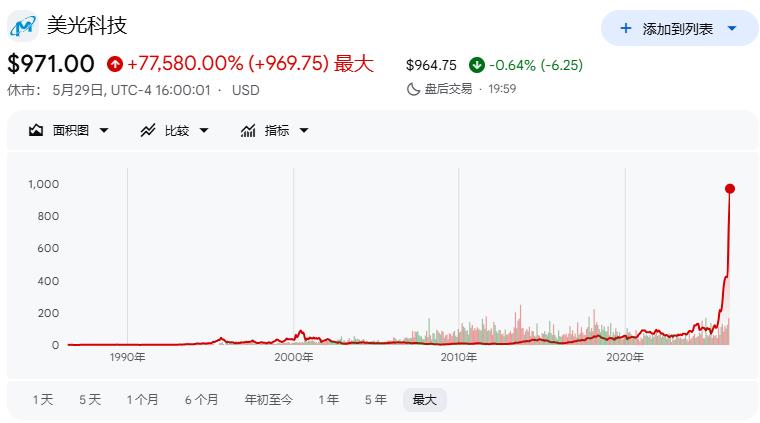
Last week, Micron officially joined the trillion - dollar market - cap club, nearly 50 years after its founding in the basement of a dental clinic in Boise, Idaho. This memory chip manufacturer's share price soared in the late 1990s after it acquired Texas Instruments' memory business, becoming one of the world's largest memory producers.
From its share price peak in July 2000 to the trough in November 2008, its market value evaporated by more than 98%. It wasn't until early 2022 that its share price reached a new all - time high again.
But in the past year, this stock has become a representative of the downstream beneficiaries of the AI spending boom. As one of the leading manufacturers of high - bandwidth memory (HBM), the demand for the company's chips has soared, far exceeding its supply capacity. Its share price has skyrocketed by more than 903% in 12 months, and it set the fastest record for its valuation to jump from $500 billion to $1 trillion, achieving this leap in just 48 trading days.
Texas Instruments
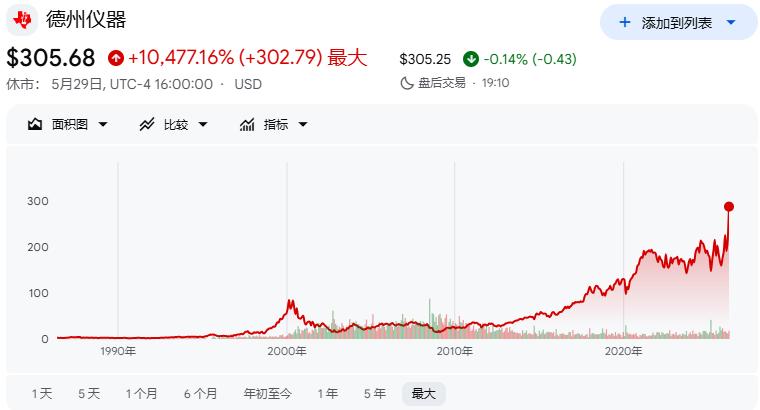
Headquartered in Dallas, Texas, USA, Texas Instruments was the absolute dominant player in the analog chip field in the 1990s. The chips it produced, which convert real - world signals into digital signals (0s and 1s), were the core of telecommunications equipment and mobile phones at that time. However, as the construction of telecommunications networks slowed down and demand declined, its share price dropped by more than 85% from the peak to the trough between 2000 and 2002.
In the early days of the AI era led by ChatGPT, Texas Instruments had a weak start due to fluctuating customer demand in the automotive and industrial markets. But as the demand for chips for higher - power - density AI servers increased, its sales began to grow at an accelerating pace. Currently, the annual sales of Texas Instruments' data center business have exceeded $1 billion, and the revenue of this business increased by more than 60% in 2025.
Market data shows that Texas Instruments' share price has soared by 76% this year and is expected to achieve its best annual performance since 2003.
Intel
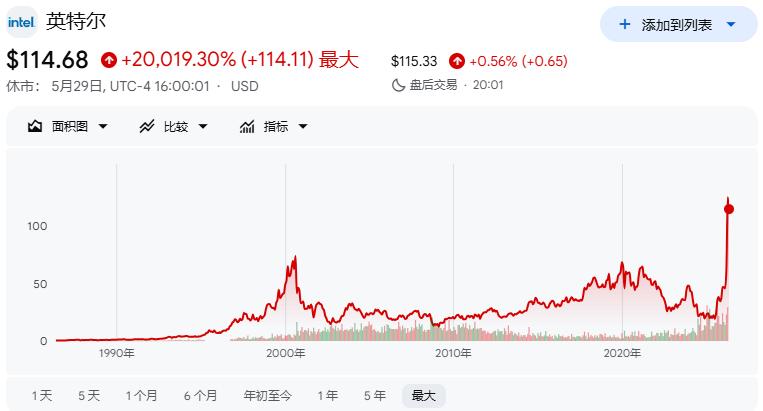
Less than two years ago, due to long - term constraints in process technology, Intel's once - dominant position in the semiconductor industry seemed to have become a thing of the past, and it was even once judged by investors as "completely out of the game."
Now, the company's road to redemption and return to the peak has been truly remarkable. In the past decade, the company has had four CEOs in quick succession. The current CEO, Lee - Wu Chen, won unanimous applause from Wall Street when he took office last year. Although he encountered a political storm a few months later when President Trump asked him to resign, he quickly turned the situation around and finally successfully attracted strategic investment from the US government.
Subsequently, NVIDIA followed up with an investment of $5 billion. In March this year, when Intel announced that its new Xeon chips were being used in some NVIDIA systems, its share price soared again. Last month, after Intel released sales forecasts far exceeding Wall Street expectations, its share price reached a new all - time high.
Earlier this month, media reports said that Intel had reached a preliminary agreement with Apple to produce some chips for its devices, which was regarded as a result of Intel's foundry business. Since the beginning of this year, Intel's share price has risen by 211% and is expected to achieve its best performance ever.
Dell
Last Friday, Dell's share price soared by 33%, setting the largest single - day increase in history. Previously, this hardware manufacturer, well - known for its personal computer business, released financial reports showing a surge in demand for its AI servers.
This surge in share price may remind people of Dell's heyday - in the late 1990s, its share price rose by more than 200% for three consecutive years. However, after the dot - com bubble burst and the company's market value evaporated by more than 80%, Dell was privatized in 2013. Dell returned to the public market at the end of 2018, and its current market value is $125 billion higher than the peak of $148 billion on March 2000.
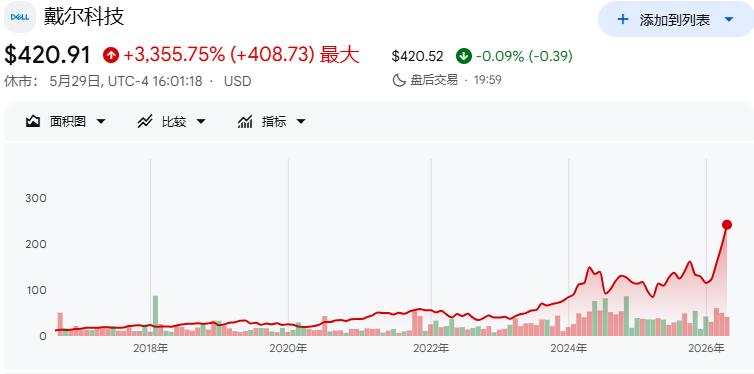
Emmanuel Valavanis of Forte Securities said that the latest amazing financial report proves that Dell is "the latest company once regarded as a 'dinosaur' in the tech world, now reborn as an AI giant."
Lenovo
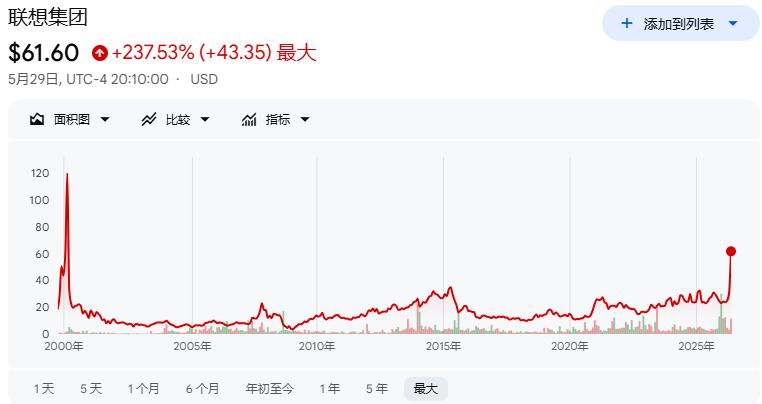
Lenovo Group became famous on the international stage when it made a bold acquisition of IBM's personal computer business (PC division) in 2005. This acquisition gave it the right to use the iconic ThinkPad series of commercial laptops and laid the foundation for it to eventually become the world's largest PC manufacturer.
Although the personal computer industry has been in a long - term decline for many years, Lenovo's promotion of AI products and services has helped this Chinese computer hardware company achieve a 20% revenue growth in the past year, and nearly 40% of its total sales now come from these businesses.
Lenovo's US - listed ADR soared by 105% throughout May, reaching a new all - time high and achieving its best single - month performance in more than 25 years. At the same time, this stock also ranked first among the constituent stocks of the Hong Kong Hang Seng Index with a year - to - date increase of 159% - bringing a return to investors more than three times that of the second - ranked constituent stock.
Nokia
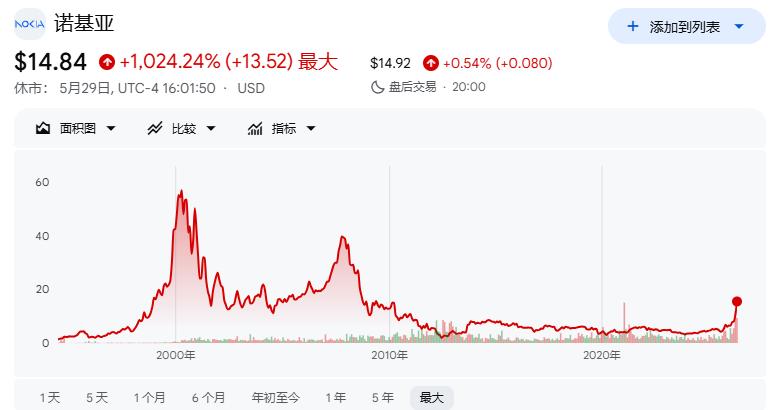
Nokia faced a series of setbacks in the 2000s: first, the boom in the telecommunications industry turned into a bust, and then its mobile phone business was hit by the rise of smartphones. Starting from its peak market value of 300 billion euros at that time, the stock had a cumulative decline of up to 98% before 2012.
After selling its mobile phone business to Microsoft in 2014, Nokia went through a difficult process of rebirth around its less - glamorous telecommunications network equipment business. Its most recent full - scale recovery has greatly benefited from the accurate acquisition of the US optical communication company Infinera in 2025 - this move coincided with the explosive growth in demand for high - speed connections between computing clusters in AI data centers.
Market data shows that Nokia's share price has soared by more than 124% this year, making it the fourth - best - performing stock in the Stoxx Europe 600 Index. Nevertheless, the stock has not yet returned to the high point of the dot - com bubble era and is still nearly 80% lower than its historical closing high.
Cisco Systems
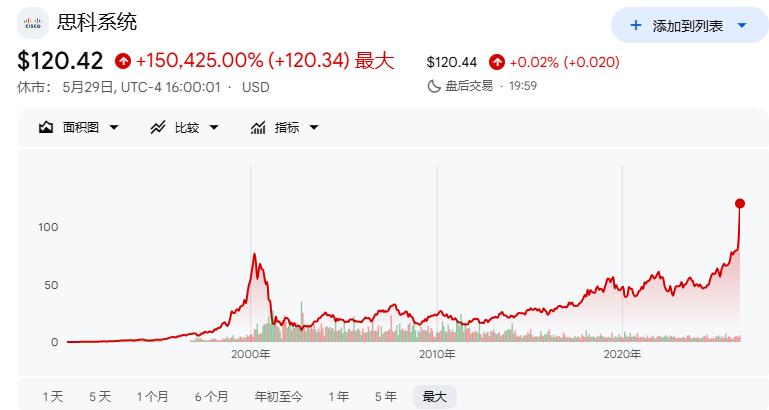
If we talk about who best represents the "Renaissance" of these veteran tech stocks, perhaps Cisco is the one. As the undisputed king of network devices, Cisco was the absolute face of the dot - com bubble era and briefly held the top spot in global market value in 2000.
Currently, the company has transformed from a traditional network business to an AI infrastructure provider. The financial report it released earlier this month demonstrated its success in the AI era - the report not only gave a strong revenue forecast for the fourth fiscal quarter but also announced a plan to lay off employees to focus on AI transformation.
These financial data are the latest evidence that the company's business is back on the upward track, further continuing the strong momentum established last year due to the inflection point of AI - related demand. Driven by this force, the stock finally returned to its historical high this year, breaking through the peak in March 2000.
Market data shows that as of now in 2026, Cisco's share price has gained a 56% increase and is expected to achieve the largest annual lead over the Nasdaq 100 Index since 2006.
This article is from the WeChat official account "Caixin Press" , author: Xiaoxiang. Republished by 36Kr with authorization.