A $7.2 trillion GDP bill black hole, even the Chairman of the Federal Reserve can't "understand" Token economics
On May 30, 2026, the semiconductor research institution SemiAnalysis released an in - depth report titled "AI Dark Output: The Visible Cost of Invisible Output", proposing the concept of "dark output". It argues that AI is creating real economic value on a large scale, but this value is hardly traceable in GDP, price indices, and employment statistics, and its scale "may be no less significant than the Industrial Revolution".
The report estimates that the labor tasks that the current generation of AI has the potential to replace or significantly enhance correspond to a wage pool of approximately $1.5 trillion. However, when AI takes over these jobs, the economic trace left may only be a few dollars in token expenses. From the perspective of GDP, the output almost "disappears".
Currently, 41% of the service - sector GDP in the United States ($7.2 trillion) is calculated using the "wage - anchoring" method, where output growth is defined as an increase in wages or working hours. This means that when AI doubles a lawyer's work efficiency but the number of lawyers and their wages remain unchanged, GDP will not record any output growth. The productivity improvement brought by AI is statistically impossible to appear.
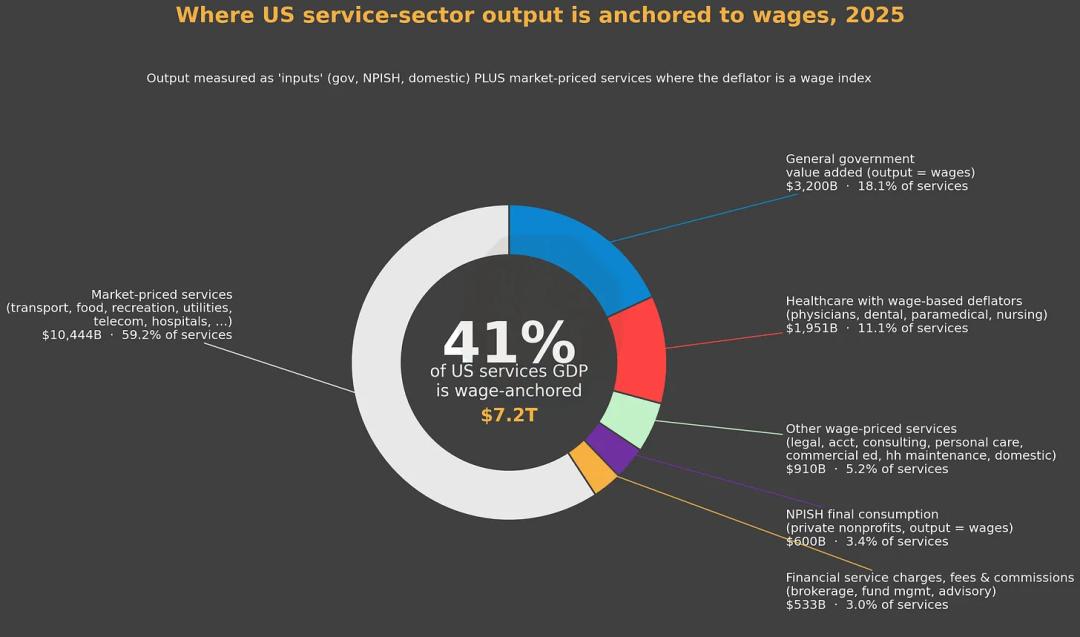
Figure: In 2025, 41% of the service - sector GDP in the United States ($7.2 trillion) was calculated using the "wage - anchoring" method - output growth is defined as an increase in wages or working hours. Therefore, the productivity improvement brought by AI is statistically impossible to appear.
This concept in the report borrows from the "dark energy" in physics. It cannot be directly observed, but it accounts for the dominant share of the universe's energy and can only be perceived through its gravitational effects on surrounding objects.
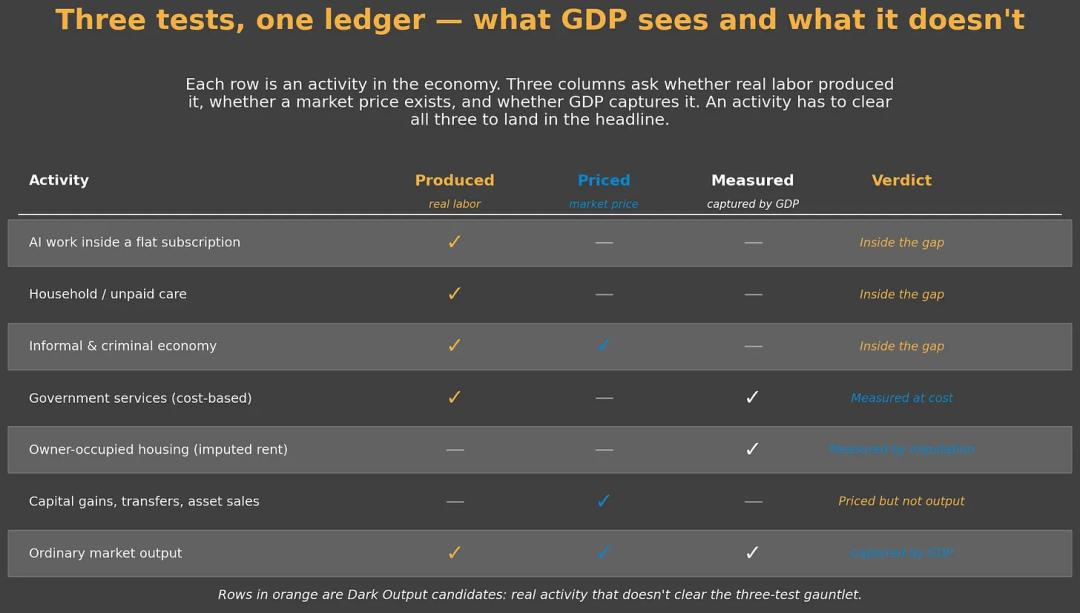
Figure: The "three - test" threshold for GDP: real labor, market price, and countable transactions. They keep a large amount of real economic activities out. The orange area is where the "dark output" hides.
This dilemma of "seeing the technology but not the output" is not the first time it has occurred.
In 1987, Nobel laureate Robert Solow discovered a strange phenomenon: although computers were already ubiquitous, the officially - reported productivity data showed no improvement, as if computers had never existed. More than thirty years later, the same problem has resurfaced, but this time the protagonist is AI, and the situation is more difficult than before.
In December 2025, Kevin Warsh, the incoming Federal Reserve Chairman, publicly admitted this dilemma: setting interest rates based solely on existing statistical data is like driving while looking in the rear - view mirror. Data lag can lead to misjudgments of the economic potential, causing people to hesitate when low - inflation and high - growth can actually be achieved. Policymakers ultimately have to take a gamble.
This may be the most underestimated measurement risk in the AI era. Macroeconomic data is like a mirror, but what it reflects at present is a severely distorted economic picture.
On one hand, data centers are being built everywhere, GPU orders are booked for up to two years later, and the revenue of power companies has increased significantly. On the other hand, the economic value of AI output is hardly traceable in GDP.
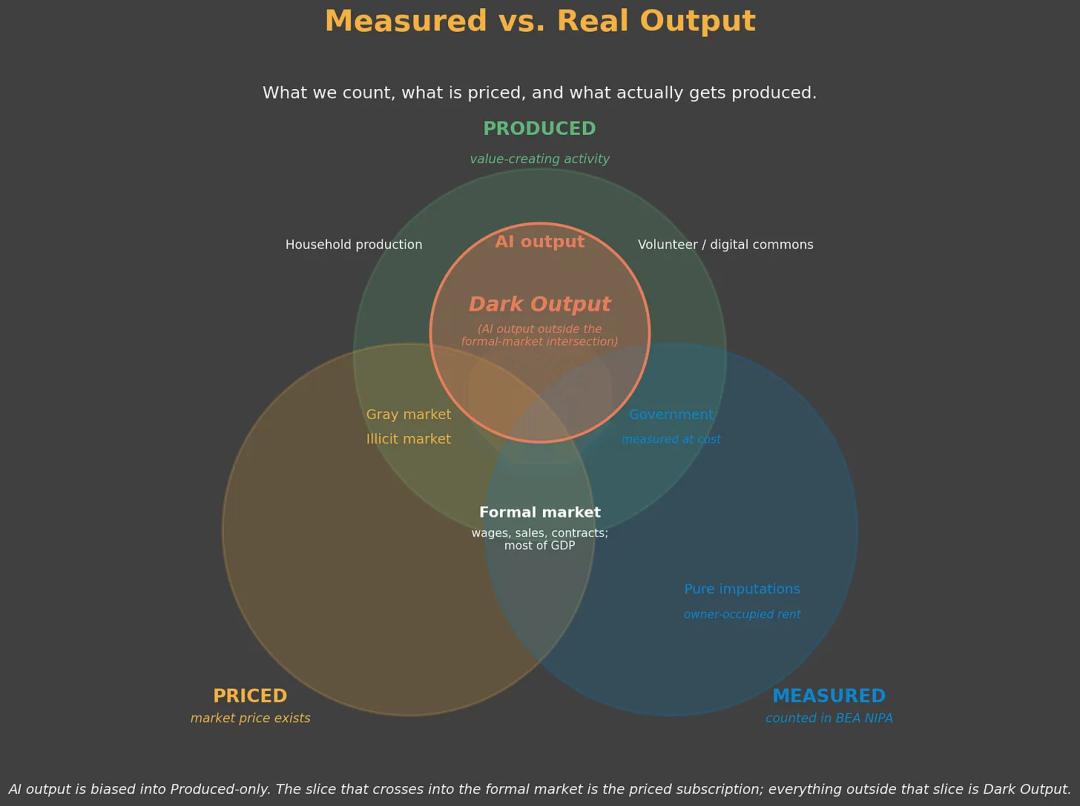
Figure: AI output exists in reality before it becomes measurable.
01 "Will" Price Drop
Let's first look at the evolution of the price of an ordinary will over the past millennium.
In the 17th century, a parchment scribe drafted a will, which cost about $3000 in today's terms. During the Renaissance, notaries charged about $800. In 1900, lawyers charged about $400. In the 1990s, independent lawyers still charged $400.
In 2010, LegalZoom reduced the price to $150. In 2026, a cutting - edge model drafted a will of about 5000 words through an API at a cost of less than $0.5. From $150 to $0.5, the cost decreased by more than 99% in 16 years.
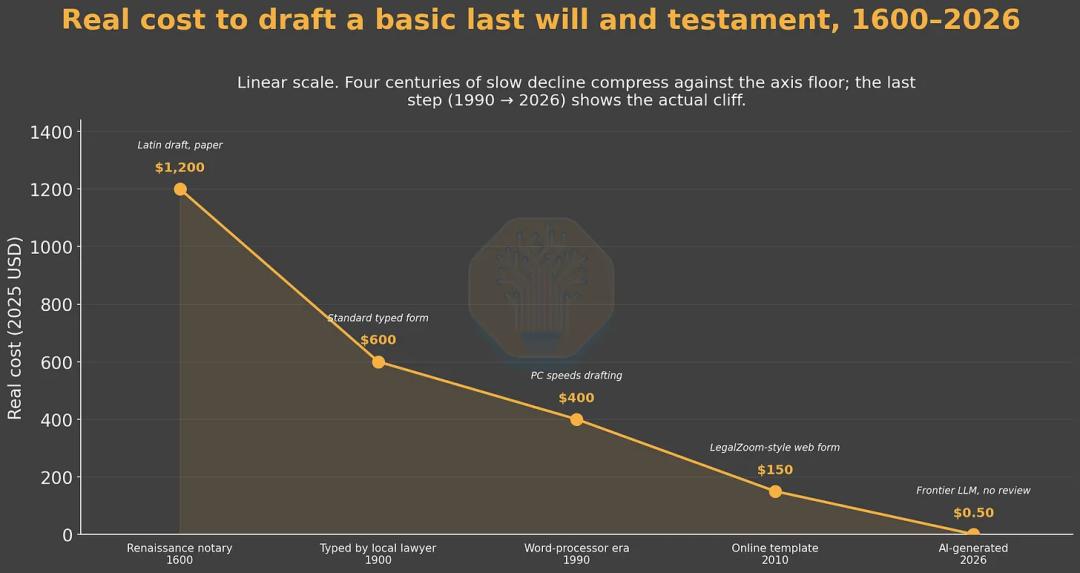
Figure: The downward trend of the cost of drafting a legal will from the 17th century to 2026.
The accounting logic of GDP fails directly when faced with such a significant price collapse.
How is the service - sector GDP calculated? It mainly relies on receipts and quotes. Statisticians ask law firms whether the service price has increased or decreased, and then divide the total corporate revenue by the price to infer the "quantity" of services. When AI takes over document drafting, the receipts of law firms disappear - the cost is absorbed into the token fee worth only a few cents.
When statisticians conduct another survey, they will find that the average service price has actually increased because the remaining cases for human lawyers are more complex and of higher value. However, what the statistics bureau sees is: price increase and revenue decrease. Conclusion: recession. A legal document of the same value simply disappears from the GDP ledger because the drafter has changed from a human to AI. The existing accounting framework was not designed from the beginning to handle such a level of cost collapse.
02 Two Types of "Dark Output"
Starting from the discussion of a will, this report divides AI dark output into two categories.
First type: Substitution - type dark output.
Jobs originally done by humans are now performed by AI. For example, the wills, standard contracts, data entry, and customer service responses discussed above. The "wage bills" for these tasks disappear from the statistical data, leaving only a few - cent API call records in the cloud service provider's billing system.
The core of substitution - type dark output is the "evaporation of transaction records". The economic value still exists, but the national economic accounting can no longer capture it.
Second type: New - type dark output.
It refers to jobs that no one used to engage in because the cost was too high and not worth doing. AI has reduced the price to a level where it can be used at any time.
For example, to complete an academic literature review, hiring a research assistant would cost $2000, but now a $2 API call can complete it in a few minutes. A few years ago, it would have seemed absurd when comparing the time, input cost, and output results.
There is also a subtle situation: AI completes human work without "generating wages".
For example, a company used to purchase external human - resource services for $10,000. Now it spends the same $10,000 to buy similar AI - driven services, and GDP is not affected. However, if the service is converted to an internal AI process, consuming only $10 in token fees, GDP will be reduced by $9990. For the same work and the same value, the difference on the ledger only depends on "where it is run".
The real statistical black hole appears in scenarios where the cost approaches zero, transactions disappear from the market, and work is internalized by the enterprise. However, these scenarios are exactly the areas where AI is most likely to penetrate on a large scale.
03 In the AI Era, It's Hard to Count How Many "Screws" Are Produced
A similar measurement problem also occurred during the Industrial Revolution. Machines replaced manual labor, and the form of output changed dramatically. However, the manufacturing industry has a natural statistical advantage: the output is physical and can be counted.
For example, over the past six centuries, the real price of screws has decreased by more than 99%, and the global production has increased by about 10 billion times. The GDP framework correctly captured this change as growth and productivity improvement.
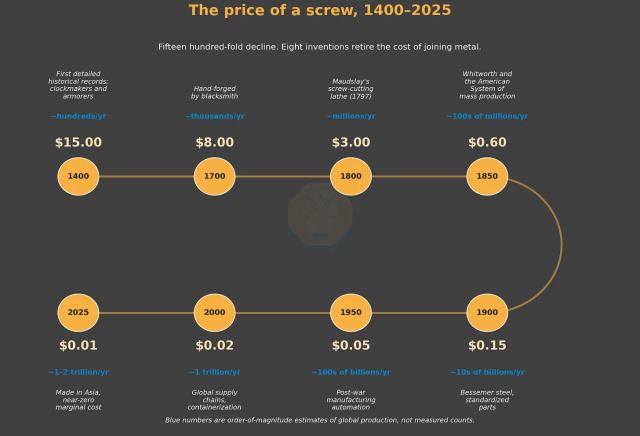
Figure: The real price and global production of screws
However, the service industry has no "screws". There is no "unit of legal service", no "metric tons of literature review", and no "barrels of consulting service". All that can be obtained are the number of invoices issued by lawyers and the service fees charged by consulting companies.
Previously, an economist team might have spent a century completing a study on the productivity of the Industrial Revolution. Now, it can be obtained with a few - dollar API fee. The output is the same, but GDP only sees the latter buried after a decimal point in the "computer system design" item.
A sentence in the report is very incisive: we still lack a set of functional vocabulary to describe mental work. The Industrial Revolution had "horsepower", which provided a way to compare machine output and human labor on the same scale.
The "token" in the AI era cannot do this because one million tokens may produce junk information or a major decision that changes a company's strategy. The economic value depends on the output content, not the number of tokens.
If the value of AI output can only be observed through token expenses, electricity prices, and water consumption - in other words, only the cost side can be seen - the economic data will present an abnormal picture: investment is surging, but the output is silent. This is like a bubble. If investors and central banks judge AI as a bubble based on the distorted data and tighten funds, the consequences will be real and profound.
04 Employment Declines, Wages Rise, but No One Gets a Raise
Since dark output cannot be directly observed, can it be indirectly tracked through its "side effects"? The report team's dark - output monitor is trying this path.
They found a strange signal: in the economic sectors most affected by AI, the number of employees is decreasing relative to the overall economy, but the wages in these sectors are increasing.
The reason is not complicated.
AI first replaces the daily work of junior employees. When the lowest - income employees disappear from the sample first, the remaining are more senior and higher - paid personnel. As a result, the average wage in the industry increases. No one actually gets a raise; it is the statistical data itself that is rising.
This divergence between employment and wages is one of the fingerprints of substitution - type dark output.
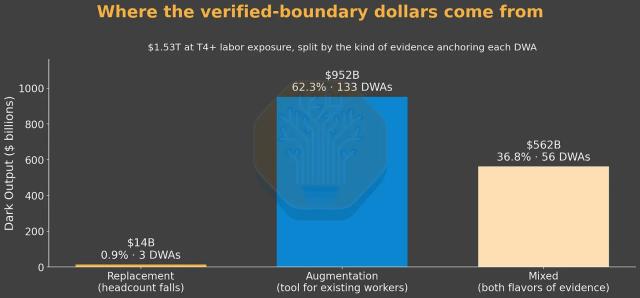
Figure: Of the $1.53 trillion in labor costs exposed to the risk of AI substitution, 62% comes from jobs with clear evidence of substitution (such as layoffs), 37% comes from enhanced evidence (AI as a tool to assist existing employees), and only 1% has both.
On the other hand, the economic index released by Anthropic in March 2026 shows that 37% of token usage is concentrated in the computer and mathematics fields. Logically, the output in this field should have explosive growth. However, the contribution of software investment to GDP has neither deviated from the trend before the rise of AI nor returned to the historical high.
A large number of tokens are being consumed, output is occurring, but the statistical data remains unchanged. This pattern indicates that the scale of new - type dark output may far exceed that of substitution - type - most tokens are used to perform jobs that never existed before, and there are no corresponding entries for these jobs in the statistical system's dictionary.
05 $1.5 Trillion Is Not the Disappeared Wages
The report designed a six - level evidence ladder: The first and second levels are based on benchmark tests and are only used to estimate costs. The third level is the hype layer, where companies publicly claim that their products have certain capabilities. The fourth level: Some enterprises indicate that the tools are already in production use. The fifth level: Some companies defend the legality of AI work in court. The sixth level: Some insurance companies underwrite relevant risks.
The $1.5 trillion mentioned at the beginning of the article is based on signals at the fourth level and above in the evidence hierarchy. It corresponds to "the wage pool of relevant tasks within the scope where the current AI has credible substitution potential", rather than "the disappeared labor force". In other words, this is the "affected labor force", not the "evaporated job positions".
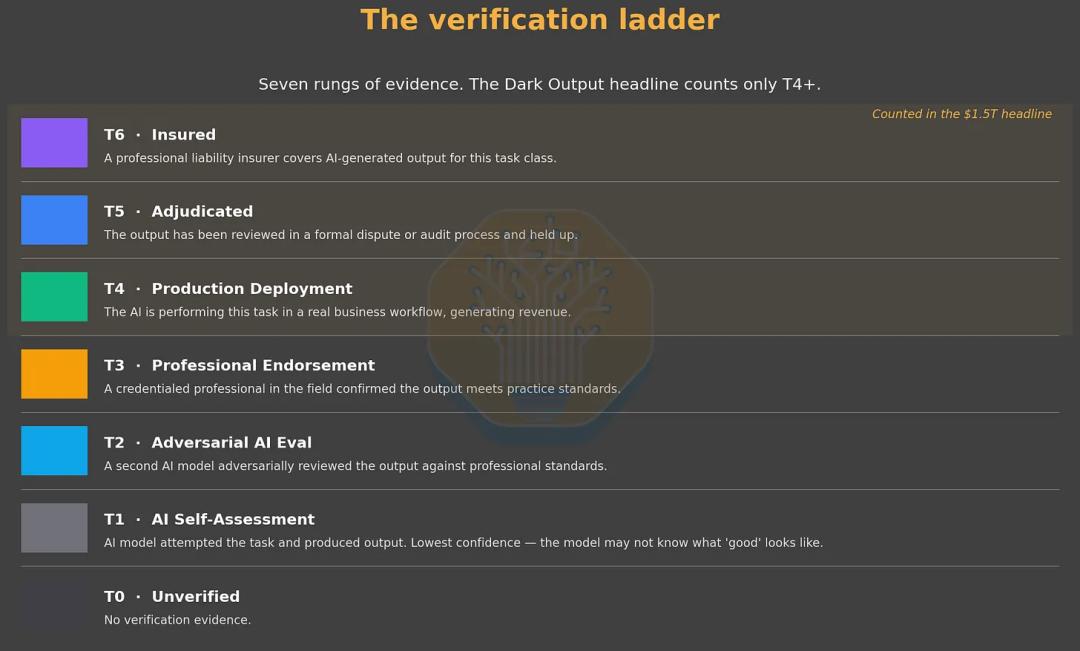
Figure: To judge whether AI can replace humans, the weakest evidence is "performing well in exams", and the strongest evidence is "insurance companies are willing to pay for its mistakes".
Among them, the sixth level is the strongest signal because insurance companies have priced the failure mode and assumed real - money risks. So far, no evidence of activities at the fifth or sixth level has been observed. In an AI industry with almost zero self - purification ability for hype, this gap itself is a wake - up call.
Most of the evidence collected so far points to the enhancing effect of AI, rather than substitution - people are using AI, not being replaced by it. An industry marked as highly exposed should be interpreted as having a very clear substitution economic logic in this field. As for the final result, only time can tell.
06 Four Ways in Which Statistical Data Fail
Finally, let's return to the original question. In summary, why can't GDP measure the value created by AI? The root lies in four intertwined statistical failures.
First, transactions disappear. In the past, a company spent $100,000 to buy a consulting report, and this transaction was recorded in GDP. Now, an employee uses AI to complete the same analysis in a few minutes, only spending a few dollars on API fees. The value of the analysis report still exists, but the $100,000 transaction disappears out of thin air. The statistical system has no idea that this output has occurred.
