The first provincial capital city in central and western China with a GDP of 3 trillion is coming.
Recently, as the "15th Five-Year" development plans of various regions are being announced one after another, the development goals of many cities for the next five years have also been revealed.
Among them, the "15th Five-Year" development plan of Chengdu proposes that by 2030, the regional GDP will exceed 3.2 trillion yuan. This means that after Guangzhou, the country will welcome the second provincial capital city with a GDP exceeding 3 trillion yuan.
Meanwhile, Chengdu will also become the first provincial capital city in the central and western regions to enter the "3-trillion club", and the ceiling of provincial capital cities in the central and western regions will be refreshed again.
01
Throughout the "14th Five-Year" period, Chengdu's GDP grew at an average annual rate of 5.8%, ranking among the top in major cities across the country.
In terms of total volume, in the past five years, Chengdu's GDP has climbed from 1.8 trillion yuan to 2.4 trillion yuan, successively crossing six 100-billion-yuan steps, and successfully entering the GDP "2-trillion club". It has become the second provincial capital city in the country after Guangzhou with a GDP exceeding 2 trillion yuan.
If the goals of the "15th Five-Year" plan are successfully achieved, Chengdu will become the second provincial capital city after Guangzhou with a GDP exceeding 3 trillion yuan. This target of 3.2 trillion yuan happens to be equivalent to the GDP scale of Chongqing in 2024.
When it comes to Chengdu, many people will think of the "strong provincial capital" model. In terms of primacy and comprehensive energy level, Chengdu is indeed one of the most representative "strong provincial capital" cities.
However, it should be noted that Chengdu's status as a "strong provincial capital" is not limited to Sichuan Province.
This is fully proven in Chengdu's "15th Five-Year" development plan. After the introduction of the planning background and main goals, the first chapter of the plan clearly states: Enhance the city's development position and energy level, and strengthen the leading and driving role of the core.
Requirements: Actively serve and integrate into the overall situation of national strategies and the overall development of the province, strengthen the responsibility of the core, optimize the core functions, and give full play to the core role. Effectively take the lead in building the "demonstration area", play a leading role in building the "metropolitan area", and work together in performing the "twin-city symphony".
Specific actions include promoting the improvement of the development energy level of the Chengdu-Chongqing economic circle; jointly building a modern Chengdu metropolitan area; leading and driving the "co-prosperity of five regions"; and enhancing the ability to serve the overall strategic situation.
02
Among them, there are three details worth noting.
First, the construction of the metropolitan area. Chengdu clearly proposes that by 2030, the economic aggregate of the Chengdu metropolitan area will exceed 4 trillion yuan, maintaining and expanding its leading position in the integration of national-level metropolitan areas.
This means that in the current situation where regional competition is increasingly in the form of metropolitan areas, Chengdu will tap new driving forces within the metropolitan area to seek further upgrading of its energy level.
Second, leading and driving the "co-prosperity of five regions". The plan clearly states that it is necessary to strengthen the radiation and driving role of the province's "main engine" and "ballast stone". Here, the keyword is "radiation and driving". As we all know, the large gap in scale between the provincial capital Chengdu and secondary cities in the province and the "unbalanced and insufficient development" are the biggest provincial conditions in Sichuan.
To solve this problem, the key lies in whether Chengdu can move out of the past "siphon" model and truly play a greater radiation and driving role.
Therefore, the plan clearly states: Strive to enhance the leading and radiation role of the supercity, orderly promote the relocation of non-core functions of the city, the transfer of some production capacities, and the empowerment of pilot demonstrations, and actively deepen cooperation models such as "headquarters + base", "design + transformation", and "platform + consumption".
This may become a major highlight of the regional economic development of Chengdu and even Sichuan in the future.
In fact, many inland provincial capital cities are facing the same challenges to varying degrees. Whether Chengdu can "break the situation" first in this regard will also provide a demonstration and reference for other provincial capital cities.
Third, enhance the ability to serve the overall strategic situation. The plan proposes to seize the opportunities of the intersection and superposition of major national strategies, actively connect with the major national productivity layout and the new industrial layout in the eastern coastal areas, actively undertake industrial transfer, strengthen the reserve of strategic materials and the bearing capacity of infrastructure, and serve and safeguard national strategic security.
This is both Chengdu's responsibility and a historical development opportunity. For example, it is mentioned that aiming at important fields such as integrated circuits, industrial mother machines, aerospace, and precision instruments, promote the construction of key industrial projects and enhance the integrity and resilience of the industrial chain and supply chain.
Strengthen the coordinated development between the military and local areas, strengthen industries such as aviation equipment, nuclear energy and nuclear technology, layout and build industrial bases for intelligent unmanned equipment, and innovation and transformation and equipment technology industrial bases for clean energy in Sichuan and Tibet, and promote the establishment of a center for the transformation of military-civilian cooperation achievements in the southwest region.
It also includes actively seeking the layout of major scientific and technological innovation platforms, national defense science and technology industrial innovation centers, and technological innovation projects in Chengdu by the state.
Build and improve a "large reserve" system of materials that meets the needs of national strategic security. The value behind this is self-evident. And Chengdu's advantages in this regard can be said to be unique. Therefore, to a certain extent, this also shows that the significance of Chengdu's "strong provincial capital" is not just for Sichuan.
This also explains why, against the background of a new review of the "strong provincial capital" model, Sichuan still clearly states that it supports Chengdu to optimize and strengthen its core functions.
03
Of course, for a supercity like Chengdu, improving the industrial development level is always the basic project to achieve the leapfrog development of the city's energy level.
In this regard, the plan also places "accelerating the optimization and upgrading of the industrial system and shaping the competitive advantages of the modern industry" in a prominent position, clearly optimizing and constructing a "9+9+10" modern industrial system with advanced manufacturing as the backbone, and implementing the "Five Improvement Actions".
Among them, the first one is "accelerating the construction of a national advanced manufacturing base". This is also part of the positioning of "three centers and one base" given to Chengdu by the state.
It is worth noting that Chengdu also clearly proposes "accelerating the development of the city based on industry and strengthening the city through manufacturing". Currently, the competition in the manufacturing industry is becoming increasingly fierce. Among cities of the same scale, Chengdu's manufacturing industry is not the most prominent. The clear positioning of this industrial development may mean that Chengdu will increase its efforts in the manufacturing industry.
This can also be seen in the specific goals: by 2030, the proportion of industrial added value in GDP in Chengdu will increase steadily, and there will be 10 and 6 industrial chains with a scale of 100 billion and 200 billion yuan respectively in the advanced manufacturing industry.
In addition, it also clearly states to accelerate the construction of a national service industry highland and build the brand of "Chengdu Services". By 2030, the added value of the service industry in Chengdu will exceed 2 trillion yuan, and the proportion of the added value of producer services in the added value of the service industry will exceed 55%.
The service industry can be said to be Chengdu's traditional advantage. In 2025, the added value of the service industry in Chengdu exceeded 1.7 trillion yuan, ranking third among sub-provincial cities; the proportion of the added value of the service industry in the city's GDP exceeded 70%, and its contribution rate to economic growth exceeded 70%.
As the deep integration of the manufacturing and service industries becomes a new trend, Chengdu's service and manufacturing industries are expected to achieve common improvement and open up new development opportunities.
Generally speaking, from the grasp of strategic opportunities to specific industrial development, the new stage is crucial for Chengdu. The two reinforce each other and will be the key to promoting Chengdu to a higher level.
04
Chengdu's development represents, to a certain extent, the upper limit of inland provincial capital cities. In the next few years, how Chengdu can achieve new breakthroughs will also become an important variable affecting the competitive landscape of inland provincial capital cities.
Currently, among the 27 provincial capital cities in the country, Chengdu's GDP is second only to Guangzhou, making it the "number one city" among inland provincial capitals. And the provincial capital cities with a GDP of 2 trillion or close to 2 trillion that rank after Chengdu also include Hangzhou, Wuhan, and Nanjing.
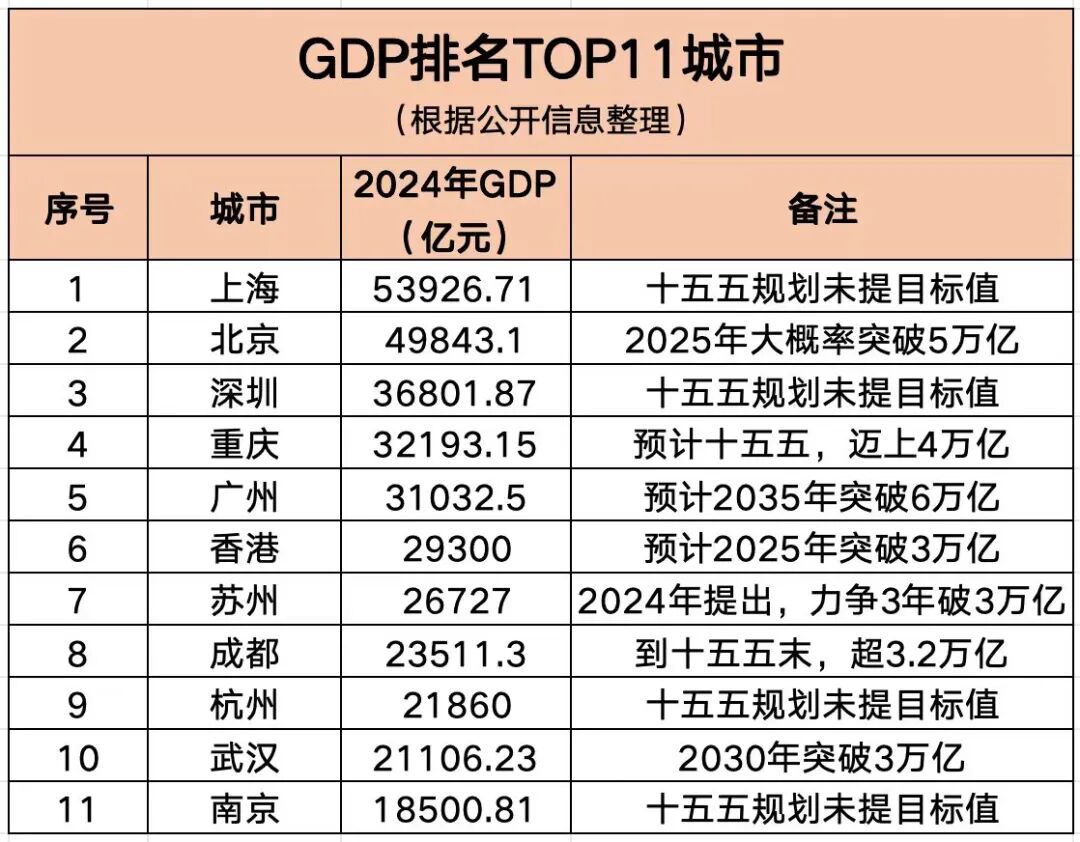
Among them, Wuhan has clearly stated that it aims to exceed 3 trillion yuan in economic aggregate by the end of the "15th Five-Year" period. That is to say, in the next few years, the central and western regions are expected to welcome two provincial capital cities with a GDP of 3 trillion yuan. In addition, more provincial capital cities are also seeking upgrading.
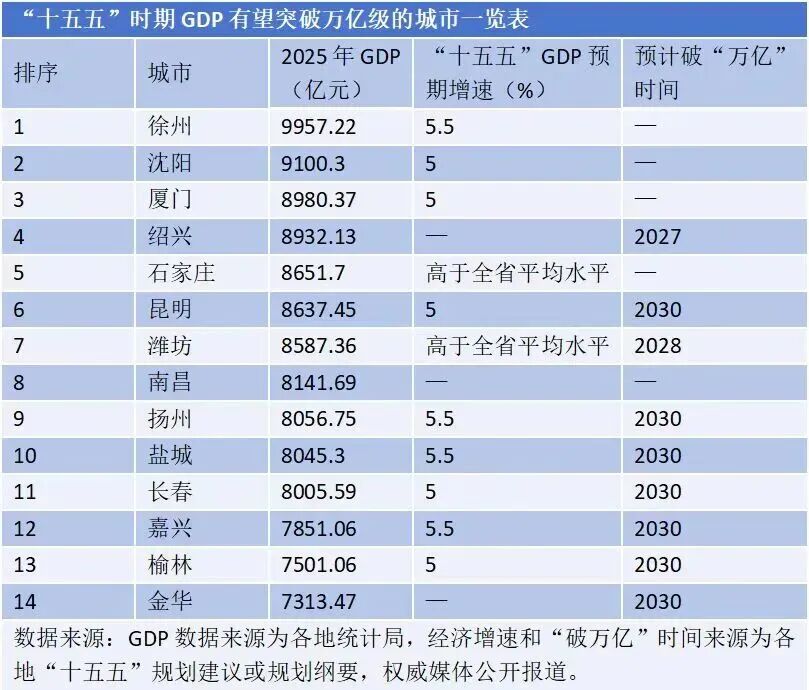
First, the club of provincial capital cities with a GDP of one trillion yuan will continue to expand. Provincial capital cities such as Shenyang, Shijiazhuang, Kunming, and Nanchang have all set the goal of exceeding one trillion yuan in the next few years.
Second, the GDP of provincial capital cities such as Changsha, Hefei, Zhengzhou, Jinan, and Fuzhou is expected to exceed 2 trillion yuan. By then, 2 trillion and 3 trillion will become new benchmarks for measuring the development energy level of cities.
In urban competition, if you don't advance, you will retreat. In the previous five years, provincial capital (autonomous region capital) cities such as Fuzhou, Hefei, Shenyang, Shijiazhuang, Nanchang, Nanning, and Hohhot have all been promoted.
In the new stage, with more variable factors, there will be another reshuffle of the pattern. It will soon be clear who can seize the opportunity.
This article is from the WeChat official account "Western City Affairs". Author: Western Jun. Republished by 36Kr with permission.