Hardcore Tech Observation | Apple's Contract Manufacturers Start Building Humanoid Robots: A High-Stakes Gamble on Future Production Capacity Migration
Author | Qiu Xiaofen
Editor | Yuan Silai
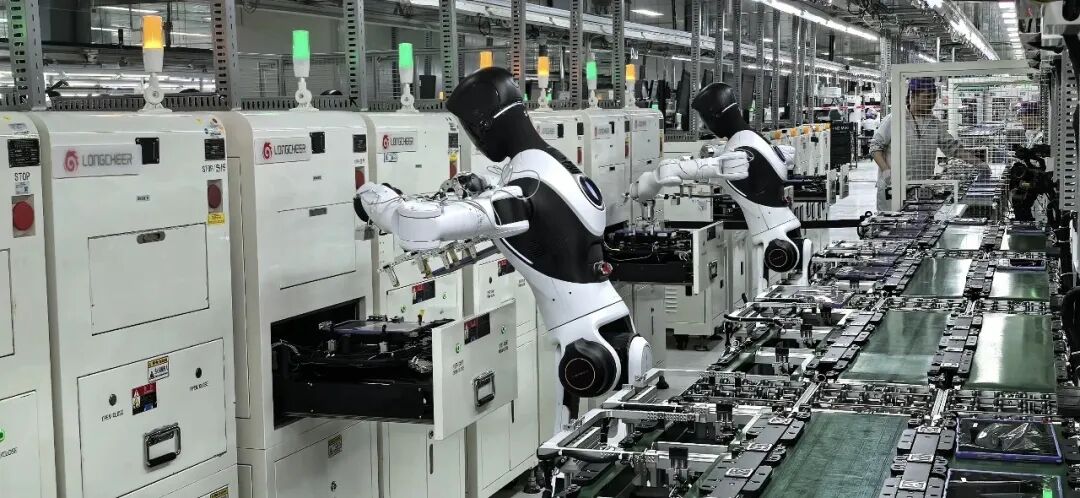
In the intelligent manufacturing factory of Longcheer in Nanchang, two Zhiyuan Elf G2 humanoid robots have been integrated into the tablet production line, taking on the loading and unloading operations of the Multimedia Integration Test (MMIT) workstation.
Its work rhythm is close to that of skilled production line workers. Relying on the three degrees of freedom of movement of the waist and the omnidirectional mobile chassis, the robot can precisely grab the produced tablets from the conveyor belt and send them into the testing chassis. After the test is completed, it can quickly take out the qualified products and neatly put them back on the conveyor belt for diversion.
According to the on - site measured data, a single robot can stably process about 310 tablet devices per hour, with a peak of 316 units. The overall success rate of continuous 8 - hour operation exceeds 99.5%.
This is not just a simple display.
In 2026, in the upsurge of embodied intelligent robots in China, a large number of mobile phone supply chain giants with a market value of tens of billions or even hundreds of billions have entered the arena, becoming key players that cannot be ignored in the robot industry. In addition to Longcheer, Foxconn, Huaqin, Lens, Luxshare Precision, etc. are also very aggressive. Their names appear on the investor list of leading embodied intelligent companies.
The introduction of robots into the production line is just the beginning. It can most directly help factories reduce costs and increase efficiency.
(Image source: Enterprise)
Obviously, mobile phone supply chain giants are not satisfied with just being buyers. Hard Krypton learned that this year, leading Chinese mobile phone contract manufacturers (including Huaqin, Luxshare, Longcheer, etc.) are actively contacting downstream robot companies. The CEO of a robot company told Hard Krypton, The contract manufacturers are willing to offer "sincere quotes" and mention "major customers with in - depth cooperation in the robot field" as their sales pitch.
They are tired of earning hard - won money. In the past decade or more, in the global division of labor system of smartphones, Chinese supply chain companies have always hovered at the end with relatively low profits.
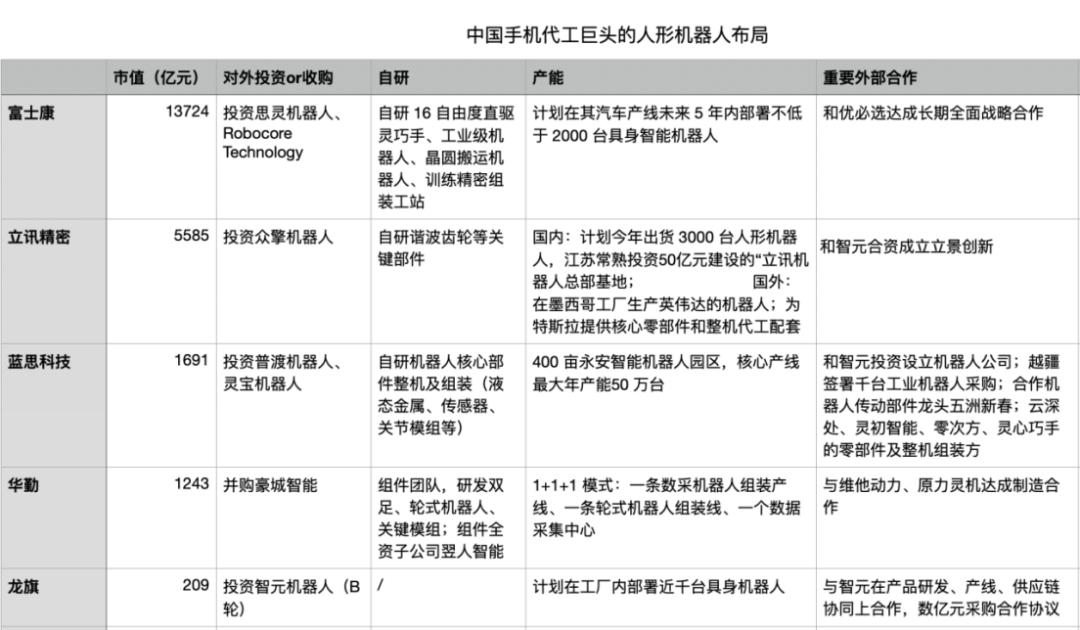
How Chinese mobile phone contract manufacturing giants layout humanoid robots. Hard Krypton compiled based on public information.
They are calling for an industry that will be born in China, defined in China, and manufactured in China. As the outline of the story of embodied intelligence becomes clearer step by step, it will be an unforgivable strategic mistake for the mobile phone supply chain to miss it.
Embodied intelligence has also waited for the mobile phone supply chain for too long. Having manufactured billions of mobile phones for the world, the Chinese mobile phone supply chain has accumulated rich consumer electronics technology and production experience. Only they can take the robot industry from the past "hand - made" stage to real mass production.
A hidden supply chain migration has begun.
Robots Enter the Factory to Manufacture 3C Products
The Chinese mobile phone supply chain is at a delicate turning point. In the past thirty years, relying on extreme cost control and a huge labor dividend, the Chinese mobile phone supply chain has created a miracle of high - efficiency and low - cost production.
However, beneath the glorious appearance of the "world factory", some hidden worries have emerged. The change in the population dividend and labor structure has forced the industrial chain players known for the labor - intensive strategy to find new solutions.
Humanoid robots have undoubtedly become the necessary option in the eyes of supply chain giants to solve the structural contradictions.
A robot engineer who cooperates with mobile phone supply chain contract manufacturers told Hard Krypton that, taking the 3C testing process as an example, in a two - shift work system, workers work ten hours a day on average and need to shuttle back and forth between multiple cabinets for inspection. In a small moving distance, workers take up to 30,000 steps a day.
The contradiction between management and risk control has also gradually emerged. Since the unit price of the components handled by workers is high while the salaries of front - line workers are relatively low, factories have to adopt a strict "military - style management" model.
Hard Krypton has visited many mobile phone contract manufacturing factories and found that closed - loop management is a daily routine for workers. Workers need to pass strict security checks before and after entering and leaving the production line, and there are also strict monitoring systems inside the production line. During work, workers cannot move freely.
A senior manager of a mobile phone contract manufacturing factory frankly told us, We must assume that human nature is evil when doing management.
The high - pressure working environment also goes against the employment concept of the new generation of labor force. The aforementioned engineer said that the monthly turnover rate of workers in Chinese mobile phone supply chain contract manufacturing factories is as high as 15%, and the production line is almost in a vicious cycle of "replacing the workforce every three months".
Frequent personnel flow, such as new - employee training, yield fluctuations, and the loss of skilled workers, is eroding the already meager contract manufacturing profits.
In the past decade, although the Chinese mobile phone supply chain has realized this and has introduced a large number of robotic arms to improve automation, this solution is somewhat inadequate in the rapidly changing consumer electronics industry.
A person in the industry told Hard Krypton that consumer electronic products are updated very quickly, the production line changes frequently, and there are obvious peaks and troughs in the off - season and peak seasons.
Traditional special - purpose robotic arms have a high degree of non - standardization. Once the product is redesigned, it means that the expensive fixtures may become useless. The advantage of humanoid robots is that they are more flexible in operation. When the process changes, only re - adaptation and fine - tuning of the model are needed. Moreover, the human - like shape is more conducive to actively adapting to the factory environment originally designed for humans.
"The introduction of humanoid robots into the factory is to replace the original workers, not the original automated robotic arms. The two will complement each other and enable the production line to achieve a higher degree of flexible production," the aforementioned person in the industry said.
A Survival Battle for the Future
However, the introduction of humanoid robots is not just a stopgap measure based on the labor situation and industry characteristics. It is also a survival battle for supply chain giants facing the future.
For them, the prospects of their old business are dim.
Although the revenues of giants such as Huaqin and Luxshare have still been growing in the past two years, the revenue has not been converted into profits. The gross profit margin of each company's contract manufacturing business still hovers between 10% - 13%, and for some low - value - added products, it is even as low as 5% - 8%. In contrast, the sales gross profit margin of Green Harmonic, known as the "number one" in the domestic robot reducer industry, was 37% in 2025.
The essence of mobile phone contract manufacturing is a scale game. Under the pressure of the global smartphone shipment volume and the rising price of upstream storage, the past idea of making small profits but large sales and trading price for volume has become very difficult. The new productivity of humanoid robots is regarded as the next growth opportunity.
"We are willing to invest and firmly believe that robots must be the next opportunity in the industry. This is not a quantitative change but a qualitative change," the general manager of the robot department of a mobile phone contract manufacturing factory told Hard Krypton.
Humanoid robots have become the straw for mobile phone contract manufacturing giants to save their profits. At the same time, the large - scale implementation of the Chinese robot industry is extremely eager for the involvement of the mature mobile phone supply chain. In the past few years, due to the immaturity of the core industrial chain, the Chinese humanoid robot industry has been in a "hand - made" state for a long time.
An executive of a humanoid robot manufacturer told Hard Krypton that in the past two years, the R & D and production process of humanoid robots has been quite "painful".
For example, due to the lack of supply chain standards and immature processes, some humanoid robots often make abnormal noises in their joints after running for a period of time, or the sole material wears out and becomes useless after only dozens of hours. This means that the subsequent design of the robots needs to be modified, and all the robots already manufactured on the production line also need to be recalled for rework.
For humanoid robot manufacturers, they not only have to provide free maintenance but also pay high costs for components and manual maintenance. This "hand - made" workshop - style production has also seriously dragged down the commercialization rhythm.
However, since this year, this situation is being broken. Top - level contract manufacturers are putting aside their pride and taking on humanoid robot orders that they would have disdained in the past.
"Companies like Huaqin and Luxshare have always been extremely sensitive to cost and quantity. If they are willing to take orders actively, it means that they think the humanoid robot category can really achieve large - scale production. This is a very positive signal," the aforementioned CEO said.
According to Interact Analysis data, the total global production of humanoid robots in 2025 exceeded 20,000 units, about 10 times that of 2024. Among them, the production of Unitree Robotics and Zhiyuan Robotics each exceeded 5,000 units, accounting for more than 50% of the global production. In addition, at least 10 Chinese humanoid robot companies are at the critical node of crossing from hundreds to thousands of units, including Ubtech, Leju Robotics, Accelerated Evolution, Galaxy Universal, etc.
A person in the industry analyzed to Hard Krypton that 1,000 units is the "threshold" for humanoid robot manufacturers in 2026, and it is the key watershed for the industry to move from showcasing skills to industrial mass production. The involvement of the Chinese mobile phone supply chain has undoubtedly brought key engineering capabilities to the industry.
From the perspective of the supply chain, humanoid robots are actually highly homologous to mobile phones.
The camera modules and microphone arrays on mobile phones can be reused as the "senses" of robots; the micro - motors and linear motors on mobile phones can support the fine operations of robots.
The high - density batteries and liquid - cooling systems on mobile phones can be converted into high - density power supply and heat - dissipation solutions for robots. In addition, the titanium alloy, carbon fiber, and precision hinges of folding - screen mobile phones accumulated in the mobile phone industry may become the bones and shells of robots.
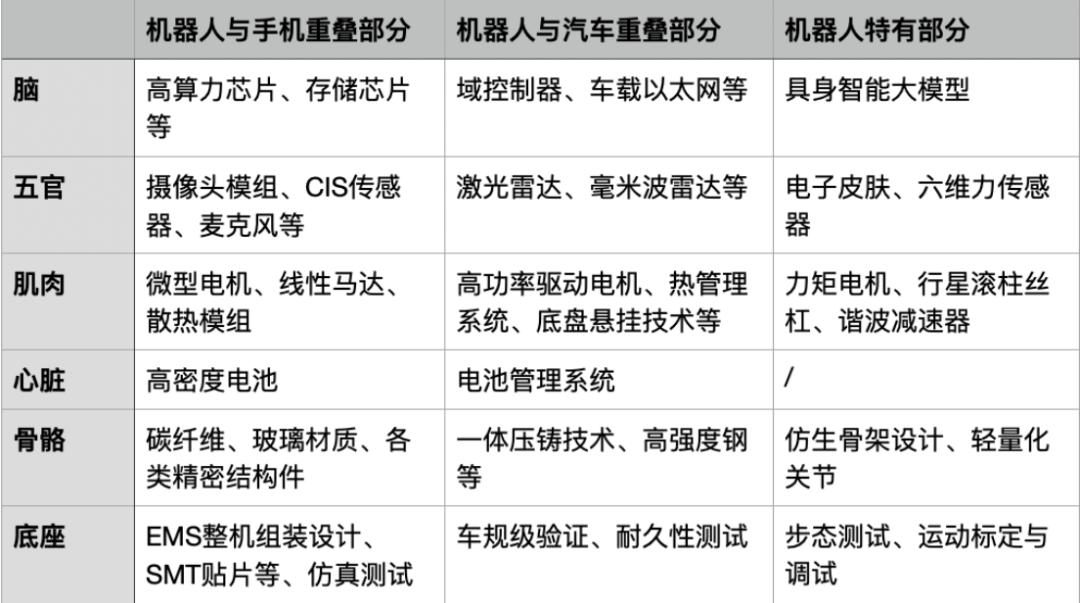
The similarities and differences between the robot supply chain, mobile phone supply chain, and automobile supply chain. Hard Krypton compiled based on public information.
A strong proof is that Glory, which entered the robot industry only one year ago, relying on reusing and integrating mobile phone technologies, defeated Unitree and the previous champion Beijing Humanoid and won the sixth place in the Yizhuang Marathon.
As humanoid robots are moving from R & D demonstrations to the inflection point of mass production of thousands of units, what the market lacks is an engineering base for large - scale, low - cost, and high - quality delivery. And this is exactly what Chinese mobile phone contract manufacturing giants are best at.
Currently, the humanoid robot industry is far from the moment of explosion, but it is certain that contract manufacturers will write a completely different story from the previous era.
Image source on the homepage | Provided by the enterprise
Typesetting | Fan Xinya

end