Is Guangzhou's economy booming again? The electronics sector has increased by 11.2%, and the automotive sector has increased by 7.3%.
Guangzhou's industrial growth rate has gone through the roof.
On May 29th, the Guangzhou Statistics Bureau released the economic data for January - April 2026.
After many years, Guangzhou's industrial growth rate has outperformed both the national and provincial averages. Among them, the electronics manufacturing industry increased by 11.2%, the automobile manufacturing industry by 7.3%, and the petrochemical manufacturing industry by 7.5%. In addition, the total amount of funds increased by 10.2%, and the growth rates of consumption and fixed - asset investment also outperformed both the provincial and national averages.
01.
Guangzhou's industrial growth outpaces the province and the nation
Let's get to the point: In the first four months of this year, the added value of industrial enterprises above designated size in Guangzhou increased by 6.6% year - on - year, significantly higher than the provincial average growth rate of 3.9% and the national average growth rate of 5.6%.
The year - on - year growth rate of the added value of industrial enterprises above designated size in the first quarter was 6.5%, and the growth rate in the first four months was 6.6%, indicating that the high - growth trend in the first quarter continued in April.
Let's take a look at the industrial growth rates in the past three years. By comparison, you'll see that this year's growth is remarkable: In the whole year of 2023, the added value of industrial enterprises above designated size in Guangzhou increased by 1.4% year - on - year; in the whole year of 2024, it decreased by 3% year - on - year; from January to April 2025, it decreased by 0.9% year - on - year; in the whole year of 2025, it increased by 1.2% year - on - year.
Many people ask, how did Guangzhou's industry turn things around this time after a few years? The answer is: The three major pillar industries have strongly recovered. Among them, the electronics manufacturing industry increased by 11.2%, the automobile manufacturing industry by 7.3%, and the petrochemical industry by 7.5%.
What does this mean? In this wave of semiconductor frenzy, Guangzhou has remained calm and maintained the foundation of its three major pillar industries.
Let's look at the specific data: From January to April this year, the automobile manufacturing industry, a core pillar of Guangzhou's industry, increased by 7.3%. Among them, the production of new - energy vehicles increased by 31.9%, which also drove the growth of the vehicle power battery and intelligent in - vehicle equipment industries by 44.9% and 34.6% respectively.
This shows that the most troublesome automobile manufacturing industry has significantly recovered.
The other two major pillar industries also performed remarkably. The electronics product manufacturing industry grew at a rate of 11.2%, and the petrochemical manufacturing industry increased by 7.5%. In addition, from January to April this year, Guangzhou's new - generation information technology has accelerated the release of its kinetic energy. The added value of the integrated circuit and electronic component manufacturing industries increased by 86.5% and 21.9% respectively, and the production of industrial robots and analog chips increased by 15.8% and 15.3% respectively.
The strong recovery of the three traditional pillar industries and the continued high - growth rate of new industries are the important reasons for the recovery of Guangzhou's industry this year.
02.
The growth of funds also outpaces the market
The flow of money is the most honest. In addition to industry, in terms of the total amount of funds, which measures a city's comprehensive strength, Guangzhou has also made steady progress.
According to the data from the Guangzhou Statistics Bureau, as of the end of April 2026, the balance of local and foreign currency deposits in Guangzhou reached 10.22 trillion yuan, a year - on - year increase of 10.2%.
Let's take a look at the situations in Guangdong and the whole country. As of the end of April 2026, the balance of local and foreign currency deposits in Guangdong Province was 40.9 trillion yuan, a year - on - year increase of 9.6%. During the same period, the growth rate of local and foreign currency deposits nationwide was 9%. That is to say, in terms of the growth rate of funds, Guangzhou has also outperformed the province and the nation.
Let's look at other cities: As of the end of April 2026, the balance of local and foreign currency deposits in Shenzhen was 15.93 trillion yuan, a year - on - year increase of 14.6%. At the end of April, the balance of local and foreign currency deposits in Hangzhou was 8.65 trillion yuan, a year - on - year increase of 6.9%. At the end of April, the balance of local and foreign currency deposits in Chongqing was 6.34 trillion yuan, a year - on - year increase of 9.1%.
It can be seen that Guangzhou's growth rate of funds is lower than that of Shenzhen, but significantly higher than that of Hangzhou and Chongqing.
03.
Consumption and fixed - asset investment are also good
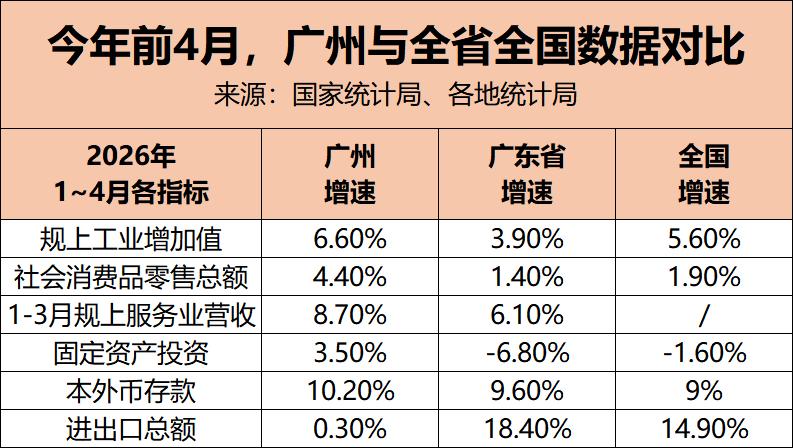
In addition to industry, Guangzhou's consumption and fixed - asset investment have also performed well. In the first four months, the total retail sales of consumer goods in Guangzhou increased by 4.4%, significantly higher than the provincial level of 1.4% and the national level of 1.9%. Fixed - asset investment increased by 3.5%, showing an upward trend against the backdrop of negative growth in both the province and the nation.
Among the above data, only the growth rate of foreign trade, at 0.3%, is temporarily lower than the provincial and national levels. As we have analyzed, this is because Guangzhou's containers lack high - end electronic components such as integrated circuits.
Generally speaking, Guangzhou's data in the first four months have stabilized because the traditional industries have strong resilience. However, to maintain its leading edge, it still needs to increase investment in future industries.
This article is from the WeChat public account "Urban Warfare", written by the Sun Bushu team and published by 36Kr with authorization.