Why is this corridor so important that the Party secretary and the mayor are seeking advice on it?
According to a message from "Qingdao Release", on the morning of May 28, the CPC Qingdao Municipal Committee held a symposium for non - Communist Party personages to solicit opinions and suggestions from the leaders of various democratic parties, the Federation of Industry and Commerce, and representatives of non - affiliated individuals on the construction of the Qingdao Science and Technology Innovation Corridor. Zeng Zanrong, Secretary of the Municipal Party Committee, attended the meeting and delivered a speech. Ren Gang, Deputy Secretary of the Municipal Party Committee and Mayor, presided over the meeting.
At the symposium, Shi Shuo, the full - time deputy chairperson of the Qingdao Committee of the Revolutionary Committee of the Chinese Kuomintang; Wei Zhiqiang, the deputy chairperson of the Qingdao Committee of the China Democratic League; Liu Ruijin, the chairperson of the Qingdao Committee of the China National Democratic Construction Association; Zhang Yongyan, the chairperson of the Qingdao Committee of the China Association for Promoting Democracy; Bo Tao, the chairperson of the Qingdao Committee of the Chinese Peasants and Workers Democratic Party; Liu Guangye, the chairperson of the Qingdao Committee of the China Zhi Gong Party; Wang Bo, the full - time deputy chairperson of the Qingdao Committee of the Jiu San Society; Cui Zuo, the chairperson of the Qingdao Federation of Industry and Commerce; and Zhang Bei, a representative of non - affiliated individuals, spoke in sequence. They put forward opinions and suggestions on collaborative innovation among government, industry, universities and research institutions, transformation of scientific and technological achievements, development of emerging industries, introduction and cultivation of high - end talents, financial support, and construction of intelligent computing centers. After carefully listening to the speeches, Zeng Zanrong said that the opinions and suggestions put forward were specific, practical, and highly operable, and they would be carefully studied and incorporated into the work.
Currently, the 15th Five - Year Plan outlines of all 31 provinces in China have been released. From the large coastal economic provinces to the emerging inland regions, a strategic competition and cooperation around emerging and future industries is in full swing. The science and technology innovation corridor is regarded as a regional development model driven by scientific and technological innovation. The Western Hangzhou Science and Technology Innovation Corridor and the Yangtze River Delta G60 Science and Technology Innovation Corridor are typical examples.
Qingdao has long planned for the science and technology innovation corridor. In the "14th Five - Year Plan Outline" of Qingdao, regarding "leading the construction of the Jiaodong Coastal Science and Technology Innovation Corridor", it was proposed to build a coastal belt integrating science, education, and industry relying on districts and functional areas such as Laoshan, Licang, and Jimo. This can be regarded as the earliest prototype of the Qingdao Science and Technology Innovation Corridor.
In 2024, the "Action Plan for Deeply Promoting Scientific and Technological Innovation and Accelerating the Construction of a Science and Technology - Strong City in Qingdao (2024 - 2028)" was issued. The concept of the "Qingdao Science and Technology Innovation Corridor" appeared in official documents, aiming to promote the in - depth integration and efficient transformation of various elements such as industries, talents, technologies, and funds, and to build a regional high - ground for scientific and technological innovation.
The 2025 Qingdao Government Work Report mentioned that efforts should be made to "accelerate the construction of the Qingdao Science and Technology Innovation Corridor". In November of that year, the construction of the Qingdao Science and Technology Innovation Corridor was officially launched. In terms of the planned scope, the Qingdao Science and Technology Innovation Corridor takes the Binhai Avenue as the main axis, with a planned area of about 190 square kilometers, connecting Laoshan District, Licang District, and Qingdao Blue Valley. This area is considered to be the area in Qingdao with the richest strategic scientific and technological strength, the most prominent "intelligent manufacturing" characteristics, and the most active innovation ecosystem.
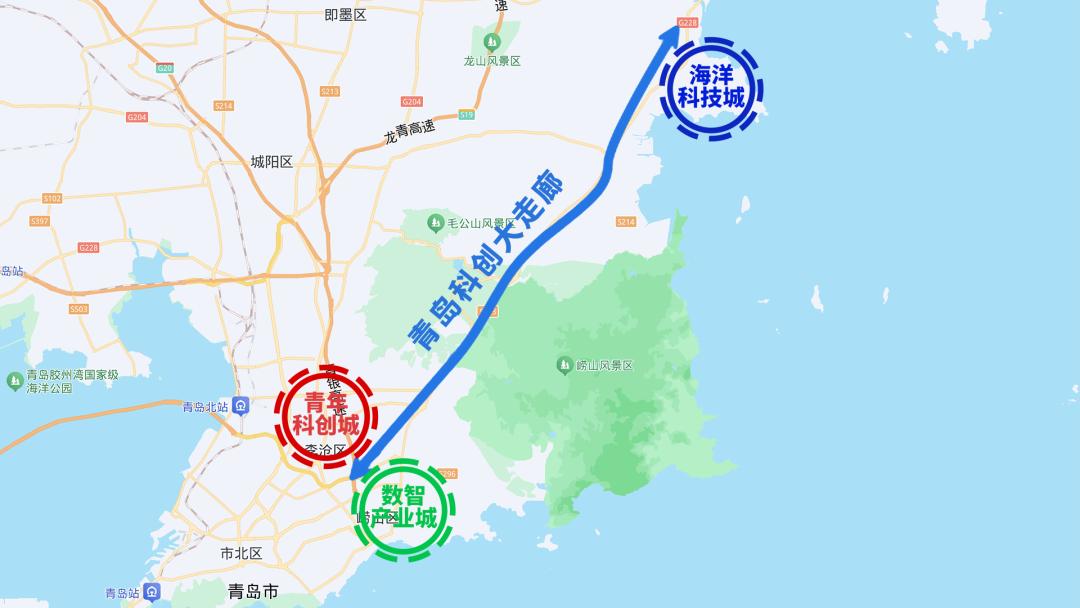
Image source: Qingdao Release
This year, the Qingdao Science and Technology Innovation Corridor has been positioned as "an influential source of scientific and technological innovation, an industrial upsurge belt, and an economic growth pole in the north". Not long ago, the Office of the Leading Group for Promoting the Work of the Qingdao Science and Technology Innovation Corridor released the first list of high - end talent requirements for the corridor, aiming to recruit high - end scientific and technological talents in the four major industrial fields of marine, digital intelligence, life, and future from around the world, attract global high - end intellectual resources, and build the main engine for the city's scientific and technological innovation development.
According to Qingdao's plan, by 2027, the functional form of the science and technology innovation corridor will take initial shape. The concentration of key laboratories and new R & D institutions in the corridor will account for more than 45% of the city, and indicators such as the number of valid invention patents per 10,000 people and the total number of scientific and technological innovation talents will increase by more than 15%.
By 2035, the leading role of the science and technology innovation corridor will be remarkable. It will drive the transformation of a number of disruptive technological achievements, gather a number of world - leading enterprises, and form a number of iconic future industries, promoting Qingdao to continuously consolidate its position as a strong engine for innovation and development in the province and move towards the goals of being a main force in national scientific and technological innovation and a global leader in marine science and technology.
This article is from the WeChat public account "Urban Evolution Theory". Author: Yang Huan. Republished by 36Kr with authorization.