Breaking the world record three times within a month, the leading photovoltaic company has fully launched the BC race.
A 0.1% difference and three world records! Recently, leading photovoltaic companies have engaged in a fierce competition in BC battery technology.
China Energy Net noticed that on April 26th, Trina Solar (SH: 688599) announced that the maximum conversion efficiency of its independently developed new THBC hybrid passivated back-contact battery reached 28.00%, breaking the world record for crystalline silicon battery efficiency.
Two days later, on April 28th, LONGi Green Energy (SH: 601012) announced that the conversion efficiency of its independently developed hybrid back-contact solar cell (HIBC) reached 28.13%, breaking the world record for crystalline silicon batteries.
On May 24th, JA Solar (SZ: 002459) subsequently announced that the cooperation between the company and Jingshi Energy on the HyperGen technology refreshed the known BC world record with a conversion efficiency of 28.2%.
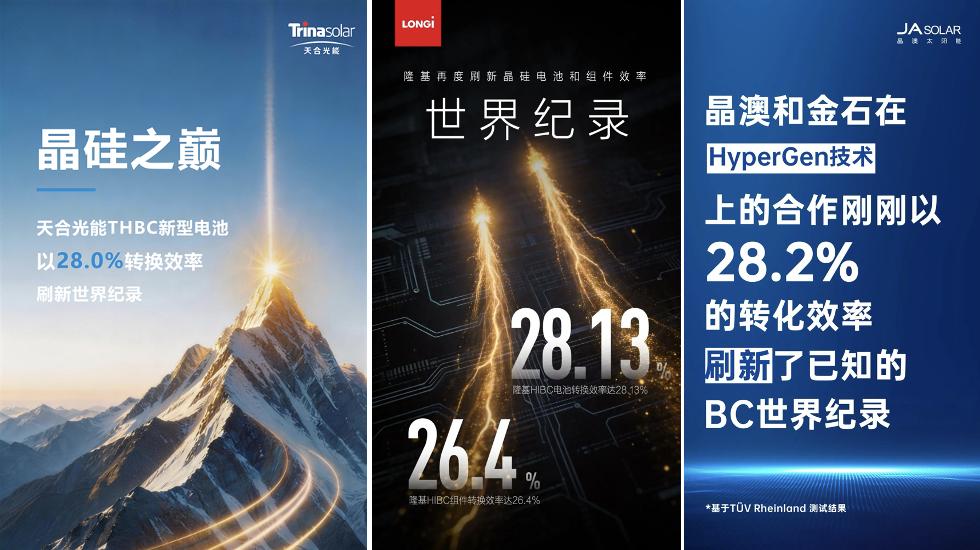
In less than a month, three leading companies created three world records for BC efficiency, with a difference of only about 0.1% between them. Such intense competition is rare in the history of photovoltaic development.
Behind the continuously refreshed world records is the increasing popularity of BC batteries. Before 2025, only a few companies such as LONGi Green Energy and Aiko Solar (SH: 600732) were involved in BC photovoltaic battery technology. However, since last year, the BC camp has been expanding, with companies like GaoJing Solar, TCL Zhonghuan (SZ: 002129), Tongwei Co., Ltd. (SH: 600438), and Trina Solar increasing their investment.
Now, as leading companies start the efficiency race, the market inflection point for BC technology is approaching, and the competitive landscape among photovoltaic leaders may change accordingly.
Expansion of the BC Camp and Acceleration of Mass Production
Compared with the mainstream TOPCon battery technology in the industry, BC has always been a "minority." In 2022, Aiko Solar, which bet on BC earlier, launched the ABC module. In 2023, LONGi Green Energy, a leading photovoltaic module company, launched the HPBC module. Based on these two companies, together with the overseas company Maxeon, which holds many BC patents, the BC camp was formed.
In the following two years, the BC camp remained a "lone warrior" without any expansion. It wasn't until 2025 that the situation changed.
In January 2025, Aiko Solar signed a contract with Skyworth PV, a leading distributed photovoltaic company. The two parties jointly invested in building BC battery and module production capacity in Baise, Guangxi. In May of the same year, Yingfa Ruineng cooperated with LONGi Green Energy to achieve the offline production of the first BC battery. GaoJing Solar, a silicon wafer manufacturer, also achieved the offline production of the first BC module in 2025 through cooperation with Aiko Solar.
China Energy Net noticed that most industry leaders also released their BC products this year, including Tongwei's TBC, Trina Solar's THBC, GCL Integration's (SZ: 002506) GPC, and Yidao New Energy's DBC...
In 2026, the development of BC battery technology has accelerated. On the one hand, the camp continues to expand. For example, Jolywood (SZ: 300393), which entered the TOPCon track earlier, released a "modified BC product." On the other hand, many leading companies have started to "compete" in this track, promoting it from technology reserve to mass production and application:
On March 18th, Tongwei Co., Ltd. signed an agreement with Jingshi Energy and Jinyang New Energy to jointly promote the large-scale mass production and commercial application of hybrid HBC battery technology and build a factory for large-scale mass production of hybrid HBC batteries at the Tongwei base.
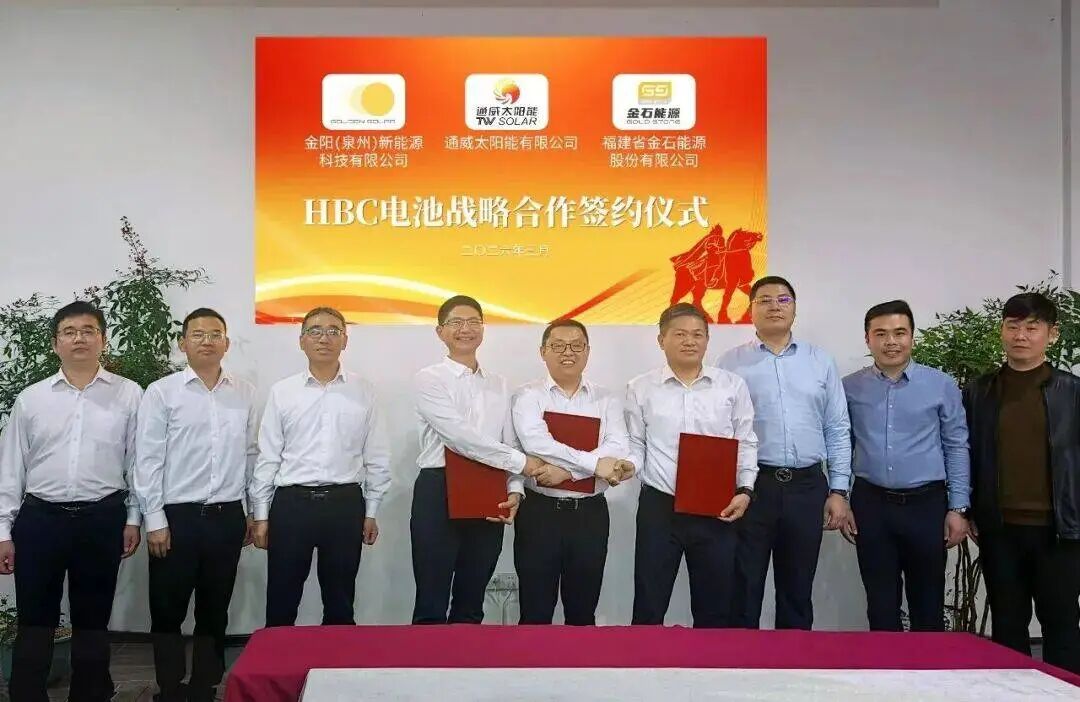
Signing ceremony for the cooperation between Tongwei, Jingshi, and Jinyang
On May 7th, the 3 millionth BC module of GaoJing Solar was officially offline, making it the third company in the world to achieve large-scale mass production of BC modules.
On May 19th, TCL Zhonghuan's Tianjin base held a ceremony for the offline production of a new generation of high-efficiency BC modules, and large-scale mass production is approaching. TCL Zhonghuan also said that it plans to gradually build a product layout with multiple channels for BC and TOPCon multi-sliced products in the next three years.
It is worth mentioning that TCL Zhonghuan's intention to hold a controlling stake in Yidao New Energy is also due to its recognition of Yidao New Energy's accumulation in BC. In April this year, Li Dongsheng, the founder and chairman of TCL, visited Yidao New Energy for the first time. He not only visited the BC battery module production line but also said that the company and Yidao New Energy will focus on promoting the large-scale application and industrialization of key technologies such as BC batteries in the future.
In addition, Trina Solar also announced that it will gradually release the production capacity of THBC this year and promote the application of THBC products in single-sided power generation scenarios, making it a "dual-drive" with TOPCon products in the company.
Competition Among BC Technology Routes Begins
While the camp is expanding, there is also a competition among technology routes within the BC camp.
The Chinese name of BC battery is back-contact battery. Any battery that moves the front grid lines to the back belongs to the BC category. That is to say, BC battery is just a general term for a type of batteries with similar structures. It can be combined with technologies such as P-type, HJT, and TOPCon to form multiple technology routes. Therefore, although many photovoltaic companies are developing BC batteries, the processes vary greatly.
In fact, the competition among technology routes within the BC camp has a long history. In September 2023, LONGi Green Energy launched the HPBC1.0 battery technology, which used a combination of "P-type + BC." However, subsequent market performance showed that the market acceptance of this product was not high. Zhong Baoshen, the chairman of LONGi, admitted the mistake in technology selection in the 2024 annual report.
Since then, TBC battery technology (a combination of "TOPCon + BC") has become the mainstream in the BC field. Currently, LONGi's HPBC2.0 and Aiko's ABC, which have achieved mass production, both belong to TBC battery technology.
Although TCL Zhonghuan did not announce what kind of BC technology its recently offline BC product uses, it is most likely TBC. China Energy Net noticed that recently, TCL Zhonghuan said that the company has three non-replicable advantages in the BC field compared with other BC manufacturers in the industry. One of them is "the battery efficiency has exceeded 27%, and the temperature coefficient is as low as -0.26%/°C."
However, since this year, the status of TBC technology has also begun to be challenged.
The BC technology released by Trina Solar in April is called THBC, which combines the advantages of TOPCon, HJT, and BC technologies. Trina Solar compared THBC with TBC in all aspects and believes that this technology is expected to replace TBC in the next 1 - 2 years.
Trina Solar said that traditional TBC batteries have inherent defects in single high-temperature diffusion passivation, while THBC will make up for this defect. In addition, the THBC production line can be transformed based on the existing TOPCon production line, and its delivery flexibility, investment intensity, and cost structure are all better than TBC.
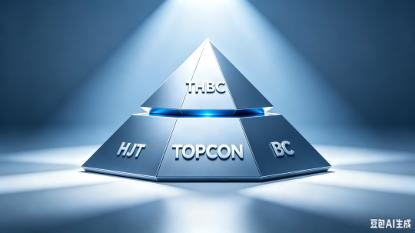
Conceptual diagram of THBC technology
JA Solar did not announce what kind of BC battery it used to refresh the world record, only calling it "HyperGen technology." However, its partner Jingshi Energy publicly stated that this technology is HBC (Hybrid BC), a perfect combination of TOPCon, HJT, and BC technologies.
China Energy Net noticed that Jingshi Energy released this technology as early as March 2023, then calling it "hybrid HBC technology." In November 2024, the battery conversion efficiency had reached 27.6%. Jingshi Energy asserted that this technology will be the mainstream technology for the future development of the photovoltaic industry.
Although each company is confident in its own technology, it remains to be seen which technology route will become the mainstream for BC batteries. The market will give the final answer.
Not Everyone Can Benefit from BC
In addition to technology bets and accelerated mass production, recently, BC modules have also been very popular in the centralized procurement by central state-owned enterprises.
For example, PowerChina added 4GW of BC modules to its 2026 centralized procurement. The centralized procurement scale of BC modules by Datang Group in 2026 increased from 1GW last year to 4GW. The centralized procurement of modules by Jingneng Group also changed from N-type single-crystalline double-sided modules last year to TOPCon modules and BC modules this year.
Under a series of favorable factors, some believe that 2026 will be the "turning point battle" for BC products, and their market share will increase significantly. So, what is the future of BC battery technology? Can all photovoltaic companies share a piece of the pie in the BC track?
Currently, BC technology is a preferred choice for companies with strong technology accumulation and R & D capabilities to pursue a differentiated competition route, but it may not be suitable for all photovoltaic companies. Due to the following four reasons, it is difficult to fully popularize BC technology.
First, in terms of efficiency, BC battery is undoubtedly the technology route closest to the limit efficiency of single-crystalline silicon batteries. However, there is a difference between the efficiency in the laboratory and the actual application. In addition, reliability, cost, and market acceptance are all issues that companies betting on BC technology need to consider. The BC route is not easy, and the future is full of challenges. Not everyone can enjoy the technology dividend.
Second, in terms of cost, the cost of BC modules has always been higher than that of TOPCon. Currently, only companies such as Aiko Solar and LONGi Green Energy can achieve full production, and only by applying silver-free technology can the cost be equal to that of TOPCon. Without a cost advantage, it is difficult to gain an upper hand in the competition with TOPCon.
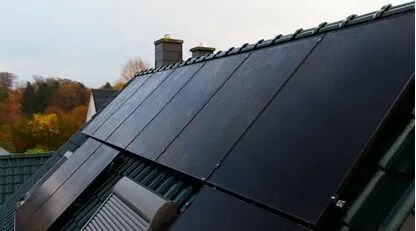
BC modules in a villa scenario
Third, in the market, by the end of 2025, the market share of BC was only 5% - 8%, far lower than that of TOPCon technology. In terms of application scenarios, although the share of BC in the centralized procurement by central state-owned enterprises has increased, its main application scenario is still in single-sided power generation scenarios such as distributed generation. Data shows that single-sided power generation scenarios only account for 15% of the photovoltaic market. This "small cake" may not be enough for many companies to share.
In addition, there is a major problem in developing BC - the technology barrier.
In the past few years, due to the lack of patent protection for TOPCon technology, many companies copied and used the technology at low cost, resulting in overcapacity and serious homogeneous competition. This is a lesson for BC companies, and the patent protection for BC technology is much stricter.
Previously, Maxeon, which holds many BC patents, launched patent lawsuits against several domestic photovoltaic companies. At the beginning of this year, MSPL, a subsidiary of Maxeon, signed a "Patent License Agreement" with Aiko Solar. Aiko Solar agreed to pay up to 1.65 billion yuan to obtain the patent authorization for Maxeon's BC technology. This shows the high threshold of BC patent technology. Companies without patent resources and independent R & D capabilities simply cannot develop BC.
In response, leading companies are also exploring more feasible ways. Recently, Ni Lili, the president of the photovoltaic product division of Trina Solar, said in an interview with China Energy Net that Trina has jointly established the first TOPCon patent pool in the photovoltaic industry with JinkoSolar and JA Solar, and will also include THBC in it in the future. Establishing a patent pool allows companies that need to use the patents to pay for the use, which may be the most economical and feasible way to quickly obtain BC technology.
This article is from the WeChat official account "China Energy Net." Author: Han Chenggong, Editor: Jiang Bo. Republished by 36Kr with authorization.