As the craze for miracle drugs subsides, who will emerge victorious in the new oncology battlefield worth over $400 billion?
Ten years ago, PD-1/PD-L1 inhibitors opened a brand - new door for tumor treatment.
It is like a key to unlock the immune system, releasing the "brake" mechanism of immune cells and opening a new era of wealth in the global innovative drug industry.
The annual sales of "Keytruda" and "Opdivo" have exceeded tens of billions of dollars. China's first - generation biotech companies have also made a collective appearance on the global pharmaceutical stage with this wave.
However, no wave can surge forever.
Now, the development bottleneck of PD - 1 has clearly emerged: Clinically, the response rate of monotherapy has hit a ceiling; commercially, the number of participants continues to increase, and the price war is constantly escalating.
The once "miracle anti - cancer drug" is gradually becoming a basic drug in the tumor treatment system.
The core question that follows is: When the "old ticket" of PD - 1 gradually becomes invalid, who can get the admission ticket for the next decade of tumor treatment?
The answer has emerged from the global mergers, acquisitions and layouts of multinational pharmaceutical companies: Bispecific antibodies, trispecific antibodies, and T - cell engagers (TCEs) are becoming the core tracks of the new round of industry competition.
This type of drug is no longer limited to the linear breakthrough of a single target but attempts to achieve multiple immune regulations within a single molecule. According to CIC Consulting's prediction, the global oncology drug market size will grow from $262.1 billion in 2024 to $724.9 billion in 2035.
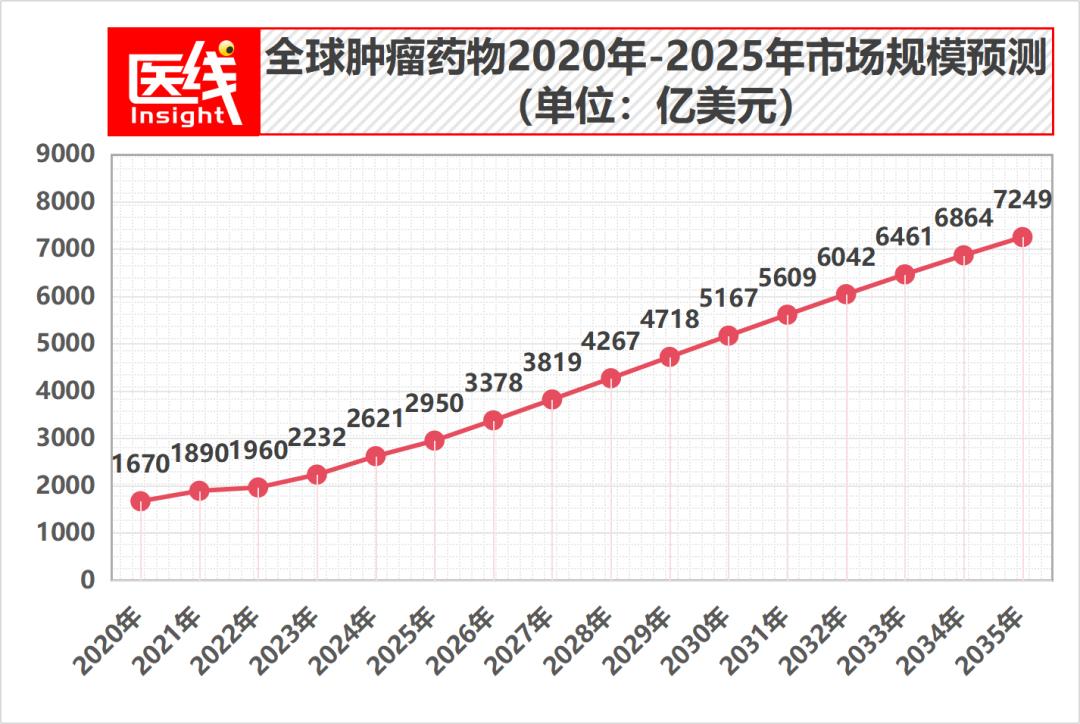
Data source: CIC Consulting
Facing a market increment of over $400 billion, the industry is not pursuing the next "PD - 1" but a brand - new underlying logic for tumor treatment.
The Ebb of the Miracle Drug: PD - 1 Sinks into the Deep Water of the Price War
To understand why bispecific and multispecific antibodies have suddenly become the focus of the industry, we must first understand the real - world dilemmas of the monoclonal antibody track - the pressure does not come from a single aspect but from the double squeeze of both the clinical and commercial ends.
First of all, the bottleneck at the clinical end has long been prominent.
The objective response rate (ORR) of a single PD - 1 inhibitor in most solid tumors is only 20% - 30%, and a large number of patients have problems with primary or secondary drug resistance.
Especially for "cold tumors" such as colorectal cancer and pancreatic cancer, which lack immune cell infiltration, single - target drugs often have difficulty playing an effective role.
Secondly, the competition at the commercial end has entered a white - hot red - ocean stage.
Taking the systematic treatment of hepatocellular carcinoma (HCC) as an example, more than 10 PD - 1 inhibitors have been approved for marketing globally. Multinational pharmaceutical companies are competing on the same stage with domestic enterprises such as Hengrui Medicine, BeiGene, Innovent Biologics, and Junshi Biosciences; in the field of head and neck squamous cell carcinoma (HNSCC), 5 PD - 1 products are also in direct competition.
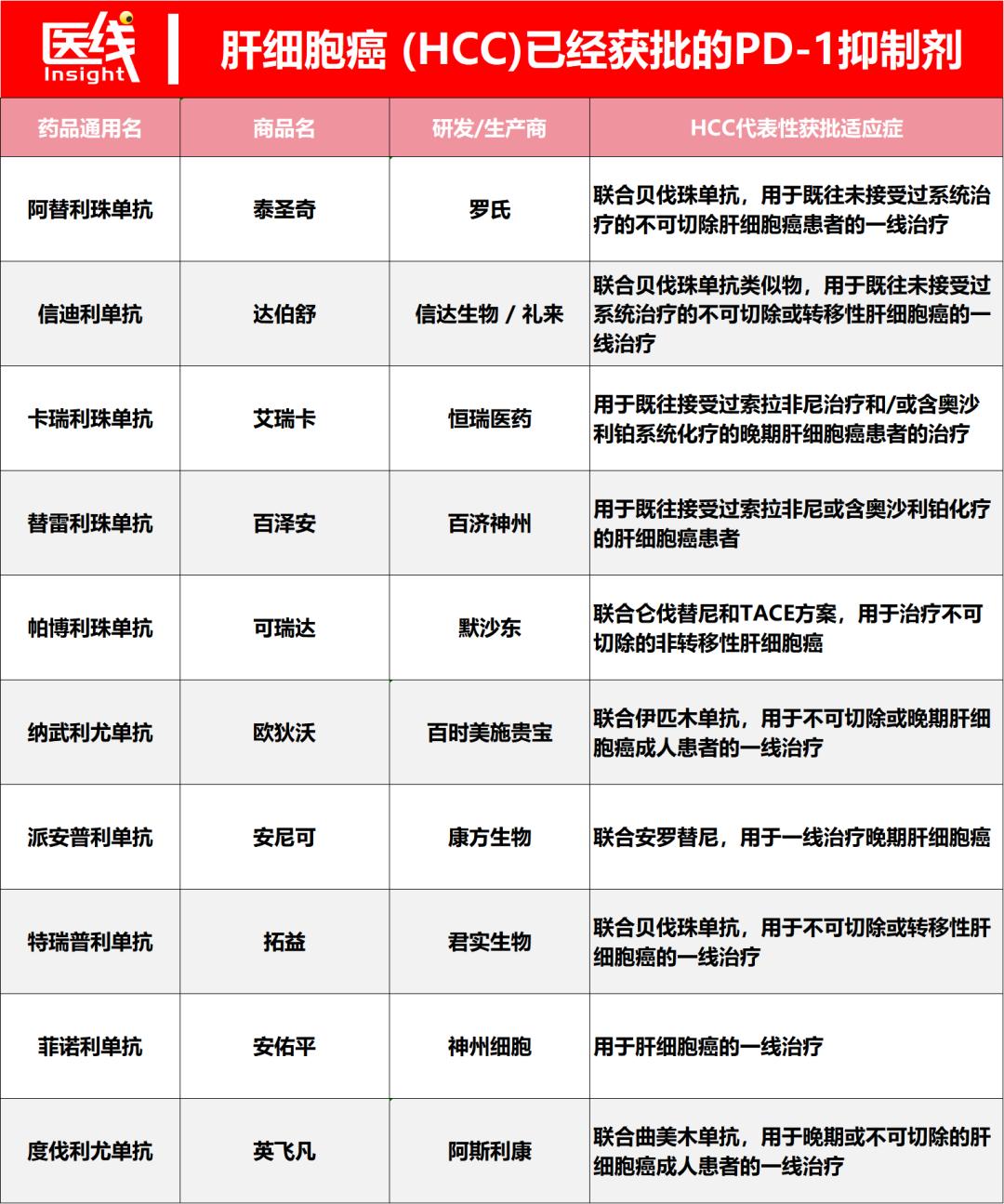
Data source: Official WeChat accounts of various companies and public information on the Internet
When more than a dozen heavy - weight players flood into a track, the technological premium will be quickly diluted.
The innovative drug industry has thus been pushed into the deep water of national medical insurance negotiations and centralized drug procurement, where "trading price for volume" is the norm. The price decline is no longer an accidental market fluctuation but an inevitable trend under the industry's structural transformation.
Financial data can most intuitively reflect this pressure. Affected by factors such as medical insurance cost control and intensified market competition, the prices of many core monoclonal antibody products have dropped significantly. The average selling price of a commercially available monoclonal antibody product has dropped from 2022.1 yuan to 1786.1 yuan within a year.
This is the "mid - life crisis" of the monoclonal antibody era: In terms of efficacy, the ceiling has not been effectively broken; commercially, the profit margin has been continuously compressed by competition and cost control.
For enterprises, researching and developing a new generation of molecular drugs is no longer just an ambition to pursue scientific breakthroughs but an inevitable choice for survival.
Bispecific Antibodies Take Over: Becoming the New Core of Tumor Treatment
If the core function of PD - 1 monoclonal antibodies is to "release the brake" for the immune system, then the goal of bispecific antibodies is to clear the "road" for immune cells to attack tumors while releasing the brake.
It is not a simple superposition of two monoclonal antibodies but a redesign of the immune response in terms of time and space.
The PD - 1/VEGF bispecific antibody is the most concerned direction in this technological route.
In the past, the clinical often used a combined medication plan of "PD - 1 monoclonal antibody + anti - angiogenesis targeted drug"; while the bispecific antibody integrates these two functions into the same molecule: one end inhibits tumor angiogenesis through anti - VEGF, normalizes the blood vessels in the tumor microenvironment, and reduces immunosuppressive factors at the same time; the other end releases the tumor's immune escape through anti - PD - 1, allowing T cells to enter the tumor tissue more efficiently and play a role.
This is also the reason why non - small cell lung cancer (NSCLC) has become a key battlefield for testing the clinical potential of bispecific antibodies.
In fact, the industry inflection point for bispecific antibodies to replace monoclonal antibodies has arrived.
The industry's confidence in bispecific antibodies stems from a decisive clinical confrontation in the past two years: The PD - 1/VEGF bispecific antibodies developed by domestic enterprises represented by Kangfang Biotech defeated Keytruda, which had dominated the industry for a decade, for the first time in a head - to - head comparison in a phase III clinical trial of advanced non - small cell lung cancer.
This landmark victory established a new consensus in the oncology community in 2026: Bispecific antibodies are no longer a substitute plan after monoclonal antibody resistance but a new gold standard that can substantially take over first - line treatment and rewrite clinical guidelines.
Driven by this consensus, subsequent enterprises are aiming for a higher efficacy ceiling through more optimized molecular design.
Taking the PD - 1/VEGF bispecific antibody candidate drug SCTB14 disclosed by Sinocelltech as an example, in patients with third - line and above non - small cell lung cancer who have not previously received immune checkpoint inhibitor treatment, the drug achieved an objective response rate of 44%, a median progression - free survival of 6.9 months, and an overall survival rate of 88% at 10 months with monotherapy; in patients with first - line non - small cell lung cancer with TPS ≥ 10%, the confirmed objective response rate of SCTB14 reached 65%, the disease control rate was 100%, and the overall survival rate at 12 months reached 82%.
It can be seen that the value of bispecific antibodies is far more than "adding one more target".
It truly reconstructs the underlying logic of tumor treatment: In the past, monoclonal antibodies were the treatment platform, and combined medication was just a supplementary means; now, the synergistic effect of multiple targets has been directly built into the molecular design.
If this trend continues to be verified by clinical data, bispecific antibodies are expected to be upgraded from supplementary options to core plans in the treatment of multiple solid tumors and become the basic foundation for the next generation of tumor treatment.
Trispecific Antibody Breakthrough: Advancing into the Uncharted Territory of Immunotherapy
Bispecific antibodies have opened a new door for tumor treatment, but the most difficult - to - overcome tumor problems are still hidden in deeper areas.
"Cold tumors" such as colorectal cancer, pancreatic ductal adenocarcinoma, and biliary tract cancer have long had a poor response to immunotherapy. The reason is not only the scarcity of immune cells in the tumor tissue but also the complex immunosuppressive network in the tumor microenvironment.
Among them, immunosuppressive ligands such as TGF - β are like a "protective shield", which not only blocks immune cells from approaching the tumor but may also cause patients to develop dual resistance to angiogenesis inhibitors and immunotherapy.
To break through this barrier, a single target is far from enough, and a dual - target approach may not be completely effective either.
Against this background, trispecific antibodies have been pushed to the forefront of the industry.
The PD - 1/VEGF/TGFβRII trispecific antibody SCTB41 developed by Sinocelltech is a typical representative of this R & D idea.
It integrates three functions simultaneously: PD - 1 is responsible for releasing the immune brake, VEGF is responsible for cutting off tumor blood vessels and blocking related immunosuppressive pathways, and TGFβRII is used to break through the deeper - level immune barrier.
More notably, this type of trispecific antibody has shown preliminary breakthrough efficacy in patients with second - line and above treatment of extremely difficult - to - treat "cold tumors" such as colorectal cancer, biliary tract cancer, and pancreatic ductal adenocarcinoma.
Among the enrolled patients, 54% had previously received immunotherapy, and SCTB41 still achieved an unconfirmed objective response rate (uORR) of 22% and an unconfirmed disease control rate (uDCR) of 81%; even in the "immune desert" population with extremely low PD - L1 expression (TPS < 1%), its objective response rate reached 38%, and the disease control rate reached 88%.
The importance of this set of data lies not in providing the final treatment answer but in proving that antibody engineering technology is moving from "single - target blockade" to "multi - target precise regulation".
In future industry competition, it may no longer be about who can discover a new target first but who can integrate multiple targets into a stable, efficient, and scalable molecular system.
TCE's Cross - Border: From an Anti - Cancer Weapon to a New Hope for Autoimmune Disease Treatment
If trispecific antibodies represent "precision warfare" against the tumor microenvironment, then T - cell engagers (TCEs) provide a more direct treatment method.
Taking CD20/CD3 TCE (T - cell engaging bispecific antibody) as an example, its mechanism of action is like building a bridge: one end specifically binds to pathogenic B cells, and the other end recruits the body's own T cells, forcing the two to come into close contact, thereby achieving the precise killing of pathogenic cells by T cells.
This mechanism was originally a "killer weapon" in the field of hematological tumor treatment.
Data shows that a CD20/CD3 TCE (SCTB35) achieved an unconfirmed objective response rate of 100% in the target dose groups of diffuse large B - cell lymphoma (DLBCL), follicular lymphoma (FL), and mantle cell lymphoma (MCL).
As of May 2026, 5 CD20/CD3 TCEs have been approved for marketing globally, among which 3 have been approved in China: Roche's Mosunetuzumab (trade name: Glofix/Columvi), for relapsed/refractory follicular lymphoma (approved in December 2024); ABBVIE and Genmab's Epcoritamab (trade name: Epkinly), for relapsed/refractory follicular lymphoma and diffuse large B - cell lymphoma (approved in China in May 2026); Roche's Glofitamab, for relapsed/refractory diffuse large B - cell lymphoma (approved in China in November 2023).
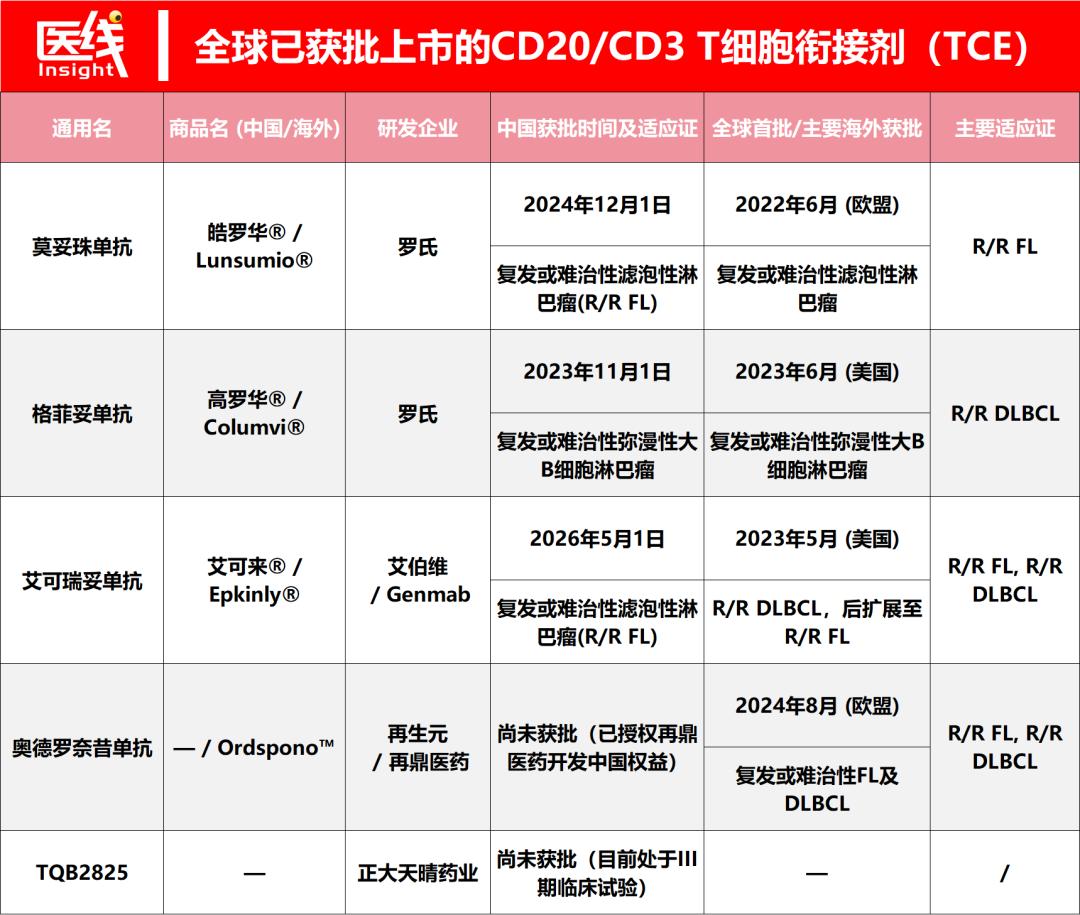
Data source: Public information on the Internet
The greater imagination space of TCE technology lies in its cross - border application.
Currently, this technology is being extended to the treatment field of autoimmune diseases such as systemic lupus erythematosus (SLE).
Systemic lupus erythematosus is known as the "incurable cancer" and is characterized by a high recurrence rate and great treatment difficulty. Compared with traditional monoclonal antibodies, the potential advantage of TCE is that it can more directly and efficiently clear pathogenic B cells that produce autoantibodies and may also promote the formation of immune memory, thereby reducing the risk of disease recurrence.
In a phase Ib clinical trial for systemic lupus erythematosus, after a single administration at a very low dose, the peripheral blood B cells of some patients quickly decreased to an almost completely depleted state, and this low - level state could last for up to 24 weeks; among all 30 patients receiving different doses of treatment, the overall PGA response rate (physician's global assessment response rate) at week 4 reached 100%, and the average SLEDAI (Systemic Lupus Erythematosus Disease Activity Index) response rate at week 24 reached 71%.
This is the core reason why both the capital and industrial circles are paying attention to TCE.
It is predicted that the global immunology and inflammation (I & I) drug market size will reach $412.4 billion in 2035.
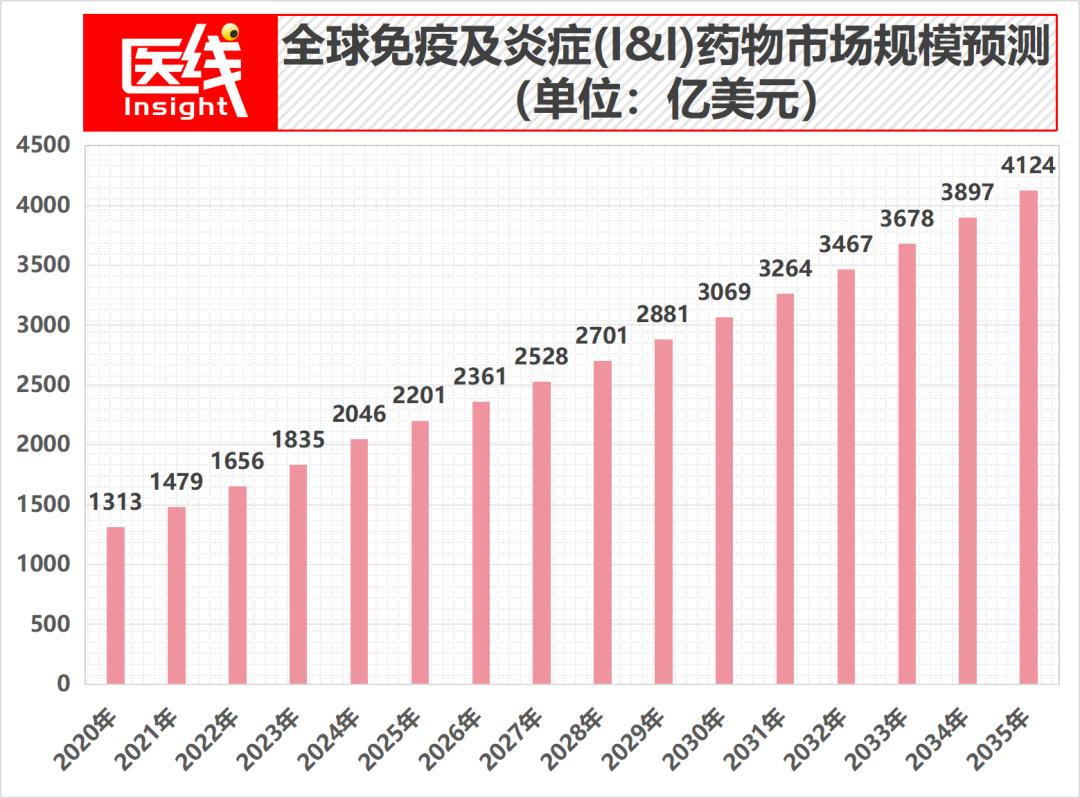
Data source: CIC Consulting
Migrating the anti - cancer technology of redirected immunity to the autoimmunity track worth hundreds of billions of dollars is expected to become an important direction for the birth of "blockbuster drugs" in the next 5 - 10 years.
The Key to Victory: The Moat Hidden in the Production Workshop
However, the more complex the molecular structure is, the more the industry competition is not just a scientific contest.
Bispecific antibodies, trispecific antibodies, and TCEs depict a beautiful clinical blueprint, but what really determines whether they can achieve commercial transformation is often the invisible production workshop.
The research and development of multispecific antibodies is essentially an extreme engineering discipline.
Integrating two or three antibody structures with different functions into the same molecule is prone to problems such as heavy - light chain mismatch, protein aggregation, and low expression levels.
A molecule may perform perfectly in laboratory papers and business roadshows, but if the mass - production cost is higher than the market - acceptable price, it cannot become a real commercial product.
This means that the asset - light operation logic prevalent in the monoclonal antibody era is no longer fully applicable in the multispecific antibody era.
Especially in recent years, with the fermentation of geopolitical factors such as the overseas "Biosafety Act", the global pharmaceutical supply chain is undergoing a profound reconstruction. The compliance risks and supply - chain fragility of the asset - light model that highly depends on a single external CXO for contract manufacturing have been fully exposed.
In the future, a large - scale and independently controllable production capacity reserve, a complete and coherent underlying production process, and an internalized supply - chain system will become the core foundation for enterprises' survival and development.