The World of Agents in the First Half of 2026: Excited and Anxious
The technology is advancing at a breakneck pace, new demands are emerging, the old is giving way to the new, and the endgame is yet to be seen. The industry is both excited and anxious.
In the first half of 2026, there were drastic changes in the field of intelligent agent implementation. "The pace of technological progress far exceeds expectations," said Zhi Zhen, the chairman of Zhonggong Internet. He described himself as being in an "excited state," devoting 99% of his energy to technology and immersing himself in customer sites to promote the integration of scenarios and technology. "As long as you can do a good job, there will definitely be someone willing to buy."
However, the rapid advancement of the technological wave has also triggered widespread anxiety among enterprises. A person from a large company revealed that almost all the enterprises he has met this year are asking: The technological architecture is changing too fast. We've already invested in building an intelligent agent system. Now that OpenClaw has emerged, should we scrap it and start over? Will the intelligent agent projects we did last year be obsolete?
The rapid advancement of technology and the confusion in decision - making coexist, which forms the background of this round of intelligent agent implementation. How can we break the deadlock in the competition between the old and new architectures? What fundamental changes are taking place in customer demands? And, when intelligent agents move from marginal pilot projects to core business, what path will the second half of this competition take?
01 The Old Map Is No Longer Valid
The product design and concept of OpenClaw have brought a lot of inspiration to the industry and also had an impact on the entire industry. The development efficiency, product form, personnel structure, and software logic have all been completely rewritten.
The ability to apply AI has become the core assessment standard. "The only standard we use to assess people now is their ability to use large - scale models," said Zhi Zhen. "One person who uses it well is equivalent to two or three who use it poorly." Yu Youping, the president of Zhongguancun Kejin, introduced that in March this year, the company launched an OpenClaw innovation competition. Employees formed cross - departmental teams to directly build "Lobster applications" and received 95 good ideas corresponding to specific business actions. Some of them have been promoted and implemented internally.
The product form is also undergoing drastic changes. Yu Youping believes that OpenClaw has made the industry realize that "the enterprise - level intelligent agent architecture should no longer be designed around the 'chat window' but around 'work tasks'." In the past, many intelligent agent products were essentially "large - scale models + knowledge bases + dialogue entrances" and were difficult to undertake enterprise - level tasks. What enterprises really need is a work system that can understand tasks, call tools, use knowledge, abide by permissions, output results, and accept evaluations. The construction of intelligent agents is moving towards business personnel, allowing front - line personnel to precipitate their experience into Skills, and the delivery target has become "digital employees".
The market has responded quickly. Whether it's large companies like Tencent, ByteDance, Alibaba, and Baidu, or front - line intelligent agent implementation manufacturers, they have all launched their own "Lobster - like" products. "Previously, we could only handle some simple approval scenarios. Now, we can handle autonomous operation scenarios, and there are more new scenario opportunities," said Wang Zhong, the co - founder of Zhongshu Xinke.
Parallel to the architectural change is the leap in development efficiency. In December last year, there was a major breakthrough in the programming ability of large - scale models. "With the same number of people, the number of projects we can handle simultaneously has at least doubled," said Wang Zhong. Now, there are very few PoCs. "First, we show the demo to help customers understand. Then, either they directly try the product or directly discuss project delivery." Because building a complete and runnable scenario demo can be done "basically within a day," the productivity has been greatly improved.
Zhi Zhen gave an example. In the past, when creating a BOM (Bill of Materials), one had to select items one by one from the drop - down box. Now, by creating a Claw tool, even if you only remember the name of one part, after inputting it, the system can automatically traverse the database, think and verify, and return a standard Excel table. "This function was not completely impossible to achieve last year, but it required using a vector library and a lot of fuzzy matching techniques, and the result was not very good after a long time. This year, it's simple. Lobster is like a scheduling shell, and you just need to create a simple skill to connect to the database."
The level of intelligence is also soaring. "It's at least 10 times better in May than in January," said Zhi Zhen. In the past, when trying to create an intelligent agent that could recognize material codes from pictures or text and generate error - free purchase orders, it took several months of development to reach the industrial - level accuracy. Before January, it was almost just a PoC and difficult to implement in practice. Now, as long as you can think of it, you can do it. Moreover, the intelligent agent can search, verify, and review repeatedly, achieving multi - agent collaboration, and the accuracy has been greatly improved.
Intelligent agents are also reconstructing the traditional software paradigm. In the past, software was updated annually. Now, the concept of 'daily - discarded software' has become a reality. Yu Youping introduced: "The reconstruction of the traditional software paradigm is coming faster than expected." Enterprises have found that AI can directly complete tasks across systems through "intention - driven" methods, and their patience with traditional SaaS is rapidly decreasing. This has occurred intensively in just a few months.
In the industrial field, "This round of disruption to industrial design simulation is significant," pointed out Zhi Zhen of Zhonggong Internet. CAX software such as CAD and CAE, which were once called "the pearls on the industrial crown," are facing disruptive changes. The solid barriers built on long - term code precipitation and large - scale model libraries in the past are now being broken by AI. "In January, I still said that industrial software might have a 3 - 5 - year barrier. Now, I think it's completely gone."
Zhi Zhen judged that the arrival of industrial intelligent agents is just a matter of "when to fully unfold," and the time window is only 1 - 2 years. "First of all, there is no such thing as industrial software this year. All enterprises that implement informatization will add intelligent agents." In the past, factories had to purchase a dozen or twenty sets of software, and 99% of the functions in each set might never be used in a lifetime. Now, only lightweight algorithms need to be generated according to specific scenarios, which have better effects, lower costs, and can highly integrate CAD, CAE, MES, PDM, etc. In the future, software will no longer be large and comprehensive in functions but will be based on needs and application scenarios to deliver value and functions.
02 The Debate on Old and New Architectures: Must We Start from Scratch?
With the rapid change of the technological wave, the issue of "new and old" has become an anxiety point for enterprises. Many enterprises are in a dilemma: Should the intelligent agent systems built with costs in the past few years be scrapped and rebuilt due to new frameworks such as OpenClaw? Will the previously implemented projects be quickly obsolete?
Yu Youping of Zhongguancun Kejin believes that "The core problem enterprises face is not whether the original system has value, but whether the original architecture is open and flexible enough." The difference between the old and new systems lies in that the new paradigm strengthens two directions: Enterprise - level intelligent agents should be organized around tasks and job Skills; the intelligent agent system should have stronger openness, scalability, and continuous operation ability. If the system built by enterprises last year adopted an open architecture, with the decoupling of capabilities such as models, tools, and knowledge bases, the switching cost of adapting to the new Skills system, accessing new tool protocols, and upgrading to the new framework is relatively controllable, and many capabilities can continue to evolve on the original foundation. On the contrary, if it was built in a closed, strongly - bound, and chimney - like way, there will be relatively large architectural pressure this year.
"What enterprises are most concerned about now is not chasing the latest framework but avoiding being locked in by the technological route. Because intelligent agents are still evolving rapidly, the enterprise - level architecture must leave enough flexibility," said Yu Youping.
Wang Zhong of Zhongshu Xinke provided another insight: Customers don't care about what paradigm to use but only look at the results. For any project that can be implemented and pass the acceptance, if the results in the limited scenario have reached the standard, customers won't require the old scenario to be transformed with the new paradigm. They prefer to use the new paradigm to create new scenarios that couldn't be done before.
"After OpenClaw became popular, many old customers came to us to discuss new scenarios," Wang Zhong gave an example. A leading enterprise in the water industry actively inquired this year whether the "Lobster" paradigm could be used for some scenarios that couldn't be done last year. Previously, they had successfully implemented intelligent agent applications. Currently, the two sides are promoting the implementation of intelligent agents in two new scenarios: process scheduling and leakage loss warning, based on the new paradigm.
Actually, since the concept of Agent emerged in 2023, there have been two routes in the industry: one is the workflow, and the other is the more autonomous - planning Agent. OpenClaw, Hermes, etc. that emerged this year are typical representatives of the latter route.
"Most of the platforms people bought before were workflow platforms, but now the intelligence and generalization ability of multi - agent collaboration far exceed those of workflow platforms," Wang Zhong said. After demonstrating the product prototype of the multi - employee cooperation concept to customers, customers tend to use this paradigm as the foundation.
However, the old and new technological architectures are not in a completely substitutive relationship but have their own applicable scenarios.
Within enterprises, there are a large number of scenarios with fixed rules, rigorous processes, and highly certain results, which can be well - solved by workflows. For example, contract review, copywriting generation, etc. The processes and knowledge are relatively fixed, and using workflows is the best and fastest way. The self - planning route will consume a large amount of additional tokens, which is not cost - effective in terms of efficiency and cost. Some simple data analysis and trend analysis are also suitable for workflows.
The new paradigm represented by OpenClaw, which features multi - agent collaboration and self - planning, is suitable for scenarios with stronger generalization ability and where the processes cannot be exhausted. Its greatest advantage lies in its openness, which can complement the workflow.
Wang Zhong gave an example. In the scenario of equipment predictive maintenance, for the diagnosis of existing faults, since the processes and knowledge are relatively fixed, the workflow model can be continued. However, for the more valuable hidden - danger prediction, since the abnormal rules cannot be exhausted, it was difficult to solve before. Now, it can be analyzed through the multi - agent framework by simulating the experience of human experts. Currently, the accuracy has been improved to over 90%, and the system has the ability of continuous learning.
However, there are still many challenges in the large - scale implementation of the new paradigm. Wang Zhong admitted that although enterprise customers recognize its value, they generally have a headache about the security implementation at the enterprise level. "The growth rate of intelligent agents is obvious, but the proportion of scenarios using the self - planning structure in scenario construction is still relatively small. People don't trust the underlying framework enough and need more verification. The large - scale implementation still depends on the emergence of an enterprise - level framework." He judged that OpenClaw is not the end of technology. "There will definitely be new frameworks emerging continuously," and intelligent agent technology will continue to iterate, and the mature solutions suitable for complex enterprise scenarios are still evolving.
03 What New Demands Are There on the Customer Side?
In the first half of 2026, the demand for intelligent agent implementation significantly accelerated. Zhi Zhen observed that the customer group has become more diverse. No enterprise doubts the value of AI anymore, but only cares about "how much money to spend and how much to achieve." The form of demand has also been clearly upgraded: "Previously, the copilot we provided to customers, they said they don't want it anymore. In the future, they want intelligent agents to be the main focus, rather than humans."
The purchasing enthusiasm of business departments has increased significantly, even exceeding that of IT departments. Xin Zhou, the general manager of Baidu Smart Cloud's AI and large - scale model platform, revealed that among the customers in industries such as ports and manufacturing they serve, there have been cases where business departments actively put forward demands and even directly made purchases. A person in the industry also confirmed that "If the business department says it's good, then implement it. If it's not good, then stop." Business experience has become the core decision - making basis.
The purchasing logic is also changing: Although customers recognize the value of the platform base, they are no longer willing to pay for the bare platform. Wang Zhong of Zhongshu Xinke said bluntly, "Without a specific scenario, it's impossible to sell the basic platform. There must be a strong core business scenario as a guide to bring in these platforms and infrastructure as necessary modules." This change is directly reflected in the budget structure. Taking several leading enterprises served by Wang Zhong as an example, the proportion of platform and computing power infrastructure procurement has dropped significantly, and resources are accelerating towards scenario - based intelligent agents. "If it was a 60 - 40 split last year, now it may be the opposite, a 40 - 60 split, and the order volume of intelligent agents has increased by at least 50%." The market either expands the computing power on - demand and flexibly or directly builds exclusive scenario - based intelligent agents. Few customers buy general platforms such as commercial - version Dify or HiAgent first and then plan the scenario implementation separately.
"Everyone is now talking about scenarios all the time and calculating very carefully," Wang Zhong said. "Don't talk to me about virtual capacity building. I just want to know where I can use this thing? Among 123456, the ones with the highest ROI should be done first." The calculation method of ROI is also deepening. In addition to traditional indicators such as accuracy rate and expert consensus rate, some leading central state - owned enterprises have introduced the FTE calculation method this year, using the replacement rate of core manual working hours as a key measurement parameter.
At the same time, customers value the complete enterprise - level functions more. "Today, you show me a good - quality demo, but I won't let it go live directly. I will definitely ask how to manage the knowledge permissions, how to conduct multiple verifications, what modifications are needed to integrate with the existing business processes, and how to verify through objective data," Wang Zhong said. Customers are starting to pay more attention to implementation, the controllability and security of the supporting facilities, and the integration with the new business processes of the existing business.
In addition, the importance of knowledge engineering is significantly increasing. Wang Zhong pointed out that the gap at the model level is continuously narrowing, and the key to determining the effect of intelligent agents has shifted to the knowledge construction at the Agent level. In the past, enterprises often simply equated knowledge engineering with document library construction and were not willing to pay extra for it. However, "raising Lobsters" has made them realize that just reading documents is far from enough, and a large amount of experience must be infused - and this experience comes from knowledge engineering. Therefore, when enterprises build scenarios now, they are generally more willing to invest resources to build general industry knowledge bases or enterprise - specific knowledge bases to make preparations for the application of other scenarios in the future.
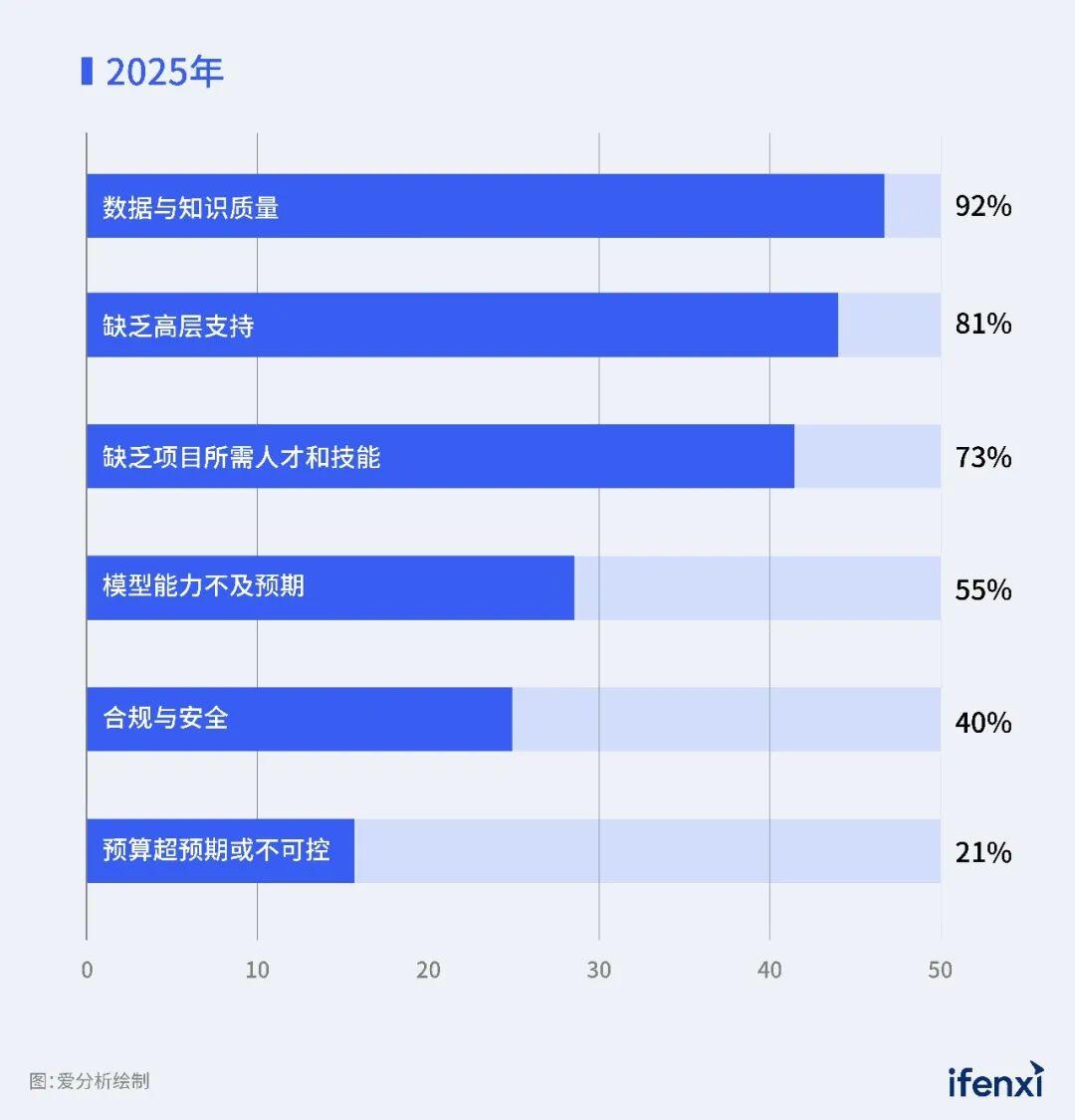
The "2026 Aifangxi Research Report on the Implementation Progress of Central State - owned Enterprise Agents" also shows that in 2025, the success rate of intelligent agent projects in central state - owned enterprises was about 70%, lower than the average level of traditional IT projects. Among them, the quality of data and knowledge has become the primary reason for failure. "Last year, many central state - owned enterprises built intelligent agent platforms based on open - source products, but the open - source products were basically blank in knowledge governance, which became a fatal problem in the implementation and application," said Zhang Yang, the co - founder and chief analyst of Aifangxi. He believes that knowledge governance should be the prerequisite and standard for the implementation of intelligent agents.
04 The Second Half Has Just Begun
Intelligent agents are still in the process of value verification and are far from being widely adopted. A survey by Deloitte of more than 3,200 enterprise executives worldwide from August to September 2025 showed that only 25% of enterprises had promoted intelligent agents to the production environment, and the implementation cycle had been extended from the initially estimated 3 months to 18 months. However, in the first half of this year, the rapid development of technology is bringing profound changes.
The industry has put forward more and more complex dimensions for the implementation of intelligent agents, from initially looking at token consumption to looking at coverage, the number of tokens connected to