A primary school student tricked the AI age verification system by drawing a beard, leaving Silicon Valley engineers speechless.
The "sneaky move" of using magic to beat magic really made me laugh.
At the beginning of this year, in response to global regulatory pressure, the social platform Discord introduced a "teen-by-default" policy, assuming everyone is a minor by default and locking some features. To unlock the adult mode, one has to pass the age verification.
There are mainly two verification methods: either take a short selfie video with the camera and let the AI estimate the age locally on our mobile phones; or honestly upload an ID card.
As a result, internet users started various extreme tests. Some tried to deceive the system with game screenshots, some used 3D models, and the most outrageous one was using a simple drawing of a finger.
Someone drew two eyes and a mouth on their thumb, held it in front of the camera, and followed the system prompts to center, align, turn the head left, turn the head right... After the AI analysis, the conclusion was: The age is between 13 - 15 years old, verification passed!
The internet has no shortage of imagination when it comes to "finding loopholes". A 12-year-old boy drew a moustache with an eyebrow pencil and was judged to be 15 years old by the system, passing the review smoothly.
Why does this happen?
To comply with regulations and minimize privacy disputes, these platforms have chosen a device-side facial age estimation solution. That is, users record a video facing the camera, and the AI model runs entirely on the local mobile phone or computer. Only the final age range judgment result is sent back to the server, and no complete video or facial data is uploaded.
This sounds like it has a low privacy risk and the verification process is relatively convenient, but the cost is that the available computing resources are limited. The model cannot be too complex, and it cannot rely on heavy analysis on the server side.
These models mainly infer age based on visual features such as eyes, mouth, facial contour, and skin texture. A thumb with two simple dots and a line, under specific lighting, angles, and low resolution, unexpectedly matches the abstract feature pattern of a "young and smooth face".
When the system requires the "face" to be centered and turned left and right, the natural slight shaking and following movements of the finger provide basic motion signals, which are enough for the relatively lightweight liveness detection to consider it a "living" object and let it pass directly.
The AI age estimation model is mainly trained with a large amount of real facial data, and it lacks sufficient robustness for such highly non-standard and abstract inputs.
In the early stage of the rollout, to prevent normal users from failing frequently due to poor lighting, wrong angles, or special looks, the platforms had to set the threshold relatively loosely, which gave an opportunity for these low-tech cheating methods.
Similar situations have also occurred on platforms like Roblox. It can be seen that the current facial age technology is far from being foolproof when facing carefully designed deception methods.
The platforms are not sitting idle.
Some time ago, Meta announced that it will use AI to actively scan photos and videos uploaded by users, judging whether the account owner is under 13 years old through general visual clues such as height and bone structure, and then directly remove the account.
Meta specifically emphasized: "This is not facial recognition." It only makes a rough age range judgment."
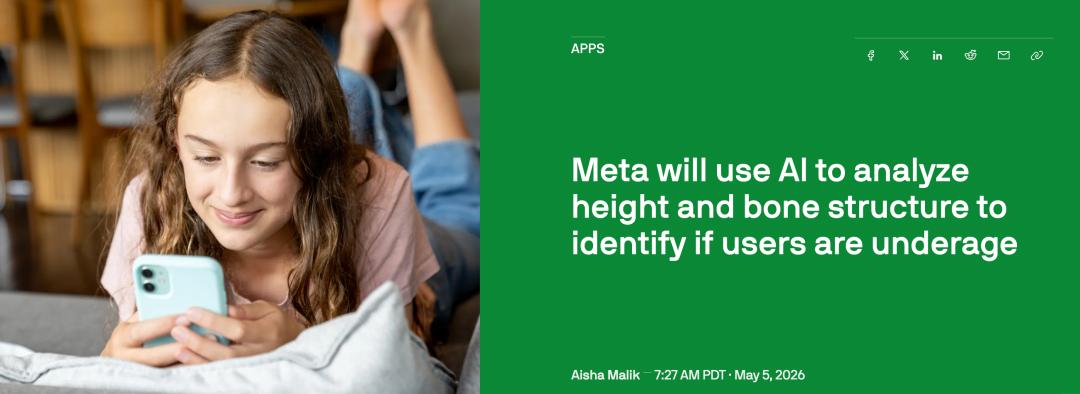
Moreover, Meta not only looks at pictures but also combines the text content and interaction behavior of the entire account for a comprehensive portrait. For example, posting birthday cakes or mentioning school grades will all be included in the judgment.
Once the AI suspects that the user is a minor, it will first disable the account. To recover it, one has to go through the official verification process. Currently, this system has been launched in some countries and will be gradually rolled out to more regions. It also plans to expand to scenarios such as Instagram Live and Facebook groups.
The platforms are using AI to plug the loopholes, while users are trying every means to find them.
This cat-and-mouse game will most likely continue.
Reference links:
https://techcrunch.com/2026/05/05/meta-will-use-ai-to-analyze-height-and-bone-structure-to-identify-if-users-are-underage/
https://www.instagram.com/reels/DUqrCoWDRI0/
This article is from the WeChat official account "MachineHeart" (ID: almosthuman2014). The author is someone who pays attention to AI. It is published by 36Kr with authorization.