Will the maximum single - signing profit exceeding 16,000 ever reappear? A pictorial guide to the new - share subscription returns of innovative drugs in the Hong Kong stock market
“The availability of funds for subscribing to new stocks in the Hong Kong stock market has reached an unprecedented level,” an investor told Arterial Network two weeks ago.
After a four-year hiatus, investors in the secondary market have returned to the grey market trading of Hong Kong stocks. From a data perspective, it is currently the “golden period” for subscribing to new stocks in the Hong Kong stock market. As one of the core modules in the transformation of the Hong Kong stock market towards technology, biotechnology has also shown outstanding performance in the current IPO and new stock subscription boom. The frequent appearance of stocks with over a thousand times of oversubscription and the substantial returns from subscribing to a single lot have made subscribing to new stocks in the Hong Kong stock market extremely popular.
However, a turning point came suddenly. On May 22, eight departments including the China Securities Regulatory Commission jointly issued the “Implementation Plan for the Comprehensive Rectification of Illegal Cross - border Securities, Futures, and Fund Business Operations” (hereinafter referred to as the “Rectification Plan”), setting a two - year concentrated rectification period. During the rectification period, overseas institutions are prohibited from providing services such as buying transactions and transferring funds for existing investors in the Chinese mainland. Only one - way selling transactions and fund transfers out are allowed, meaning that the funds for cross - border stock trading can only flow in and not out. Meanwhile, three major cross - border brokers were issued fines of different amounts.
Under the new policy, domestic funds are temporarily unable to participate in subscribing to new stocks in the Hong Kong stock market. The just - revived innovative drugs in the Hong Kong stock market are once again full of uncertainties. However, at least in the short term, the absence of domestic funds may still not be able to stop the wave of oversubscription for innovative drugs. As the first new stock to be listed on the Hong Kong Stock Exchange after the release of the “Rectification Plan”, Creality 3D was open for subscription from May 20 and ended the offer on May 26, with an oversubscription of more than 2,500 times.
The “Popularly Elected” Golden Track
On the afternoon of May 12, Jitai Technology completed its grey market trading and awaited its official listing on the Hong Kong Stock Exchange the next day. As a stock with nearly 7,000 times of oversubscription, the grey market price of Jitai Technology once soared by 319%. This made Jitai Technology a highly profitable new stock. If a successful applicant sold at the peak of the grey market, the return from subscribing to a single lot would exceed HK$16,000.
In fact, since the second half of 2025, the enthusiasm for subscribing to new stocks across all industries in the Hong Kong stock market has generally increased. 98% of new stocks have been oversubscribed, and 86% of them have an oversubscription multiple of more than 20 times, doubling compared to 2024. “Prioritize the layout of the golden tracks: the AI industry chain, semiconductors, and innovative drugs.” In the Hong Kong stock new stock subscription strategies that have been circulating again, innovative drugs are prominently listed as one of the three golden tracks. Although these strategies for retail investors are somewhat speculative, they have also confirmed the status of innovative drugs as the “popularly elected golden track”. In this process, the popular labels in the Hong Kong stock market such as oversubscription, significant gains on the first day of listing, and highly profitable new stocks have once again complemented each other during the IPO process of innovative drugs.
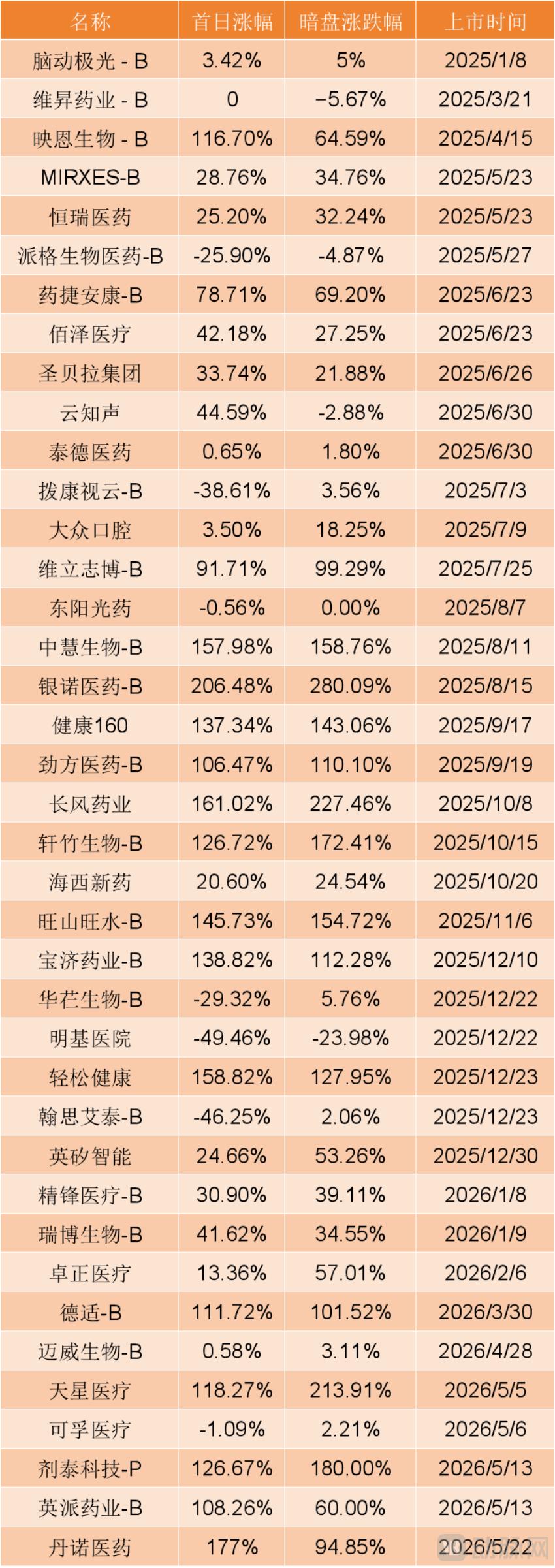
Performance of new medical stocks in the Hong Kong stock market since 2025. Data source: Compiled from public information.
Among them, a representative example is that in April 2025, InnoCare Pharma, a domestic ADC star enterprise, was listed on the Hong Kong Stock Exchange, becoming the largest 18A enterprise in terms of fundraising scale in the Hong Kong stock market since 2022. On the first day of its IPO, InnoCare Pharma's stock price closed up 116.7%, and the return from subscribing to a single lot was as high as HK$11,000. Subsequently, in October, Changfeng Pharmaceutical became another super - profitable new stock in the Hong Kong stock market. This inhalation preparation enterprise with budesonide suspension as its core product showed even stronger momentum. It recorded an oversubscription of about 6,700 times during the offer period, and its stock price closed up 161% on the first day of its IPO, with the highest return from subscribing to a single lot reaching HK$16,125. The frequent appearance of highly profitable new stocks has made subscribers earn a lot and quickly ignited investors' enthusiasm for innovative drugs in the Hong Kong stock market.
According to the statistics of Arterial Network, since 2025, a total of 40 biotechnology new stocks have been listed on the Hong Kong Stock Exchange, and all of them have achieved oversubscription. Among them, 28 companies such as DinoPharm, Zhonghui Biotech, Health 160, Jitai Technology, and InnoCare Pharma have achieved over a thousand times of oversubscription. The top three, DinoPharm, Zhonghui Biotech, Health 160, and Jitai Technology, have oversubscription multiples as high as 9,015 times, 7,823 times, and 6,911 times respectively.
These oversubscribed new stocks have also fulfilled investors' enthusiastic profit expectations. Except for six companies such as BenQ Hospital, Hansi Aitai, and Bokan Shiyun, the stock prices of most biotechnology companies closed with significant gains on the first day of listing, and the break - even rate has dropped to 15%. Among them, the stock prices of 14 companies such as Yinnuo Pharmaceutical, Changfeng Pharmaceutical, and Qingsong Health doubled on the first day of trading, and Yinnuo Pharmaceutical topped the list with a first - day increase of 206.48%. In addition, many newly listed biotechnology companies in the Hong Kong stock market, including Yingpai Pharmaceutical, Zhonghui Biotech, Jingfang Pharmaceutical, and Xuanzhu Biotech, have all created significant returns of HK$4,000 to HK$8,000 from subscribing to a single lot.
Subscribing to new innovative drug stocks in the Hong Kong stock market has once again created a wealth - making myth. Therefore, although the daily market of innovative drugs in the Hong Kong stock market has declined from its peak in 2025, the enthusiasm for subscribing to new stocks has not decreased but increased. In addition to Jitai Technology mentioned above, Yingpai Pharmaceutical, which was also listed on the Hong Kong stock market on the same day, also performed excellently. During the offer period in the Hong Kong stock market, Yingpai Pharmaceutical introduced a luxurious lineup of cornerstone investors such as Tencent, Lilly Asia Ventures, and Vivo Capital. The public offer subscription multiple reached 2,282.4 times, and the return from subscribing to a single lot exceeded HK$3,000. On May 22, DinoPharm once again refreshed the offer record with an oversubscription multiple of more than 9,000 times, and the return from subscribing to a single lot was as high as HK$6,600.
Behind the boom in subscribing to new stocks in the Hong Kong stock market, there is an important mechanism change. In the Hong Kong Stock Exchange, there are two types of offer channels for Hong Kong stocks: international offer and public offer. The former is for professional investors and institutional investors, while the latter is for small and medium - sized investors and retail investors. The so - called oversubscription usually refers to the ratio of the actual subscription amount of investors to the planned fundraising amount in the public offer. In the past, if the oversubscription multiple was high, shares would be re - allocated from the international offer to the public offer. For example, when the oversubscription exceeded 100 times, the public offer ratio needed to be ensured to reach 20%. Re - allocation would reduce the scarcity of new stocks in the public offer and increase the risk of market fluctuations in the later stage. However, the new regulations of the Hong Kong Stock Exchange that came into effect in August 2025 set up an issuance mechanism that does not require re - allocation. Since then, most IPOs have only publicly issued 10% of new stocks.
In other words, with the support of the system, new stocks in the Hong Kong stock market with scarcer and more stable shares are naturally more popular among investors.
Two Types of Innovative Pharmaceutical Companies Are Sought After
Of course, the boom in subscribing to new stocks is not evenly spread across all biotechnology new stocks. Arterial Network's review found that only a few companies are the focus of capital pursuit, and they often have some commonalities.
On the one hand, companies with significant cross - border BD transactions are more likely to achieve over a thousand times of oversubscription. For example, InnoCare Pharma, which was the first to stand out in this round of subscription boom, was a star enterprise in the cross - border BD transaction market before its IPO in Hong Kong. Since 2023, InnoCare Pharma has successively reached pipeline BD transactions with leading pharmaceutical companies such as BioNTech, GSK, and BeiGene, with a cumulative potential total transaction value of about US$6 billion. In addition, Jingfang Pharmaceutical has reached BD transactions with a cumulative potential total transaction value of more than US$1 billion with companies such as Innovent Biologics and SELLAS. Yingpai Pharmaceutical has signed an exclusive licensing and cooperation agreement with Eikon Therapeutics for IMP1734 and other PARP1 selective inhibitors and received a US$5 million milestone payment from the latter in April this year.
For the secondary market, companies with these BD transactions mean relatively controllable investment risks and relatively stable future cash flows. The premise of a BD transaction is that the due - diligence team of the buyer has verified the clinical value and commercialization potential of the molecule over several months, which is more convincing than any third - party rating. In addition to the considerable upfront payment, the direct benefits brought by BD transactions also include more predictable cash flows from future milestone payments. Arterial Network has learned that in the accelerating BD wave, some investment institutions are already planning to issue public funds based on the cash flows from BD milestone payments.
On the other hand, companies with a relatively clear commercialization path are more likely to stand out in the wave of oversubscription. When the Hong Kong Stock Exchange's 18A rule first opened the door to unprofitable biotechnology companies, the secondary market was willing to pay for the stories of innovative drug pipelines with new targets and new platforms. However, now that the hot money has receded, the market has also shifted its focus back to the companies' commercialization capabilities.
The oversubscribed companies often have a clear commercialization path for their core molecules. They have either achieved the commercialization of early products or received milestone payments and sales royalties after licensing their core pipelines through BD. The increase in commercialization certainty directly reduces the risk discount in IPO pricing. For example, DinoPharm has been deeply involved in the antibacterial innovation track. Two of its core new drugs have advanced to the stage of listing applications, and its commercial cooperation layout has been implemented, getting closer to product monetization. Another example is Yingpai Pharmaceutical, which specializes in anti - tumor drugs. Its core product, Senapali, has been launched and included in the medical insurance. In 2025, it achieved drug sales revenue, and with the licensing income, its commercialization model has been established, and its development path is clear.
How Long Is the Window Period?
It is true that this rare boom in subscribing to new stocks in the Hong Kong stock market has given many innovative pharmaceutical companies new hope.
The most direct impact is that domestic innovative drugs have finally received incremental funds. In the first quarter of 2026, the pharmaceutical sector in the Hong Kong stock market continued its previous momentum. The average increase in the grey market of new stocks was 45.37%, and the average increase on the first day of listing was 33.29%. A total of about HK$4.3 billion was raised through IPOs of 18A biotechnology companies, and the number of listings doubled year - on - year. At the same time, existing listed innovative drug companies have also intensively launched refinancing. For example, Pharmaron completed a placement of H - shares to raise more than HK$1.3 billion, which was mainly used for capacity expansion and R & D platform upgrading. CStone Pharmaceuticals completed a rights issue to raise more than HK$1 billion and continued to increase investment in the clinical advancement of ADC and multi - specific innovative pipelines.
In this context, innovative pharmaceutical companies are paying more attention to the secondary market as an exit channel, especially the cross - market layout of relatively mature pharmaceutical companies has become a trend. For example, Hengrui Medicine on the A - share market was listed on the Hong Kong Stock Exchange in just 120 days, raising HK$9.89 billion and setting a record for the largest IPO in the Hong Kong stock market's pharmaceutical sector in the past five years. In addition, Insilico Medicine submitted its IPO application for the third time on May 8, 2025, after two previous failures, and was finally listed on December 30, with a market value of up to HK$19.5 billion. Since May 2026, more than 30 companies have submitted IPO applications to the Hong Kong Stock Exchange, and the subscription multiples of many popular targets have exceeded a thousand times. The IPO of innovative drugs in the Hong Kong stock market is experiencing a “collective dash to the finish line”.
It is worth noting that although the “Rectification Plan” has basically closed the legal channels for mainland investors to directly participate in subscribing to new stocks in the Hong Kong and US stock markets, it does not mean that mainland funds will not flow into the cross - border capital market at all. For example, the Stock Connect does not support new stock subscription operations but allows trading of stocks included in the Connect. Another example is that QDII funds, as an indirect investment channel, allow the allocation of overseas fund shares. The Cross - Boundary Wealth Management Connect 2.0 also provides residents in the nine cities of the Guangdong - Hong Kong - Macao Greater Bay Area with an annual quota of 3 million yuan each for investing in qualified financial products of financial institutions in Hong Kong and Macao. In addition, the CSRC will also guide funds to flow out through standardized paths such as mutual recognition funds and cross - border return swaps.
However, from the perspective of innovative pharmaceutical companies themselves, only a few can benefit from this round of new stock subscription boom in the Hong Kong stock market. First of all, the huge R & D capital pressure still widely exists. As mentioned above, the beneficiaries are high - quality targets with BD transactions or clinical data support. At present, there are still a large number of innovative pharmaceutical companies in the early clinical stage, without BD income and commercialized products. Their financing channels are still narrow, and many innovative drug pipelines have been forced to slow down or be interrupted. In the primary market, the investors who left earlier have not returned, and the remaining investors are more cautious in assessing the risks of innovative drugs. Most traditional innovative pharmaceutical companies have not directly benefited from this new stock subscription boom.
Secondly, the enthusiasm for subscribing to new stocks is decoupled from the medium - and long - term performance of stock prices. Although the Hang Seng Biotechnology Index has shown significant increases since 2025, it is mainly the result of the rebound of leading companies rather than the overall recovery of the sector. In other words, the valuation repair in the secondary market is more differentiated. High - quality targets with BD are sought after, while many 18A companies still break their issue prices or face liquidity shortages. This structural characteristic means that the new stock subscription boom is essentially a process of concentrating existing funds on high - quality targets, and its driving effect on the entire innovative drug industry is far less significant than the numbers suggest.
Finally, even before the release of the “Rectification Plan”, signs of a turning point were gradually emerging. On the one hand, the break - even rate has rebounded. Since 2025, the average break - even rate of innovative drugs since their listing has been close to 50%. On the other hand, the impact of the lock - up expiration wave. In 2026, a large number of cornerstone and early investors' shares with a six - month lock - up period will enter the expiration period one after another. The sudden increase in the floating shares may break the price support brought by the concentrated chips.
For most innovative pharmaceutical companies, the significance of this new stock subscription boom is more like a mirror: it reflects the reality of industry differentiation and the survival proposition that must be faced before the next window of opportunity arrives.