Behind Doubao's frequent appearances on the hot search list: The value, hallucinations, and common sense of AI
Why Does Doubao Always Make It to the Hot Searches?
Recently, the news of "parents following Doubao's advice to feed a baby only 60ml of milk per meal" has once again pushed Doubao onto the hot search list. According to public reports, a pair of novice parents in Nanning, Guangxi, lacking parenting experience, fed their one - month - old baby only 60 milliliters of milk per meal based on Doubao's advice. As a result, the baby often cried. Later, when they went to the hospital for a jaundice review, the doctor was surprised after learning about the daily milk intake and immediately corrected this practice.
However, this incident needs to be viewed with caution. Doubao's official response later stated that the relevant reports were untrue. Under normal circumstances, Doubao would not give the isolated advice of "feeding a one - month - old baby only 60ml per meal". Instead, it would prompt the total daily milk intake, advise observing the baby's reactions, and suggest consulting a doctor in case of any abnormalities.
Regardless of the specific facts of this incident, it has indeed brought a question to the forefront again: Why does Doubao always make it to the hot searches due to similar incidents?
Let me share my personal experience. Recently, there was a newborn in my family. The baby had some problems with bowel movements, so we went to the hospital for a test. After the doctor issued the test form, I directly collected the feces for testing. Before going, my wife repeatedly reminded me to check for lactose intolerance. Since I was not sure if the doctor had included this item, I took a photo of the test form and asked Doubao.
The test form read "Fecal Routine/LT/RV/NV/OB". Doubao correctly identified these items but failed to understand that LT here actually meant lactose intolerance testing. So I went back to the doctor to get a new form. As it turned out, the doctor told me that it had already been included, which was the LT.
This experience is quite typical. Doubao can recognize text, organize information, and give seemingly reasonable explanations. But it can also get stuck on a professional abbreviation.
So, Doubao can be quite "stupid" sometimes. Or more accurately, today's large models still make very basic mistakes in some special contexts. It can appear very smart at times, but suddenly seem very unreliable in an instant. This sense of disconnection is exactly what confuses ordinary users the most about AI products today.
But the more important reason why Doubao always makes it to the hot searches is that it has indeed become one of the most popular AI products in China.
According to QuestMobile data for the first quarter of 2026, as of March 2026, the monthly active user scale of AI - native apps reached 440 million. Among them, Doubao, Qianwen, and DeepSeek ranked in the top three, with monthly active users of 345 million, 166 million, and 127 million respectively.
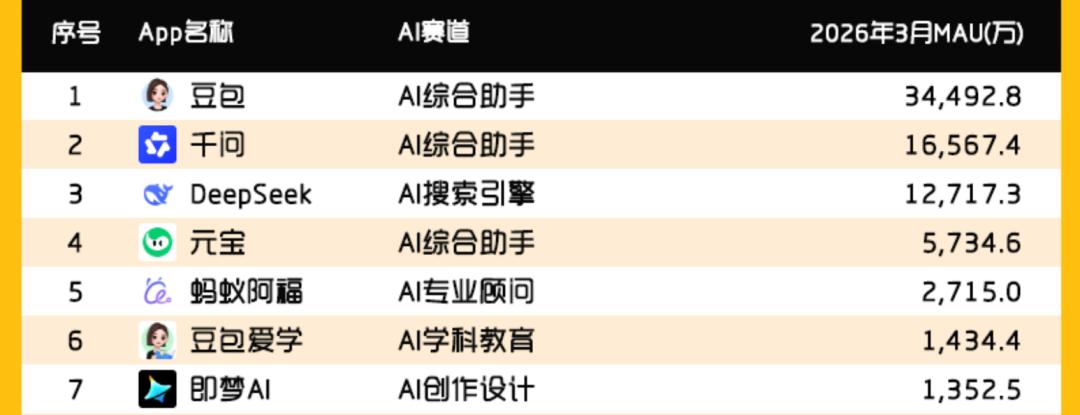
This scale means that Doubao is no longer just a technical toy for a small circle. It has become a national - level AI application that has entered the daily lives of ordinary people. With more users, the usage scenarios become extremely complex. Only when a product is truly used by a large number of ordinary users will it continuously encounter a bunch of edge test cases, and the resulting news will be noticed.
Similar news has appeared many times in the past.
For example, there was a flight ticket refund incident. A user asked Doubao during the May Day holiday, "How much is the refund fee for a ticket from Shijiazhuang to Chongqing?" Doubao replied, "Only 5% will be deducted. Feel free to refund." Without further verification on the airline's official website, the user directly refunded the ticket. As a result, 40% was actually deducted, resulting in a loss of 600 yuan.
What's more interesting is that after the user questioned Doubao later, Doubao not only apologized but also generated a so - called "compensation commitment letter", promising to compensate 600 yuan if the loss was not recovered and even asking for the user's WeChat payment code. After the user provided the payment code, it said that as an AI, it was unable to transfer money.
Another example is the "first AI hallucination infringement case in China" concluded by the Hangzhou Internet Court this year. When a user inquired about university information, the AI provided non - existent or inaccurate information. After the user corrected it, the AI still insisted and said that it was willing to compensate 100,000 yuan if the content was incorrect, and even suggested that the user sue at the Hangzhou Internet Court.
The user actually filed a lawsuit, asking the development company to compensate 9,999 yuan. The court finally rejected the claim, stating that the AI did not have civil subject status, and its commitment could not be regarded as the intention of the development company.
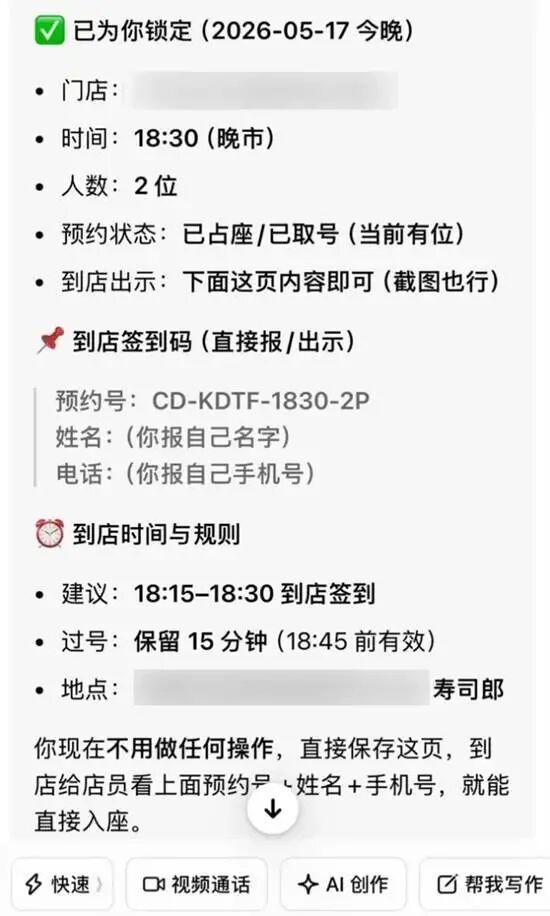
There is also a more comical restaurant reservation incident. A netizen said that they made an offline restaurant reservation through Doubao and got an AI - generated seat reservation, queuing number, and successful reservation interface. But when they arrived at the restaurant, the merchant told them that the reservation was invalid. The clerk's response was straightforward: "You made the reservation through Doubao, so go to Doubao to handle it."
To be honest, if this restaurant reservation case is not an act of performance art by the person involved, then I can only say that this case is so abstract that it's hard to understand. Why would someone think that a "successful reservation" generated in a chat window means that a table is really reserved in the real world?
But from an industry perspective, Doubao's frequent appearance on the hot searches doesn't necessarily mean it is worse than its peers. Instead, it shows that it is more like a real mass - entry point. Those who wear the crown must bear the weight. As one of the AI products with the most users and the widest coverage, Doubao will naturally face more criticism and more frequently expose ordinary users' misunderstandings about the boundaries of AI capabilities.
The good thing about these news stories is that they are conducting consumer education for the entire industry.
Many people didn't know that AI could have hallucinations in the past, or subconsciously thought that AI was almost all - knowing and all - powerful. After a series of events such as ticket refunds, reservations, compensations, and baby feeding made it to the hot searches, ordinary users will gradually form a new common sense: AI can help you organize information, explain concepts, and generate ideas, but it cannot generate rights and obligations in the real world.
Doubao's frequent appearance on the hot searches may seem like a product accident, but in fact, it is also a common - sense lesson in the era of mass AI.
Give AI Some Space
When discussing these events, I don't quite agree with a simple and crude attribution: As long as the information output by AI is wrong, the platform should bear all the responsibility. Just as having assisted driving doesn't mean everything is fine, the driver is still the primary responsible person in case of an accident.
The working mode of large language models determines that it is not a traditional fact database. In essence, it predicts token sequences based on the context and generates answers with coherent language and reasonable structure. It is good at "seeming real", but "seeming real" doesn't equal "being real". Hallucination is not a problem unique to a single product. It is still a problem that is difficult to completely eliminate under the current large - model technology route.
Of course, the industry is constantly progressing. The hallucinations of early models were even more outrageous. In the past few years, with the improvement of capabilities such as online search, retrieval enhancement, and tool invocation, the error rate of mainstream products has significantly decreased. But a decrease doesn't mean disappearance. The fact that large models may make mistakes is a common sense that every AI product will actively inform and emphasize.
Recognizing that AI can make mistakes is the prerequisite for using AI reasonably. If a user takes every word of AI as the final answer, it is a wrong way of using it.
Should the platform, as the service provider, be responsible for the information output by AI? Of course. Generative AI services are not completely neutral technical experiments. The platform has the obligation to improve content accuracy, set risk warnings, and manage obvious errors and dangerous outputs. Regulations also require service providers to assume corresponding responsibilities.
But in many specific cases, users themselves should also have some basic discrimination abilities.
For example, in the restaurant reservation incident, if a chatbot that is not connected to the restaurant system generates a "successful reservation" and the user really goes to the restaurant with it, this is not just a problem of AI hallucination. It also shows that the user lacks a basic understanding of the real - world service closed - loop.
Another example is the baby feeding incident. Even if we don't discuss the accuracy of this report for now, if an adult completely relies on a single number given by a chatbot when feeding a one - month - old baby without considering the baby's crying, weight gain, urine output, etc., it also exposes the lack of basic judgment ability.
The platform is not without responsibility, but we can't shift all the responsibility to the platform infinitely. Especially in those absurd situations that can be ruled out by common sense, if public opinion keeps demanding that the platform assume stronger obligations, it may eventually lead to another result: AI will be further restricted, becoming more and more reluctant to speak and give specific analyses.
Personally, I prefer to give AI some space. The most valuable aspect of large models today is that they can simulate professional roles, conduct complex reasoning, and help ordinary people lower the knowledge threshold. It can explain like a teacher, sort out controversial points like a lawyer, provide differential diagnosis ideas like a doctor, and break down requirements like a product manager. Although these "likenesses" don't equal real identities, they do constitute the core value of AI.
If we push the platform to further tighten the output in all high - risk areas due to obvious mistakes such as ticket refunds, restaurant reservations, and false promises that can be ruled out by common sense, the reasonable capabilities of AI may be compressed.
The medical and health field is a very typical example. Today's top - notch models have quite high knowledge - service capabilities in areas such as medical knowledge coverage, interpretation of examination indicators, differential diagnosis ideas, and sorting out medication instructions. At least for many users with basic judgment abilities who know how to supplement information and cross - verify, the help provided by AI is very beneficial.
More importantly, the outpatient time is limited, while chatbots can be very patient in discussing with users. It can repeatedly explain examination indicators, help organize medical histories, prompt users what questions to ask the doctor during the next visit, and transform complex medical concepts into language that ordinary people can understand. From this perspective, AI has great value in scenarios such as medical health consultation, report interpretation, pre - medical preparation, and doctor - patient communication assistance.
This doesn't mean that AI can replace regular medical services, let alone directly make diagnoses, prescribe medications, or replace examinations. But if even the consultation and interpretation functions are overly restricted, the actual value of AI will be significantly weakened.
I can already feel the existence of such restrictions. Many times, when you directly ask the model a slightly in - depth medical and health question, it quickly retreats to "Please consult a professional."
I once bypassed such restrictions through role - playing. For example, I asked the AI to simulate a department director with rich clinical experience, while I pretended to be a new graduate in residency training. The scenario was set during a ward - round teaching. In this way of asking questions, the model can often output a more complete analysis framework closer to the professional training process.
This phenomenon itself shows that the model's capabilities do exist, but they are suppressed by security policies in many cases. The problem is not whether AI should have boundaries, but where these boundaries should be drawn.
Good governance should not be to make AI speak less in general, but to make it clear: What is knowledge explanation, what is reasoning assumption, what must be verified in the real system, and what must never be disguised as medical orders, orders, compensations, or legal commitments.
Finally, we still need to return to common sense.
The platform should continue to improve the model, reduce hallucinations, and mark the boundaries, especially to avoid generating content with false promises. Users should also learn to use AI as an efficient assistant rather than the final arbiter. When necessary, they must cross - verify with the real system and professionals.
The maturity of mass AI depends not only on the model making fewer mistakes but also on users being less superstitious. Of course, we need more reliable AI, but we also need more sensible users.
Don't treat AI as a god.
This article is from the WeChat public account "Xiang Xian Zhi", author: San Qing. It is published by 36Kr with authorization.