36Kr Exclusive | A Robot Solution Provider Serving Foxconn with Over 20 Million in Half-Year Revenue Completes Angel Round Financing
Author | Qiao Yujie
Editor | Yuan Silai
Yingke learned that Chengwu Robotics (Shenzhen) Co., Ltd. (hereinafter referred to as "Chengwu Robotics") recently completed its angel round of financing. It was strategically invested by Hecheng Technology, a leading enterprise in the field of industrial automation and intelligent robot solutions in Taiwan, China. Huajun Capital served as the exclusive financial advisor.
Chengwu Robotics was founded in 2025 and is headquartered in Shenzhen. It focuses on the R & D of industrial embodied intelligence technology and product solutions, and has the integrated technical capabilities from software and hardware R & D, data collection, model training, to scenario deployment and maintenance.
The founder, Huang Jinlong, has a technical background and more than a decade of experience in full - stack R & D and industrialization of robots. He has led the R & D and implementation of various industrial robot products. Dr. Shan Yuhu, the co - founder, has successively been responsible for the R & D of core robot technologies in companies such as Tencent, XPeng, and Meituan. He has been deeply involved in fields such as multi - modal large models, 3D perception, and multi - sensor fusion, and has rich mass - production practical experience.
In industrial scenarios, non - standard scenarios are common, and the implementation of robots often requires customized solutions. Chengwu Robotics entered the market from this point. Since its establishment, it has focused on industrial scenarios. By integrating mature supply - chain solutions in the main body, self - developing end - execution structures, electronic hardware, software algorithms, cloud capabilities, and core large models, it has quickly precipitated a standardized technical product package and has the delivery ability to cover the entire process of industrial scenarios.
Currently, the company has completed more than a dozen industrial scenario implementation projects. In 2025, its cumulative revenue exceeded 20 million yuan, and it served a series of representative leading manufacturing enterprises including Foxconn.
During this period, the team established in - depth cooperative relationships with dozens of leading mainstream robot body manufacturers and obtained the highest - level authorization from 8 leading brands to provide customized services for their specific scenario implementations.
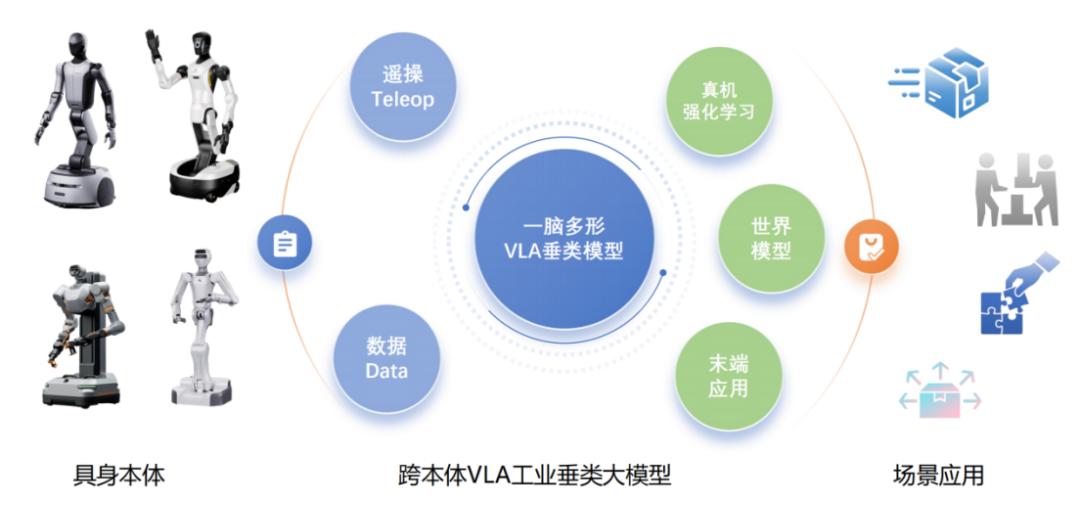
At the same time, Chengwu Robotics is also deploying in the model field. The company is taking the industrial vertical VLA (Vision - Language - Action) large model as the core R & D direction, hoping to create an embodied intelligence model with the cross - body generalization ability of "one brain with multiple forms".
(Image source/Enterprise)
This model integrates the capabilities of spatial perception, reinforcement learning, and world models, which can improve the three - dimensional perception, precise operation, and cross - scenario generalization ability of complex and irregular objects, and solve the problem of insufficient generalization of traditional solutions.
One of the core bottlenecks of the embodied model lies in data. Chengwu Robotics has self - developed the Egocentric - UMI data collection device and the Bybot - TeleOp remote operation system. By remotely operating and simulating the real production - line environment, it can efficiently collect multi - modal data such as vision and torque, greatly reducing the model training and deployment cycle, and solving the problems of high cost and low efficiency of traditional data collection.
Currently, the training and deployment process of the company's self - developed VLA model Bybot Foundation Model - 1 (BFM - 1) has been fully run through, and the technical verification is progressing smoothly.
At the hardware level, Chengwu Robotics is simultaneously developing a prototype product of an upper - body robot for precise industrial operations. It is equipped with core components such as bionic force - controlled dual robotic arms, dexterous hands, wrist cameras, and RGBD cameras, providing hardware support for the training of industrial vertical basic models and scenario adaptation, and promoting the in - depth integration of large models and industrial robot bodies.
The following is an excerpt from the interview (slightly edited):
Yingke: Why did you shift from scenario implementation to model R & D?
Huang Jinlong: We are very optimistic about the development direction of VLA and embodied intelligence. In our view, the robot body itself is not the most difficult part, especially in the hardware industrial - chain environment like Shenzhen. Making a robot is not a particularly high threshold. The real difficulty is how to integrate the model with the body and finally implement it in real customer scenarios, so that customers are willing to pay continuously.
Currently, there are not many cases of large - scale implementation in the industry. We believe that the development path of embodied intelligence will follow a gradual evolution process of "industry - commerce - service - household". Among them, industrial scenarios are the easiest to be implemented first because many industrial tasks do not require particularly complex dexterous operations, and many scenarios can be completed with two - finger grippers. In contrast, household scenarios have higher requirements for safety, generalization, and stability.
In addition, besides strategic investment, Hecheng has also brought us a large number of industrial customer resources. We have currently entered the customer systems of companies such as Foxconn, and some projects have entered the actual delivery stage. Since we can directly contact front - line customers, we can better understand what customers really need: if traditional automation technology can solve the problem, we will give priority to traditional solutions; if the embodied model can create higher value, we will use embodied technology for delivery.
Yingke: What are the core advantages of Chengwu Robotics in making embodied models?
Huang Jinlong: First is the full - stack ability and real - world delivery experience. The team has complete R & D capabilities from machinery, electronics to software, algorithms, and cloud services. In the past, it has also long provided customized solutions for leading robot manufacturers, so it has a very in - depth understanding of non - standard requirements, delivery processes, and customer pain points in industrial scenarios. Compared with teams that only focus on models, we know better how to transform models into commercially viable solutions.
Secondly, we hope to build a "platform - based" embodied model ability. Currently, VLA models generally have the problem of insufficient generalization ability: the data and models trained in one scenario often cannot be migrated to another robot or another environment. The model design of Chengwu Robotics is not bound to a single body but can be adapted to different manufacturers and different types of robot platforms, thus solving the problem of difficult cross - platform deployment of models in the industry.