Frontline | The 12th "Cape of Good Hope Science Salon" of Zhongke Chuangxing focuses on "space intelligent driving", and satellites will shift from passive response to autonomous decision-making
"The era of space intelligent driving is coming. Satellites and constellations will, just like L4-level autonomous driving cars, have the capabilities of autonomous environmental perception, mission planning, and maneuver decision-making in space."
On May 28th, at the "Cape of Good Hope Science Salon" held in Shanghai, Shao Xiaopeng, the deputy director of the Xi'an Institute of Optics and Precision Mechanics of the Chinese Academy of Sciences (hereinafter referred to as "Xi'an Institute of Optics and Precision Mechanics"), put forward this judgment in his speech.
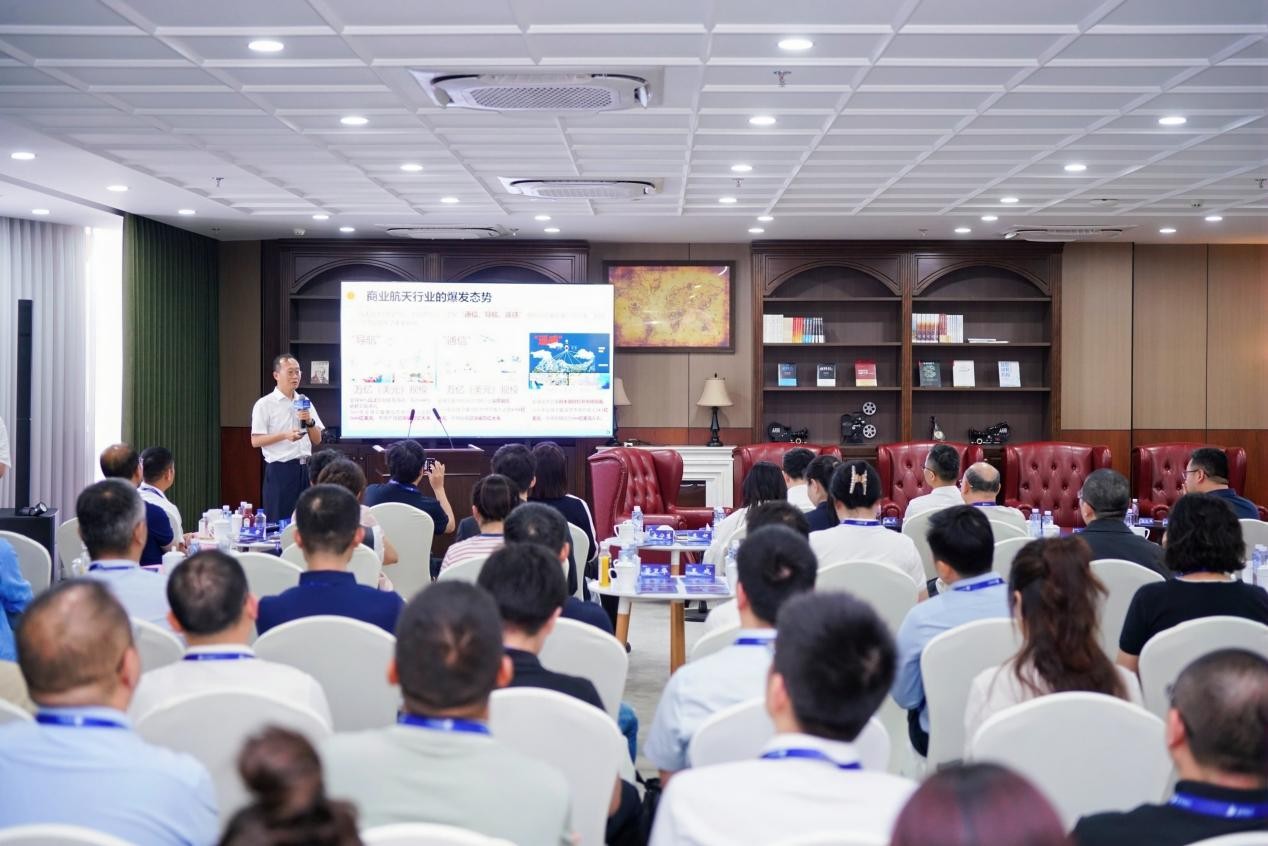
Shao Xiaopeng, the deputy director of Xi'an Institute of Optics and Precision Mechanics, giving a speech at the salon
The "Cape of Good Hope Science Salon" is a platform for scientific and technological innovation integration and cross - border communication initiated by Zhongke Chuangxing and co - hosted by Zhongke Chuangxing, Dongbi Technology Data, Shanghai R & D Public Service Platform Management Center, and Curvature Engine. This session of the salon was themed "Interstellar Intelligent Control - The Industrial Resonance of Space Intelligent Driving and Remote Sensing Technology", bringing together experts in the aerospace field and nearly a hundred representatives from science and technology innovation enterprises, investment institutions, and local governments to jointly discuss the technical paths and implementation models for the upgrade of satellites and constellations from passive response to autonomous decision - making.
In the past few years, the global commercial aerospace has entered an accelerated stage. The number of satellites in orbit has been continuously rising, and the risks such as space debris and orbital collisions have also increased. The traditional on - orbit management mode of satellites that relies on ground stations for one - by - one control has become unsustainable. The concept of "space intelligent driving", which emphasizes the satellite's capabilities of autonomous perception, autonomous response, and autonomous decision - making, has emerged.
In his speech titled "Computational Imaging: Remodeling 'Space Intelligent Driving'", Shao Xiaopeng said that the new paradigm of "AI + Optics" will promote the transformation of aerospace optical payloads from traditional "precision machinery" to "intelligent information terminals" and further enhance the autonomy of satellite systems.
The core theoretical support for this idea is the "computational imaging" technology.
Shao Xiaopeng gave an example: "There's no need to grind the lens to absolute perfection. Just grind it to 'almost perfect', and use algorithms to make up for the remaining errors." In engineering terms, it means simplifying the hardware in the physical domain (relaxing the accuracy requirements and reducing the number of lenses) and using AI for compensation in the information domain (aberration restoration and intelligent recognition).
On September 5th, 2025, the computational imaging remote sensing camera (all - metal camera in the visible light band) jointly developed by Xi'an Institute of Optics and Precision Mechanics and other units was carried on the Kaiyun - 1 (Tianyan 28) satellite and launched into space by the Ceres - 1 Y15 carrier rocket. This marked the first verification of the collaborative innovation technology model of computational imaging optical system theory and computational domain compensation in the real space environment.
Compared with traditional remote sensing cameras, this system has a simpler structure, a significantly reduced weight, a greatly relaxed surface shape accuracy, and the manufacturing cost has been reduced to 1/5 to 1/10 of the original. According to the preliminary on - orbit data, under the condition of low signal - to - noise ratio, the details of the computationally restored images are basically the same as those of the traditional remote sensing imaging mode, verifying the feasibility of the technical path.
For satellite autonomy, it is not only necessary to "see clearly" but also to "understand what is seen".
It is reported that in response to the problem of limited on - board computing power, the team of Xi'an Institute of Optics and Precision Mechanics has carried out processing such as "pruning", "quantization", and "knowledge distillation" on the ground large - scale models to form lightweight models suitable for the on - board environment, so as to lower the deployment threshold and improve the on - board autonomous processing ability.
Xi'an Zhongke Tianta Technology Co., Ltd. (hereinafter referred to as "Zhongke Tianta") is the industrialization platform of Xi'an Institute of Optics and Precision Mechanics in the field of commercial aerospace. Zeng Weigang, the general manager of Zhongke Tianta, said at the salon that the company is jointly deploying relevant capabilities for "space intelligent driving" with Xi'an Institute of Optics and Precision Mechanics and industrial chain partners.
According to its plan, in the future, the ground end will provide services such as measurement, operation and control, health management, simulation training, and automated remote control around satellite on - orbit management; the on - board end will focus on the new - generation on - board laser communication terminal to improve the data transmission and collaboration capabilities between satellites.