Is it turning a fake show into a real one or outsmarting oneself? Pinduoduo's expectation management has "gone out of control".
Before the U.S. stock market opened on May 27, 2026, Pinduoduo released its financial report for the first quarter of 2026.
On the same day, the stock price tumbled by more than 8% in pre - market trading and closed down about 10.38% for the whole day. What triggered this round of selling was a set of figures that caught the market off guard: The Non - GAAP net profit was 14.1 billion yuan, only 57% of the market's consensus expectation of 24.6 billion yuan; the GAAP net profit was 12.5 billion yuan, a year - on - year decrease of 15%. Although the revenue of 106.2 billion yuan increased by 11% year - on - year, it was about 3 percentage points lower than expected.
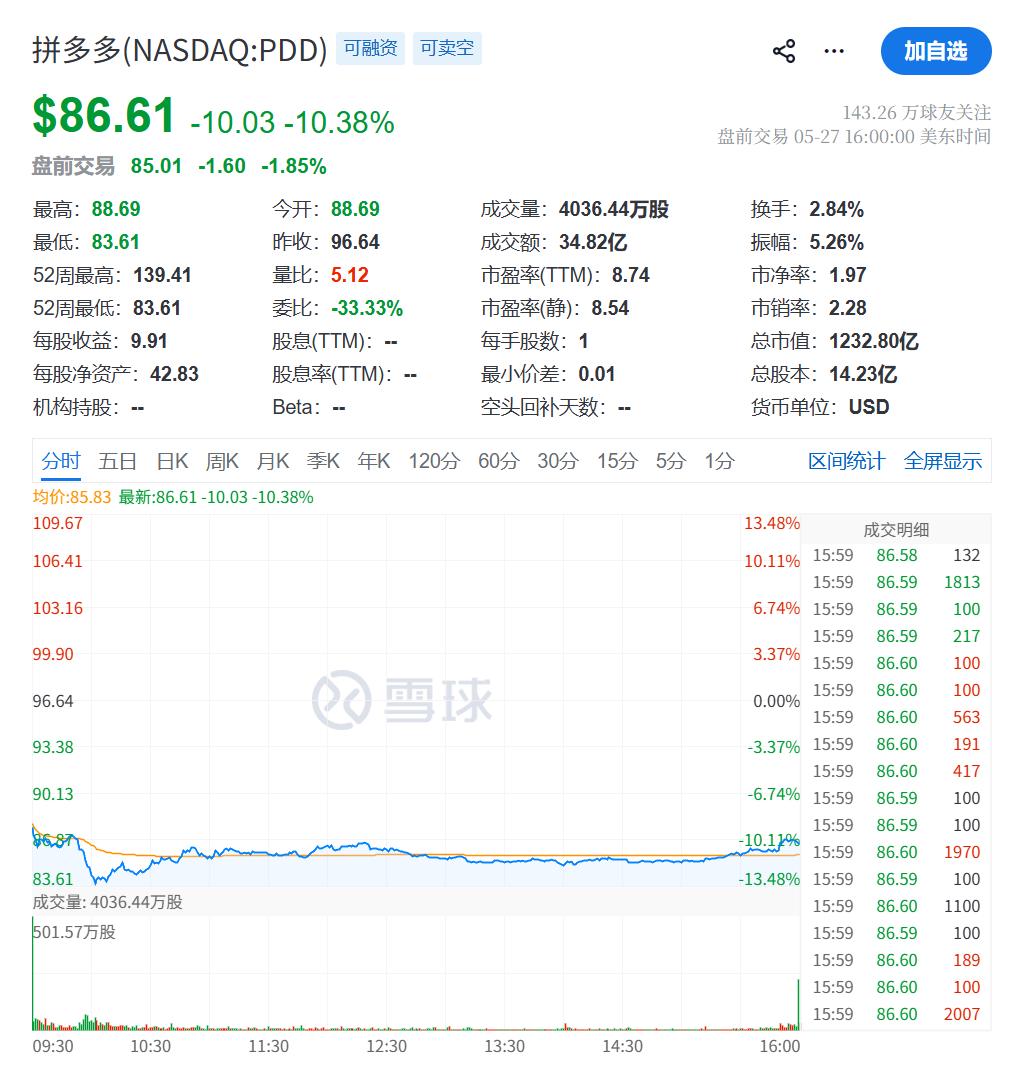
However, in the same financial report, another figure was almost completely drowned out by the above noise - the operating profit was 19.6 billion yuan, a year - on - year increase of 22%. Two arrows pointing in opposite directions appeared on the same report, leading to completely different results.
This gap is the key to understanding this financial report. In the past eight quarters, Pinduoduo's management has reiterated the same judgment in every earnings call: The downward trend of profit margin is inevitable, and the long - term value of the platform ecosystem takes precedence over short - term financial performance.
This article attempts to sort out three clues based on this financial report: Why did the growth rate of advertising revenue narrow to about 2.5% against the backdrop of the overall improvement of the industry? What does the widening gap between operating profit and net profit mean? And what kind of project is the officially launched "New Pinmu" in Shanghai actually undertaking?
Torn Profits and Restrained AI
Two years ago, 44 - year - old Huang Zheng topped the list of China's richest people with a net worth of $48.6 billion, becoming the first tech founder to reach this position in three years. Huang Zheng himself probably learned about becoming the richest person on social media. This science and engineering founder who graduated from Zhejiang University is so low - key that he hardly appears in the media spotlight. Becoming the richest person doesn't seem to be on his agenda.
More than half a month later, in the earnings call for the second quarter of that year, the statement "the general direction of gradually declining profits is inevitable" caused Pinduoduo's stock price to drop by 28% on the same day, and its market value evaporated by $55 billion overnight. Huang Zheng's position as the richest person only lasted for 18 days, and his net worth shrank by $14.1 billion in one day, dropping to the fourth place.
Since then, Pinduoduo has started a longer transformation period of actively sacrificing profits for the ecosystem. As of Q1 this year, it is the most thorough implementation of this cycle so far.
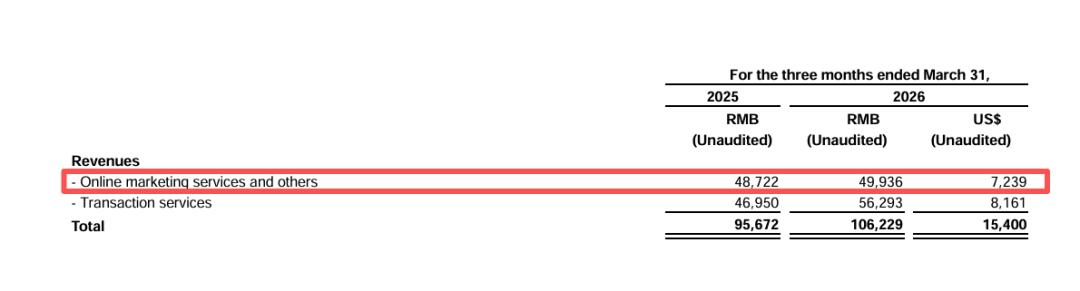
In this quarter, Pinduoduo's online marketing revenue was 49.9 billion yuan, with a year - on - year growth rate of about 2.5%, far lower than market expectations. With the platform's GMV still growing, the collapse of the advertising growth rate exceeded the boundaries of general logic.
The cause of the gap lies in two forces acting in the same direction. One is a regulatory variable: The implementation of the policy requiring e - commerce platforms to uniformly declare and pay taxes has passively increased the actual costs of small and medium - sized merchants who used to rely on information asymmetry for tax reporting, directly squeezing their advertising budgets. This pressure is most directly reflected on platforms with a large number of small and medium - sized merchants, and Pinduoduo is the first to bear the brunt due to its merchant structure.
The second factor acting in the same direction is that Pinduoduo's "100 - billion support" policy continues with high - intensity investment, and the platform has actively lowered the monetization rate for merchants. This profit - sharing is reflected in the short - term report as a decline in the growth rate of advertising revenue.
Meanwhile, there is a more difficult - to - quantify but real disturbance. Since the regulatory conflict at the end of 2025, the uncertainty of the pending investigation results has permeated the entire Q1. For small and medium - sized merchants operating on the Pinduoduo platform, this wait - and - see attitude has to some extent reduced their willingness to invest in advertising in Q1.
Goldman Sachs analysts directly asked the management about the reasons for the slowdown in advertising growth and GMV during the earnings call. The management's response was hundreds of words long, but they kept talking about supply - chain construction, rural free shipping and other projects, not mentioning the reasons for the slowdown at all and providing no forward - looking guidance.
If we shift our focus from advertising, there is another more notable gap in the report: the operating profit increased by 22%, while the net profit decreased by 15%. The main reason for the widening gap comes from the "other gains and losses" item. In Q1, about 2 billion yuan of other losses were recognized, while in the same period last year, there were about 3 billion yuan of other profits. The change from positive to negative directly lowered the absolute level of net profit.
However, Pinduoduo did not disclose the detailed composition of the losses. The general judgment of institutions such as Goldman Sachs is that it is due to the change in the fair value of financial assets. Pinduoduo holds a large amount of available - for - sale bonds and equity investments, and fluctuations in interest rates and the market may have led to paper losses this quarter. Evidence can also be found in the cash - flow statement: The net cash inflow from investing activities this quarter was 2.08 billion yuan (a net outflow of 6.38 billion yuan in the same period last year), which means that some assets matured or were sold, and the resetting of the asset portfolio may have triggered the recognition of paper losses.
There was once speculation in the outside world that "Pinduoduo lost money in stock trading", but there is no definite evidence pointing to equity investments. Any change in parameters such as the duration, interest - rate curve, and credit spread of available - for - sale bonds could lead to changes of the same magnitude on the books.
Interestingly, as of the end of the first quarter of this year, Pinduoduo's cash and short - term investments on the books totaled 436.1 billion yuan, an increase from 422.3 billion yuan at the beginning of the year. This is a cash reserve that ranks among the top in domestic Internet companies, mainly allocated to time deposits and debt securities. In the past few quarters, the interest income from this money was a positive contributor to the company's non - GAAP profit. Huachuang Securities also specifically pointed out in the third - quarter report of 2025 that the year - on - year increase of about 3 billion yuan in interest income was one of the important sources of the improvement in net profit in that period.
The changes in the market interest - rate environment and exchange rate have turned the cash management, which had been a positive contributor to profits for several consecutive quarters, into a negative drag this quarter. In the quarter with the most cash on the books, it contributed the largest non - operating loss - The plot from the summer two years ago was repeated in a different part of the report. The financial report did not further disclose the specific composition of the relevant losses, and the management did not take the initiative to explain it during the earnings call.
For a company with 436.1 billion yuan in cash on the books, handling idle funds in the tens of billions is never just a math problem. Sometimes, it's not just up to the money itself whether it stays on the books.
In addition, another trend was further confirmed in Q1: The transaction service revenue was 56.3 billion yuan, a year - on - year increase of 20%, exceeding the advertising revenue for two consecutive quarters and slightly higher than the Bloomberg consensus expectation of 18%.
Advertising is essentially a traffic tax. Pinduoduo sells exposure and rankings to merchants, making money from information asymmetry; commissions are a transaction tax, collecting a share when a transaction is completed. In theory, this shift in position creates a deeper moat. But it also means that the platform and merchants are more closely bound by interests. Once the transaction volume fluctuates, the impact on revenue will be more direct.
In addition, the R & D expenses were 4.4 billion yuan, a year - on - year increase of 22%. Against the backdrop of a revenue growth rate of only 11%, the relative intensity of R & D investment is actually increasing. This mismatch usually means that the company is preparing for something that has not yet appeared in the report.
Speaking of which, Pinduoduo's AI layout is extremely restrained. There are no large - model press conferences, and the term "AI strategy" rarely appears in the official statements. However, if we bypass the press conferences and directly look at the products, we will find another picture: In the second half of 2025, Pinduoduo successively launched functions such as AI virtual try - on, AI interactive dramas, and conversion of static product images to live - action videos in its APP, covering multiple scenarios such as product recommendation, content, and product display.
Reports show that Pinduoduo poached employees from Baidu's Fengchao team with high salaries and established a large - model team of dozens of people in Shanghai, clearly targeting e - commerce vertical scenarios such as customer - service dialogue, search recommendation, and advertising placement. By Q1, it was reported that the platform had started a gray - scale test of the AI search function.
Pinduoduo's technical approach is in line with Huang Zheng's early thinking about the limitations of AI. He proposed the concept of "distributed AI": dispersing intelligent agents into each specific scenario to make local optimal decisions, rather than building a centralized super - brain.
The result of this approach is that Pinduoduo concentrates its limited R & D resources on areas closest to transactions. This is practical in the short term, but the cost is also real - its dozens - person large - model team is not on the same level as the thousands - person investment of industry leaders. Once the focus of AI competition shifts from scenario applications to underlying model capabilities, this structural gap may be further magnified.
There is a cost to being practical, and this is currently an unresolved variable.
The Officially Launched New Pinmu is Heavier Than Expected
New Pinmu Special Company was launched in Shanghai in early February this year, and the brand self - operated business has entered the substantive promotion stage.
Its business scope covers Internet sales, goods import and export, supply - chain management services, procurement agency, and international freight forwarding. From the registration information, New Pinmu is designed as a full - link operating entity facing both domestic supply and overseas markets, rather than just a brand incubation fund. Zhao Jiazhen's positioning of it is "to mobilize the entire group's strength and focus on one goal". In Pinduoduo's management discourse system, this kind of wording usually means the highest priority.
If we compare New Pinmu with Temu, we will find that their relationship is an upgrade of the division of labor. Temu has completed in three years what Pinduoduo's domestic e - commerce took ten years to achieve and has covered more than 90 countries and regions around the world. A research report from Goldman Sachs predicts that Temu's global GMV will exceed $100 billion in 2026 and is expected to reach the EBIT profit inflection point in 2027.
A platform of this scale already has the distribution ability to handle higher - quality supply. What New Pinmu needs to do is to provide a batch of self - operated products with quality standards directly controlled by the platform for this channel.
In terms of product - selection strategy, New Pinmu chooses the "classic blockbuster product" route: categories with stable demand, clear repurchase, and high standardization. The logic is more similar to the Kirkland self - operated brand under Costco - a limited number of core categories to achieve the optimal solution in terms of cost - performance and quality. The moat of this route comes from depth and repurchase, rather than speed and breadth, forming a difference from SHEIN's "small - order, quick - response" model.
This choice is reasonable, but it also means that Pinduoduo has chosen to avoid a battlefield it is not good at, but the competition itself has not become easier because of this. SHEIN is making large - scale investments in heavy - asset supply - chain infrastructure, investing more than 10 billion yuan in the construction of the Bay Area Smart Industrial Park in Zhaoqing and Zengcheng, Guangdong, and simultaneously promoting the localization manufacturing layout in Latin America and Turkey to meet the demand for supply - chain resilience after the tightening of tariffs. This layout shows that the competition threshold in the cross - border brand track is rising across the board, and the light - asset, pure - traffic approach is becoming increasingly unsustainable.
Anker provides another reference. Starting from Amazon in 2011, it has established global premium ability in the consumer - electronics category through continuous product improvement and word - of - mouth accumulation, verifying that there is a replicable path for the branding of Chinese manufacturing. However, this path requires a time cost of years and does not tolerate a short - term mindset.
Pinduoduo's starting point in this competition is different from that of SHEIN and Anker: its in - depth understanding of industrial belts, the proven global fulfillment system of Temu, and the real - time consumer data on the platform side. The combination of these conditions is indeed rare among Chinese cross - border e - commerce players.
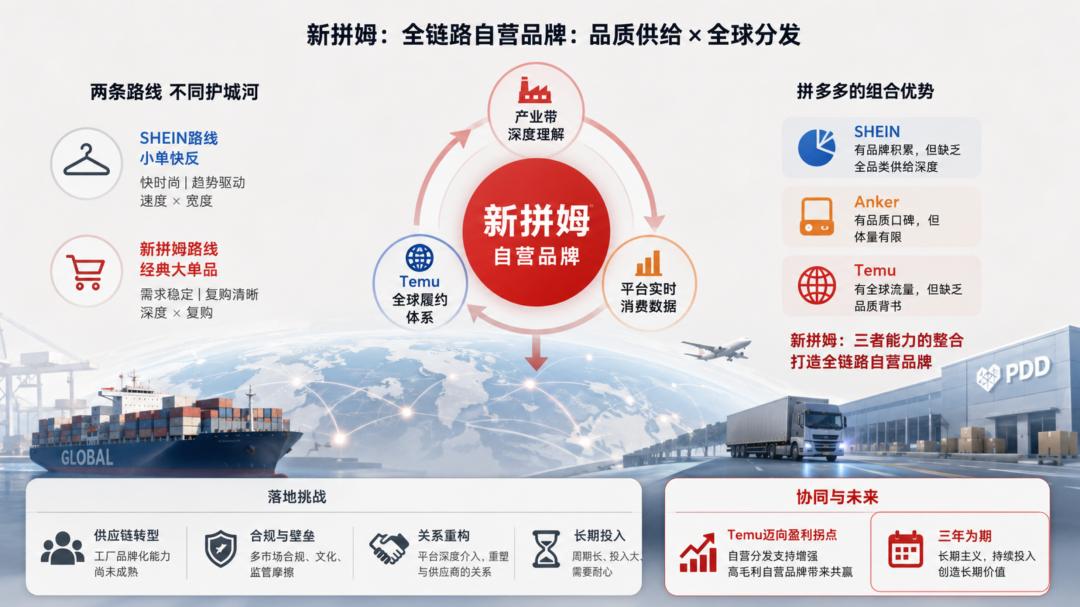
Of course, although the conditions on the books are sufficient, the difficulty of implementation is another matter. The management admitted that many manufacturing enterprises in industrial belts "are limited by talent, information, and scale and have not completed the branding transformation". The growth of a brand needs to start from changing the internal logic of the factory. The funds and channels provided by the platform are necessary conditions, but not sufficient conditions.
Meanwhile, the compliance costs, cultural barriers, and regulatory risks in different markets are all real frictions, and these frictions will continuously consume resources before scaling up. New Pinmu has been launched for less than half a year, and any judgment on its success can only be a hypothesis at present.
There is another challenge that is less discussed but may have a more profound impact: The branding that New Pinmu aims to achieve is essentially redefining the power relationship between the platform and suppliers. In the past, Pinduoduo's logic was that the platform provided traffic and the merchants provided goods, and the two parties kept a distance. New Pinmu means that the platform takes the initiative to get involved in product design, pricing, and quality standards, transforming the past "buy - sell relationship" into a deep - binding relationship of "co - creating a brand".
This reconstruction of the relationship requires the cooperation willingness of the supply - chain side and the ability accumulation of the platform side.
Judging from Temu's growth curve, if Temu's profit inflection point really arrives in 2027 as Goldman Sachs expects, its support for the distribution of New Pinmu's self - operated products will no longer be a strategic preference from the group. After all, the gross profit margin of self - operated brands is usually higher than that of white - label matching, which is also valuable for Temu, which is looking for a profit path.
The synergy logic between the two is valid financially and is an advantage different from other brand - incubation models.
It is worth noting that the management said in the earnings call: "These investments are aimed at the long - term, will create considerable long - term value for the industry, and cultivate new growth drivers." The keyword in this sentence is "will", not "has".
Pinduoduo has set a three - year assessment period for itself. Whether the market's patience can last for these three years is the biggest uncertainty in this story at present.