20VC's latest podcast transcript: When Anthropic sparks discussions on commercialization, will sales become more expensive in the AI era?
Editor's Note of "UnDefined Players" ✍️
This episode of the podcast from 20VC with Harry Stebbings forces everyone to face the reality of AI commercialization.
Anthropic, the company behind Claude, has seen its monthly revenue grow N - fold within half a year, and the growth curve has become almost linear:
In January this year, its annualized revenue was still $9 billion; in February, it became $14 billion, in March $19 billion, in April $30 billion, and by May, this figure was approaching $45 billion.
Here, it refers to the annual revenue calculated based on the monthly revenue rate. Even so, such a growth rate has rarely occurred in business history.
In contrast, many companies regarded as ToB legends, such as Snowflake and Salesforce, often took more than a decade or even two decades to reach a revenue scale of billions of dollars. Today, an AI company may cover in a few months the path that traditional software companies took years or even decades to complete.
Thus, a question that has remained unresolved in the past two years - whether the commercialization of AI is a slow - building process like cloud computing and SaaS, or whether a brand - new growth logic will emerge - has suddenly been put back on the table.
In the past two years, the rapid development of large models has created an illusion in the industry. People think that technology will swallow organizations, so the stronger the model, the less important sales are, and the better the product, the easier the commercialization.
This conversation reveals the truth hidden beneath the AI frenzy with many counter - intuitive viewpoints:
The product solves value creation, while sales solve value capture. Even if you have the best product in the world, if your salespeople are lousy, you will still lose money in vain. It's like a person sitting on a gold mine but only using a small spoon.
The so - called "not making money means losing money" is why they repeatedly emphasize the need to recruit "hunter" - type salespeople. In companies like Salesforce, the brand and market share have already done most of the work for sales. Many salespeople are just like restaurant receptionists, responsible for receiving customers who come to the door and providing them with renewal and expansion services, like "order takers". What is truly scarce are those "hunters" who can still win orders in the market even when the brand and product are at a disadvantage.
Founders often break down sales targets from the top - down, and these targets are usually set by founders based on their gut feelings or capital pressure. But in fact, the target should be determined by the hard formula of "per - capita sales productivity × the number of effective salespeople". If the derived number is not good, it's a problem with your team's ability, not the target.
Is sales management mediocre? Sometimes it's because the Quota (performance indicator) is set unreasonably. Founders are always worried about paying too much, but they underestimate the lethality of no one making money. If the Quota is set too low, it just means spending a little more money, but if it's set too high, the cost is losing the entire sales organization. The former is a financial problem, while the latter is a survival problem.
Many people believe that AI SDRs, automated emails, and intelligent customer service will largely replace sales. In fact, AI will change tools, but it won't replace relationships. In the future, low - value, templated sales actions will be replaced by AI. However, high - value, complex sales involving trust and risk will become even more precious.
All of this reveals a truth hidden by the AI frenzy - no matter how technology disrupts, the underlying business logic of incentives, accountability, trust, and talent density has never changed and has even become more important. This episode is suitable for all audiences. As long as you want to understand what's going on at the commercial bottom - layer of AI, it won't disappoint you.
Let's get to know the host and the two guests.
Chris Degnan is a figure rarely matched in the history of technology sales. He joined Snowflake as the 13th employee and the first sales employee. In 11 years, he increased the company's annual revenue from less than $1 million to over $3 billion. The sales team he managed expanded from 1 person to over 6,000 people globally. He experienced four CEO changes and led Snowflake to complete one of the largest software IPOs in history in 2020. After his departure, countless entrepreneurs asked him for advice on how to build a sales organization.
Chad Peets is one of the top sales operators and hunters in the past 25 years. He was the managing director of Sutter Hill Ventures, a top - tier investment institution in Silicon Valley, and was an investor in Snowflake during its most critical early stage. Today, he is building sales teams for the hottest AI companies such as xAI and Harvey and serves as a board member of many high - growth companies.
The host, Harry Stebbings, founded this podcast in his bedroom at the age of 18 with a £50 microphone set. Harry Stebbings used the knowledge and connections accumulated through the podcast to establish the fund 20VC, which manages assets of about $800 million and has invested in more than 13 unicorn companies.
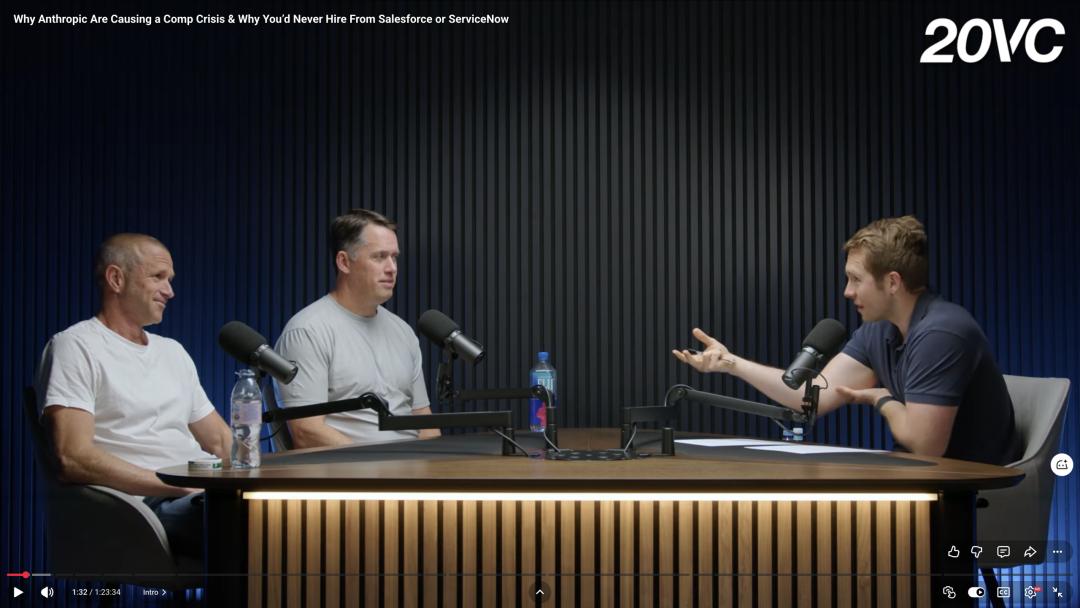
Original link: https://www.youtube.com/watch?v=vRPBhik_AXU&t=2839s
(We couldn't find a text version of this article online, so we translated and summarized it ourselves with the help of AI tools.)
The core contents discussed in the podcast include:
- Even the best product will result in losses without good sales.
- Order takers vs. hunters: How to distinguish them in interviews?
- Domain expertise vs. sales DNA: Which type of people should be recruited?
- How to set Quota: The risks of setting it too high or too low.
- Hesitation means certainty: Lay off employees quickly and kindly.
- Forecasting in high - speed growth: The bottom - up approach.
- Seat - based pricing is dying: Transitioning to usage - based billing.
- Why it's difficult for European founders to build world - class sales teams.
01
Even the best product will lead to wasted money without good sales
In the AI era, the expansion model of companies has changed significantly. However, in the past two years, there has been an illusion in the AI startup circle: if the product is good enough, sales are not important - a strong model, an amazing demo, and users will come on their own.
Product - led growth (PLG) is regarded as a panacea by many founders. They assume that a good product will sell itself, and the sales team seems to be a relic of the old world.
Chris Degnan doesn't agree with this view: "Building a sales team is the core challenge faced by early - stage and growth - stage founders." Chris took Snowflake from scratch to an annual revenue of $4 billion. Chad is building sales teams for the hottest AI companies like xAI and Harvey. They have seen too many companies with excellent products whose growth suddenly stalled because the sales organization couldn't keep up.
"Even if you have the best product in the world, if your salespeople are lousy, you will still lose money in vain," Chad said bluntly.
Will a good product sell itself? A good product only creates value, but converting "how much the product is worth" into "how much the customer pays" is the value captured by sales. A good product can't find out who has the budget, persuade the other party to trust you, handle the interference of competitors, negotiate contract terms, or complete the legal and procurement processes.
A mediocre product with lousy sales has no market opportunities, so there is no loss. But for a great product, the potential market demand may be $1 billion. If your sales team can only capture $100 million of it, the remaining $900 million is the opportunity cost lost in vain. It's like a person sitting on a gold mine but only using a small spoon.
Chris pointed out another hidden truth.
During the ultra - high - speed growth period driven purely by the product, the inefficiency of the sales organization can be masked. Customers are queuing up to buy your product, and you don't need salespeople to knock on doors. But when the growth curve slows down and competition intensifies, a team without real sales ability will become the most expensive burden.
The key lies in distinguishing between two types of people: order takers and hunters.
02
Order Takers VS Hunters: How to Identify Real Hunters?
When most founders recruit salespeople, they often first look at the brand of the company the candidate previously worked for: those from Salesforce or ServiceNow seem to be reliable. This is the most common perception.
Chad Peets thinks this is completely wrong. "If a salesperson has worked at Salesforce for 5 years, he probably hasn't developed new customers." The reason is simple. Salesforce has a monopoly in the market, and most customers have been with the company for a long time. If a salesperson says he won Wells Fargo as a client, he may just have taken over an old customer that Salesforce has had for 10 years.
He calls these people "order takers". They usually stay in companies with strong brands, large platforms, and existing customer pools. Most Salesforce salespeople belong to this category. They receive customers who come to the door, handle renewals, and manage expansions, just like restaurant receptionists.
The other type of people are "hunters". They develop new customers from scratch, find water in the desert. Even if the product is at a disadvantage, they can defeat competitors. They find internal supporters within the customer company and then find the people who truly hold the budget and decision - making power. They generate leads, create demand, and drive the process to close deals.
A sales organization without hunters is like a football team without strikers. You can control the ball well, but you can't score goals.
How to distinguish which category a well - known candidate belongs to in an interview?
Chris's method is straightforward. He asks the candidate to give examples of 2 - 3 new customers they developed in the past 24 months. Then he asks for details: Who is your internal champion? Who is the economic buyer? If the candidate starts to stutter, it means they are lying.
Chad doesn't focus on the candidate's industry experience fit but on the quality of the sales organization itself. There may be lousy sales organizations in good companies, and there may be world - class sales organizations in lousy companies. "Who did the candidate work for? What kind of training did they receive? Do they have resilience, determination, and all the other qualities you think are important? Do you know anyone who can confirm the authenticity?"
Chris also believes that a candidate's ability to sell enterprise - level technology is more important than industry expertise.
Why does industry experience seem less important? Because sales is a transferable skill. A top - notch salesperson who is successful in industry A can quickly learn and succeed in industry B. Their core ability is "the sales action itself", not "industry knowledge".
For example, in the security industry driven by channels, the requirements for sales technology are not as high as in other industries. Conversely, a person from an unknown company, with a product at a disadvantage, but still able to win orders may be more worth recruiting. That's a real hunter.
A new problem arises. How can startups compete with large companies for hunters in the AI era? Large companies have endless money and only care about speed. What can startups rely on to recruit talent?
Chad and Chris's strategy is not to compete on money but to attack the other side's weakness, which is the group quota. The performance targets of the entire sales team are tied together. Regardless of individual performance, everyone gets similar bonuses. "Almost everyone in these companies is a passenger because there is no accountability. You can't learn anything from a sales perspective. Eventually, this will backfire on your career."
This is fatal for salespeople. Real salespeople believe in getting more for more work and hate the equal - sharing system. Chad said, "You should ask the candidate: Do you want to go to a place with a group quota, where you'll get the same money as the slacker no matter how well you do? Is this the environment you want?" Chris added, "If they don't care about these and just want to make quick money, they're not the people I want."
So what can startups rely on to recruit talent? "Salespeople are capitalists. They believe in meritocracy. They want to be rewarded for their performance and hard work." So, first, by teaching real sales skills and making them hunters, not order takers. The salespeople of companies like MongoDB and Wiz are in high demand because their sales leaders train their people. Second, by offering a sense of mission in building something. "They want to build something. They believe in the CEO and want to build something together, rather than being a passenger."
03
How to Set Quota? Don't Make Empty Promises
After recruiting the right people, the next question is how to set performance indicators for them?
This is the pitfall that founders are most likely to fall into - using wishes to replace plans.
Every time Chad joins a company, he encounters the same scenario. The founder says, "We must achieve $15 million in revenue so that we can raise $100 million at a $500 million valuation (Top - Down)." Chad's answer is always the same: "This won't work. You can't just say this is the number we must reach. Please help us figure it out based on facts." Because it sounds like the dot - com bubble. We need a bottom - up approach.
What is the bottom - up approach? It formulates sales targets based on objective facts, sales capabilities, and market data, rather than making decisions based on gut feelings or capital pressure. First, figure out the per - capita sales productivity, and then look at the number of effective salespeople: How many salespeople are there now? Based on the historical attrition rate, how many will be left by the end of the year? How long does it take for new salespeople to reach full productivity? Add these numbers up layer by layer to get the most likely achievable forecast based on the team's capabilities.
The opposite is the top - down approach. Start with the target: "We need to achieve $3 billion in revenue this year." Then work backward: "There were 100 salespeople last year, and we'll add 200 more this year. Divide $3 billion by 300 salespeople, and each person gets a $10 million Quota." As for whether the salespeople can achieve $10 million? We don't know. Just set the target first.
Founders usually think that setting high targets challenges the team and stimulates potential, while setting low targets wastes resources and makes it too easy to get commissions. So they tend to set high targets. But Chris and Chad's judgment is the opposite: The risk of setting the Quota too high is much greater than setting it too low.
The cost of a low Quota is spending a little more money, while the cost of a high Quota is losing the entire sales organization.
Founders are usually afraid of "paying too much", but they underestimate the lethality of "no one making money" - When no one in the sales organization makes money, morale collapses. Type - A salespeople will leave, and once they leave, other Type - A salespeople will also know it's not a good place to stay. Finally, Type - B salespeople will take over the customers of Type - A salespeople... In the end, the cost is "losing the entire sales organization".
Chad also mentioned that they are now doing something different - adding a Windfall Clause to the contract: If a salesperson signs a huge deal, the company has the right to review the deal and renegotiate the compensation plan with the salesperson, which may reset the salesperson's income. "If a salesperson signs a $1.5 - 2 billion deal, the original commission plan would make the company unable to afford it. According to the regular commission rate, the salesperson may get $3 - 4 million, but according to the clause, the salesperson will only get $2 million." Chad triggered this clause 5 times when he was at Snowflake.
Sales incentives are not just a pure mathematical formula but a management judgment. Extreme situations require extreme measures. More importantly, the existence of this clause itself changes behavior. Salespeople won't chase unreasonable huge