What's the value of BYD's first 4nm automotive-grade intelligent driving chip?
On the evening of May 28, 2026, BYD held the "Dare to Act" intelligent strategy press conference at its global headquarters in Shenzhen, unveiling its self-developed intelligent driving chip, "Xuanji A3". This is BYD's 567th automotive-grade chip, manufactured using a 4nm process. BYD claims it to be "China's first 4nm intelligent driving chip".
"In the first half of electrification, the focus is on batteries; in the second half of intelligentization, it's on chips." Wang Chuanfu, the chairman of BYD, set the tone at the press conference. After years of being labeled as a "battery" company, this world's largest new energy vehicle manufacturer has for the first time pushed "chips" to the forefront of the intelligent narrative.
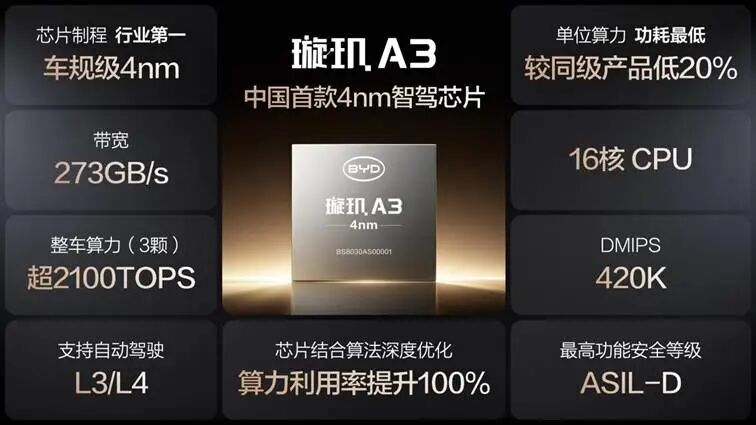
According to the technical data provided by BYD, the Xuanji A3 is equipped with a 3-core NPU, supporting the Transformer large model and natively supporting L3 and L4 autonomous driving. Through the collaboration of three chips, the total computing power of the vehicle exceeds 2100 TOPS. The chip uses a 16-core CPU as the logic and decision-making center and adopts a self-developed bus. The DDR memory bandwidth reaches 273GB/s, reducing decision-making latency. It meets the highest automotive-grade functional safety level, ASIL-D, and the power consumption per unit of computing power is approximately 20% lower than that of similar products. BYD states that after in-depth optimization with self-developed algorithms, the computing power utilization rate has doubled, and the chip has entered large-scale mass production.
Wang Chuanfu emphasized the difficulty of developing automotive-grade chips at the press conference: "The R & D and manufacturing standards for automotive-grade 4nm chips are extremely strict. The technical difficulty is equivalent to that of the 2nm level in the consumer electronics field."
In addition to the chip, BYD also announced an urban assisted driving guarantee policy that evening. Starting from now, new users who purchase models equipped with Tian Shen Zhi Yan A or Tian Shen Zhi Yan B within one year will enjoy a one-year "urban navigation" guarantee starting from the date of vehicle pickup. Existing owners of Tian Shen Zhi Yan A/B models will also enjoy this benefit after an OTA upgrade to the Tian Shen Zhi Yan 5.0 system. Only the Yangwang U9, due to its special intelligent driving solution, and the Fang Cheng Bao Leopard 8, due to its use of the Qian Kun intelligent driving solution, do not qualify for this guarantee policy. When users are using the urban navigation function in compliance and are involved in a responsible traffic accident, BYD will cover the direct economic losses borne by the vehicle, including vehicle repair costs, third-party property damage, and personal injury losses.
According to BYD, this guarantee policy is free of charge throughout, has no upper limit on compensation, is not included in the personal vehicle insurance system, and does not affect the next year's insurance premium. This is BYD's second assisted driving guarantee policy following the intelligent parking guarantee launched in July 2025.
BYD also disclosed three "firsts among Chinese automakers" at the press conference: the number of assisted driving vehicles in use exceeds 3.15 million, the Tian Shen Zhi Yan system generates over 200 million kilometers of data per day, and the assisted driving R & D team consists of over 5,000 engineers. Wang Chuanfu set three goals for the second half of intelligentization: zero traffic accidents, a super driver, and a super secretary, and stated that BYD will continue to invest over 100 billion yuan in R & D funds.
BYD's Current Intelligent Driving Resources: Outsourcing Chips and Algorithms
BYD's chip layout can be traced back to 2002 when it established a chip team (the IC design department, the predecessor of BYD Semiconductor). Currently, it has a R & D team of over 7,000 people, has invested over 100 billion yuan, has four R & D bases and five wafer fabs, and has launched over 2,000 chip products. Its automotive-grade chips cover 13 major categories and are used by 46 automotive brands. BYD claims to be "the world's only automaker with full-process and full-link chip manufacturing capabilities."
However, BYD's in-house wafer fabs mainly focus on mature processes such as power semiconductors. BYD has not publicly disclosed the specific foundry for advanced 4nm process chips like the Xuanji A3. The industry generally speculates that they are still manufactured by advanced process foundries such as TSMC and Samsung. The "full-link manufacturing capabilities" refer to BYD's overall chip system, not that every process of this 4nm chip is completed in-house.
To understand the significance of the Xuanji A3, one must first understand BYD's intelligent driving resources. Before the mass production of this self-developed chip, almost all the computing chips in BYD's "Tian Shen Zhi Yan" system were outsourced.
The "Tian Shen Zhi Yan" system is divided into three levels based on hardware and computing power: Tian Shen Zhi Yan A uses two NVIDIA Orin X chips with a computing power of approximately 508 TOPS, plus three lidars, and is installed in the Yangwang brand. Tian Shen Zhi Yan B uses one Orin X chip with a computing power of approximately 254 TOPS, plus one or two lidars, and is used in Denza and BYD's mid - to high - end models. The entry - level Tian Shen Zhi Yan C is a pure vision solution, using either an NVIDIA Orin N chip with a computing power of approximately 84 TOPS or a Horizon Journey 6M chip with a computing power of approximately 128 TOPS, and is installed in mainstream models such as the Qin PLUS DM - i and the Seagull.
The algorithm level is more complex. BYD's official statement about the "Tian Shen Zhi Yan" has always been "self - developed." However, according to previous reports from multiple media outlets, the intelligent driving algorithm solutions for the two high - end versions, Tian Shen Zhi Yan A and B, are supported by the intelligent driving supplier Momenta. BYD and Momenta established a joint venture, DiPai Zhi Xing, with BYD holding 60% and Momenta holding 40%. The English name of Tian Shen Zhi Yan, DiPilot, belongs to this company.
Before the Xuanji A3, BYD's self - development focus was on the vehicle's electronic and electrical architecture, domain controller integration, some perception and control algorithms, and a large - scale data closed - loop. The two most core aspects - high - level intelligent driving algorithms and core chips - previously relied on external sources.
The significance of the Xuanji A3 lies in filling the "chip" as the hardest core link. Combining with BYD's repeatedly emphasized self - developed underlying algorithms, it is shifting from "purchasing chips + jointly developing algorithms" to "self - developed chips + self - developed algorithms" in a hardware - software integrated approach. However, it will take time to fully switch from the outsourced solution to self - development. BYD also made it clear at the press conference that the Xuanji Architecture 2.0 is compatible with both the self - developed Xuanji A3 and third - party chips, meaning that outsourced solutions from NVIDIA and Horizon will coexist with the Xuanji A3 for a long time.
What's Special and Difficult about Intelligent Driving Chips?
Whenever an automaker releases an intelligent driving chip, the computing power unit "TOPS" is always mentioned repeatedly, as if chips only differ in computing power. However, when comparing automotive - grade intelligent driving chips, data center AI (artificial intelligence) chips, and mobile phone/computer chips, it becomes clear that they are designed for completely different purposes.
Mobile phone and computer chips pursue peak performance, energy efficiency, and cost. They have a narrow operating temperature range, a lifespan expectation of two to five years, and occasional crashes and restarts are acceptable. Therefore, they often adopt the most advanced processes first.
Data center AI chips (such as NVIDIA's H100 and B200) pursue extreme throughput. The power consumption of a single chip can reach hundreds or even thousands of watts, supported by liquid cooling in the computer room and redundant power supply. Reliability is mainly achieved through cluster redundancy at the system level.
Automotive - grade intelligent driving chips are different. They do not pursue the fastest speed but rather almost no errors over a decade and a million kilometers. They need to work stably in an ultra - wide temperature range from - 40°C to 125°C, withstand continuous vibration, electromagnetic interference, and power fluctuations, and meet strict standards such as functional safety (ISO 26262/ASIL - D) and reliability (AEC - Q100). This is the origin of Wang Chuanfu's statement that "the difficulty of automotive - grade 4nm is equivalent to that of consumer - grade 2nm." The difficulty does not come from the process but from the much higher safety and reliability thresholds.
The real challenges of automotive - grade intelligent driving chips lie beyond the computing power figures. Firstly, there is functional safety. Once an intelligent driving chip fails, it may endanger lives. The ASIL - D standard requires the hardware to have the ability to detect, isolate, and degrade faults, which consumes a large amount of design redundancy, verification man - hours, and tape - out costs.
Secondly, there is long - life and high - reliability. This means more conservative design redundancy, more stringent device screening, and a long - term aging test. The R & D cycle is much longer than that of consumer chips.
Thirdly, intelligent driving chips pursue "effective computing power" rather than "nominal computing power." The TOPS standards of different companies vary. Whether it is dense or sparse, INT8 or FP8/FP - 4, and whether it is effective computing power, the differences can be several times. For example, the nominal 560 TOPS of the Horizon Journey 6P is a 1/2 sparse equivalent value, while the dense computing power value is 280 TOPS.
Fourthly, there is hardware - software collaboration and toolchains. NVIDIA has established a large and mature ecosystem through CUDA. Automakers using NVIDIA chips can quickly develop on this mature ecosystem. However, if a self - developed chip uses a new architecture, a large number of new tools need to be developed. For example, after Li Auto's "Mahe 100" adopted a data - flow architecture, it could not reuse the CUDA ecosystem, and almost had to rewrite the compiler.
Fifthly, there are the production capacity and geopolitical risks of advanced processes. Representatives in this regard are Black Sesame and Huawei. Black Sesame's Huashan A2000 exceeded the US export control red line in terms of performance. It took about 11 months of review after tape - out to get approval, resulting in a significant loss of business opportunities due to the time delay. Huawei's Ascend series can only rely on domestic mature processes due to sanctions.
What Exactly Do Automakers Self - Develop?
The value of the term "self - developed" varies greatly. An intelligent driving chip usually includes modules such as a CPU core, an AI acceleration core (NPU/BPU), a GPU, an ISP, a memory controller, and a security island, as well as back - end physical design, tape - out foundry, packaging and testing, and upper - layer compilers and software stacks. Automakers' self - development can be roughly divided into several levels.
Almost the entire industry uses Arm - licensed IP for CPU cores. Currently, no automaker has developed a CPU core from scratch. It is common to purchase Arm IP and customize the integration. What truly reflects "self - development" is the AI acceleration core (NPU/BPU). NIO's Shenji, XPeng's Turing, Li Auto's Mahe, and Horizon's Journey have all self - developed the micro - architecture of this dedicated accelerator to match their respective algorithms. BYD's Xuanji A3 also emphasizes "in - depth optimization combined with self - developed underlying algorithms." Physical design and tape - out are basically outsourced.
The degree of self - development of the software stack and toolchain determines whether the chip can be truly used, which is also the biggest difference between suppliers and automakers' self - development. Suppliers such as Horizon, Black Sesame, NVIDIA, and Qualcomm must provide a complete and open toolchain to help different customers complete development and adaptation. Automakers' self - development is more inclined to a customized software stack that only serves their own algorithms.
Therefore, the so - called "self - developed intelligent driving chips" of current automakers are, to be precise, "self - developed AI acceleration core micro - architecture and software stack, integrated with mature IP such as Arm, and tape - out foundry by TSMC, Samsung, etc."
Currently, 10 intelligent driving chips have been released on the market with clear vehicle - installation plans. We have sorted out the specific information of these 10 chips. It should be noted that the computing power standards of different manufacturers vary (dense/sparse, INT8/FP8/FP - 4, nominal/effective) and cannot be directly compared horizontally. Many Chinese manufacturers have not officially disclosed the advanced process foundry. All information marked as "speculated/not disclosed" is the industry's judgment from public reports rather than official confirmation. The "number of designated models" and "fleet size" are mostly estimated based on the sales of the equipped models as most companies have not announced the exact data based on the chip caliber.

Looking at the ten chips, in terms of process, Tesla's AI5 is the only intelligent driving chip using a 3nm process. It even used Samsung's SF2T 2nm - level process during the tape - out testing. BYD, NVIDIA, and Qualcomm are at the 4nm level, NIO and Li Auto are at 5nm. XPeng has not officially confirmed the process, with most reports indicating 7nm and a few indicating 5nm. Horizon has also not officially disclosed the specific process, and 7nm is the general consensus in the industry. Black Sesame's A2000 is confirmed to use a 7nm process. However, a more advanced process does not necessarily mean a better experience. The key still lies in algorithm adaptation.
In terms of mass - production rhythm, Huawei, NVIDIA, Horizon, and the self - developed chips of NIO and XPeng have been widely installed in vehicles. BYD has just started. Tesla's AI5 is targeted for next year, but its previous - generation 7nm AI4 chip has already been installed in millions of vehicles. Li Auto's M100 and Black Sesame's A2000 have not been mass - produced and installed in vehicles yet.
In terms of technical routes, automakers exchange efficiency with "dedicated + self - developed algorithms," while suppliers exchange scale with "general + open ecosystem." Huawei is in between, and neither route has reached the end. The real significance of BYD's entry into this field is not about leading in a certain parameter but about bringing together the scale of the world's largest new energy vehicle manufacturer, the most complete chip system, and the three difficult tasks of advanced processes, automotive - grade verification, and large - scale mass production for the first time.
This article is from the WeChat official account "Banshu - Caijing" (ID: Banshu - Caijing), author: Yin Lu, published by 36Kr with authorization.