Soaring 40% After Earnings, Unveiling Dell's Financial Reports: In the Second Half of the AI Era, an Arms Race of "Those Who Control Physical Infrastructure Reign Supreme"
If your understanding of AI still remains at the level of "chat software" or "intense competition among large models", then the FY27 Q1 (the first quarter of fiscal year 2027) financial report just released by Dell will completely shatter your imagination.
This is a report card that can be described as "terrifying".
Driven by both AI and traditional IT infrastructure, Dell not only achieved a record - high single - quarter revenue, but also its management's statements seem like showing off: "The demand far exceeds the supply. We want more goods, but we simply can't get them!"
Even more exaggerated is that due to the soaring upstream costs and the rush to grab goods, Dell's product pricing has changed from being adjusted monthly or quarterly in the past to "almost being repriced every day". The once down - to - earth IT hardware giant has now been forced to become a "luxury goods dealer" that quotes prices daily.
Behind this explosive financial report, what unknown changes are hidden in the AI industry?
Terrible numbers: A backlog of $51.3 billion, and the existing orders can guarantee profits for more than half a year!
Let's first look at a set of the most core financial data, which can only be described as "far exceeding expectations":
Single - quarter revenue: $43.8 billion (the market expected $34.81 billion), a year - on - year increase of 88%, reaching a record high!
Adjusted EPS (Earnings Per Share): $4.86 (the market expected $2.88), a year - on - year increase of 214%, also reaching a record high!
Operating cash flow: $4.1 billion. You know, Q1 has always been the off - season for cash flow in the hardware industry, but Dell's performance in this off - season has even outperformed many peak seasons in the past.
The real highlight is the AI servers.
In Q1, Dell's AI server revenue soared to $16.1 billion, a year - on - year increase of 757%! And the orders received in a single quarter reached as high as $24.4 billion. Currently, the backlog of AI server orders in Dell's hands has reached an astonishing $51.3 billion!
What does this mean? Dell has raised its annual AI server revenue guidance to $60 billion. This means that even if Dell doesn't accept any new orders from today on, the backlogged work in hand is enough for the entire factory to operate at full capacity for more than half a year. This kind of terrifying order visibility is extremely rare in the history of the hardware industry.
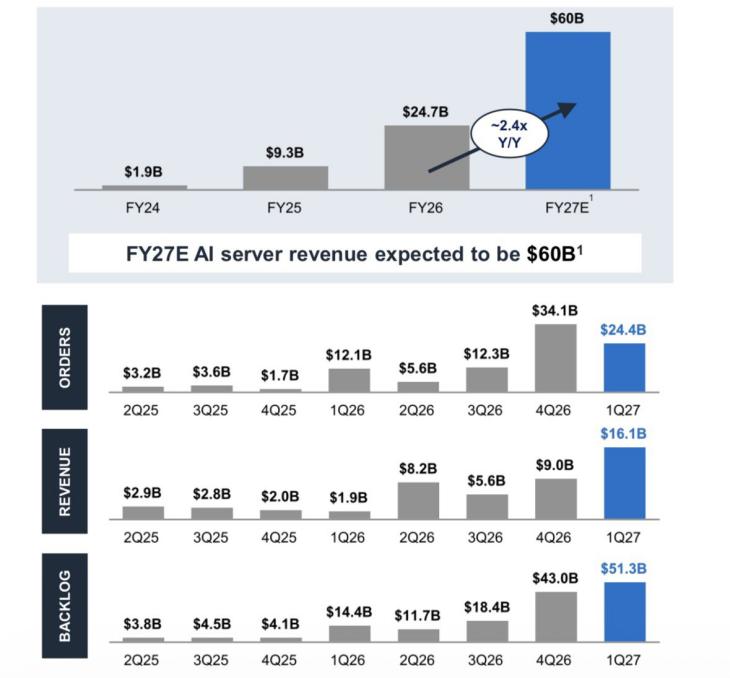
Due to the underlying explosion, Dell has completely overturned its original annual performance guidance, violently raising its annual revenue forecast to $165 - 169 billion (an increase of about $27 billion directly), and raising the adjusted EPS to $17.9 ± $0.25.
This move of significantly raising the annual guidance after the quarterly financial report shows that the company's confidence in demand has undergone a qualitative change.
The management's narrative has changed greatly: AI is reshaping the traditional IT market
If you only look at the data, you may think that Dell is just lucky to catch the wave of GPU servers. But by carefully studying the narrative transformation of Dell's management, you will find that the second stage of AI (the era of Agentic AI) is reshaping the entire traditional computing market in a way that no one expected.
1. The "revival" of traditional servers: Agentic AI is the driving force behind
In the past few years, the traditional x86 server market has basically been in a state of low growth or even decline. But in this quarter, Dell's revenue from traditional servers and network business reached $8.5 billion, a year - on - year increase of 92%.
The management admitted: "We didn't know this in October last year." Previously, people thought that AI only drove GPUs. But now, AI is changing from an "advisor" to an "operator" (Agentic AI). When each AI agent runs serial tasks in the background (managing status, branches, retries, etc.), it requires a large number of CPUs to run the underlying management. AI not only hasn't killed traditional servers, but has instead created a huge amount of new workload for them.
2. Customers are going crazy: From "normal procurement" to "locking in a 5 - year long - term contract"
In the past, enterprises planned to purchase servers quarterly or annually. But now, Dell revealed that they are negotiating 5 - year supply agreements with customers.
Customers are doing one thing: In order to hedge against future shortages and inflation, they are actively locking in long - term infrastructure. Even many large customers who "usually don't need financing" are now using Dell Financial Services (DFS) for double - digit growth financing loans. They are borrowing money to grab equipment, and supply security and price risk avoidance have become the first instinct of enterprises.
3. Is pricing like an annual event? No, now it's "being adjusted every day"
Dell's COO Jeffrey Clarke said: "We feel like we're repricing every day."
Due to the extremely tight supply of core components such as DRAM, NAND, CPUs, and hard drives, and the sharp fluctuations in upstream costs, Dell has to start a "daily update" pricing model. Currently, some customers are waiting because they think it's too expensive, but more customers are accelerating their purchases because they are worried that it will be even more expensive tomorrow.
All business segments are booming, with no laggards
Under this wave, almost all of Dell's business segments have achieved a full - stack explosion:
In the core AI business segment, the total revenue of ISG (Infrastructure Solutions Group) reached $29 billion, a year - on - year increase of 181%, achieving double - digit growth for 9 consecutive quarters. Among them, not only did the AI servers earn $16.1 billion, but the traditional servers + network also earned $8.5 billion. Its nearly doubling growth of 92% is a structural and extremely explosive increase. Even the storage business, which has a relatively slower growth rate, achieved a revenue of $4.3 billion, a year - on - year increase of 8%, and the demand growth rate of Dell IP storage has been higher than the market for 5 consecutive quarters.
