With 6 trillion, the world's most powerful siblings are born.
The world's largest AI unicorn has arrived.
Anthropic has just announced the completion of its Series H financing, raising $65 billion, and its valuation has reached $965 billion (approximately RMB 65 trillion). At this point, Anthropic has officially surpassed OpenAI to become the world's number one.
You may find it hard to imagine that this giant was founded by a pair of siblings - Dario Amodei and Daniela Amodei. In 2021, they left OpenAI and started anew with a group of core members. In just five years, Anthropic's valuation has exceeded that of its former parent company.
An unprecedented AI financing race is sweeping across. The only certainty is that the stakes are getting higher, and the number of people who can sit at the table is getting smaller.
Former Baidu employees, siblings join hands, with a valuation of 6 trillion
The story begins with the siblings.
In 1983, Dario Amodei was born in San Francisco. He studied physics at Stanford University for his undergraduate degree. After graduation, he wanted to do something "truly impactful on humanity." At that time, AI was far from as popular as it is today, and he chose a seemingly more circuitous path: to understand intelligence, he first needed to understand the brain.
So, Dario furthered his studies at the California Institute of Technology and Princeton, researching neuroscience and computational neuroscience. After completing his post - doctoral studies, he was recruited by Andrew Ng to join Baidu and participated in the Deep Speech speech recognition project. This was his first real entry into the AI field. It was also here that he began to closely observe whether the performance of the model would steadily improve as the model parameters, training data, and computing power continued to increase.
One year later, Dario left Baidu and joined Google Brain. Although that experience was not long, it laid the groundwork for his later understanding of the "Scaling Law."
His sister, Daniela Amodei, studied English literature at the University of California, Santa Cruz for her undergraduate degree. Later, she entered Silicon Valley and worked at the fintech company Stripe for five years, mainly in charge of recruitment and business operations.
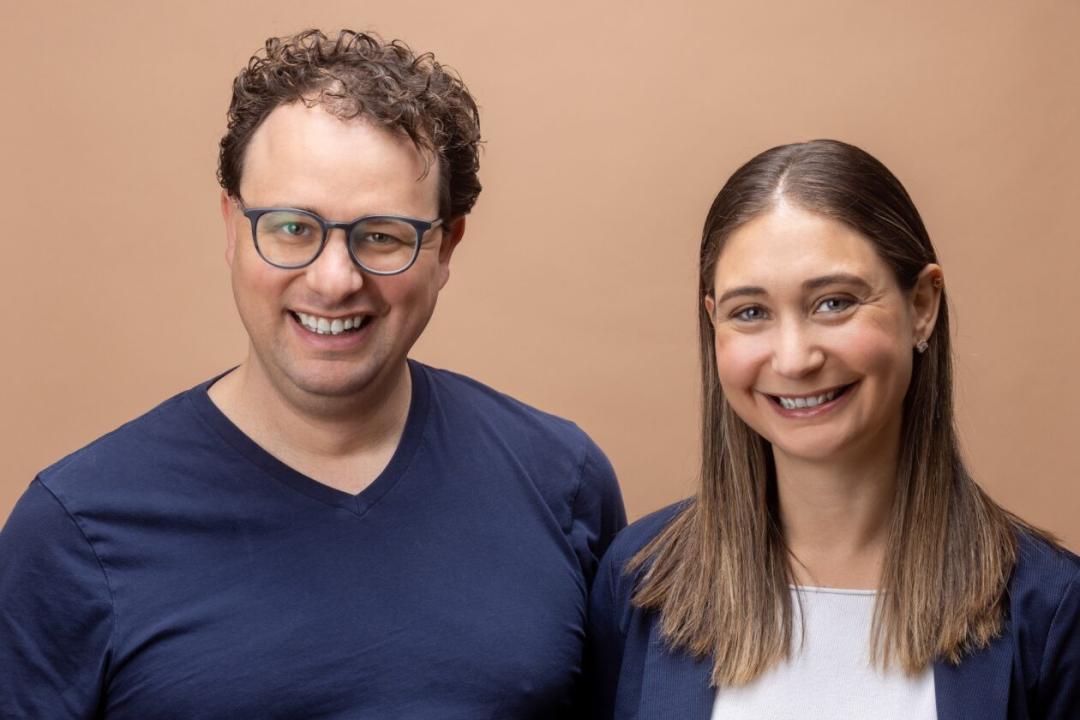
In 2016, the second year of OpenAI's establishment, the team recruited Dario, who was still at Google. Two years later, his sister Daniela also joined. She worked her way up from an engineering manager to the vice - president of safety policy.
During his five - year tenure at OpenAI, Dario became a key figure in the early GPT development path. He was deeply involved in and promoted the research and development of models such as GPT - 2 and GPT - 3, and was also one of the co - inventors of Reinforcement Learning from Human Feedback (RLHF).
The more he stood at the forefront, the more uneasy he became. Dario often talked about his judgment at that time: he believed that artificial intelligence would change the world as profoundly as the Industrial Revolution, but he did not believe that it would happen naturally and smoothly.
Just six months after the launch of GPT - 3, the siblings decided to resign. Five other core members of OpenAI also left with them. In early 2021, they founded Anthropic in San Francisco. The name itself carries a certain declarative meaning - AI that belongs to humanity.
Since then, the siblings have had a clear division of labor: Dario serves as the CEO, leading the research and product direction; Daniela serves as the president, responsible for operations, commercialization, and the talent system. Different from OpenAI, which first opened up the consumer market with ChatGPT, Anthropic chose another path: starting with enterprise customers. At the beginning of this month, Anthropic's annualized revenue exceeded $47 billion.
Along the way, the financing has been fierce. The company completed its Series A financing of $124 million just two months after its establishment. In 2022, it secured $580 million in Series B financing. Subsequently, Google, Amazon, Salesforce, etc. entered the scene one after another. By October 2023, the cumulative financing had exceeded $7.6 billion.
Since then, the valuation has skyrocketed. At the beginning of 2025, the company's valuation reached $61.5 billion; in February this year, after the Series G financing, the valuation rose to $380 billion; and three months later, the Series H financing pushed this figure to $965 billion.
In just five years, a pair of siblings who left OpenAI have come to the center of the global AI stage.
The world's most expensive AI unicorn will break the IPO record
This is a financing deal that will be written into the history of technology venture capital.
Anthropic has just announced the completion of its Series H financing, raising a staggering $65 billion, and its post - investment valuation has reached $965 billion - just one step away from the trillion - dollar mark.
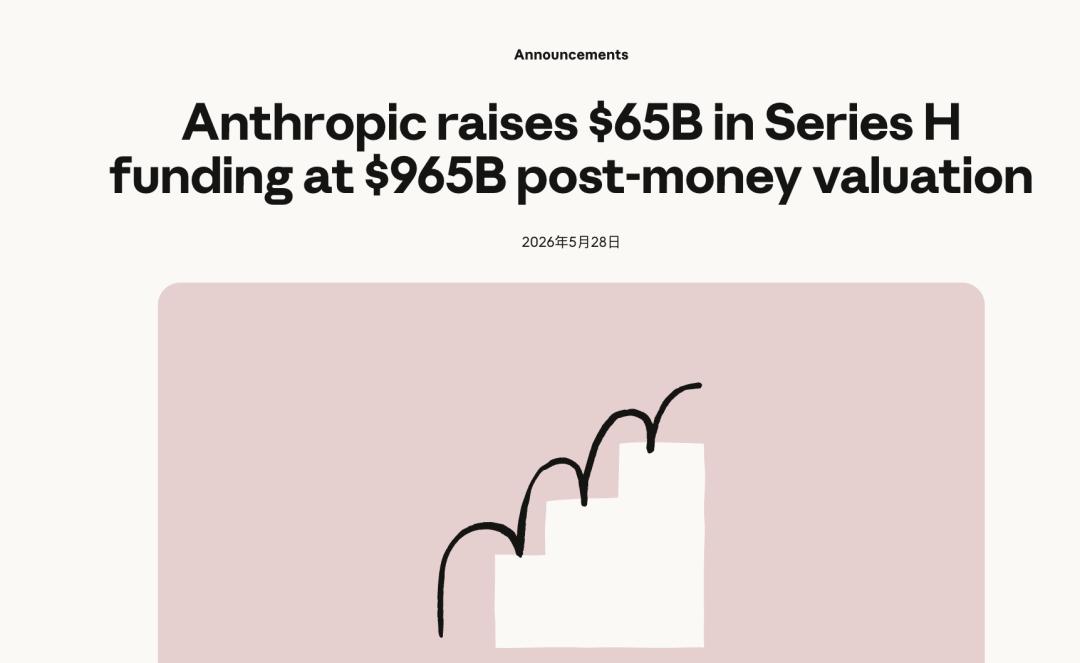
This round of financing was led by Altimeter Capital, Dragoneer, Greenoaks, and Sequoia Capital, with the participation of Capital Group, Coatue, D1 Capital Partners, GIC, ICONIQ, XN, etc.; among the longer list of investors, institutions such as Blackstone, Fidelity, General Catalyst, Insight Partners, Jane Street, Lightspeed Venture Partners, MGX, and Temasek also appeared.
In addition, it also includes a previously committed investment of $15 billion from hyperscale data centers, with Amazon investing $5 billion. Meanwhile, companies such as Micron, Samsung, and SK Hynix have also joined, which points to the storage and chip supply capabilities.
"Both startups and Fortune 5000 companies are deploying Claude to handle complex workflows. In the process, Claude is also learning how enterprises actually operate, including business background, processes, and judgments." Alfred Lin, a partner at Sequoia Capital, said that Anthropic is building a bridge between the current state of enterprise artificial intelligence and its future development direction.
Brad Gerstner, the founder and CEO of Altimeter Capital, was more straightforward: "This momentum enables Anthropic to lead the next stage of artificial intelligence innovation."
Meanwhile, Anthropic has simultaneously released a new model, Claude Opus 4.8. The pricing remains the same as the previous generation, but the price of the fast mode is only one - third of the original. However, the real surprise is yet to come. The company revealed that it plans to launch a new model, Claude Mythos, which is more advanced than Opus, in the next few weeks.
More subtly, this time Anthropic has outpaced OpenAI.
In the past few years, OpenAI has almost been synonymous with the global AI wave. ChatGPT was the first to detonate the mass market and pushed large models to the center of consumer - grade applications. However, after the latest round of financing, Anthropic's valuation has exceeded OpenAI's previous valuation of $852 billion.
The investor structures of the two companies are also quite interesting - institutions such as MGX, Blackstone, Fidelity, Sequoia Capital, T. Rowe Price, and Temasek appear on the shareholder lists of both sides. In other words, investors are not putting all their chips on one company.
For Anthropic, the Series H financing may be the last round of financing before its listing. On the other hand, OpenAI has started to expand its finance department and is accelerating its IPO process, targeting the fourth quarter of 2026.
The story is far from over. But at least for now, Anthropic has proven that beyond OpenAI, another trillion - dollar answer is emerging in the AI world.
The biggest bubble in human history? Who can stay at the table
As we can see, AI financing is like a race with no brakes. In the past period, huge amounts of capital have poured in, and OpenAI, Anthropic, and xAI have taken turns to break valuation records.
The more fanatical it gets, the louder the alarm bells ring.
Ironically, the people who are soberly talking about the AI bubble are precisely the winners of this feast.
Jeff Bezos, the founder of Amazon, previously said bluntly that the AI bubble does exist. "A company with six people getting billions of dollars in financing is not a rational act. This kind of thing is happening every day now."
But he doesn't think the bubble means that everything is illusory. On the contrary, in Bezos' view, even a bubble may leave something truly valuable. He compared it to the biotechnology boom in the 1990s: 90% of the money was wasted, but the companies that survived form today's entire biomedical industry.
Sam Altman, the CEO of OpenAI, was more direct: too many AI startups have received valuations that their fundamentals cannot support, and investors may lose a lot of money.
This is exactly the most contradictory aspect of the current AI field.
On the one hand, AI is undoubtedly reshaping the world and has become a ticket that cannot be missed. On the other hand, this ticket is getting more and more expensive. At the beginning of this year, Dario Amodei revealed that Anthropic is spending $10 billion to train the next model - although each model is profitable, the company as a whole is still losing money. And two years ago, the training cost of cutting - edge models was less than $100 million.
The AI battle is no longer just a story of genius engineers, a few lines of code, and a popular product. It is a super - project supported by capital, computing power, energy, chips, and infrastructure. Jensen Huang gave another explanation. He previously flatly denied the existence of a bubble, calling it "the biggest infrastructure construction in human history."
Most of the time, a bubble only means that imagination has arrived ahead of time. When the leading winners have not fully emerged, countless latecomers have crowded through the same door. This is a scene that all technology cycles will go through.
The real question is: when the hot money and the hype cool down, who can still stay at the table.
This article is from the WeChat official account "Investment World" (ID: pedaily2012), author: Wang Lu, published by 36Kr with authorization.