The situation is reversed. As AI becomes increasingly powerful, humans start to "prove their innocence".
AI is becoming more and more human-like, so humans are forced to prove that they are not AI.
Just this month, two things happened in the literary circle.
One is that a winning work of the Commonwealth Short Story Prize was judged to be "100% AI-generated" by a third-party AI detection tool. However, when the organizer rechecked it with Claude, no similar result was obtained.
The other is that before the new novel of a Nobel laureate in literature was even released, it was suspected to be written by AI.
AI is getting stronger and stronger, and it is becoming increasingly difficult to distinguish texts, images, and videos with the naked eye. However, at the same time, the judgment tools in human hands are not equally reliable.
Thus, a new order has emerged.
Literary award winners have to explain their works, Nobel laureate writers have to explain their creative methods, painters have to record their screens, go live, and show their layers, and ordinary bloggers may also be questioned in the comment section for "smelling too much of AI."
In the past, machines tried hard to pass the Turing test to prove that they were like humans.
Now, more and more people are starting to take a reverse Turing test: proving that they are not machines.
01
Even Nobel laureates in literature can't escape "AI identification"
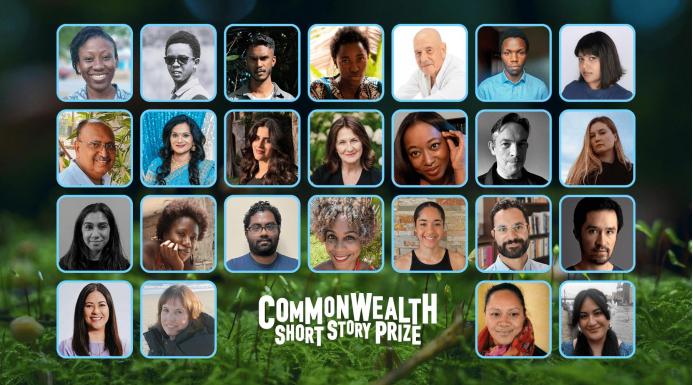
In May this year, a winning work of the Commonwealth Short Story Prize triggered a large-scale "AI identification" controversy.
The controversial work is a short story by Jamir Nazir, a writer from Trinidad and Tobago.
This work won the Caribbean region award of the 2026 Commonwealth Short Story Prize and was published in the literary magazine Granta. Soon, some readers and industry insiders began to question that there were obvious AI traces in the language of this novel: mixed metaphors, neat sentence patterns, and rhetoric that seemed to be mass-produced.
Subsequently, the AI detection tool Pangram gave a seemingly very definite judgment: 100% AI-generated.
The figure of 100% seems like irrefutable evidence, but it didn't immediately become a ruling.
The Commonwealth Foundation stated that all shortlisted authors confirmed that they did not use AI assistance; Granta also couldn't simply determine that the author violated the rules based on just one detection result.
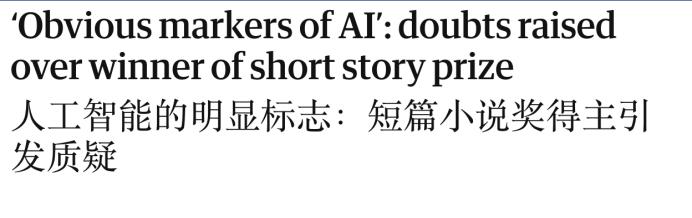
So, the matter entered an extremely absurd stage. Granta magazine tried to recheck this novel with Claude, hoping to let another AI determine whether it was written by AI.
As a result, Claude didn't give a conclusive answer. That is to say, the work that Pangram confidently judged to be "100% AI-generated," Claude couldn't confirm.
Olga Tokarczuk, a Nobel laureate in literature, also recently encountered a controversy.
The cause of the incident was that in an interview, she mentioned that she would use AI to assist in idea generation, data organization, preliminary research, and fact-checking.
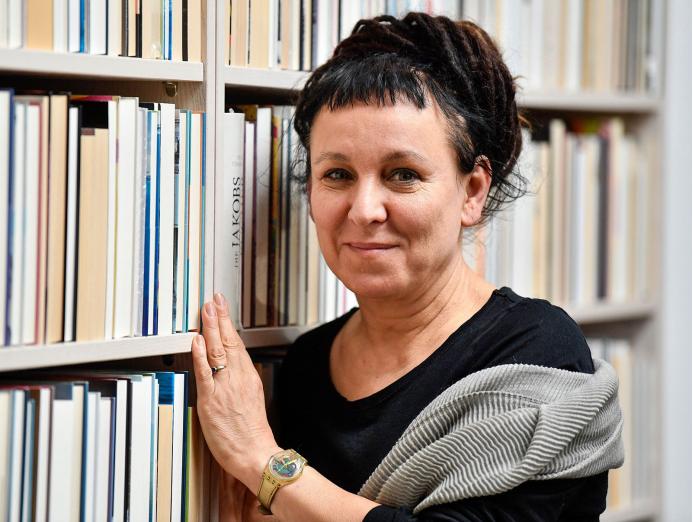
This statement quickly triggered outside discussions. The problem was that Tokarczuk was about to release a new book, so everyone was hotly debating whether her new novel was written by AI.
Subsequently, Tokarczuk had to publicly clarify that her new Polish book to be published in the autumn of 2026 was not written by AI or anyone else. She emphasized that she had been writing alone for decades.
After all, AI is indeed getting stronger and stronger now, and it is becoming more and more difficult to identify AI.
At the end of last year, The New Yorker published an experimental article. Researchers fine-tuned models with the works of multiple writers, allowing AI to learn and imitate their personal styles.
In the experiment, students majoring in creative writing read human texts and AI texts without knowing it and judged which paragraph they preferred. As a result, in nearly two-thirds of the cases, they preferred the AI-generated version.
This is more troublesome than "AI can write novels."
Vauhini Vara, the author of The New Yorker, also wrote in the article that friends and professional readers would mistake sentences generated by AI for her own writing style and would criticize her real original text as "looking like AI."
02
Painters who record the whole process to "prove their innocence" are in despair
The "uncanny valley effect" is not limited to an entity that looks somewhat like a human. When the texts, images, and videos output by AI are getting closer and closer to those of humans, and even the most human-like "style" has been conquered, humans inevitably experience an existential crisis.
This is a core motivation for the current popularity of "casual AI identification."
In other words, it is understandable for people to "identify AI." Behind it is actually a certain kind of fear - Is this a human? Is this AI? Who am I? Who are we?
However, being understandable doesn't mean it's just and upright. "AI identification" is bringing troubles to creators in various fields, making them incur the cost of "proving their innocence" in addition to their creative work.
Regarding the impact brought by AI, the painting circle is no stranger. We discussed the impact of AI on the painting circle a few years ago, as well as the resistance of many painters to AI.
However, at present, the trouble that painters are facing is not only having to watch AI refine their works but also having their hand-drawn works "identified as AI."
Searching for "painting UP self-proof" on social platforms, you will see many cases.
Some painters, after being "identified as AI," record their screens to show all the layers to prove that the works are their own.
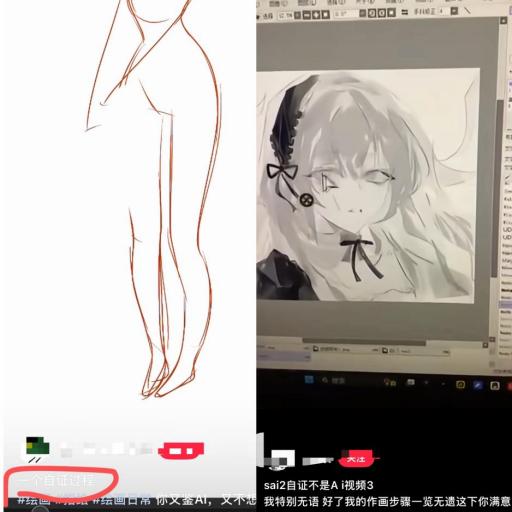
But often, this is not enough.
A friend who is an illustrator told us that now many illustrators will record the whole process while painting to prevent difficulties in proving themselves when being "identified as AI." This is also the most reliable way at present.
If there is no recording, or if there is a recording "evidence" but they are still suspected of "tracing," then there is a next step - a bet.
Yes, due to AI, a bet has emerged in the painting circle between the "AI identifiers" and the "identified as AI." In a case we saw, the poster presented several reasons such as "disconnected hair" and "problems with the shoulder and neck structure" to identify that a painter's work was suspected of tracing an AI image or copying it.
The two sides bet 2000 yuan. In the end, the painter "successfully proved himself," and the poster paid 2000 yuan to the AI painter.
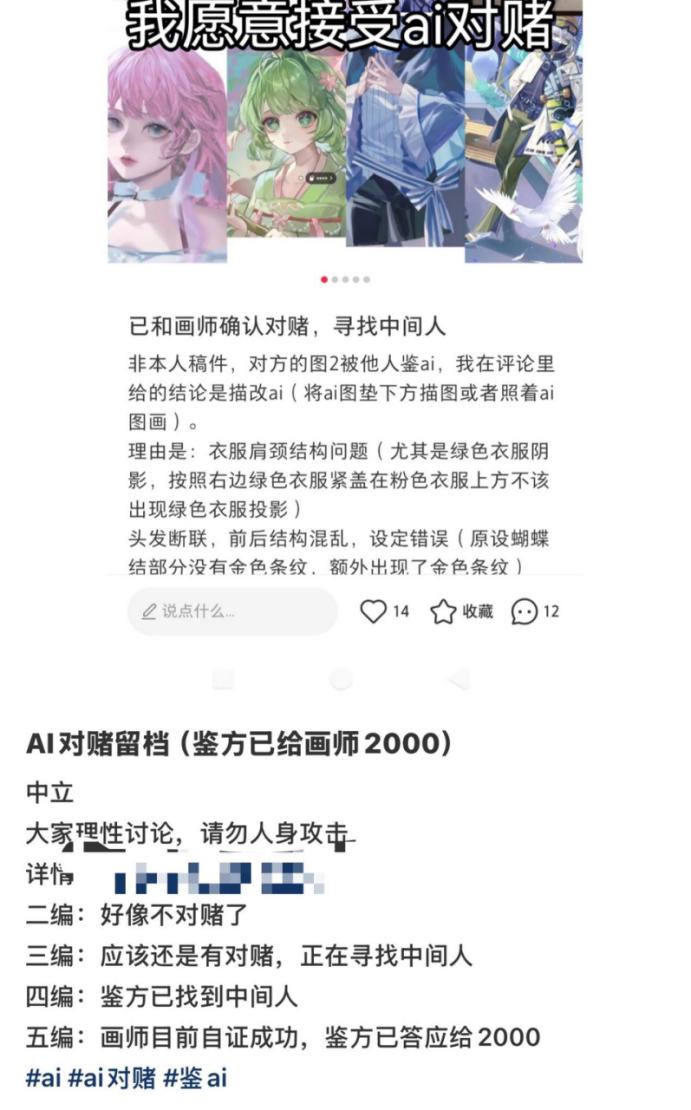
Generally speaking, in the "self-proof" link of the "bet," the two sides agree on a time to have a live painting session. And the live broadcast needs multiple cameras. For example, one camera shows the screen drawing process, and the other records the painter's appearance while painting to prevent someone from "writing on behalf of others."
It's not hard to see the helplessness from the "self-proof posts" of many painters. They often sigh "It's finally my turn" and vow "This is the first and last time I prove myself."
Just like this, on one hand, hating "casual AI identification," on the other hand, having to "prove their innocence" when it really happens to them, it's really uncomfortable.
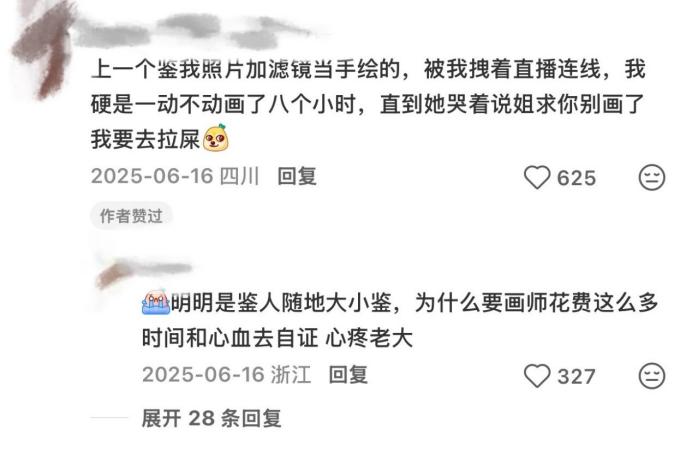
Are there cases where painters "fail to prove themselves" in "AI identification"? Yes. But this still can't make the act of "AI identification" more justifiable. After all, the cost of "AI identification" is almost zero.
And the means of "AI identification" are even more crude - relying on the human eye.
Here, we have to mention a recent joke. An X user posted a picture, saying it was an "Impressionist-style picture" generated by AI, and asked everyone to "explain in as much detail as possible why it's not as good as a real Monet."
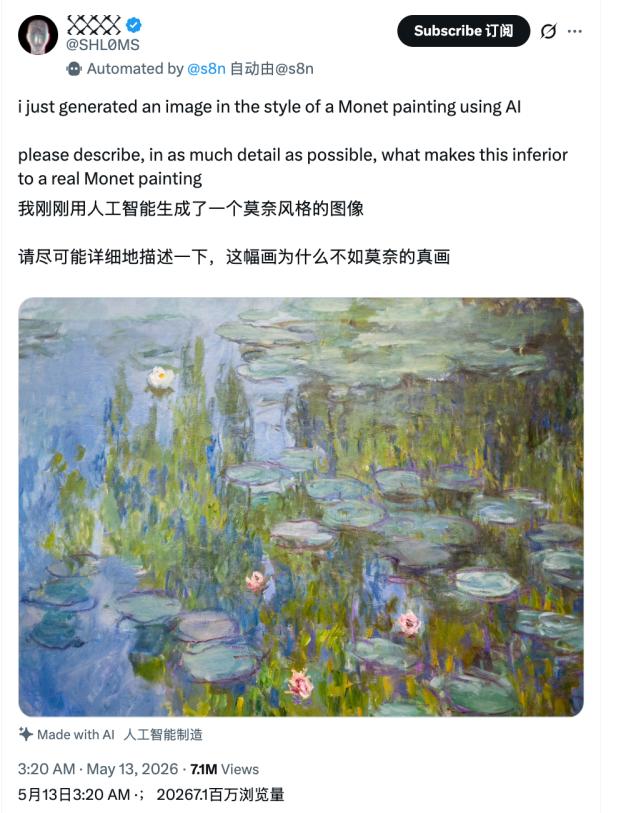
The post later got 7 million views, and many people in the comment section began to seriously "identify AI," saying that it lacked depth, the colors were not unified, it lacked a human touch, the composition was not as good as the real one, and some even analyzed it in great detail from the brushstrokes and sense of space.
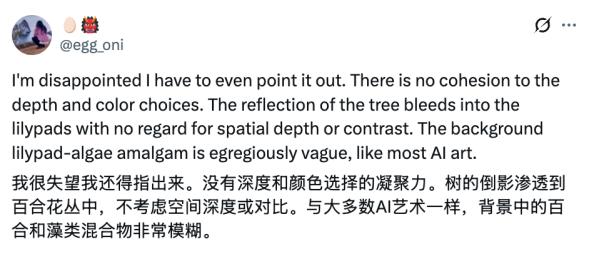
The result was a reversal: that picture was actually a real Monet.
03
Who has the final say in "AI identification"?
So, this is actually a contradiction between the fear of AI becoming more and more human-like and the lack of a perfect "AI identification" method.
The crudeness of the "AI identification" method is another important factor that makes creators collectively fall into the situation of "proving their innocence."
In addition to the "human eye identification" method, as mentioned above about the works of the literary competition champion, another main way of "AI identification" is the third-party detection tool Pangram.
AI detection tools are commonly used in the text field, which easily creates an illusion: they will give a percentage, such as "80% AI-generated" or "100% AI-generated." This number looks like a conclusion, or even a kind of technical appraisal.
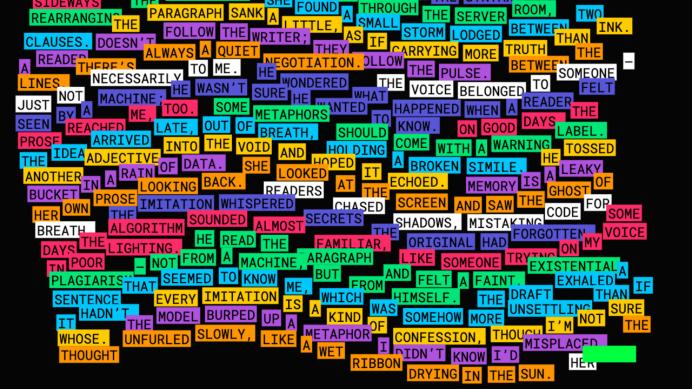
But text detection is not the same as DNA identification. What it actually judges is "what this text is more like in terms of statistical features."
The AI detection tool is also looking at "whether it looks like it was written by AI."
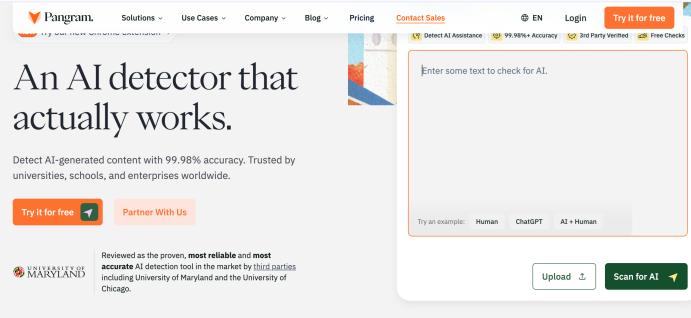
Pangram explains on its official website that its AI detector uses natural language processing technology and a large amount of human writing and AI writing data to analyze the structure, style, and semantic patterns in AI texts. Pangram's technical report also states that its core is a neural network classifier based on Transformer, and the training goal is to distinguish texts written by large language models from those written by humans.
That is to say, this kind of tool doesn't take an article to check the "AI text database" to see if it matches a known sample.
It's more like doing pattern recognition. Whether the word choice, sentence rhythm, structure arrangement, and semantic connection mode of this text are closer to the human texts it has seen or the AI texts it has seen.
What's more troublesome is that there are too many special situations. If an article is written by a human first and then a few sentences are polished by AI, how should it be calculated? If an outline is generated by AI and then a human rewrites the whole text, how should it be calculated? If an English material is translated into Chinese by AI and then the author modifies it manually, can the detection tool still make a judgment? If a student is a non-native English writer and their sentences are more regular and template-like, are they more likely to be misjudged?
The same is true in the painting field. Some painters wail - indeed, there are problems with the structure of the painting, but that's because my skills still need to be improved, not because it was drawn by AI!
In 2023, researchers at Stanford University tested 7 AI text detectors.
They selected 91 TOEFL essays written by non-native English students - these essays were from the official TOEFL exam corpus and were handwritten by students in a real exam environment, so it could be confirmed that they were not AI-generated.
As a result, 89 of them were marked as AI-generated by at least one detector; the average false alarm rate reached 61.22%; and 18 of them were unanimously judged as AI-generated by all 7 detectors. That is to say, these students were regarded as machines by the tools just because they were writing in a foreign language and their expressions were more regular and closer to the template.
Of course, the detection tools in 2023 and 2024 cannot be simply equated with today's tools. In the past few years, commercial detectors have indeed been iterating, and