In 21 trillion-yuan cities, the population increased by 1.66 million in just over a year.
Cities with a GDP of one trillion yuan are the driving force for the country's economic growth and the core engine for population growth.
As of the time of publication, 25 out of the 29 cities with a GDP of one trillion yuan have released their population data at the end of 2025. After sorting out the data, reporters from Times Weekly found that 21 of these cities achieved positive population growth, with a total population increase of 1.6685 million.
Among them, Shenzhen ranked first among cities with a GDP of one trillion yuan with an increase of 259,000, and also ranked first nationwide. As a result, the permanent population of Shenzhen exceeded 18 million for the first time, reaching a total of 18.2485 million.
Among the top ten cities with a GDP of one trillion yuan in terms of population increase, there are four cities in Guangdong.
The change in the total population is usually determined by both mechanical growth and natural growth. The former mainly reflects the attractiveness of a region to the floating population, while the latter is related to factors such as the population structure and fertility intention. From this perspective, many cities in Guangdong have certain advantages in both aspects.
In recent years, the competition for population among cities has become increasingly fierce.
From 2021 to 2025, the cities with the highest annual population increase in the country were Wuhan, Changsha, Hefei, Guiyang, and Shenzhen respectively. Behind their rapid population growth, there is not only the employment absorption capacity brought about by industrial expansion, but also a close relationship with factors such as talent policies, housing costs, and population structure.
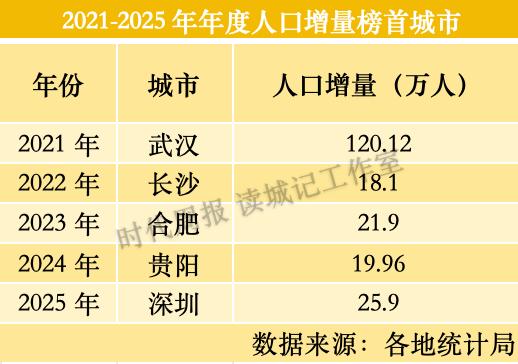
Cities with the largest population increase from 2021 to 2025 (Compiled by: Urban Reading Studio)
In 2021, the population of Wuhan increased by 1.2012 million. In the following years, cities such as Changsha, Hefei, and Guiyang successively became the cities with the largest population increase, reflecting that the provincial capitals in the central and western regions have significantly enhanced their population absorption capacity driven by industrial upgrading, talent attraction policies, and the expansion of urban agglomerations.
Shenzhen's topping the list in 2025 shows that the population flow is re - concentrating towards first - tier cities and core urban agglomerations with dense industries and active innovation. Especially against the background of the rapid development of emerging industries such as artificial intelligence, new energy vehicles, and electronic information, this city is absorbing a large number of employed people.
01
Eyeing the "Double - Ten Million"
Among the 21 cities with a GDP of one trillion yuan and positive permanent population growth, in addition to the four cities in Guangdong, cities such as Changsha, Jinan, Hangzhou, Xi'an, Nanjing, and Qingdao also had remarkable growth performance, with an increase of more than 60,000 people each.
Most of these cities are the industrial, educational, and transportation centers in their respective regions. On the one hand, they can continuously provide employment opportunities, and on the other hand, they also have a strong capacity to carry public services. Therefore, against the background of the overall slowdown in population flow, they still maintain a strong attraction.
Especially the strong provincial capitals in the central and western regions, the trend of population concentration has continued in recent years.
For example, in 2025, the permanent population of Changsha increased by 104,900, that of Xi'an increased by 68,700, that of Zhengzhou increased by 52,000, and that of Wuhan increased by 52,800.
Against the background of China's continuous promotion of regional strategies such as the large - scale development of the western region and the rise of the central region, the population growth of these cities is mostly based on industrial upgrading and the development of the new economy. The development of industries such as new energy vehicles, electronic information, and advanced manufacturing is becoming an important driving force for attracting young people.
One of the highlights of the recent population changes is the accelerated expansion of "quasi - ten - million - population cities": the permanent population of Wenzhou is 9.902 million, that of Ningbo is 9.833 million, that of Foshan is 9.7919 million, and that of Jinan is 9.616 million.
Among them, the population of Ningbo increased by 56,000 in 2025, and that of Wenzhou increased by 50,000. Their population increases are among the top in the country's cities with a GDP of one trillion yuan. For these cities, population growth not only means the expansion of the labor force and consumer market, but also means the further improvement of the city's level and regional influence.
In recent years, "double - ten - million cities" (cities with a GDP of over one trillion yuan and a permanent population of over ten million) have gradually become an important indicator to measure a city's comprehensive competitiveness. With industrial upgrading and the expansion of urban agglomerations, many cities that have just entered the "GDP Trillion Club" have begun to regard "reaching a population of ten million" as an important goal for the next stage.
Judging from the current trend, Wenzhou and Ningbo are more likely to achieve this goal in the next few years.
02
Guangdong Takes the Top Three
Judging from the distribution of the top ten cities in terms of population increase, the current population flow in the country is increasingly showing a trend of concentration towards regional central cities.
At present, the permanent population data of 31 provinces in 2025 have all been released. Among them, 7 provinces achieved an increase in permanent population, namely Guangdong, Zhejiang, Xinjiang, Hainan, Shanghai, Tibet, and Ningxia. Among them, Guangdong ranked first in the country with a population increase of 790,000.
As the population data of cities across the country are gradually disclosed, the specific performance of Guangdong's population growth has become clearer.
In 2025, the top three cities with a GDP of one trillion yuan in terms of population increase are all from Guangdong, namely Shenzhen, Dongguan, and Guangzhou. Among the top ten cities with a GDP of one trillion yuan in terms of population increase, Guangdong occupies 4 seats, in addition to the above three cities, there is also Foshan.
Not only do the cities with a GDP of one trillion yuan in Guangdong have remarkable population growth, but the population growth of Huizhou in Guangdong is also worthy of attention. At the end of 2025, the permanent population of Huizhou was 6.193 million, an increase of 76,200 compared with 2024.
The population of these five cities increased by a total of 780,800 in 2025, accounting for 98.8% of the population increase in Guangdong, showing a trend of accelerated population concentration in the Pearl River Delta in Guangdong.
In terms of the driving force for population growth, although these cities all maintain a strong attraction, the supporting factors behind them are not exactly the same.
Shenzhen and Guangzhou are more driven by innovative and service - oriented economies. In recent years, industries such as artificial intelligence, new energy vehicles, biomedicine, and the digital economy have developed rapidly, continuously attracting a large number of highly - educated young talents to flow in. Especially Shenzhen, which has obvious advantages in the fields of the Internet, electronic information, and technological innovation, still has a prominent ability to attract young people.
Cities such as Dongguan, Foshan, and Huizhou rely more on the manufacturing system and cost advantages to undertake the inflow of population. With the continuous upgrading of the industrial chain in the Pearl River Delta, many manufacturing enterprises in Guangzhou and Shenzhen have begun to layout in surrounding cities with relatively lower costs, which has also driven the transfer of employed people to these cities.
Compared with first - tier cities, the housing prices and living costs in these cities are relatively lower, which has a strong attraction for young employed groups and new citizens.
In addition to Guangdong, in provinces such as Zhejiang, Hunan, and Shaanxi, cities with relatively rapid population growth such as Hangzhou, Changsha, and Xi'an reflect the characteristics of the "strong provincial capital" model. These cities usually concentrate the highest - quality universities, medical care, transportation, and industrial resources in the province, and have an obvious siphon effect on the surrounding population. Especially in the central and western regions, the trend of the further concentration of high - end industries and population resources towards the provincial capitals continues.
At the same time, the competition for talents across the country is also continuously intensifying.
In recent years, Guangdong has continuously promoted the "One Million Talents Gather in South Guangdong" campaign, and has continuously increased support in terms of employment, housing, and entrepreneurship through talent introduction policies. Not only Guangdong, but also cities in other provinces such as Hangzhou, Xi'an, and Changsha have successively introduced policies such as subsidies for young talents and housing purchase support, hoping to enhance their attraction to young people by reducing the living and employment thresholds.
Overall, the population pattern of cities with a GDP of one trillion yuan in 2025 is increasingly showing a trend of "the strong getting stronger".
The population continues to concentrate in cities with active industries, many employment opportunities, and strong innovation capabilities. Especially against the background of four consecutive years of negative population growth in the country, the cities that can continuously attract young people and retain talents are more likely to take the initiative in future urban competition.
This article is from the WeChat public account "Urban Reading Studio". Author: Li Hang, Editor: Liang Li. Republished by 36Kr with permission.