Which enterprises are flowing into Beijing? Which regions are attracting enterprises away from Beijing?
On May 27th, at the 2026 Beijing-Tianjin-Hebei Innovation and Development Forum, the report "Research on the Coordinated Industrial Development of Beijing-Tianjin-Hebei from the Perspective of Enterprise Relocation" jointly released by Shangqi and Jingbao Think Tank attracted wide attention. Based on the enterprise relocation data of the past five years, the report systematically reveals for the first time the rules and trends of the mutual relocation of enterprises among the three regions of Beijing, Tianjin, and Hebei.
For industrial park operators and investment promotion personnel, this report is like a "dynamic heat map" for enterprise site selection. We have extracted several key insights from it.
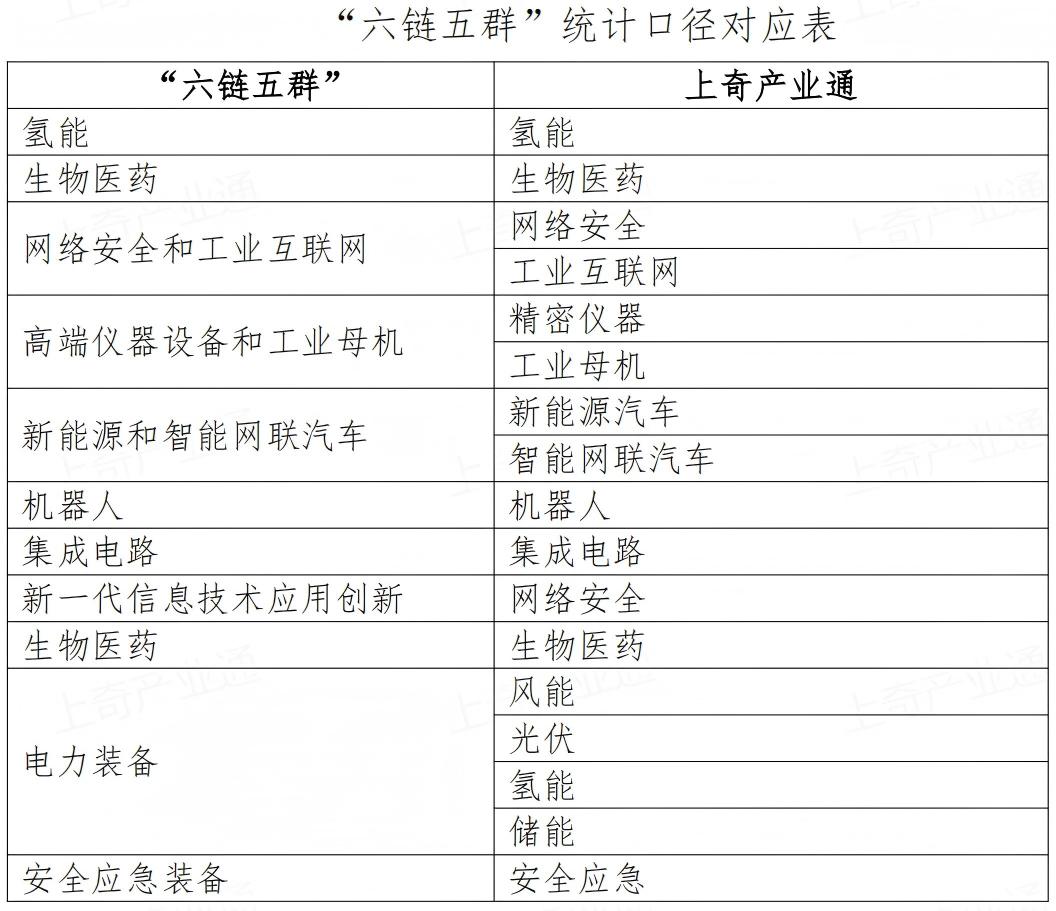
Beijing: A High - ground for National Enterprises, with Southern Enterprises Accelerating Northward
Data shows that in the past five years, over 1.44 million new enterprises have been established in Beijing. Among them, the scientific research and technology service industry accounts for as high as 37.78%, indicating that Beijing is still dominated by R & D and services. From the perspective of the sources of incoming enterprises, Beijing is not only the center of the Beijing-Tianjin-Hebei region but also a gathering place for high - quality enterprises across the country.
The top five provinces in terms of the number of enterprises relocating to Beijing are: Guangdong with 13,547, Shanghai with 13,064, Hainan with 10,256, Tianjin with 9,512, and Shandong with 9,158.
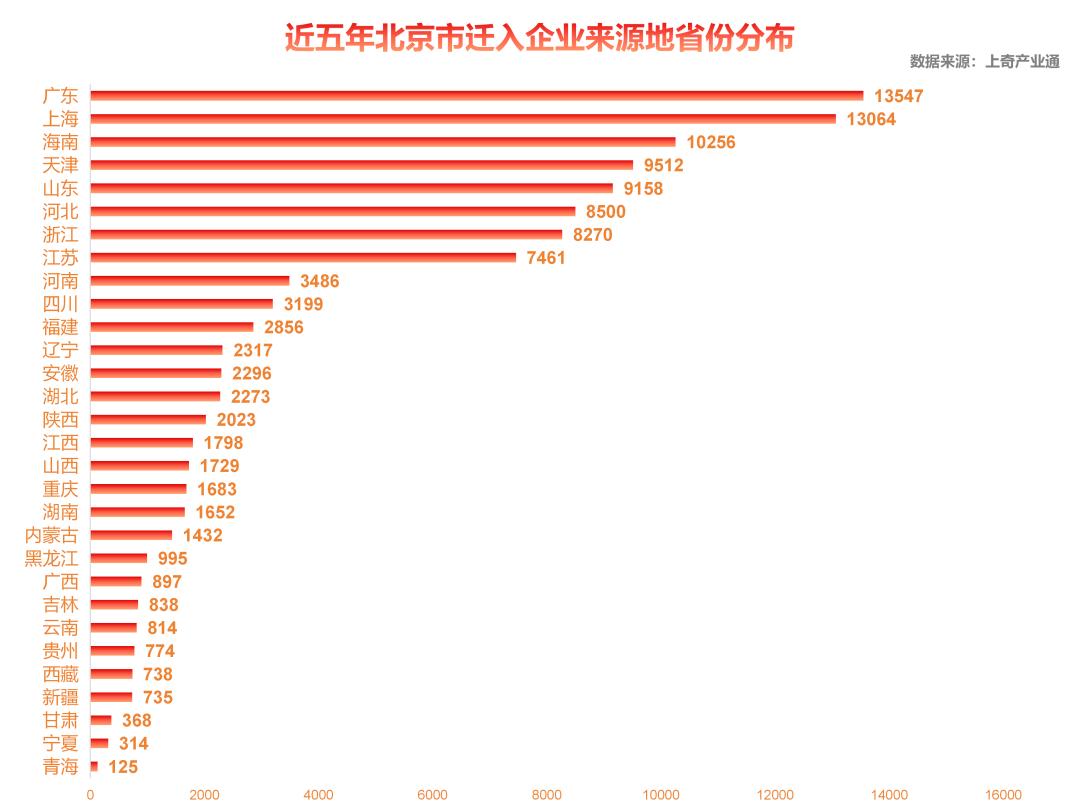
Notably, southern provinces and municipalities such as Guangdong, Shanghai, and Hainan rank among the top three, indicating that Beijing still has a strong appeal to enterprises, especially in high - tech, finance, and headquarters economy. The rapid rise of Hainan may be related to the enterprise layout adjustment under the free trade port policy.
In the past five years, among the enterprises relocating from Beijing, nearly 32,000 have settled in Tianjin and Hebei, accounting for nearly a quarter. Among them, Binhai New Area in Tianjin (4,882), Baoding in Hebei (4,228), and Langfang in Hebei (4,020) rank among the top three.
In terms of industries, network security, industrial Internet, and power equipment are the two major fields with the largest number of relocating enterprises, which not only aligns with Beijing's industrial relocation direction but also matches the carrying capacity of Tianjin and Hebei.
Tianjin and Hebei: Also Attracting Beijing Enterprises in Reverse
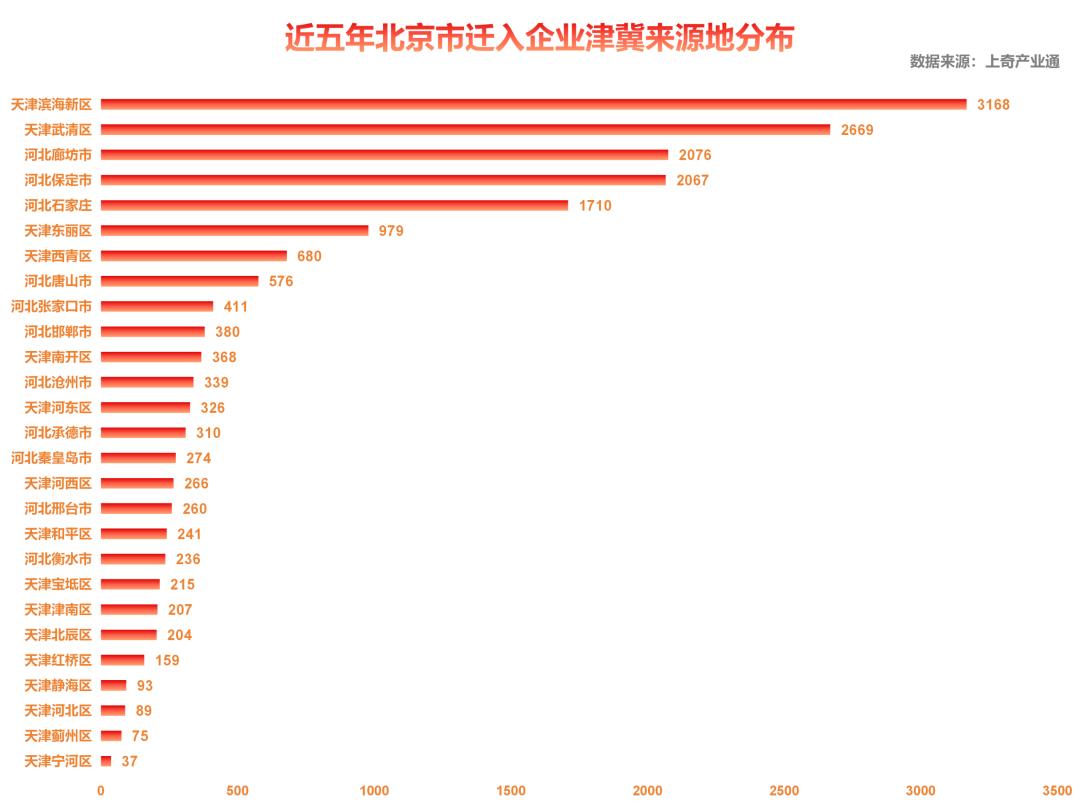
Although Beijing is the area for industrial relocation, data shows that Tianjin and Hebei are also attracting Beijing enterprises to return or establish new ones. In the past five years, 98,000 enterprises have relocated to Beijing, of which Tianjin and Hebei account for 18%.
Binhai New Area and Wuqing District in Tianjin, as well as Langfang and Baoding in Hebei, are not only destinations for Beijing enterprises to relocate but also important sources for sending enterprises to Beijing.
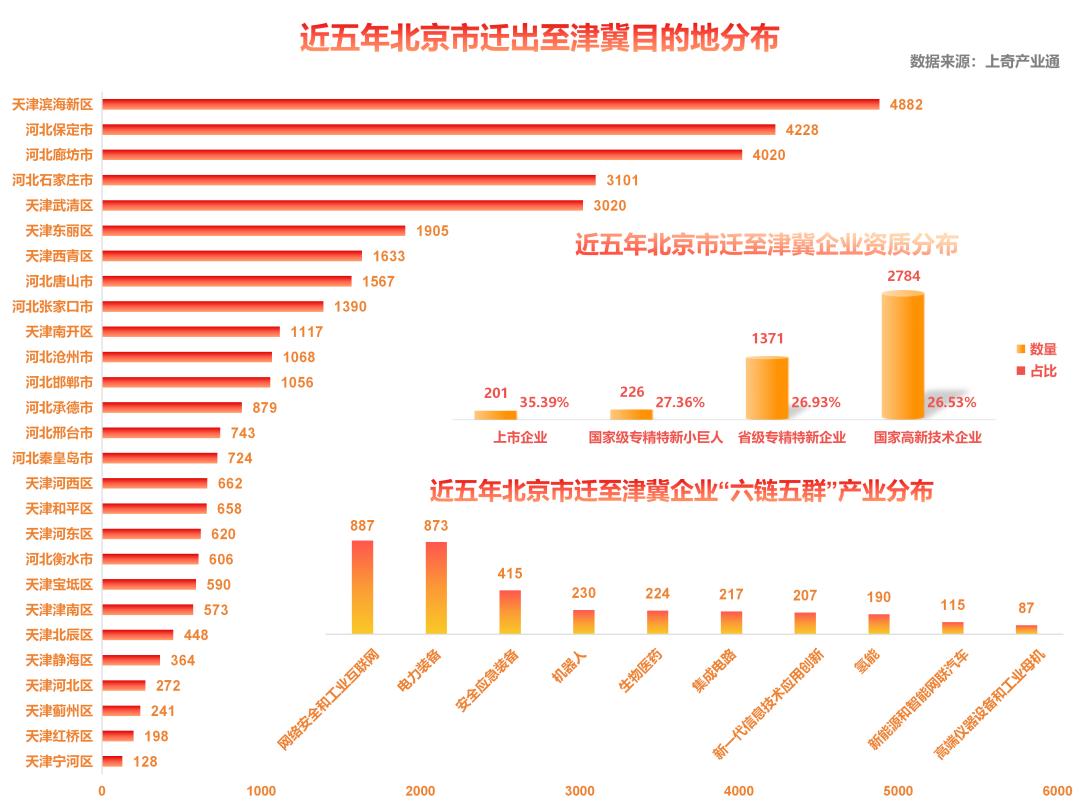
An easily overlooked highlight is that among the enterprises relocating to Tianjin and Hebei, national high - tech enterprises account for 26.5%, provincial specialized and sophisticated "little giant" enterprises account for 26.9%, and there are also a large number of listed enterprises and national - level "little giant" enterprises. Enterprises established within 10 years account for over 60%.
This shows that the relocation is not a low - end transfer but an orderly spill - over of high - quality scientific and technological production capacity.
The report publisher also put forward practical suggestions, which deserve the attention of the investment promotion departments of industrial parks:
Improve the "chain - length system": Link the three regions to dynamically solve the bottlenecks in the industrial chain; Implement classified policies: Develop investment promotion strategies for network security, energy equipment, emerging industries, etc. respectively; Build pilot test platforms: Bridge the "last mile" from R & D to pilot test to industrialization; Recognize standards mutually: Promote the inter - communication of qualifications, access, and policies among the three regions to build a unified, open, and integrated business environment.
From the data, the enterprise relocation in the Beijing-Tianjin-Hebei region has shifted from "policy - driven" to "market - driven + chain - based collaboration". Enterprises increasingly value industrial chain support, talent accessibility, policy stability, and pilot test capabilities when selecting locations.
For industrial parks, future investment promotion is no longer about "grabbing projects" but "building an ecosystem". Those who can find their positions in the "six chains and five clusters" will gain an advantage in this round of industrial reconstruction.
This article is from the WeChat official account "Industrial Park Gathering". Author: Connecting Enterprises and Industrial Parks. Republished by 36Kr with authorization.